Category: Uncategorized
Alberto Alesina has passed away at age 63
He was one of the great economists of our time and a possible candidate for a Nobel Prize. Here is his Wikipedia page. Here are previous MR discussions and mentions of Alesina. Here is a short biography. Here are his most cited papers. Here are Twitter tributes.
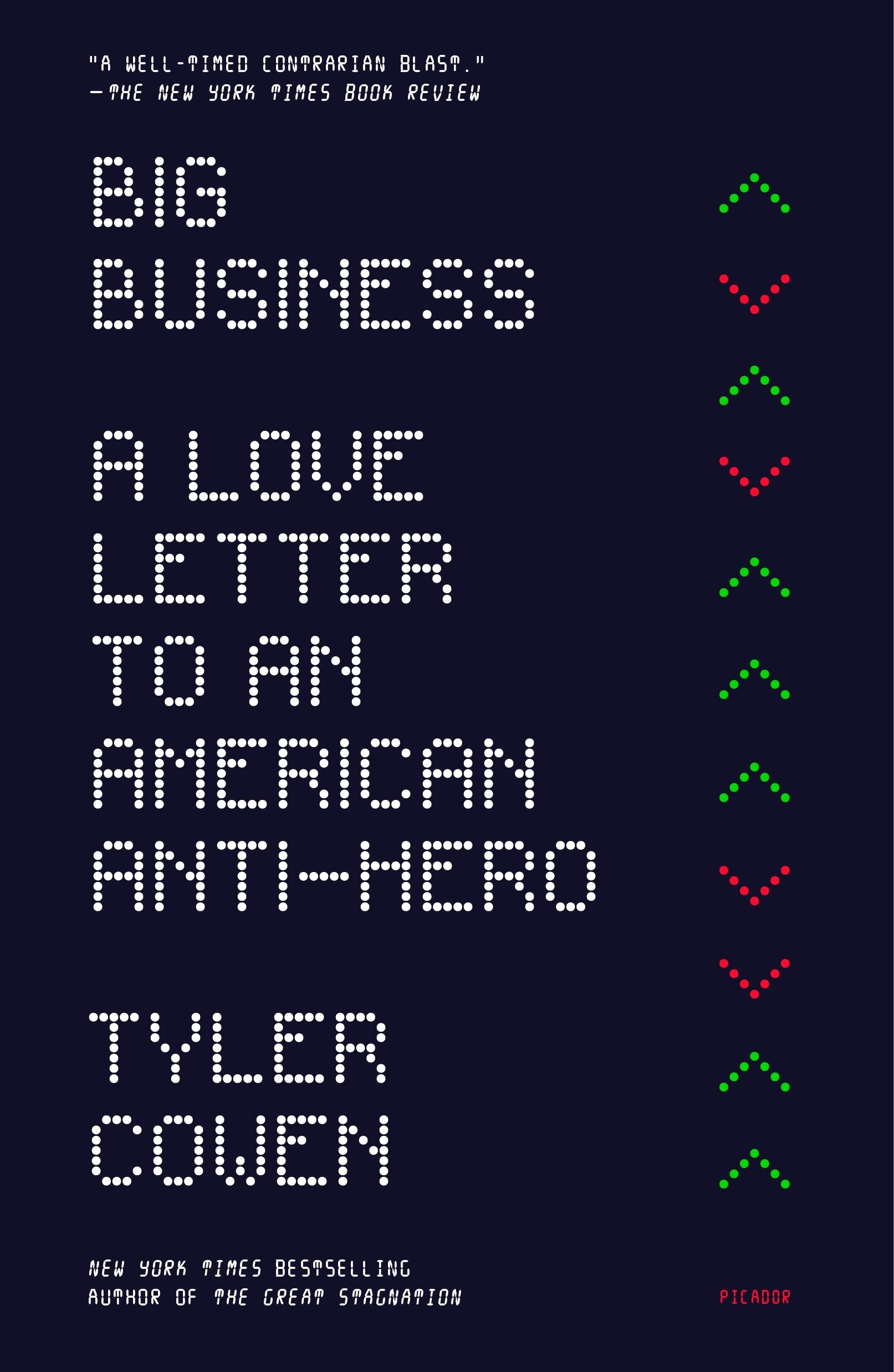
*Big Business: Love Letter to an American Anti-Hero*
The paperback edition is now out, you can order here through Amazon, here through Barnes & Noble.
Saturday assorted links
2. How is cocaine trafficking doing?
3. Edenville dam failure caught on video.
4. Ten arguments against immunity passports. I mean…those are the arguments you should make. But there is no conception that you have to “solve for the equilibrium” if there are no formal immunity passports, and compare the two situations in terms of cost, unfairness, and the like. In that sense the authors cannot conceive that there needs to be a comparison at all.
6. Do proponents of moral outrage wish to “sneak up on women”? That would explain a lot.
7. The import of super-spreaders in Israel.
8. American Interest interview with Larry Summers. “LHS: There’s a lot of empirical evidence since Keynes wrote, and for every non-employed middle-aged man who’s learning to play the harp or to appreciate the Impressionists, there are a hundred who are drinking beer, playing video games, and watching 10 hours of TV a day.” It’s a good thing that has nothing to do with subsequent delayed re-employment (also known as “unemployment”), isn’t it?
*The Price of Peace*
The author is Zachary D. Carter, and the subtitle is Money, Democracy, and the Life of John Maynard Keynes. Maybe you’ve read plenty about Keynes, but still this book is good enough to qualify (without reservation) for the year’s “best of non-fiction” list published every December.
One surprise is that the author seems to “get” the Bloomsbury Circle, Woolf, and the like, even though he is not an old, crusty British pain in the ass.
A second surprise is that much of the biography goes well past the life of Keynes, though with no diminution of quality. I very much enjoyed for instance the discussion of Samuelson vs. Galbraith, the career of Milton Friedman, the role of the Volker Foundation, and so on.
Very readable, substantive, and the main topic never ceases to be interesting. I am not sure if there is anything truly new in here, but it is nonetheless a very good book to read about Keynes and his later influences on economic thought.
Oliver Williamson, RIP
Oliver Williamson won the Nobel in 2009 with Elinor Ostrom. My post on that event is reprinted below (no indent). See also Tyler here.
——————
In Adam Smith there is the pin factory and the market and from that beginning we trace the long literature in economics focused on the twin questions, What price to set? How much to produce? Following Coase, Williamson asks different questions, Why a pin factory? Why are the 18 steps to make a pin performed by a single firm rather than two or more? Why are there many firms instead of one large firm? Why does the pin factory not vertically integrate upwards to buy the steel factory and downwards to buy the retail hardware shop?
Williamson’s answers rest on the notions of bounded rationality, contract incompleteness, asset specificity and opportunism. Start at the end, asset specificity and opportunism. When a deal has been sealed the parties typically move from having many potential partners to being locked in. That’s bad because it raises the possibility of opportunism–one party can exploit the other. But it’s also good because when the lock-in is credible each party may be more willing to invest in assets which are extra-productive but specific to the relationship.
Marriage, for example, takes away some possibilities but it adds others. With marriage, for example, comes a greater willingness to invest in children (n.b. asset specificity, the child is of extra value but only to the specific parties involved in the marriage) but that very benefit also means that one of the parties has the leverage to be opportunistic. Knowing all of this when they enter the contract the parties bargain ex-ante, they exchange promises and make investments (the ring), they establish rules for ex-post bargaining or decide on the background rules to apply in that eventually (pre-nup, no fault divorce, covenant marriage). The rules are never perfect and the contacts are always incomplete.
Transaction cost economics is all about applying these ideas in different settings to figure out the best governance structures (marriage, vertical integration etc.) in different circumstances. How does one deal with expensive investments (such as highly individual dies or plant construction) that are specific to a given
trade and put the investor at risk yet which increase productivity? Williamson analyzes how firms come to rely on long term contracts or vertical integration or other seemingly non-competitive solutions to enhance market productivity. Early generations of antitrust enforcers often saw these as monopolistic dealings, but scholars such as Williamson helped us understand how these are essential to the workings of the invisible hand.
Williamson’s paper, The Economics of Governance is an excellent recent summary of his views in the area.
Williamson’s work is notable for inspiring a large body of empirical and theoretical work in modern industrial organization and having influence in law, political science, and management. His work has been widely cited, and by some counts he was the most widely cited economist in the world.
I especially thank John Nye who contributed to this post.
Which NBA teams will gain in relative prospects from the shutdown?
The Los Angeles Lakers, far and away.
The most valuable stars, such as LBJ, have their own private gyms and work-out rooms, often in their homes. They have stayed in the best shape, and of course LBJ has the discipline too. Those star players also are the most used to unusual circumstances (All-star games, Olympics, etc.) and being accustomed to higher than average levels of pressure. They rely less on crowd support than do the role players, noting it is the latter who benefit much more from home court advantage. If the games are played in Las Vegas and Orlando, and without crowds, no one will have home court advantage (except the Orlando Magic, sort of).
So teams built around star veterans will have higher chances of doing better in the playoffs.
The interrupted and probably shortened season also will be easier on the older players, which again covers LeBron. Anthony Davis is not so old but the Lakers would love to play him as many minutes as possible.
The teams with “many necessary complementary parts” will fare worst in relative terms. With such a long break, surely at least 10-20% of those players have “gone off the reservation,” so to speak, and will not return to quality form for some time. Those teams will not gel so easily and find their groove.
Who might that be? I know the Clippers have two big stars, but they seem to rely a lot on the team as a whole. Who else? The Celtics maybe? Indiana?
What are the implications of this analysis for management and business firms? Will teams built around a superstar have an advantage there too?
Should you worry about the rate of price inflation being too high?
Of course you should worry, not withstanding all of the dogmatism on Twitter and the pre-Lucasian framing of various charts and graphs.
Here is a simple way to look at it. Let’s say the Fed does the very best job possible with its monetary policy (and in my view the Fed has done a very good job so far). That would mean in terms of the loss function a Fed error in one direction would mean a too low rate of price inflation, and a Fed error in the other direction would mean a too high rate of price inflation.
Now, supply conditions have never been so volatile in my lifetime, and perhaps never in American history. We don’t know how the virus will spread, how reopenings will go, when a vaccine will arrive, how good the vaccine will be, how much a climate of fear will persist, and so on. Demand conditions in turn depend on how these supply conditions will evolve.
The Fed thus could make an error on either side of its target, through no procedural fault of its own. As a result, as a simple matter of logic, the rate of price inflation could be too high, or it also could be too low.
if you think you know the direction of the error in advance, you aren’t paying enough attention to the underlying unpredictable uncertainties.
And if your response is to cite old open letters to the WSJ and the like, that is the same dogmatic error that the inflation hawks from the 1970s have been making.
There are other, more substantive arguments why the rate of price inflation might end up too high (the fiscal side really matters!), but that is the simplest one and you won’t see it on Twitter. And it is fine to argue, by the way, as does Matt Yglesias, that you would rather see it too high than too low.
I was glad to see Martin Wolf tackle this whole question (FT) and not be too scared off by the yappers.
Friday assorted links
1. Paul Kedrosky assorted comments.
3. The Florida strategy. Too early to say in my view, but still this piece is of interest.
4. “Magnus the platform” lets it rip.
5. America’s top spelling searches: in Virginia, they don’t know how to spell “Virginia.” Recommended.
6. Volunteer history booming during the lockdown.
8. Plexiglass vs. Plexiglas(TM).
9. The polity that is Dutch: grandmother ordered to delete Facebook photos. At least they didn’t kill her.
10. A real smokescreen. Really.
11. The new seroprevalence studies show relatively low rates of infection.
12. Fast Grants active at UC Berkeley. Good coverage.
13. TreatEarly, a new biomedical initiative (possibly influenced by Fast Grants?), looks interesting note I have no direct knowledge of their work.
Alan Merten, RIP
Alan Merten, former President of GMU, has died after a battle with Parkinson’s disease. I got to know Alan just a little when we visited China together in 2008. Our visit was part of GMU’s 1+2+1 program in which students in China earned their degree by doing 1 year at a partner university in China, 2 years at GMU and then a final year in China. We were touring the partner universities to participate in their graduation ceremonies. It was a great trip. I visiting the Great Wall, stayed in a Hutong in Beijing, and visited Kunming in Yunan province.
I also found it exhausting as we traveled from graduation ceremony to graduation ceremony. One night at the beginning of another such ceremony I said to Alan “I guess your job is to go to a lot of these events” and he turned to me beaming and full of energy and said “Oh yes, I love seeing the students so happy and their parents so proud. It’s the best part of my job.” And he meant every word. I’ve never forgotten that. He was a good university president.

Income Share Agreements Looking Up
The Federal Reserve Bank of Richmond has a good piece reviewing income share agreements, aka income-contingent loans, including a timely example:
ISAs provide students with funding to cover their education expenses in exchange for a portion of their income once they start working. Under a typical contract, recipients pledge to pay a fixed percentage of their incomes for a set period of time up to an agreed cap. For example, a student who has $10,000 of his or her tuition covered through an ISA might agree to repay 5 percent of his or her monthly income for the next 120 months (10 years), up to a maximum of $20,000. ISAs typically also have a minimum income threshold before payments kick in; if the recipient earns less than the minimum, he or she pays nothing. This means that ISAs offer students more downside protection than a traditional loan.
This downside protection is what attracted Andrew Hoyler to Purdue’s “Back a Boiler” ISA program, which launched in the fall of 2016. Hoyler, who graduated from Purdue’s professional flight program in 2017, signed up for Back a Boiler in his senior year. He received $21,263 in reduced tuition and flight fees in exchange for agreeing to repay 7.83 percent of his monthly income for 104 months, or until he had paid back 2.5 times the amount he originally received. Now a pilot for PSA Airlines, a subsidiary of American Airlines, he has been making payments on his ISA for about 30 months.
…Hoyler is particularly grateful to have that safety net now, as the airline industry is being rocked by the COVID-19 outbreak. “The ISA is giving me a sense of relief. If I find myself furloughed, my payments stop with zero interest,” he says.
Thursday assorted links
1. The coffin culture that is Peruvian municipal politics.
2. Carmen Reinhart named new World Bank Chief Economist.
3. The Georgia reopening seems to be going OK.
5. Amateur archaeology from home during the lockdown.
6. The declining middle class and yes based on consumption data.
7. Economic Development in Puerto Rico after US Annexation: Anthropometric Evidence.
8. “I’m thrilled to announce a new online learning program in progress studies for high school students: Progress Studies for Young Scholars.” Link here.
How will Fairfax County evolve?
That is the topic of my latest Bloomberg column, here is one excerpt:
The immediate future of my region thus appears to be a major demand shock to the stores, acceptable continuing employment for the upper middle class, and economic devastation for lower-income individuals. The traditional mix of government-connected employment and retail will swing heavily in the direction of government. In essence, the federal government will pay its employees to click on Amazon while working from home.
And:
The ethnic dimension of Covid-19 in Fairfax County is especially noteworthy. Latinos make up 16.8% of the county’s population, but account for 62.7% of the diagnosed Covid-19 cases. And if you assume that perhaps lower-income Latinos are less willing or able to go to a doctor, the true percentage of the Latino cases may be higher yet.
I thus foresee a future where people are more reluctant to hire Latino immigrants for housework or for child care, and thus additional home responsibilities will fall on parents, probably disproportionately on women. In turn, I expect many Latinos to leave the area, at least temporarily, unable to afford the higher rents when there is little work. There may also be greater employer discrimination against Latino applicants, as unfair or unjust as that would be.
Those developments will lead to Fairfax County becoming whiter. (If you are wondering, blacks are a slightly lower Covid-19 case share in the county than population share).
Recommended, for all those who care.
My (second) Conversation with Paul Romer
Interesting throughout, here is the audio and transcript. Here is the summary:
Paul Romer makes his second appearance to discuss the failings of economics, how his mass testing plan for COVID-19 would work, what aspect of epidemiology concern him, how the FDA is slowing a better response, his ideas for reopening schools and Major League Baseball, where he agrees with Weyl’s test plan, why charter cities need a new name, what went wrong with Honduras, the development trajectory for sub-Saharan Africa, how he’d reform the World Bank, the underrated benefits of a culture of science, his heartening takeaway about human nature from his experience at Burning Man, and more.
I liked the parts about charter cities and the World Bank the best, here is one excerpt:
COWEN: How optimistic are you more generally about the developmental trajectory for sub-Saharan Africa?
ROMER: There’s a saying I picked up from Gordon Brown, that in establishing the rule of law, the first five centuries are always the hardest. I think some parts of this development process are just very slow. If you look around the world, all the efforts since World War II that’s gone into trying to build strong, effective states, to establish the rule of law in a functioning state, I think the external investments in building states have yielded very little.
So we need to think about ways to transfer the functioning of existing states rather than just build them from scratch in existing places. That’s a lot of the impetus behind this charter cities idea. It’s both — you select people coming in who have a particular set of norms that then become the dominant norms in this new place, but you also protect those norms by certain kinds of administrative structures, state functions that reinforce them.
And this:
COWEN: If you could reform the World Bank, what would you do?
ROMER: Oh, that’s an interesting question. I think the Bank is trying to serve two missions, and it can’t do both. One is a diplomatic function, which I think is very important. The World Bank is a place where somebody who represents the government of China and somebody who represents the government of the United States sit in a conference room and argue, “Should we do A or B?” Not just argue, but discuss, negotiate. On a regular basis, they make decisions.
And it isn’t just China and the US. It’s a bunch of countries. I think it’s very good for personal relationships, for the careers of people who will go on to have other positions in these governments, to have that kind of experience of, basically, diplomatic negotiation over a bunch of relatively small items because it’s a confidence-building measure that makes it possible for countries to make bigger diplomatic decisions when they have to.
That, I think, is the value of the World Bank right now. The problem is that that diplomatic function is inconsistent with the function of being a provider of scientific insight. The scientific endeavor has to be committed to truth, no matter whose feathers get ruffled. There’s certain convenient fictions that are required for diplomacy to work. You start accepting convenient fictions in science, and science is just dead.
So the Bank’s got to decide: is it engaged in diplomacy or science? I think the diplomacy is its unique comparative advantage. Therefore, I think it’s got to get out of the scientific business. It should just outsource its research. It shouldn’t try and be a research organization, and it should just be transparent about what it can be good at and is good at.
And toward the end:
COWEN: Last question thread, what did you learn at Burning Man?
ROMER: Sometimes physical presence is necessary to appreciate something like scale. The scale of everything at Burning Man was just totally unexpected, a total surprise for me, even having looked at all of these pictures and so forth. That was one.
Another thing that really stood out, which is not exactly a surprise, but maybe it was the surprise in that group — if you ask, what do people do if you put them in a setting where there’s supposed to be no compensation, no quid pro quo, and you just give them a chance to be there for a week. What do they do?
They work.
For purposes of contrast, here is my first Conversation with Paul Romer.
Wednesday assorted links
1. How much do you need in the way of masks to stop an epidemic?
2. Robot dog herds sheep on a New Zealand farm.
3. Community labs and DIY biology (New Yorker, interesting piece).
4. John Cochrane talk on reopening.
5. Are airplanes actually pretty safe for Covid-19 risk? (Not endorsing this piece or offering it up as advice, I do not myself know one way or the other. Any opinions here?)
6. “More generally, the entire Yemeni monetary system has split on the basis of banknote age.” The older notes of course no longer can be increased in supply and thus, if priced separately, are more stable in value.
7. Sweden is not getting to herd immunity very quickly. This also seems to imply Swedish policy does not matter very much.
8. On the clustering of coronaviruses, recommended, important. And more here.
Incentivizing Plasma Donation for Convalescent Therapy
Kominers, Pathak, Sonmez, and Unver apply market design tools to incentivize convalescent therapy:
COVID-19 convalescent plasma (CCP) therapy is currently a leading treatment for COVID-19. At present, there is a shortage of CCP relative to demand. We develop and analyze a model of centralized CCP allocation that incorporates both donation and distribution. In order to increase CCP supply, we introduce a mechanism that utilizes two incentive schemes, respectively based on principles of “paying it backward” and “paying it forward.” Under the first scheme, CCP donors obtain treatment vouchers that can be transferred to patients of their choosing. Under the latter scheme, patients obtain priority for CCP therapy in exchange for a future pledge to donate CCP if possible. We show that in steady-state, both principles generally increase overall treatment rates for all patients|not just those who are voucher-prioritized or pledged to donate. Our results also hold under certain conditions if a fraction of CCP is reserved for patients who participate in clinical trials. Finally, we examine the implications of pooling blood types on the efficiency and equity of CCP distribution.
The idea is quite similar to the “no give, no take” rule for organ donation that I have promoted for many years. Namely, if you don’t sign your organ donor card you go to the back of the queue should you ever need an organ donation. Israel adopted the idea some years ago by giving points to people who signed their organ donor card. As with no-give, no-take, the point of the rules that Kominers et al. promote isn’t fairness per se but rather as an incentive to increase donations and thus increase the supply of plasma.