Thursday assorted links
1. The economic cost of gender gaps; “We find that gender gaps cause an average income loss of 15 percent in the OECD, 40 percent of which is due to entrepreneurship gaps.”
2. Our first “practice questions” video for MRU, on economic growth and the Rule of 70.
3. Wearable robot transforms musicians into three-armed drummers.
4. The global black market in cacti.
5. Does chocolate make you smarter? (speculative)
China fact of the day
With 32 newly minted super-rich in the past year, China’s capital has become the billionaire capital of the world, the latest Hurun Global Rich List says, with a total of 100 to the Big Apple’s 95.
And this:
China’s growing clout in the rankings is even starker in the world of female “self-made” billionaires, according to Hurun, where the country dominates with 93 of the global total of 124.
That is from Yuan Yang at the FT.
The economics of used book sales
Matt G. asks me:
Twice a year the San Francisco Public Library holds a book-sale benefit at which it resells a warehouse’s worth of used books that have been donated. They advertise that +500,000 items are available. Not matter freaking what, every hardcover is $3 and every paperback is $2. The books are loosely organized into “fiction,” “history,” “essay,” etc but beyond that totally unsorted.
I say the people who bought Pynchon tend to keep him, and the potential donations of the most popular authors are rejected by the library staff, on the grounds that they otherwise would be accepting too many copies and selling them at too low a price. I, too, have seen plenty of Herman Wouk at Virginia sales, what is up with that? Do they simply not know they ought to reject his titles?
The way to do well at those sales is to arrive with a knowledge of which editions and translations of the classics are the worthwhile ones. Otherwise, in this age of used copies available on Amazon, I don’t see why attending such sales should be worthwhile. They can be good for atlases and picture books. In the old days I used to scour used book sales for copies of Augustus Kelley editions of the economics history of thought classics, do they still turn up?
I have high hopes for Stripe Atlas
Stripe Atlas [is] a new product the company unveiled this week at Mobile World Congress in Barcelona. It aims to make it easier for entrepreneurs to set up small businesses in the United States. If all goes according to Stripe’s plan, Atlas could let start-up founders sidestep some of the bureaucratic hurdles that often hamper building a new business.
Determining eligibility requires little more than filling out a form. After that, Stripe will incorporate an entrepreneur’s company as a business entity in Delaware, and provide the entrepreneur with a United States bank account and Stripe merchant account to accept payments globally.
The target audience is all of the entrepreneurs outside the United States who want access to the country’s well-developed banking infrastructure and business services. Stripe is particularly interested in attracting entrepreneurs from Africa, Latin America, the Middle East and parts of Asia, among other regions.
…Eligible entrepreneurs will also be offered access to basic tax and legal consulting and business services from partners like PricewaterhouseCoopers, and will receive free credit to run their online business on the Amazon Web Services hosting platform.
Atlas is to begin on Wednesday in an invitation-only beta test; entrepreneurs can apply for the program through Stripe or one of the 50-plus start-up accelerator programs that the company has teamed up with globally. The beta program’s cost is $500.
Here is the Mike Isaac NYT article.
What is the dollar value of U.S. citizenship?
Neil Munro writes to me with a question:
…[what is] the dollar value of U.S. citizenship, because of its financial, security, status and other benefits for an immigrant form China or India?
Do you know of people who have tried to calculate the value? Net-present value, I’d guess.
There is the famous paper by Michael Clemens, but I don’t think it calculates such a number straight up. How about the lead Sumption link here? Do any of you know the best answer?
How to fix the incentive structure of science
This is from David L. Stern, who is not the David Stern who was formerly commissioner of the NBA:
…I am won over by the arguments that science papers should be made available freely to everyone as soon as authors feel that the work is complete. Posting papers to preprint servers is one good solution; I imagine there are others. (I prefer to call such documents open papers to remove the stigma associated with calling the work “pre” anything.) However, the discussion about the future of open papers has been imbalanced, with too much emphasis on the consequences of open papers for peer review and too little discussion of the fact that scientists are driven to publish in journals because of the existing incentive structure. The CV, and, specifically, journal names (and impact factors, journal reputation, etc.) are used extensively to judge scientists in competitions for jobs, promotions, and grant money. This is the main impediment to widespread adoption of open papers. I have heard many arguments about how it is too hard to change the structure of these competitions and that we should, instead, focus on producing great science in open papers, and let the culture-shift follow. In contrast, I think it is easier to change the incentive structure first; widespread adoption of open-papers will follow, like water flowing downhill.
There are further suggestions at the link. Hat tip goes to Jeffrey Flier.
Wednesday assorted links
1. MIE: clothes designed especially for wheelchair users.
2. The market-facilitating role of the Roman state.
3. Martin Gurri and Scott Adams as early understanders of the Trump phenomenon. And using “The Apprentice” to teach a managerial economics class.
4. Canadian Jeopardy protectionism — are anti-spam laws to blame?
5. Time series that move through X-Y space.
6. Does the Caribbean have an economic future?
7. “At the moment, the stress in the financial sector has a clear cause: the energy debt held by banks.“
“Are Choosers Losers?”– the value of control and the propensity to underdelegate
This is one of the more understudied behavioral biases, so I was pleased to see this new paper by Bobadilla-Suarez, Sunstein,and Sharot:
Human beings are often faced with a pervasive problem: whether to make their own decisions or to delegate decision tasks to someone else. Here, we test whether people are inclined to forgo monetary rewards in order to retain agency when faced with choices that could lead to losses and gains. In a simple choice task, we show that even though participants have all the information needed to maximize rewards and minimize losses, they choose to pay in order to control their own payoff. This tendency cannot be explained by participants’ overconfidence in their own ability, as their perceived ability was elicited and accounted for. Rather, the results reflect an intrinsic value for choice, which emerges in the domain of both gains and losses. Moreover, our data indicates that participants are aware that they are making suboptimal choices in the normative sense, but do so anyway, presumably for psychological gains.
I believe this is one reason why individuals can be so tribal, because otherwise they fear losing control to outsiders.
Why don’t better movies cost more?
This is from an email from Ashok Rao:
You might have addressed this. On iTunes – to some extent – they do, though this appears to matter more with something you might call “scale of production” than quality of movie. Avatar is still at $15 compared to $10 for most others mainstream films (with very crappy and very lowbrow comedies sometimes lower).
But in general it seems absurd that westerns that I’ve never heard about cost as much as Harry Potter. Some points:
Does the movie industry – and ensuing bargaining with important agents like Apple – prefer completely homogenized pricing? Certainly it might be negative signaling that “we know this movie is trash” but that shouldn’t matter after the initial critic and audience review cycle is over.
A lot of crappy movies might make for good TV fodder, though the pricing structures are complicated enough that I have no idea exactly where or how this happens.
The comparison doesn’t even need to be on quality. How on earth does Godfather still cost $15 a pop – isn’t it going to be in the public domain soon?
My gut tells me piracy is a key instigator though I don’t know how exactly. Logically I feel it’s just the opposite. The price elasticity of someone who will not pirate to begin with is much lower than someone who will, on average…
Are there multiple equilibria? 1) Given that the price elasticity of non-pirates is low, you can and should charge them similar rates but 2) Given that pirates are highly elastic it makes sense to price quality.
Is the fact that I’m browsing on iTunes at all enough of an information signal to segregate the market?
It appears Netflix is what will change this entirely, and iTunes prices are completely irrelevant because no one plans on buying Sharknado 2 in HD anyway.
The other interesting question (which also requires a finessed understanding of Netflix economics) is comparing the entertainment value of television vs. cinema on the dollar. It appears there is a “timepass” value to both and a completion value for movies (and TV as well, but distributed over n episodes so basically 0).
One season of TV, which might be about 20 hours of entertainment, is frequently only 2x one movie which might be 2 hours of entertainment. Is the “scale of production” and completeness factor enough to justify 10 hours of entertainment? It is also the case that the median show and median movie are converging in parity on the margin, and increasingly on average too. – You would have to watch many hours of TV before reaching a cliff in quality where the marginal movie is dramatically better than the marginal show, versus a baseline of the best show vs. best movie.
If you insist on legal purchases only learning to read subtitles on Hindi movies is also a really cheap hack to amazing entertainment – foreign films otherwise tend to be too highbrow though that might be a rather lowbrow thing to say.
These are of course “demand side” factors, though after a reasonable period of time the supply side should largely be a sunk cost and somewhat irrelevant.
By the way, there is a new app –called Atom — which among other things will help groups of moviegoers receive discounts for movies which are doing less well.
And here is my earlier post on the uniform pricing of movie tickets.
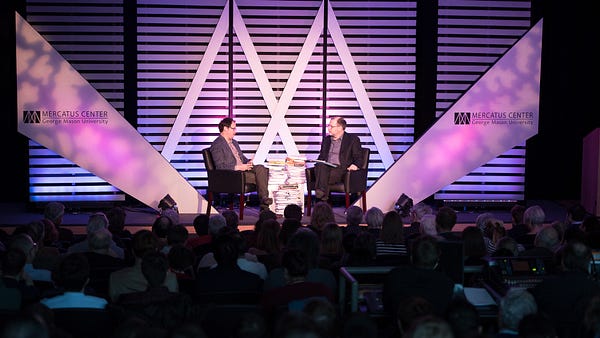
My conversation with Nate Silver
The video, podcast, and transcript are here. Nate of course was excellent, here are just a few bits:
COWEN: What are the differences between forecasting and futurism, and do you have any predictions for the year 2050? They don’t have to be great. They just have to be better than the market. We’ll take a 52 percent prediction and go home and celebrate.
SILVER: I’m mildly pessimistic in some ways.
COWEN: What’s the biggest source of your pessimism?
SILVER: [laughs] There’s probably some survivorship bias in the United States, and thinking about how our way will persevere forever and ever and ever. We were talking backstage about how you go to Asia and I go to Asia — not as often as you. If you want to feel optimistic about civilization, then go there.
And:
COWEN: You’re a fan of baseball, and I’d like to ask you, of all the different baseball records, which is the one that is most impressive to you, or the most a statistical aberration, and try to stay a bit modern. We both know in 1889, Hoss Radbourn won 59 games.
Start with [Owen] Wilson’s — was it 36 triples in 1912? That, and up through the modern age. What’s the most statistically impressive baseball record, and why?
SILVER: I think the biggest outlier is the number of intentional walks that Barry Bonds drew. I forget what year it was, 2001, where he had like 161 intentional walks, and the next closest player is 50?
And:
COWEN: Singapore. Overrated or underrated?
SILVER: Underrated except by you.
There is of course much, much more, including remarks on the candidates and the elections, as well as My Bloody Valentine and more on sports too, prediction markets as well, the weather, and why so few professional athletes have come out as gay. Recommended.
Pay by the word — China innovation of the day
Consider China’s largest online/ebook publishing company, Yuewen Group, which has over three million digital books in its catalogue. More notable than the scale here however is how the company monetizes: Chinese readers can pay per every 1000 words (sort of like by chapter), and have been able to do so for more than half a decade.
Not only does this micro-transaction model encourage more readers to sample more e-books while providing instant revenue to writers (who can begin selling a book right after the first chapter is completed), the collected data can help TV producers make series-optioning decisions at a more granular level. But the unintended consequence of all this is that authors with extremely popular books never want the story to end, changing the narrative significantly. Over time, it could even change the act of storytelling altogether; it’s not unlike what’s already happening in the U.S. with shows like Game of Thrones or with binge watching/streaming leading to an entirely new genre of entertainment.
More broadly speaking, Yuewen is also an example of how Chinese and Western users monetize differently across multiple tech categories. For instance, less than 20% of Tencent’s (the creator of WeChat) revenues come from advertising compared to over 95% for Facebook’s revenue. In fact, most large consumer mobile companies in China (and elsewhere around the world) do not rely on advertising as their primary source of revenue; they focus on transactions instead. Chinese internet companies have therefore experimented with numerous non-advertising business models including in-app or in-game fees, other microtransaction models, free-to-play, and more. For a U.S. company that was previously monetizing only via ads, studying its Chinese counterpart could reveal alternative ways of generating revenue so it’s less dependent on advertising as many U.S. internet companies are.
The Connie Chan article, which focuses on tech innovation in China, is interesting throughout. And don’t forget this:
In fact, 4 of the top 5 free apps in the U.S. Google Play store tools category are apps that originated in China. This isn’t just happening in the “invisible” tools category; right now, 3 of the top 10 free apps in the photography category on the U.S. Google Play store are also made in China.
Recommended. And who is this Connie Chan, and why don’t we know more about her?
Tuesday assorted links
1. ““When economic development happens, metal scenes appear. They’re like mushrooms after the rain,” says Roy Doron, an African history professor at Winston-Salem State University.” Link here.
2. New interview with Elena Ferrante.
3. Who are the globally known famous people and what do they do?
4. When will global aging drive interest rates back up again? Hint: later than you might think.
5. Mesmerizing mass sheep herding (short video, drone, model this). And mesmerizing mass human herding (photo, recommended).
6. Economic Report of the President (big pdf).
7. Kareem on political correctness, a good piece.
The Good News on the FDA and ANDAs
Yesterday, I pointed out that generic drug prices are falling. So what accounts for the small number of large price increases in the generic drug market? It’s a combination of market shenanigans, supply shocks, and FDA delay.
The markets where price increases have been large tend to be relatively small. Daraprim, for example, is only prescribed some 8-12 thousand times per year in the United States. The small size of these markets is no accident. Keep in mind that whatever one may think of Shkreli, he did show a kind of entrepreneurial genius in scouring the universe of drugs in the United States to select one where monopoly power could be so effectively exploited. Shkreli found a market where 1) the total size of the market was low so there wasn’t much competition but 2) the drug treated a serious illness and 3) there wasn’t a good substitute so the value of the drug to the small number of patients was very high.
In addition, Shkreli knew that he had at least a 3-4 year window of opportunity to exploit monopoly power. To compete with Daraprim a competitor would have to submit an Abbreviated New Drug Applications (ANDA) to the FDA. Despite the name, Abbreviated, it costs at least five million dollars to go through the process and right now there is a backlog of nearly 3,000 ANDAs at the FDA’s Office of Generic Drugs. In recent years, it has taken 3- 4 years to get a generic drug approved. The cost is too high and the delay too long.
(I am focusing on the standard route to market entry and ignoring the possibility of importation or compounding which I discussed earlier. I’m also ignoring that Daraprim is unusual in that it was approved in 1953 before the current FDA system of safety and efficacy trials, and the FDA is being absurdly cagey about whether they would allow a simple ANDA for Daraprim. I may write about that in a future post– see here for a related case.)
So what’s the good news? In 2012 Congress passed the Generic Drug User Fee Act (GDUFA). Modeled after the very succesful PDUFA, the act earmarks fees paid by generic drug manufacturers to the FDA’s Office of Generic Drugs. As a result of those fees, the FDA has hired more reviewers and they are rapidly reducing the backlog. That’s the first piece of good news.
A second piece of good news is that FDA delay isn’t the only cause of the backlog. Another cause of the ANDA backlog was an unexpected increase in the number of ANDAs. I would have been much more worried if the number of ANDAs had decreased. Despite new user fees and some increase in regulation the increase in submissions is evidence that the US generic market is competitive, vibrant, and profitable.
The generic drug market in the United States has been very successful. We are constantly told, for example, that US pharmaceutical prices are the highest in the world and that is true for patented drugs but generic drug prices in the US are among the lowest in the developed world and most prescriptions are of generics.
We can address the price hiccups in the generic market by opening up to more world suppliers, speeding up the ANDA process and keeping costs of entry low. Overall, however, we shouldn’t let the price hiccups detract attention from the fact that the generic drug market is competitive, vibrant and thriving and we want to keep it that way.
China fact of the day
WeChat had more mobile transactions over just Chinese New Year than PayPal had during 2015…
According to WeChat, owned by digital media business Tencent, 420 million people sent each other lucky money via the app’s payment service on the eve of Chinese New Year. According to WeChat, it has seen a total of 8.08 billion red envelopes sent so far for Chinese New Year, eight times more than last year.
To put this into context, according to PayPal it made 4.9 billion transactions in 2015 (half of the number of transactions made on WeChat just for Chinese New Year) and only 28 per cent were made on a mobile device.
Here is the article, hat tip goes to Erik Brynjolfsson. Do not underestimate the potential for Chinese innovation in information technology!
What I’ve been reading
1. Jonathan Bate, Ted Hughes: The Unauthorised Life. Fun, lots of sex for a serious book, and it makes you appreciate the diversity of human beings.
2. Ted Gioia, How to Listen to Jazz. Delivers what the title promises, in short, readable form; this book is good for either the jazz lover or the beginner. I am a big fan of pretty much anything Ted Gioia does, and this book has not broken the streak. By the way, here is Gioia on Ortega y Gasset and his continuing relevance.
3. Albert Camus, The Stranger. Worth a reread, especially if you grew up with something other than the Matthew Ward translation. Surprisingly current in its orientation and interests.
4. L. Jon Wertheim and Sam Sommers, This is Your Brain on Sports: The Science of Underdogs, the Value of Rivalry, and What We Can Learn from the T-Shirt Cannon. I enjoyed this book and found it reasonably analytical. There is a “home court” advantage even during hockey fights, and having sex before a big game doesn’t seem to diminish performance.
5. Joshua Gans, The Disruption Dilemma. A very good introduction to the game theory and institutions of “disruptive innovation,” the book also dispels many myths about that concept.
6. Nathaniel Hawthorne, The Blithedale Romance. I’m surprised this novel doesn’t attract more ongoing attention, even if some of the final plot choices seem a bit strange or forced. It is a brilliant critique of utopianism, socialism, Romanticism, and also philanthropy. I kept on thinking Arnold Kling should read it. In any case it is a marvelous story, a good read, and chock full of social science. You’ll find one controversial reading of the story here (jstor), a panoply of speculative hypotheses here (pdf).