Do conservatives prefer to use nouns?
The researchers, led by Dr Aleksandra Cichocka of the School of Psychology, also established that conservatives generally, to a greater degree than liberals, tend to refer to things by their names, rather than describing them in terms of their features. An example would be saying someone ‘is an optimist’, rather than ‘is optimistic’.
This use of nouns, rather than adjectives, is seen to preserve stability, familiarity and tradition – all of which appear to be valued more highly by conservatives than liberals.
Because nouns ‘elicit clearer and more definite perceptions of reality than other parts of speech’, they satisfy the desire for ‘structure and certainty’ that is common among social conservatives, the research authors found.
The research was based on studies carried out in three countries – Poland, Lebanon, and the USA. The US study compared presidential speeches delivered by representatives of the two main political parties. The sample included 45 speeches delivered by Republicans, considered to be more conservative, and 56 speeches delivered by then Democrats, considered to be more liberal.
The (gated) paper is here, and for the pointer I thank Charles Klingman.
Churchill and His Money
That is the subtitle, the proper title of David Lough’s new book is No More Champagne. I had not known the extent of the story here, namely that Churchill had appalling standards for money management and exercised extremely poor judgment over most of his adult life. Here is one bit from the opening:
…Churchill had recently inherited his great-grandmother’s Irish estate, transforming the erstwhile entrepreneur into a propertied landlord for the first time in his life — a rentier, as his wife Clementine put it.
To her intense disappointment, Churchill consumed the entire inheritance within a decade — by underestimating the cost of converting his new country home at Chartwell, by gambling more than he ever let on and by losing heavily in the Wall Street Crash of 1929…
In fact Churchill resigned from the Conservative front bench in the 1930s so he could earn more money as a writer and to some extent make up for these losses; that was one reason why he developed such a vivid writing style. He ended up borrowing about $3.75 million in current dollars. And there is this:
…during the decade, he gambled heavily enough on his holidays to lose an average of £40,000 each year in today’s money.
I enjoyed this sentence from the book:
Churchill was conscious that as chancellor of the exchequer his financial habits would have to change.
And this:
After the war, when taxes on income reached an eye-watering 97.5 per cent, Churchill rarely considered any business proposition unless his advisers assured him that he could present it to the Inland Revenue as a capital receipt, which would escape tax, rather than as income.
During the war, Churchill in fact challenged tax rulings from Inland Revenue on his various filings, and typically the rulings were in his favor. Over time, Inland Revenue stopped bothering his claims and assessments. Churchill had ongoing skirmishes with the tax collectors for over forty years and, believe it or not, he won most of them.
Recommended, an interesting book. The topic of politicians with money problems could indeed use more study.
Christina and David Romer on the Sanders plan
They have produced a systematic critique of the overly optimistic projections (pdf):
…standard indicators of slack suggest that the output gap is currently no more than moderate. The unemployment rate, at 4.9%, is at normal levels. A broader measure of unemployment (the “U-6” measure) is just 2 percentage points above its low point before the 2008 recession. The Federal Reserve index of capacity utilization is about 4 percentage points below its pre-recession level. Job vacancies, which one would expect to be low with vast slack, are above their pre-recession levels. And inflation, which one would expect to fall in an economy operating far below capacity, is flat or perhaps creeping slightly upward. None of this is remotely consistent with a shortfall of output from capacity of even 10%, much less the amount that would be needed to accommodate Friedman’s estimate that the Sanders policies would raise output in 2026 37% above the CBO forecast.
There is much more at the link. For the pointer I thank many people in my Twitter feed, including Austan Goolsbee.
Jonathan Haidt seeks a hire
From an email, via Dan Klein:
We are seeking a talented and experienced researcher with some tech skills to help run two projects that use social science research to improve major American institutions. Your main job would be research director for HeterodoxAcademy.org, a collaboration of social scientists trying to increase viewpoint diversity in the academy. You would also be part of the team at EthicalSystems.org, a research collaboration that uses behavioral science to “make ethics easy” for businesses.
The ideal candidate will be a recent Ph.D. or ABD in the social sciences with both technological sophistication and excellent writing skills.
To Apply: Send a CV, writing sample, and cover letter explaining why you would be a good fit for the job to Jeremy Willinger, Communications Director, at [email protected].
China estimate of the day
Consider that China’s National Bureau of Statistics reported that China’s migrant population (defined as Chinese people that have left their hometown to seek employment or education elsewhere in the country) decreased by 5.7 million people in 2015. This was the first reported decrease in 30 years.
That is from the Bass letter outlining a bearish case on China, too bearish from my point of view. But still I am worried. On related matters, here is Christopher Balding on whether China in fact still has a trade surplus.
Thursday assorted links
1. The economic cost of gender gaps; “We find that gender gaps cause an average income loss of 15 percent in the OECD, 40 percent of which is due to entrepreneurship gaps.”
2. Our first “practice questions” video for MRU, on economic growth and the Rule of 70.
3. Wearable robot transforms musicians into three-armed drummers.
4. The global black market in cacti.
5. Does chocolate make you smarter? (speculative)
China fact of the day
With 32 newly minted super-rich in the past year, China’s capital has become the billionaire capital of the world, the latest Hurun Global Rich List says, with a total of 100 to the Big Apple’s 95.
And this:
China’s growing clout in the rankings is even starker in the world of female “self-made” billionaires, according to Hurun, where the country dominates with 93 of the global total of 124.
That is from Yuan Yang at the FT.
The economics of used book sales
Matt G. asks me:
Twice a year the San Francisco Public Library holds a book-sale benefit at which it resells a warehouse’s worth of used books that have been donated. They advertise that +500,000 items are available. Not matter freaking what, every hardcover is $3 and every paperback is $2. The books are loosely organized into “fiction,” “history,” “essay,” etc but beyond that totally unsorted.
I say the people who bought Pynchon tend to keep him, and the potential donations of the most popular authors are rejected by the library staff, on the grounds that they otherwise would be accepting too many copies and selling them at too low a price. I, too, have seen plenty of Herman Wouk at Virginia sales, what is up with that? Do they simply not know they ought to reject his titles?
The way to do well at those sales is to arrive with a knowledge of which editions and translations of the classics are the worthwhile ones. Otherwise, in this age of used copies available on Amazon, I don’t see why attending such sales should be worthwhile. They can be good for atlases and picture books. In the old days I used to scour used book sales for copies of Augustus Kelley editions of the economics history of thought classics, do they still turn up?
I have high hopes for Stripe Atlas
Stripe Atlas [is] a new product the company unveiled this week at Mobile World Congress in Barcelona. It aims to make it easier for entrepreneurs to set up small businesses in the United States. If all goes according to Stripe’s plan, Atlas could let start-up founders sidestep some of the bureaucratic hurdles that often hamper building a new business.
Determining eligibility requires little more than filling out a form. After that, Stripe will incorporate an entrepreneur’s company as a business entity in Delaware, and provide the entrepreneur with a United States bank account and Stripe merchant account to accept payments globally.
The target audience is all of the entrepreneurs outside the United States who want access to the country’s well-developed banking infrastructure and business services. Stripe is particularly interested in attracting entrepreneurs from Africa, Latin America, the Middle East and parts of Asia, among other regions.
…Eligible entrepreneurs will also be offered access to basic tax and legal consulting and business services from partners like PricewaterhouseCoopers, and will receive free credit to run their online business on the Amazon Web Services hosting platform.
Atlas is to begin on Wednesday in an invitation-only beta test; entrepreneurs can apply for the program through Stripe or one of the 50-plus start-up accelerator programs that the company has teamed up with globally. The beta program’s cost is $500.
Here is the Mike Isaac NYT article.
What is the dollar value of U.S. citizenship?
Neil Munro writes to me with a question:
…[what is] the dollar value of U.S. citizenship, because of its financial, security, status and other benefits for an immigrant form China or India?
Do you know of people who have tried to calculate the value? Net-present value, I’d guess.
There is the famous paper by Michael Clemens, but I don’t think it calculates such a number straight up. How about the lead Sumption link here? Do any of you know the best answer?
How to fix the incentive structure of science
This is from David L. Stern, who is not the David Stern who was formerly commissioner of the NBA:
…I am won over by the arguments that science papers should be made available freely to everyone as soon as authors feel that the work is complete. Posting papers to preprint servers is one good solution; I imagine there are others. (I prefer to call such documents open papers to remove the stigma associated with calling the work “pre” anything.) However, the discussion about the future of open papers has been imbalanced, with too much emphasis on the consequences of open papers for peer review and too little discussion of the fact that scientists are driven to publish in journals because of the existing incentive structure. The CV, and, specifically, journal names (and impact factors, journal reputation, etc.) are used extensively to judge scientists in competitions for jobs, promotions, and grant money. This is the main impediment to widespread adoption of open papers. I have heard many arguments about how it is too hard to change the structure of these competitions and that we should, instead, focus on producing great science in open papers, and let the culture-shift follow. In contrast, I think it is easier to change the incentive structure first; widespread adoption of open-papers will follow, like water flowing downhill.
There are further suggestions at the link. Hat tip goes to Jeffrey Flier.
Wednesday assorted links
1. MIE: clothes designed especially for wheelchair users.
2. The market-facilitating role of the Roman state.
3. Martin Gurri and Scott Adams as early understanders of the Trump phenomenon. And using “The Apprentice” to teach a managerial economics class.
4. Canadian Jeopardy protectionism — are anti-spam laws to blame?
5. Time series that move through X-Y space.
6. Does the Caribbean have an economic future?
7. “At the moment, the stress in the financial sector has a clear cause: the energy debt held by banks.“
“Are Choosers Losers?”– the value of control and the propensity to underdelegate
This is one of the more understudied behavioral biases, so I was pleased to see this new paper by Bobadilla-Suarez, Sunstein,and Sharot:
Human beings are often faced with a pervasive problem: whether to make their own decisions or to delegate decision tasks to someone else. Here, we test whether people are inclined to forgo monetary rewards in order to retain agency when faced with choices that could lead to losses and gains. In a simple choice task, we show that even though participants have all the information needed to maximize rewards and minimize losses, they choose to pay in order to control their own payoff. This tendency cannot be explained by participants’ overconfidence in their own ability, as their perceived ability was elicited and accounted for. Rather, the results reflect an intrinsic value for choice, which emerges in the domain of both gains and losses. Moreover, our data indicates that participants are aware that they are making suboptimal choices in the normative sense, but do so anyway, presumably for psychological gains.
I believe this is one reason why individuals can be so tribal, because otherwise they fear losing control to outsiders.
Why don’t better movies cost more?
This is from an email from Ashok Rao:
You might have addressed this. On iTunes – to some extent – they do, though this appears to matter more with something you might call “scale of production” than quality of movie. Avatar is still at $15 compared to $10 for most others mainstream films (with very crappy and very lowbrow comedies sometimes lower).
But in general it seems absurd that westerns that I’ve never heard about cost as much as Harry Potter. Some points:
Does the movie industry – and ensuing bargaining with important agents like Apple – prefer completely homogenized pricing? Certainly it might be negative signaling that “we know this movie is trash” but that shouldn’t matter after the initial critic and audience review cycle is over.
A lot of crappy movies might make for good TV fodder, though the pricing structures are complicated enough that I have no idea exactly where or how this happens.
The comparison doesn’t even need to be on quality. How on earth does Godfather still cost $15 a pop – isn’t it going to be in the public domain soon?
My gut tells me piracy is a key instigator though I don’t know how exactly. Logically I feel it’s just the opposite. The price elasticity of someone who will not pirate to begin with is much lower than someone who will, on average…
Are there multiple equilibria? 1) Given that the price elasticity of non-pirates is low, you can and should charge them similar rates but 2) Given that pirates are highly elastic it makes sense to price quality.
Is the fact that I’m browsing on iTunes at all enough of an information signal to segregate the market?
It appears Netflix is what will change this entirely, and iTunes prices are completely irrelevant because no one plans on buying Sharknado 2 in HD anyway.
The other interesting question (which also requires a finessed understanding of Netflix economics) is comparing the entertainment value of television vs. cinema on the dollar. It appears there is a “timepass” value to both and a completion value for movies (and TV as well, but distributed over n episodes so basically 0).
One season of TV, which might be about 20 hours of entertainment, is frequently only 2x one movie which might be 2 hours of entertainment. Is the “scale of production” and completeness factor enough to justify 10 hours of entertainment? It is also the case that the median show and median movie are converging in parity on the margin, and increasingly on average too. – You would have to watch many hours of TV before reaching a cliff in quality where the marginal movie is dramatically better than the marginal show, versus a baseline of the best show vs. best movie.
If you insist on legal purchases only learning to read subtitles on Hindi movies is also a really cheap hack to amazing entertainment – foreign films otherwise tend to be too highbrow though that might be a rather lowbrow thing to say.
These are of course “demand side” factors, though after a reasonable period of time the supply side should largely be a sunk cost and somewhat irrelevant.
By the way, there is a new app –called Atom — which among other things will help groups of moviegoers receive discounts for movies which are doing less well.
And here is my earlier post on the uniform pricing of movie tickets.
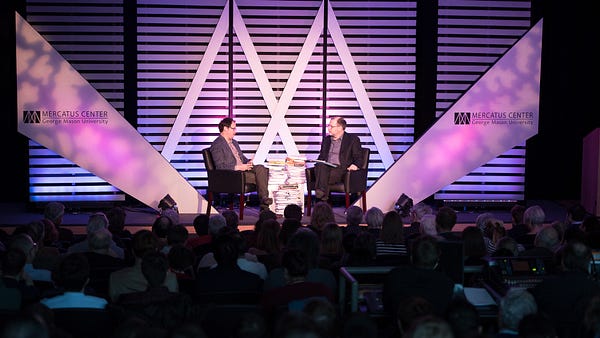
My conversation with Nate Silver
The video, podcast, and transcript are here. Nate of course was excellent, here are just a few bits:
COWEN: What are the differences between forecasting and futurism, and do you have any predictions for the year 2050? They don’t have to be great. They just have to be better than the market. We’ll take a 52 percent prediction and go home and celebrate.
SILVER: I’m mildly pessimistic in some ways.
COWEN: What’s the biggest source of your pessimism?
SILVER: [laughs] There’s probably some survivorship bias in the United States, and thinking about how our way will persevere forever and ever and ever. We were talking backstage about how you go to Asia and I go to Asia — not as often as you. If you want to feel optimistic about civilization, then go there.
And:
COWEN: You’re a fan of baseball, and I’d like to ask you, of all the different baseball records, which is the one that is most impressive to you, or the most a statistical aberration, and try to stay a bit modern. We both know in 1889, Hoss Radbourn won 59 games.
Start with [Owen] Wilson’s — was it 36 triples in 1912? That, and up through the modern age. What’s the most statistically impressive baseball record, and why?
SILVER: I think the biggest outlier is the number of intentional walks that Barry Bonds drew. I forget what year it was, 2001, where he had like 161 intentional walks, and the next closest player is 50?
And:
COWEN: Singapore. Overrated or underrated?
SILVER: Underrated except by you.
There is of course much, much more, including remarks on the candidates and the elections, as well as My Bloody Valentine and more on sports too, prediction markets as well, the weather, and why so few professional athletes have come out as gay. Recommended.