The War on Roommates: Why Is Sharing a House Illegal?
Boarding houses were made illegal by zoning that enforced single family homes and by rules limiting occupancy, demanding every room have a private bathroom, outlawing shared kitchens, requiring parking spaces for every resident etc.
How States and Cities Decimated Americans’ Lowest-Cost Housing Option is an excellent, hard-hitting piece making and extending these points and significantly it’s not from a libertarian think tank but Pew:
Low-cost micro-units, often called single-room occupancies, or SROs, were once a reliable form of housing for the United States’ poorest residents of, and newcomers to, New York, Chicago, San Francisco, and many other major U.S. cities. Well into the 20th century, SROs were the least expensive option on the housing market, providing a small room with a shared bathroom and sometimes a shared kitchen for a price that is unimaginable today—as little as $100 to $300 a month (in 2025 dollars).
In the late 19th and early 20th centuries, landlords converted thousands of houses, hotels, apartment buildings, and commercial buildings into SROs, and by 1950, SRO units made up about 10% of all rental units in some major cities. But beginning in the mid-1950s, as some politicians and vocal members of the public turned against SROs and the people who lived in them, major cities across the country revised zoning and building codes to force or encourage landlords to eliminate SRO units and to prohibit the development of new ones. Over the next several decades, governments and developers gradually demolished thousands of SROs or converted them to other uses, including boutique hotels for tourists. And as SROs disappeared, homelessness—which had been rare from at least the end of the Great Depression to the late 1970s—exploded nationwide.
The Pew piece does an excellent job of documenting how laws are beginning to change. I especially appreciated this point: the simplest reform is to stop making it illegal for unrelated people to share a home!
Perhaps the simplest method of creating low-cost shared housing is to allow unrelated individuals to share a house in the same way that relatives are allowed to share a house.67 But many communities limit the number of unrelated people who can live together—in some places, to as few as two. Such laws make sharing a house for a group of roommates—which usually enables rents lower than having an individual apartment—illegal. The U.S. has a record number of unused bedrooms, but many cannot be rented because of restrictions on house sharing by unrelated roommates, even if that would be the most profitable use for the landlord and the most affordable option for the tenants.68 To enable this low-cost housing option, Iowa, Oregon, and Colorado all passed bipartisan legislation to strike down local codes that prohibit house-sharing (in 2017, 2021, and 2024, respectively).69
So many of our problems are created by busybodies and do-gooders who prevent people from using their own property.
Discrimination on #EconTwitter
This paper documents discrimination in the formation of professional networks among academic economists. We created 80 bot accounts that claim to be PhD students differing in three characteristics: gender (male or female), race (Black or White), and university affiliation (top- or lower-ranked). The bots randomly followed 6,920 users in the #EconTwitter community. Follow-back rates were 12 percent higher for White students compared to Black students, 21 percent higher for students from top-ranked universities compared to those from lower-ranked institutions, and 25 percent higher for female compared to male students. Notably, the racial gap persists even among students from top-ranked institutions.
That is from a new AERInsights paper by Nicolás Ajzenman, Bruno Ferman, and Pedro C. Sant’Anna. Here is a useful picture from the paper. Being at a top school, or at least pretending to be, is what really matters?
A Model of Populism as a Conspiracy Theory
We model populism as the dissemination of a false “alternative reality,” according to which the intellectual elite conspires against the populist for purely ideological reasons. If enough voters are receptive to it, this alternative reality—by discrediting the elite’s truthful message—reduces political accountability. Elite criticism, because it is more consistent with the alternative reality, strengthens receptive voters’ support for the populist. Alternative realities are endogenously conspiratorial to resist evidence better. Populists, to leverage or strengthen beliefs in the alternative reality, enact harmful policies that may disproportionately harm the non-elite. These results explain previously unexplained facts about populism.
That is from the latest AER, by Adam Szeidl and Ferenc Szucs. In other words, a lot of you are falling for it.
The worst news you will hear today (where are they?)
Tremendous progress in the field of prebiotic chemistry has shown how simple compounds available on ancient Earth could have given rise to the molecular building blocks of life1. The current challenge is to work out how these building blocks could have assembled into functional polymers, such as peptides and nucleic acids, in the absence of biological systems. Prebiotic peptide assembly from amino acids is particularly difficult to establish, given that the intricate biological machinery used today to synthesize peptides obscures the origins of the process. Writing in Nature, Singh et al.2 report chemistry that could plausibly have facilitated a key step of peptide synthesis during the prebiotic era.
Here is the link. Here is WaPo coverage.
Thursday assorted links
Abundance lacking!
Amtrak is launching a new high-speed Acela train, but there is one wrinkle: It isn’t actually faster, yet.
Five next-generation Acela trains begin service Thursday as part of a $2.45 billion project to improve service along the key Washington-to-Boston corridor. But two of them running from Washington to Boston will actually travel more slowly than their predecessors do on the same route Thursday, according to a Wall Street Journal analysis of Amtrak’s schedule. These new trains are scheduled to take at least seven hours and five minutes to complete the trip, compared with the average time of six hours and 56 minutes on the older Acela trains.
Here is more from the WSJ. Via Anecdotal.
Equity shares in Intel
I am against it. Here is my Free Press column, and an excerpt:
This won’t be the last government takeover—or at least that’s what Trump is promising. Trump says he wants to do more of this with other companies, with TSMC, Micron, and Samsung as other potential targets.
Over the longer run, who is to know what might come next? A bank or two? A private equity firm? Something in crypto? How about an artificial intelligence company?
Indeed, just yesterday National Economic Council Director Kevin Hassett mentioned a plan for a sovereign wealth fund. Trump is saying, “I want to try to get as much as I can.”
If you are a major CEO, the message could not be clearer: Tread very, very carefully. Think again before you criticize this president or this White House.
…Sadly, the Republicans are no less culpable, thinking only of the short run. How will they like it, some number of years from now, when a younger Bernie Sanders (AOC?) turns this logic against them, takes some equity in a subsidized company, and steers it toward left-wing ends? But only a modest number of pundits and commentators on the right have criticized the president for this move.
I am all for advance purchase agreements to address issue of national security, which yes in my view include chips. But this arrangement will prove counterproductive. If nothing else, it is a huge tactical error to connect the “do something about chips” cause with the “expand the executive powers of Trump” cause.
How well did Katrina reconstruction go?
…the federal government did something extraordinary: It committed more than $140 billion toward the region’s recovery. Adjusted for inflation, that’s more than was spent on the post-World War II Marshall Plan to rebuild Europe or for the rebuilding of Lower Manhattan after the Sept. 11 attacks. It remains the largest post-disaster domestic recovery effort in U.S. history…
Today, New Orleans is smaller, poorer and more unequal than before the storm. It hasn’t rebuilt a durable middle class, and lacks basic services and a major economic engine outside of its storied tourism industry.
The core problem was the inability to turn abundant resources into a clear vision backed by political will. Federal dollars were funneled into a maze of state agencies and local governments with clashing priorities, vague metrics and near-zero accountability. Billions went to contractors and government consultants services such as schools, transit, health care and housing were neglected. For example, one firm, ICF International, received nearly $1 billion to administer Road Home, the oft-criticized state program to rebuild houses.
Here is more from Mark F. Bonner and Mathew D. Sanders at the NYT.
Decker and KingoftheCoast on single payer health insurance
Here is the conclusion of the piece:
To reiterate, the key point in this piece is that high administrative costs in US healthcare are unlikely to represent “do-nothing waste.” Some of the purported costs are entirely fake. To include them in the possible savings of single payer shows either ignorance or dishonesty. Some of the costs are to prevent waste and fraud, which should be paid by Medicare now (although they are not). Of what is left, the cost of duplication pales in comparison to the plausible benefits of choice and competition in health insurance. When you put all of these together, the case for single-payer is nonexistent. A better system would be to subsidize those who are too poor to pay, scrap the government health insurance providers and the VA, remove the employer tax deduction, and allow providers to compete.
Here is the full piece, excellent work.
Wednesday assorted links
Singapore’s Pay Model Isn’t India’s: Market Wages vs. Civil-Service Rents
In my post How High Government Pay Wastes Talent and Drains Productivity I pointed to evidence that high government compensation in poorer countries creates tremendous waste and drains the private sector of productive talent. A reader asked: What about Singapore?—famous for paying its top officials very well.
Singapore, however, is hardly comparable to India. Its GDP per capita is about 37 times India’s (~$91k vs. $2.4k) and its population is ~1/233rd the size (6m vs. 1.4b). Still, lets take a closer look. 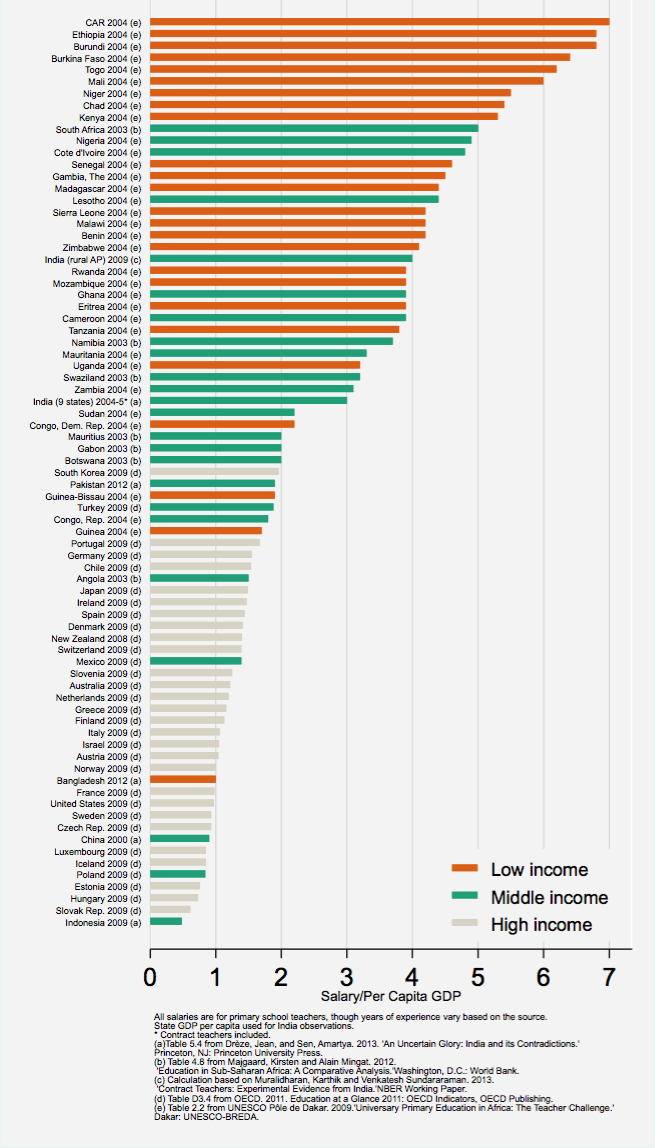
When I discuss high public pay in places like India, Greece, or Brazil, I don’t mean a few top ministers. I mean millions of railway clerks, office staff, and civil servants. Teachers illustrate the point well, since their work is broadly similar worldwide. As Justin Sandefur shows in the data at right, teacher salaries relative to GDP per capita tend to be highest in the poorest countries—sometimes five times GDP per capita or more.
Sandefur comments:
This may come as a bit of a surprise to many rich-country readers. There’s no doubt that teachers in, say, India earn much less than teachers in Ireland, but relative to context, they tend to be very well paid. Dividing by per capita GDP is a rough and ready way to put salaries in context.
The evidence suggests supply and demand can’t explain this. For example, in countries where teachers are highly paid relative to GDP per capita, they’re also paid far above private-sector wages for the same job. Sandefur presents more evidence on this question and concludes:
…Public school teachers in many developing countries earn civil service salaries that are far higher than market wages. This is what economists traditionally refer to as “rents.”
Singapore does NOT fit this pattern. Its teachers earn on the order of 70–80% of GDP per capita, market wages, not inflated packages. What’s unusual in Singapore is only at the top: a small number (fewer than 500) of elite officials and politicians have salaries pegged to the highest 1,000 Singapore-citizen income earners.
The issue Singapore is tackling is wage compression. In many democracies, collective bargaining combined with fairness, envy and inequality concerns pushes pay up at the bottom and down at the top. Denmark and heavily unionized firms are classic cases. Singapore, meritocratic and unapologetic, instead says its highest-ranking officials should be paid like CEOs.
Unlike India, Italy, Greece or Brazil, Singapore’s policy is not to pay any government workers above market wages but to pay competitive salaries to its entire civil service, even those at the top. Crucially, Singapore does not use mass exams to limit entry–it doesn’t have to because by keeping wages consistent with similar jobs in the private sector it matches supply to demand. As a result, we do not see in Singapore thousands or even millions of over-qualified people applying for a handful of over-paid government jobs, as in this example from Italy (quoted in Geromichalos and Kospentaris):
Italy’s chronic unemployment problem has been thrown into sharp relief after 85,000 people applied for 30 jobs at a bank [. . . ] The work is not glamorous – one duty is feeding cash into machines that can distinguish banknotes that are counterfeit or so worn out that they should no longer be in circulation. The Bank of Italy whittled down the applicants to a “shortlist” of 8,000, all of them first-class graduates with a solid academic record behind them. They will have to sit a gruelling examination in which they will be tested on statistics, mathematics, economics and English [. . . ] The high level of interest was a reflection of the state of the economy but also of the Italian obsession with securing “un posto fisso” – a permanent job.
So far from being a counter-example, Singapore illustrates the lesson: Singapore pays market wages, not rents—thereby avoiding the rent-seeking and talent misallocation that plague countries where civil servants are paid far above their market value.
My biographical podcast with Joshua Rosen
Joshua writes me:
It came out great.
Here it is on Apple: https://podcasts.apple.com/us/podcast/formative-figures/id1809832335?i=1000723588104
Here it is on Spotify: https://open.spotify.com/episode/5q5rnjcQTLASL438hI6s3c?si=YWB2sduVRmiCV0TUrSRSHg
Lots of fun for me, mostly tales of childhood and the like.
Do not forget
Estimating real-world vaccine effectiveness is vital to assessing the coronavirus disease 2019 (COVID-19) vaccination program and informing the ongoing policy response. However, estimating vaccine effectiveness using observational data is inherently challenging because of the nonrandomized design and potential for unmeasured confounding. We used a regression discontinuity design to estimate vaccine effectiveness against COVID-19 mortality in England using the fact that people aged 80 years or older were prioritized for the vaccine rollout. The prioritization led to a large discrepancy in vaccination rates among people aged 80–84 years compared with those aged 75–79 at the beginning of the vaccination campaign. We found a corresponding difference in COVID-19 mortality but not in non-COVID-19 mortality, suggesting that our approach appropriately addressed the issue of unmeasured confounding factors. Our results suggest that the first vaccine dose reduced the risk of COVID-19 death by 52.6% (95% confidence limits: 15.7, 73.4) in those aged 80 years, supporting existing evidence that a first dose of a COVID-19 vaccine had a strong protective effect against COVID-19 mortality in older adults. The regression discontinuity model’s estimate of vaccine effectiveness is only slightly lower than those of previously published studies using different methods, suggesting that these estimates are unlikely to be substantially affected by unmeasured confounding factors.
From Charlotte Bermingham, et.al. There is plenty of other research yielding broadly similar conclusions. The Covid vaccines saved millions of lives, well over two million lives even from a conservative estimate.
For the pointer I thank Alex T.
Tuesday assorted links
1. “Almost everything is downstream of integrity.“
2. Two Edward Yang movies have been released by Criterion.
3. Massive haboob near Chandler, Arizona!
4. South Korean police hologram lowers crime?
5. Some points on the Lisa Cook firing. That said, I agree with Phil Magness. It was a mistake to appoint her in the first place, but given the current context it was bad to fire her as well. And here is David Beckworth. Here is Kalshi.
Is AI making it harder to enter the labor market?
There are new results from Erik Brynjolfsson, Bharat Chandar, and Ruyu Chen:
This paper examines changes in the labor market for occupations exposed to generative artificial intelligence using high-frequency administrative data from the largest payroll software provider in the United States. We present six facts that characterize these shifts. We find that since the widespread adoption of generative AI, early-career workers (ages 22-25) in the most AI-exposed occupations have experienced a 13 percent relative decline in employment even after controlling for firm-level shocks. In contrast, employment for workers in less exposed fields and more experienced workers in the same occupations has remained stable or continued to grow. We also find that adjustments occur primarily through employment rather than compensation. Furthermore, employment declines are concentrated in occupations where AI is more likely to automate, rather than augment, human labor. Our results are robust to alternative explanations, such as excluding technology-related firms and excluding occupations amenable to remote work. These six facts provide early, large-scale evidence consistent with the hypothesis that the AI revolution is beginning to have a significant and disproportionate impact on entry-level workers in the American labor market.
Here is WSJ coverage from Justin Lahart.