What should Latin America learn from India?
That is another MR reader request. Here are a few possible answers:
1. You could word this question the other way around, noting that Bolivia — one of the poorer Latin American economies — is richer than India per capita.
2. At least partial integration with the Anglo world — and through the English language rather than the drug trade — is worth a great deal.
3. Learn more good English. It can become a meaningfully useful second or third language for your country, you need only to will it so.
4. Encourage your smartest young kids to be obsessed with the internet.
5. Create top institutions of elite education in your country. Most (all?) of Latin America has nothing comparable to the Indian IIT system.
6. In India it used to be super-high status for your kid to attend Oxford and Cambridge, now American universities have stepped into these spots as well. I don’t see a similar phenomenon in Latin America, not on a widespread basis.
7. Single parent families can be disastrous. In Colombia the current rate of that is 84 (!) percent, in Argentina, Mexico, and Chile it is more than half. For India I see estimates ranging from 4.5 percent to 7.5 percent for single parent families. Hail the disapproving Indian auntie! Hail the “difficult” Indian mother who insists on a proper wedding and marriage for the family’s children. etc.
8. More generally, one might praise the general notion of “families that bust your balls.”
What else?
San Francisco fact of the day
…the city of San Francisco is upping its toilet game and is prepared to spend up to $1.7 million to build a single commode in one neighborhood plaza.
City leaders are slated to gather Wednesday afternoon at the Noe Valley Town Square to officially announce a “$1.7 Million state budget win” to build a toilet there, according to an online event schedule. The proposed facility would include just one toilet in a 150-foot space, according to a new report by San Francisco Chronicle columnist Heather Knight.
The city’s Recreation and Parks Department and the Department of Public Works, which will work together to build the pricey potty, expect it will take three years to complete.
Here is the full story, via Fernand.
Thursday assorted links
1. Why Vienna is so livable, the theory may help explain Ljubljana as well.
2. Devon Zuegel and Russ Roberts on hyperinflation in Argentina.
3. Woman releases bees during eviction.
4. NFTs and the economics of royalties.
5. Brian Chau on me on the New Right, etc.
6. Out of the Blue Liz Truss about to be cancelled markets in everything?
A Vision of Metascience
Lots to praise and to ponder in this excellent piece by Michael Nielsen and Kanjun Qiu on improving the discovery ecosystem with metascience. The piece contains some pop-ideas to stimulate thinking such as:
- Fund-by-variance: Instead of funding grants that get the highest average score from reviewers, a funder should use the variance (or kurtosis or some similar measurement of disagreement5) in reviewer scores as a primary signal: only fund things that are highly polarizing (some people love it, some people hate it). One thesis to support such a program is that you may prefer to fund projects with a modest chance of outlier success over projects with a high chance of modest success. An alternate thesis is that you should aspire to fund things only you would fund, and so should look for signal to that end: projects everyone agrees are good will certainly get funded elsewhere. And if you merely fund what everyone else is funding, then you have little marginal impact6,7.
But it’s really not about one one idea but about understanding why scientific tools are rarely applied to science itself and what can we do to improve metascience. Lots of bad news but there are some positive examples. Thereplication revolution (no longer a crisis!) appears to be working:
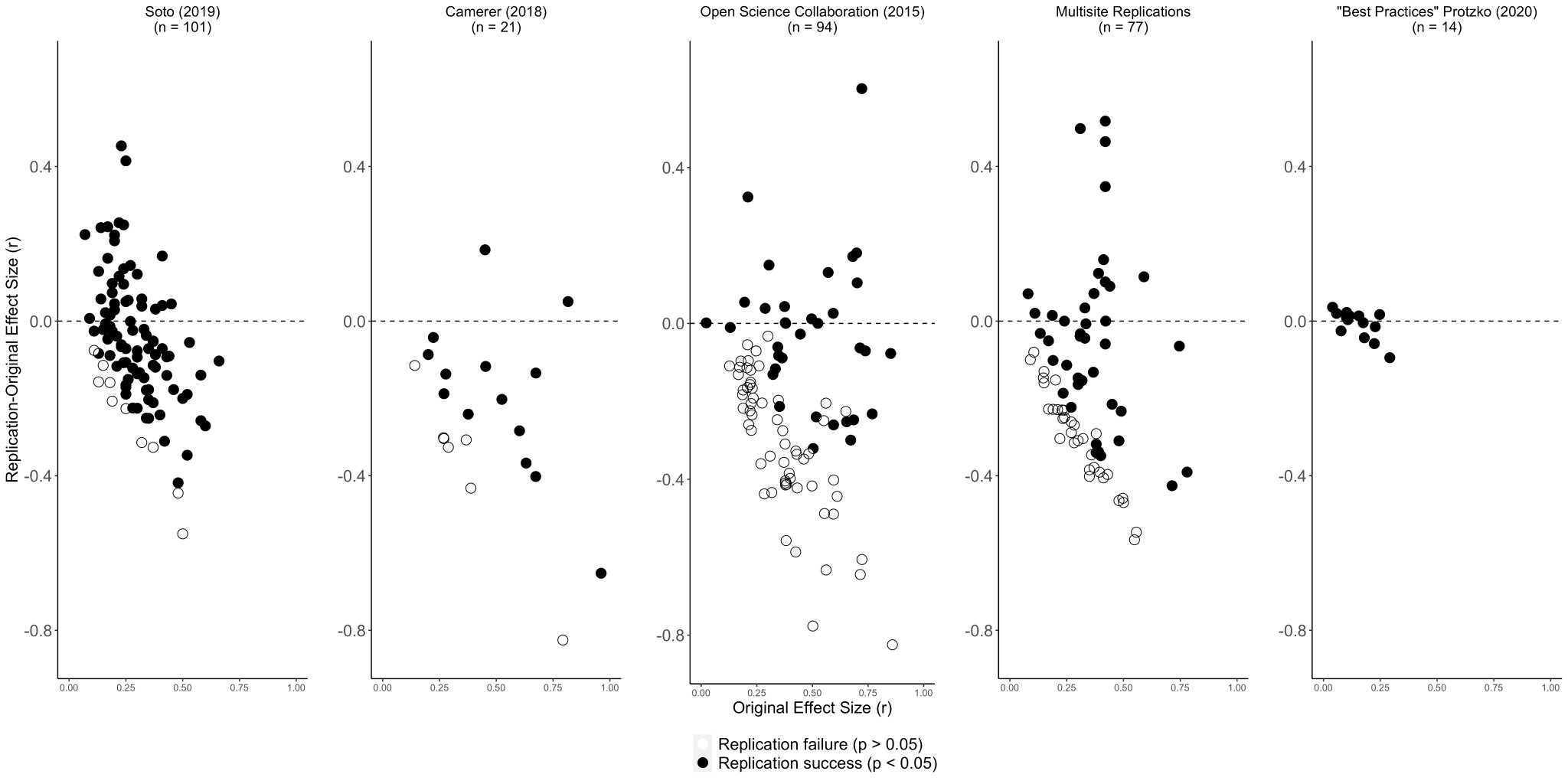
There are encouraging signs that pre-registered study designs like this are helping address the methodological problems described above. Consider the following five graphs. The graphs show the results from five major studies89, each of which attempted to replicate many experiments from the social sciences literature. Filled in circles indicate the replication found a statistically significant result, in the same direction as the original study. Open circles indicate this criterion wasn’t met. Circles above the line indicate the replication effect was larger than the original effect size, while circles below the line indicate the effect size was smaller. A high degree of replicability would mean many experiments with filled circles, clustered fairly close to the line. Here’s what these five replication studies actually found:
As you can see, the first four replication studies show many replications with questionable results – large changes in effect size, or a failure to meet statistical significance. This suggests a need for further investigation, and possibly that the initial result was faulty. The fifth study is different, with statistical significance replicating in all cases, and much smaller changes in effect sizes. This is a 2020 study by John Protzko et al90 that aims to be a “best practices” study. By this, they mean the original studies were done using pre-registered study design, as well as: large samples, and open sharing of code, data and other methodological materials, making experiments and analysis easier to replicate…In short, the replications in the fifth graph are based on studies using much higher evidentiary standards than had previously been the norm in psychology. Of course, the results don’t show that the effects are real. But they’re extremely encouraging, and suggest the spread of ideas like Registered Reports contribute to substantial progress.
The story of Brian Nosek is very interesting:
Many people have played important roles in instigating the replication crisis. But perhaps no single person has done more than Brian Nosek. Nosek is a social psychologist who until 2013 was a professor at the University of Virginia. In 2013, Nosek took leave from his tenured position to co-found the Center for Open Science (COS) as an independent not-for-profit (jointly with Jeff Spies, then a graduate student in his lab). Nosek and the COS were key co-organizers of the 2015 replication paper by the Open Science Collaboration. Nosek and the COS have also been (along with Daniël Lakens, Chris Chambers, and many others) central in developing Registered Reports. In particular, they founded and operate the OSF website, which is the key infrastructure supporting Registered Reports.
…The origin story of the COS is interesting. In 2007 and 2008, Nosek submitted several grant proposals to the NSF and NIH, suggesting many of the ideas that would eventually mature into the COS95. All these proposals were turned down. Between 2008 and 2012 he gave up applying for grants for metascience. Instead, he mostly self-funded his lab, using speaker’s fees from talks about his prior professional work. A graduate student of Nosek’s named Jeff Spies did some preliminary work developing the site that would become OSF. In 2012 this got some media attention, and as a result was noticed by several private foundations, including a foundation begun by a billionaire hedge fund operator, John Arnold, and his wife, Laura Arnold. The Arnold Foundation reached out and rapidly agreed to provide some funding, ultimately in the form of a $5.25 million grant.
To do this, Nosek had to leave the University of Virginia? Why? He was then attacked by many in the scientific community. Why? Read the whole thing for much more.
My Conversation with Reza Aslan
On a bunch of normal issues, I disagree with him rather vehemently, but overall I thought this Conversation worked out quite well. Here is the audio and video and transcript. Here is part of the episode summary:
He joined Tyler to discuss Shi’a and Christian notions of martyrdom, the heroism of Howard Baskerville, the differences between Sunni and Shi’a Islam, esoteric vs. exoteric expressions of religion, how mystical movements arise more organically than religion, the conflicts over Imams in the Islamic world, how his upbringing as an Iranian immigrant shaped his view of religion, his roundabout spiritual journey, the synthesis of Spinoza and Sufism, the origins of Wahhabism, the relationship (or lackthereof) between religion and political philosophy, the sad repetition of history in Iran, his favorite Iranian movie, and more.
Here is one excerpt:
COWEN: In your understanding, can Sufism stand alongside the prophetic structure of Islam as something separate? Or is it synthesized with it into one consistent picture?
ASLAN: That’s a hardcore, brilliant theological question because it’s been debated for generations. What I will say is this: that Sufism is, like all mystical traditions, incredibly eclectic. It comes in thousands of different forms.
There are some Sufis that are very traditionalist, very hard to even, sometimes, tell the difference between them and your basic Sunni. And there are some Sufis that take part in the spectacular displays, sometimes displays that involve putting swords through their bodies, taking part in painful acts, ways of trying to deny the self and the body in a way that most Muslims would look at and say, “That looks nothing like Islam.” Sufism is what a Sufi says it is, basically.
COWEN: If I go to Albania and I chat with the Bektashi, how is their version of Sufism different?
ASLAN: Then say the Naqshbandi? Absolutely. What’s great about Sufism — and again, this is a standard description of all mystical movements — is that they absorb themselves into local cultures and local practices. When you have these kinds of deeply spiritual, mystical movements, they most often arise from the culture. They’re not so often brought in from the outside.
Religion, in its most orthodox sense, is usually introduced to a culture or to a people. Somebody shows up and says, “This is Islam, this is Christianity, this is Buddhism.” Sufism, like much of mystical movements, is something that comes out of the ground itself and then starts to marry itself to that dominant religion.
We see Christian mysticism all around the world that in some places looks like paganism, and in some places looks like traditional nature worship. It uses some of the symbols and metaphors of Christianity, and it becomes an indigenous version of Christianity. That’s exactly the same thing with Sufism and Islam. It depends on where you go —
Interesting throughout.
A simple explainer on global warming positions
Here is Chris Hayes calling for lower gas prices, here is the White House. I do understand the median voter theorem!
But let me explain how a lot of the Right wing sees this issue. They believe the Left was never entirely serious about the climate change crusade in the first place, but wanted to use it to achieve certain political goals. “Why go along with this charade if the Left is going to pull the plug on the effort anyway?” A lot of the Right is less naive about climate change than you might think. They won’t come out and say all this, but they also think the Left is at least as dishonest about the issue, albeit in a more self-deceiving, ostensibly more sincere fashion. The Right sees messages like this and then they feel “Ah, we were right!”.
To be clear, I believe that economists should present good policies to internalize externalities in simple, straightforward non-Straussian fashion. Someone has to! So we ought to stay the course.
But if you are trying to understand the debate, and why it is not as morally one-sided as you might think, I find this a useful framework.
Wednesday assorted links
Treason!
The International Shipping panel of the Maritime Transportation System National Advisory Committee, a quasi-official advisory board, is not happy with the Cato Institute and Mercatus.
The Dispatch: After a March 21, 2020 meeting, the international shipping subcommittee sent draft recommendations to the Transportation Department’s Maritime Administration, according to a document the Cato Institute recently obtained from the government. The document, reviewed by The Dispatch, broadly discusses the problems of an aging U.S. fleet and insufficient shipping capacity.
Nestled among bullet points recommending policy changes to fix those problems is one labeled, “Unequivocal support of the Jones Act.”
Beneath it: “Charge all past and present members of the Cato and Mercatus Institutes with treason.
If these rent-seeking gangsters think this is going to dissuade Cato and Mercatus scholars from continuing to attack the awful Jones Act they are very much mistaken.
Classical liberalism vs. The New Right
It has become increasingly clear that the political Right in America is not what it used to be. In particular, my own preferred slant of classical liberalism is being replaced. In its stead are rising alternatives that don’t yet have a common name. Some are called “national conservatism,” and some (by no means all) strands are pro-Trump, but I will refer to the New Right. My use of the term covers a broad range of sources, from Curtis Yarvin to J.D. Vance to Adrian Vermeule to Sohrab Ahmari to Rod Dreher to Tucker Carlson, and also a lot of anonymous internet discourse. Most of all I am thinking of the smart young people I meet who in the 1980s might have become libertarians, but these days absorb some mix of these other influences.
I would like to consider where the older classical liberal view differs from these more recent innovations. I don’t so much intend a cataloguing of policy positions as a quest to find the most fundamental difference, at a conceptual level, between the classical liberal views and their New Right competitors. That main difference – to cut to the chase — is how much faith each group puts in the possibility of trustworthy, well-functioning elites.
A common version of the standard classical liberal view stresses the benefits of capitalism, democracy, civil liberties, free trade (with national security exceptions), and a generally cosmopolitan outlook, which in turn brings sympathy for immigration. The role of government is to provide basic public goods, such as national defense, a non-exorbitant safety net, and protection against pandemics.
In the classical liberal view, elites usually fall short of what we would like. They end up captured by some mix of special interest groups and poorly informed voters. There is thus a certain disillusionment with democratic government, while recognizing it is the best of available alternatives and far superior to autocracy for basic civil liberties.
That said, classical liberals do not consider the elites to be totally hopeless. After all, someone has to steer the ship and to this day we do indeed have a ship to steer. Most elites are intelligent and also they are as well-meaning as the rest of us, even if the bureaucratic nature of politics hinders their performance. We can entrust them with supplying basic public goods, and indeed we have little choice. Those truths hold even if the DMV will never be as efficient as Amazon, and even if sometimes our elites commit grave errors, for instance when the Johnson administration escalated the Vietnam War, to cite one example of many.
In the classical liberal view, the great failing of elites is that they do not keep society as free as it ought to be.
The New Right thinkers are far more skeptical of elites. They are more likely to see elites as evil and pernicious, and sometimes they (implicitly) see these evil elites as competent enough to actually wreck society. The classical liberals see checks and balances as strong enough to limit the worst outcomes, whereas the New Right sees ideological conformity and indeed collusion within the Establishment. Checks and balances are a paper tiger.
Once you start seeing elites as so bad and also so collusive, many other changes in your views might follow. You might become more skeptical about free speech, because you view it as a recipe for putting a lot of power in the hands of (often Democratic-led) major tech companies. And is there de facto free speech if a conservative sociologist cannot get hired at Yale? You also might become more skeptical about immigration, not because you are racist (though of course there are racists), but because you see it as a plot of the Democratic Party to remake America in a new image and with a new set of voters (“you will not replace us!”). Free trade becomes seen as a line peddled by the elite, and that is an elite unconcerned with the social and national security costs of a deindustrialized America. Globalization more generally becomes a failed project of the previous elite.
The New Right doesn’t entirely reject the basic principles of free market economics, but it does try to transcend libertarian views with a deeper understanding of the current power structure. In each case there are sociological forces operating that are seen as more important than “mere” free market economics. In this regard the New Right has a more interdisciplinary worldview than do many of the classical liberals. The New Right thinkers regard most power as cultural in nature, rather than rooted in coercive government alone.
Using this kind of contrast, just about every classical liberal view can be redone along New Right lines. The policy emphasis then becomes learning how to use the government to constrain the Left and its cultural agenda, rather than ensuring basic liberties for everyone. The New Right view is that this obsession with basic liberties leads, in reality, to the hegemony of a statist Left, and a Left that will use its power centers of government, media and academia to crush and cancel the New Right.
There is also a self-validating structure to New Right arguments over time. You can’t easily persuade New Right advocates by pointing to mainstream media reports that contradict their main narrative. Mainstream media is one of the least trusted sources. Academic research also has fallen under increasing mistrust, as the academy predominantly hires individuals who support the Democratic Party.
Most classical liberals are uncomfortable with the New Right approaches, and seek to disavow them. I share those concerns, and yet I also recognize that hard and fast lines are not so easy to draw. The New Right is in essence accepting the original classical liberal critique of the state and pushing it a few steps further, adding further skepticism of elites, a greater emphasis on culture, and a belief in elite collusion rather than checks and balances. You may or may not agree with those intellectual moves, but many common premises still are shared between the classical liberals and the New Right, even if neither side is fully comfortable admitting this.
The New Right also tends to see the classical liberals as naïve about power (the same charge classical liberals fling at the establishment), and as standing on the losing side of history. Those aren’t the easiest arguments to refute. Furthermore, the last twenty years have seen 9/11, a failed Iraq War, a major financial crisis and recession, and a major pandemic, mishandled in some critical regards. It doesn’t seem that wrong to become additionally skeptical about American elites, and the New Right wields these points effectively.
While I try my best to understand the New Right, I am far from being persuaded. One worry I have is about how it initially negative emphasis feeds upon itself. Successful societies are based on trust, including trust in leaders, and the New Right doesn’t offer resources for forming that trust or any kind of comparable substitute. As a nation-building project it seems like a dead end. If anything, it may hasten the Brazilianification of the United States rather than avoiding it, Brazil being a paradigmatic example of a low trust society and government.
I also do not see how the New Right stance avoids the risks from an extremely corrupt and self-seeking power elite. Let’s say the New Right description of the rottenness of elites were true – would we really solve that problem by electing more New Right-oriented individuals to government? Under a New Right worldview, there is all the more reason to be cynical about New Right leaders, no matter which ideological side they start on. If elites are so corrupt right now, the force corrupting elites are likely to be truly fundamental.
The New Right also overrates the collusive nature of mainstream elites. Many New Right adherents see a world ever more dominated by “The Woke.” In contrast, I see an America where Virginia elected a Republican governor, Louis C.K. won a 2022 Grammy award on a secret ballot and some trans issues are falling in popularity. Wokism likely has peaked. Similarly, the New Right places great stress on corruption and groupthink in American universities. I don’t like the status quo either, but I also see a world where the most left-wing majors – humanities majors – are losing enrollments and influence. Furthermore, the internet is gaining in intellectual influence, relative to university professors.
The New Right also seems bad at coalition building, most of all because it is so polarizing about the elites on the other side. Many of the most beneficial changes in American history have come about through broad coalitions, not just from one political side or the other. Libertarians such as William Lloyd Garrison played a key role an anti-slavery debates, but they would not have gotten very far without support from the more statist Republicans, including Abraham Lincoln. If you so demonize the elites that do not belong to your side, it is more likely we will end up in situations where all elites have to preside over a morally unacceptable status quo.
The New Right (and the classical liberals I might add) also seem to neglect the many cases where American governance has improved over time. My DMV really is many times better than it was thirty years ago. New York City is currently seeing some trying times, due to the pandemic aftermath, but the city is significant better run today than it was in the 1970s. Social Security, for all of its flaws, remains one of the world’s better-functioning retirement systems. The weapons the U.S. military is supplying to Ukraine seem remarkably effective. The Fed and Treasury, for all their initial oversights, did forestall a great depression in 2008-2009. Operation Warp Speed was a major success and saved millions of lives.
It is missing the point to provide a counter-narrative of all of our government’s major and numerous screw-ups. The point is that good or at least satisfactory elite performance is by no means entirely out of our reach. We then have to ask the question – which philosophy of governance is most likely to get us there next time around? I can see that some New Right ideas might contribute to useful reform, but it is not my number one wish to have New Right leaders firmly in charge or to have New Right ideology primary in our nation’s youth.
Finally, I worry about excess negativism in New Right thinking. Negative thoughts tend to breed further negative thoughts. If the choice is a bit of naivete and excess optimism, or excess pessimism, I for one will opt for the former.
Perhaps most of all, it is dangerous when “how much can we trust elites?” becomes a major dividing line in society. We’ve already seen the unfairness and cascading negativism of cancel culture. To apply cancel culture to our own elites, as in essence the New Right is proposing to do, is not likely to lead to higher trust and better reputations for those in power, even for those who deserve decent reputations.
Very recently we have seen low trust lead to easily induced skepticism about the 2020 election results, and also easily induced skepticism about vaccines. The best New Right thinkers will avoid those mistakes, but still every political philosophy has to be willing to live with “the stupider version” of its core tenets. I fear that the stupider version of some of the New Right views are very hard to make compatible with political stability or for that matter with public health.
I would readily grant that my opinion of our mainstream elites has fallen over the last five to ten years, and in part from consuming intellectual outputs from the New Right. But I don’t long for tearing down the entire edifice as quickly as possible. That would break the remaining bonds of trust and competence we do have, and lead to reconstituted governments, bureaucracies, and media elites with lower competence yet and even less worthy of trust. If you yank out a tooth, you cannot automatically expect a new and better tooth to grow back.
The polarizing nature of much of New Right thought means it is often derided rather than taken seriously. That is a mistake, as the New Right has been at least partially correct about many of the failings of the modern world. But it is an even bigger mistake to think New Right ideology is ready to step into the space long occupied by classical liberal ideals.
The importance of Greek migrants in world history
Here is a new paper by Andreas Link:
During the Renaissance numerous discoveries and inventions significantly bolstered European development. This paper examines the role played by Greek migrants in this process. While the vast majority of works by ancient Greek scholars such as Galen, Hippocrates, and Euclid were unknown in Western Europe during the middle ages, such knowledge had been preserved in the Byzantine Empire. The revival of ancient Greek knowledge within Western Europe coincided with the conquest of Constantinople by the Ottomans in 1453 and the subsequent surge in Greek migration to Western Europe. Using a newly constructed dataset on Greek migrants in Europe, I show that a Greek presence around the year 1500 is positively associated with city growth in the sixteenth century. This finding is corroborated by a difference-in-differences analysis as well as an instrumental variable approach that exploits distance to Constantinople as a source of exogenous variation in Greek presence in European cities. In terms of mechanisms, I find that a Greek presence is associated with larger numbers of published book editions in astronomy, mathematics, and medicine – fields in which ancient Greek and Byzantine scholars were especially advanced – as well as larger levels of upper-tail human capital. Finally, the results show that destination places for Greek migration became centers of innovation. Together, these results emphasize the importance of Greeks in the dissemination and application of scientific knowledge in early modern Europe and suggest that a Greek presence was one of the major growth drivers during the early modern period.
Via Kris Gulati.
Tuesday assorted links
1. For readers who can get through the academic gate, my 2003 review of Nozick’s Invariances.
2. Is fencing good for college admissions? (NYT)
3. Why are the populists relatively good on regulatory reform?
4. Renowned Arecibo telescope won’t be rebuilt.
5. More from Summers; he is not losing this debate.
Irresponsible Gain of Function Research
Scientists at Boston University have grafted the new Omicron spike protein onto the old SARS-Cov-2 virus creating a new and deadlier version of Omicron.
bioRXiv: The recently identified, globally predominant SARS-CoV-2 Omicron variant (BA.1) is highly transmissible, even in fully vaccinated individuals, and causes attenuated disease compared with other major viral variants recognized to date1-7. The Omicron spike (S) protein, with an unusually large number of mutations, is considered the major driver of these phenotypes3,8. We generated chimeric recombinant SARS-CoV-2 encoding the S gene of Omicron in the backbone of an ancestral SARS-CoV-2 isolate and compared this virus with the naturally circulating Omicron variant. The Omicron S-bearing virus robustly escapes vaccine-induced humoral immunity, mainly due to mutations in the receptor49 binding motif (RBM), yet unlike naturally occurring Omicron, efficiently replicates in cell lines and primary-like distal lung cells. In K18-hACE2 mice, while Omicron causes mild, non-fatal infection, the Omicron S-carrying virus inflicts severe disease with a mortality rate of 80%. This indicates that while the vaccine escape of Omicron is defined by mutations in S, major determinants of viral pathogenicity reside outside of S.
Some of the headlines (here, here, here and here) aren’t making clear that the newly created chimeric virus is deadlier than Omicron (in mice) but less deadly than the ancestral strain. Nevertheless, in my view, this is gain of function research that should have come under extra scrutiny. The authors, however, did not go through P3CO review, a rule requiring agencies under HHS to review grant applications for any research on “a credible source of a potential future human pandemic.” More specifically:
The HHS Framework for Guiding Funding Decisions about Proposed Research Involving Enhanced Potential Pandemic Pathogens (HHS P3CO Framework)(link is external) was established in 2017 to guide funding decisions on proposed research that is reasonably anticipated to create, transfer or use potential pandemic pathogens resulting from the enhancement of a pathogen’s transmissibility and/or virulence in humans, called ePPP research.
I think this research qualifies. Frankly, the authors of the study were irresponsible. Boston University also failed terribly in its oversight. I also put some blame on Anthony Fauci for evading and obfuscating earlier gain of function research in a way that suggested very little falls under this category. (Rand Paul was right about this). Note, I am not taking a position on whether this research should have passed P3CO review but it should have been subject to review. I am also well aware that BSL-3 labs are heavily regulated, greatly increasing the cost of useful research. Overregulation is a real cost than can make us less safe and secure.
Nevertheless, if there is even a 5% chance that the SARS-CoV-II pandemic started with a lab leak–and don’t trust anyone who tells you the probability is less than 5%–then we need more care and scrutiny of research on potential pandemic pathogens. Furthermore, the United States must lead if we are to have any influence at all on what happens elsewhere in the world.
Which historical figures would you like to see good movies made about?
That is another reader request, and here the answer is simple: none!
I don’t like biopics, and I don’t know of many good ones. They seem too mechanical to me, too predictable, and too “paint by numbers.” Too many parts of the movie have to be laid out didactically, and I rarely feel much of the dramatic tension.
Furthermore, a movie made about a person can skew your sense of history because a good movie will be so vivid. Which should I trust “The Buddy Holly Story” or the book I read about Buddy Holly? And no, I didn’t like Shakespeare in Love.
For “the others” I would be happy with any popular movie made about scientific figures, putting science in a positive light. That said, I think Spock and “the Professor” from Gilligan’s Island are far more effective than a biopic of Ernest Rutherford.
Either way, I probably won’t go see it. I want the direct falsehoods!
Ranking of major tourist sites
Tyler’s ranking of major world heritage/tourist sites (could be buildings, national parks, etc.) in terms of which far exceed/underwhelm expectations derived from casual internet surfing.
This is off the top of my head and not pondered for very long, with eleven or more in the top ten:
1. Northern Arizona/southern Utah, various national parks, culminating in the North Rim of the Grand Canyon.
Yes, #1 in the whole world and overall I am not such a travel nationalist. So it must be really, really good.
2. Iguassu Falls.
I have seen only the Brazilian side, Argentina would make it better yet. Beware the coatimundis who like to sniff your balls!
3. Ålesund, Norway.
4. The architecture of Brasilia.
I like modernism. The view from the Rio Christ statue is pretty good too.
5. The architecture of Helsinki.
Kind of follows!
6, Macchu Picchu, seen properly. Or maybe Lalibela?
Now the former is too full of crowds, I suspect.
7. Swiss Alps, including the integration of natural beauty, landscape, and human footprint.
Get a car, don’t talk yourself into the train only.
8. Sikh Golden Temple and surrounding site, Amritsar, Punjab.
9. Niagara Falls.
10. Ginza district, Tokyo.
11. Singapore, Marina Bay Sands area, most of all the view from the Infinity Pool, looking out in all directions.
Other contenders: Istanbul on the water, view from the Eiffel Tower, Yunnan province in China, average quality of beauty in New Zealand, the new parts of Copenhagen and also Hamburg on the waterfront, cruising in Mexico City, the very old parts of Rome, Venice in a fast water boat, Marrakesh, Busan, Korea, Faroe Islands, many different parts of Chile including Patagonia, random geothermal parts of Iceland.
I am sure I have forgotten plenty!
Long Social Distancing
From Jose Maria Barrero, Nicholas Bloom, and Steven J. Davis:
More than ten percent of Americans with recent work experience say they will continue social distancing after the COVID-19 pandemic ends, and another 45 percent will do so in limited ways. We uncover this Long Social Distancing phenomenon in our monthly Survey of Working Arrangements and Attitudes. It is more common among older persons, women, the less educated, those who earn less, and in occupations and industries that require many face-to-face encounters. People who intend to continue social distancing have lower labor force participation – unconditionally, and conditional on demographics and other controls. Regression models that relate outcomes to intentions imply that Long Social Distancing reduced participation by 2.5 percentage points in the first half of 2022. Separate self-assessed causal effects imply a reduction of 2.0 percentage points. The impact on the earnings-weighted participation rate is smaller at about 1.4 percentage points. This drag on participation reduces potential output by nearly one percent and shrinks the college wage premium. Economic reasoning and evidence suggest that Long Social Distancing and its effects will persist for many months or years.
That is a new NBER working paper.