Our regulatory state is failing us
You don’t think airlines can just provide hand sanitizer to passengers, do you? On Tuesday the FAA wrote to American Airlines granting permission, and the letter they sent (.pdf) offers a window into process the airline had to go to in order to secure the government’s blessing.
Tuesday’s correspondence came from the FAA’s American Airlines Certificate Management Office in Irving, Texas. Imagine having a local office of a federal agency dedicated to your business, with its own letterhead.
American wanted permission to provide “personal use quantities of hand sanitizer gel and sanitizing wipes to customers prior to boarding and/or distributed during flight.” That means there would be hand sanitizer on the aircraft, and that falls within the FAA’s jurisdiction.
Before writing for permission, a team from American Airlines held two separate meetings with FAA inspectors, from two separate FAA offices – the airline’s direct regulators in their certificate management office, and also with the Office of Hazardous Materials Safety. The purpose of these meetings was “to discuss the 14 CFR part 5 required safety risk assessment” required to have hand sanitizer on board.
Passengers and crew are permitted to carry hand sanitizer, consistent with 49 CFR §175.10. And shippers can carry hand sanitizer, consistent with 49 CFR §173.150(g). For the airline to carry and distribute it, though, 49 CFR §175.8 (a)(4) requires permission of the Administrator of the FAA.
And:
The FAA issued a finding that American’s proffered plan to offer hand sanitizer to passengers “meets conditions for FAA approval allowed in 49 CFR §175.8 (a)(4).” Even so, the specific products that the airline sources for use must be “approved by the AA Chemical Review Board (CRB) to meet the above CFR limitations and will be tracked on an internal reference list.”
Furthermore, permission is contingent on “mitigations and procedures included in the AA RWM ‘Corp SMS and Team – 200512- 01 / Hand Sanitizer in Amenity Kits and Snack Bags’ [being] “completed and complied with.” Any deviations require advance coordination with the dedicated FAA Certificate Management Office for American Airlines “prior to any further flights that provide personal use quantities of hand sanitizer gel and sanitizing wipes to customers.”
A small matter, yes, but indicative of the larger whole. Here is the full post from Air Genius Gary Leff, via Lama.
Tuesday assorted links
A weird Lancastrian method for reopening higher education
I’m not sure this could work, but everyone else is doing weird ideas, so let’s consider another one.
Remember Lancastrian methods of education from 19th century England? Part of the idea was to keep small group size, and economize on labor, by having the students teach each other, typically with the older students instructing the younger.
Here is my suggestion: have students use an app to arrange in-person meetings, in groups of five, for periods of a few weeks running. Social distancing and masks can be applied as conditions at the time dictate. The app will match students on the basis of stated interests, and sometimes by other methods too, such as levels of mathematical sophistication or if you wish cultural diversity. The app also will tell them where to meet on campus, all classes being held outside.
Some classes would be led by professors, but there are not enough professors to go around so many others would be led by the more senior or otherwise better informed students. Professors and TAs could rotate across various groups if so needed.
All students are given free iPads, connected to campus wireless, and sometimes those iPads would serve as collective blackboards for the small groups.
Central admin. or departments could impose curricular structure in advance, or within a topic area particular assignments might be generated by “Unconference” methods, for instance the students might agree to read a particular book or essay, or to all learn a particular skill. To the extent overseeing faculty are scarce, you can try having the students themselves finding the relevant teaching materials. Very good groups would have the option of continuing for further weeks.
Start in August, keep on going until its gets too cold, they did it at Valley Forge and people learn in the desert and tropics too. Many of the meetings can be short — say 45 minutes — and you can privilege the more valuable majors with locations in the shade. Put up as many tents as you can.
Every class has a supply of back-up YouTube material, and associated testing, for when the weather is bad, or for when the semester has to end.
For the final semester grade each student writes a 20-25 pp. paper about what he or she learned through these units. Professors and sometimes TAs would grade those papers, and do note this is not an insuperable grading burden. It rewards the “did you learn anything useful at all?” approach, rather than “did you manage to sit and suffer through through all of your boring classes?”.
I suspect it feels too much like chaos to a university administrator, but perhaps that is an argument in its favor?
You will note that this method, for all of its learning uncertainties, has two big advantages. First, it really does prioritize the health of everyone involved. Second, students still have lots of contact with each other and get to enjoy some version of the campus experience. The interactive groups might even provide a more engaging campus experience than did the status quo ex ante, keeping in mind that some schools will combine this method with the abolition or radical paring down of dorms.
Addendum: Hand out free diapers, all other plans have that issue too.
Three myths about federal regulation
By Patrick A. McLaughlin and Casey Mulligan, Patrick of course being from GMU/Mercatus:
Despite evidence to the contrary, three common myths persist about federal regulations. The first myth is that many regulations concern the environment, but in fact only a small minority of regulations are environmental. The second myth is that most regulations contain quantitative estimates of costs or benefits. However, these quantitative estimates appear rarely in published rules, contradicting the impression given by executive orders and Office of Management and Budget guidance, which require cost-benefit analysis (CBA) and clearly articulate sound economic principles for conducting CBA. Environmental rules have relatively higher-quality CBAs, at least by the low standards of other federal rules. The third myth, which is particularly relevant to the historic regulations promulgated during the COVID-19 pandemic, is the misperception that regulatory costs are primarily clerical, rather than opportunity or resource costs. If technocrats have triumphed in the regulatory arena, their victory has not been earned by the merits of their analysis.
Here is the link to the NBER working paper.
Rewatching *Dirty Harry* (no real spoilers)
Released in 1971, as usual with San Francisco movies one can see the reach of NIMBY — the city doesn’t look much larger or busier today. The subtext of the film is that law and order is collapsing, yet San Francisco was far cleaner back then and street harassment never is presented as a risk. Even the red light district of 1971 seemed better kept than many of the nicer parts circa 2020.
You can see how much the debate has shifted from “how the police treat the guilty” to “how the police treat the innocent.”
It is startling to see actual San Francisco children in the movie — they did not seem to be hired extras.
Yana was shocked that Clint Eastwood did not direct the movie, I was amazed when he started directing.
Overall it held up remarkably well I thought. Virtually every scene is good, and its ability to offend both sides (and indeed other sides too) remains evident.
Monday assorted links
4. “Historically, immigrant men were more likely to be employed than native men. The COVID-related labor market disruptions eliminated the immigrant employment advantage. By April 2020, immigrant men had lower employment rates than native men.” Link here.
5. Further evidence that violent media content lowers violence.
8. What the development of penicillin tells us about coronavirus vaccines. The piece makes several interesting points about speed.
Vaccine Testing May Fail Without Human Challenge Trials
In Why Human Challenge Trials Will Be Necessary to Get a Coronavirus Vaccine I asked, “What if we develop a vaccine for COVID-19 but can’t find enough patients–healthy yet who might get sick–to run a randomized clinical trial?” Exactly that problem is now facing the Oxford vaccine in Britain.
An Oxford University vaccine trial has only a 50 per cent chance of success because coronavirus is fading so rapidly in Britain, a project co-leader has warned.
…Hill said that of 10,000 people recruited to test the vaccine in the coming weeks — some of whom will be given a placebo — he expected fewer than 50 people to catch the virus. If fewer than 20 test positive, then the results might be useless, he warned.
As I wrote, “A low infection rate is great, unless you want to properly test a vaccine.” Challenge trials have issues of external validity and they take time to setup properly but they produce results quickly and they can be especially useful in whittling down vaccine candidates to focus on the best candidates.
1DaySooner now has over 25 thousand volunteers from over 100 countries.
Vaccines: Billions in Costs, Trillions in Benefits
Bloomberg: As sections of the global economy tip-toe toward reopening, it’s becoming clearer that a full recovery from the worst slump since the 1930s will be impossible until a vaccine or treatment is found for the deadly coronavirus.
Consumers will stay on edge and companies will be held back as temperature checks and distancing rules are set to remain in workplaces, restaurants, schools, airports, sports stadiums and more.
China — the first major economy consumed by the virus and the first to emerge on the other side — has been able to revive production but not demand. The lesson for other economies: it’ll be a stop-start path back toward normal.
There’s also the risk of new flare-ups. Some 108 million people in China’s northeast region have been put back under varying degrees of lockdown amid a new cluster of infections. Doctors there are also seeing the coronavirus manifest differently, suggesting that it may be changing in unknown ways.
In South Korea – where the virus was controlled without a hard lockdown – consumer spending remains weak as infections continue to pop up.…Harvard University professor Carmen Reinhart, who is the incoming chief economist of the World Bank, had a similar message. “We’re not going to have something akin to full normalization unless we (a) have a vaccine and (b) — and this is a big if — that vaccine is accessible to the global population at large,” she told the Harvard Gazette.
The virus is being beaten back and there are reasons for optimism but I agree with Reinhart that we won’t get full normalization without a vaccine. The world economy is on the order of $90 trillion and the IMF is projecting a 3% decline instead of an expected 3.3% increase so a loss to the world economy of around $6 trillion in 2020. Growth will probably return in 2021 and there will be some catchup but the IMF projects a cumulative loss of 9 trillion. Ending the pandemic early could generate hundreds of billions, even trillions, in output–that’s why Susan Athey, Nobel laureate Michael Kremer, Chris Snyder and myself advocate for going big on vaccines. It’s billions in costs and trillions in benefits. Warp speed ahead!
That was then, this is now
Ali Akbar was two years younger than Robu [later named Ravi Shankar], but a couple of years ahead in his musical training. He has been through a brutal regime: Baba had even tied him to a tree and beaten him when his progress was unsatisfactory. Although Baba had arranged for Ali Akbar to marry at the age of fifteen, he still expected him to remain celibate — married to music. Twice Ali Akbar ran away. Ultimately the harsh discipline brought out his talent and made him into a master of the sarod, although one wonders about the emotional cost.
That is from Oliver Craske’s Indian Sun: The Life and Music of Ravi Shankar, which I am quite enjoying.
Stockholm City’s Elderly Care and Covid19
Upwards of 70 percent of the Covid19 death toll in Sweden has been people in elderly care services (as of mid-May 2020). We summarize the Covid19 tragedy in elderly care in Sweden, particularly in the City of Stockholm. We explain the institutional structure of elderly care administration and service provision. Those who died of Covid19 in Stockholm’s nursing homes had a life-remaining median somewhere in the range of 5 to 9 months. Having contextualized the Covid19 problem in City of Stockholm, we present an interview of Barbro Karlsson, who works at the administrative heart of the Stockholm elderly care system. Her institutional knowledge and sentiment offer great insight into the concrete problems and challenges. There are really two sides the elderly care Covid19 challenge: The vulnerability and frailty of those in nursing homes and the problem of nosocomial infection—that is, infection caused by contact with others involved in the elderly care experience. The problem calls for targeted solutions by those close to the vulnerable individuals.
That is the abstract of a new paper by Charlotta Stern and Daniel B. Klein.
Sunday assorted links
1. Timeline of new ideas in science fiction.
2. Richard Timberlake has passed away.
3. Bolivian orchestra stranded at haunted German castle surrounded by wolves.
4. Hong Kong super-spreaders. And WSJ on the same, potentially important.
5. Too many pop-ups, but still a useful piece on the India-China border flare-up.
6. Radio stations are playing more positive and upbeat music.
7. Amihai Glazer is now on Twitter.
In developing countries the coronavirus deaths are younger
In Brazil, 15 percent of deaths have been people under 50 — a rate more than 10 times greater than in Italy or Spain. In Mexico, the trend is even more stark: Nearly one-fourth of the dead have been between 25 and 49. In India, officials reported this month that nearly half of the dead were younger than 60. In Rio de Janeiro state, more than two-thirds of hospitalizations are for people younger than 49.
And here are the speculations:
Because population density is so much higher in much of the developing world — and because so many people must keep working to survive — a far greater share of the population ends up being exposed to the virus.
The virus then spreads through a population that’s less resilient. People in the developing world grapple not only with the diseases that have long been associated with it — malaria, dengue, tuberculosis, HIV/AIDS — but increasingly with those more closely associated with wealthier countries. Rates of diabetes, obesity and hypertension are surging. But treatment for many such illnesses is lacking.
Alberto Alesina has passed away at age 63
He was one of the great economists of our time and a possible candidate for a Nobel Prize. Here is his Wikipedia page. Here are previous MR discussions and mentions of Alesina. Here is a short biography. Here are his most cited papers. Here are Twitter tributes.
Fairfax County fact of the day
Fairfax County Health Department responded to my request for nursing home/longterm care facility deaths from COVID-19. As of May 22, there have been 249 coronavirus deaths in these facilities. That’s ***75 percent*** of all Fairfax County deaths from coronavirus as of today (330)
Here is the link, via Alex T. For epidemiology, shouldn’t those numbers be in a separate model altogether?
Also, it would be very interesting to test the performance of the private sector vs. public sector institutions here.
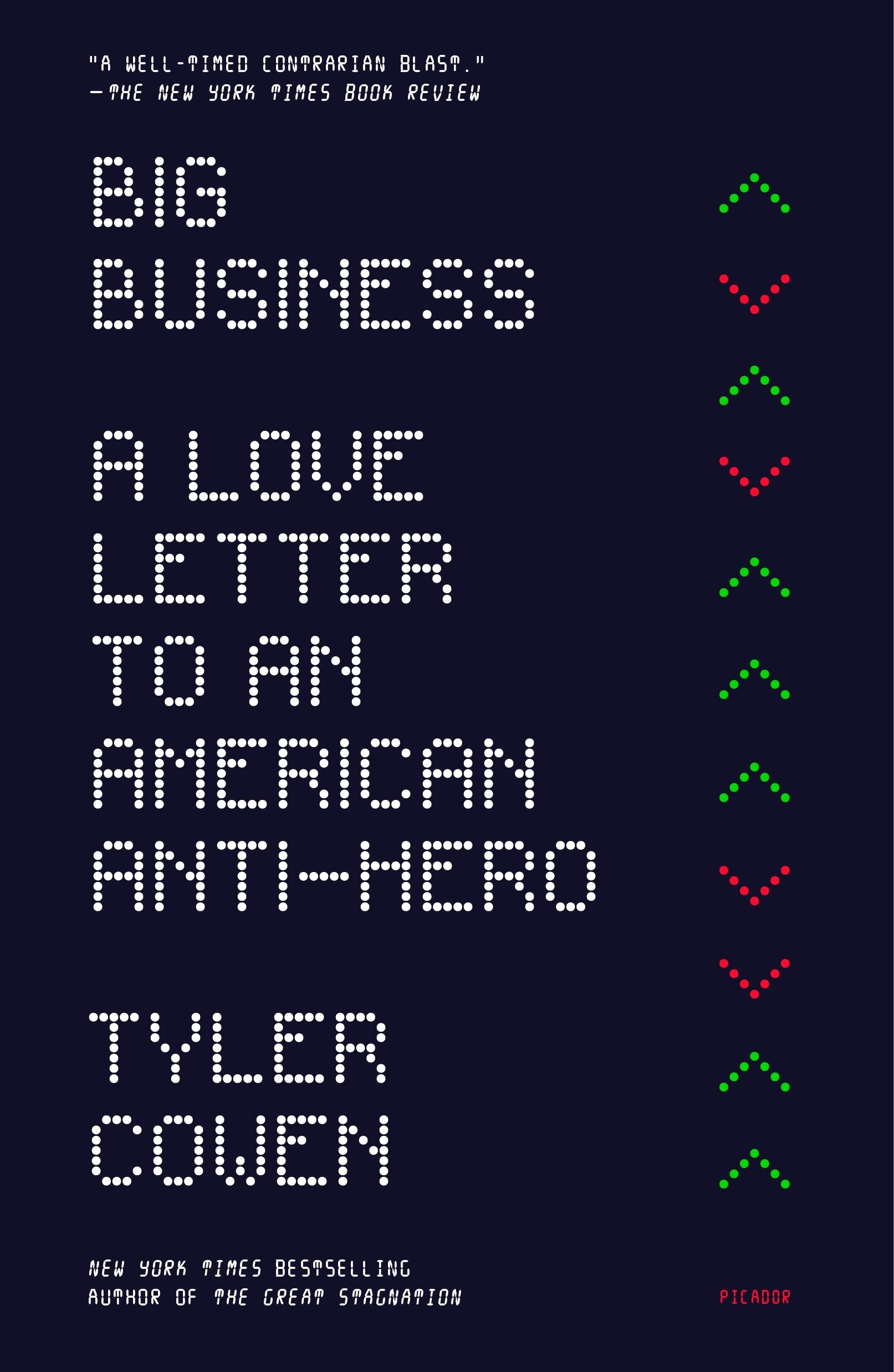
*Big Business: Love Letter to an American Anti-Hero*
The paperback edition is now out, you can order here through Amazon, here through Barnes & Noble.