The culture that is Disney? The culture that is GWU?
The George Washington University faculty and staff ain’t got no culture. Or worse, we’ve got a negative culture. This was the verdict of the Disney Institute, which the president of our university commissioned last year to assess the culture on our campus. Fortunately, the institute, which is the “professional development and external training arm of The Walt Disney Company,” has a remediation plan. It has designed workshops to teach us the cultural “values” and “service priorities” we evidently require….
Our president is rumored to have forked over three to four million dollars to the Disney Institute to improve our culture (he refuses to reveal the cost). A select group of faculty and staff, those identified as opinion leaders, are being offered all-expenses paid trips to the Walt Disney World Resort in Orlando “to gain first-hand insight into Disney’s approach to culture.” For everyone else, the university is conducting culture training workshops that run up to two hours. All staff and managers are required to attend. Faculty are strongly “encouraged” to participate, and some contract faculty, who have little job security, evidently have been compelled to do so.
I attended one of these workshops. It was a surreal experience. About a hundred mostly sullen university employees—maintenance workers, administrative staff, faculty members, and more—filled a ballroom. Two workshop leaders strained to gin up the crowd’s enthusiasm with various exhortations and exercises, supplemented by several slickly produced videos. The result was a cross between a pep rally and an indoctrination camp.
We were introduced at the beginning of the workshop to the university’s brand new slogan: “Only at GW, we change the world, one life at a time.”
Here is the full blog post from Dane Kennedy, faculty at GWU. Via Isaac C.
Reversing the STEM gender gap in Israel?
A new study compares Hebrew-speaking with some Arabic-speaking communities, here is the abstract:
In the past three decades in high‐income countries, female students have outperformed male students in most indicators of educational attainment. However, the underrepresentation of girls and women in science courses and careers, especially in physics, computer sciences, and engineering, remains persistent. What is often neglected by the vast existing literature is the role that schools, as social institutions, play in maintaining or eliminating such gender gaps. This explorative case study research compares two high schools in Israel: one Hebrew‐speaking state school that serves mostly middleclass students and exhibits a typical gender gap in physics and computer science; the other, an Arabic‐speaking state school located in a Bedouin town that serves mostly students from a lower socioeconomic background. In the Arabic‐speaking school over 50% of the students in the advanced physics and computer science classes are females. The study aims to explain this seemingly counterintuitive gender pattern with respect to participation in physics and computer science. A comparison of school policies regarding sorting and choice reveals that the two schools employ very different policies that might explain the different patterns of participation. The Hebrew‐speaking school prioritizes self‐fulfillment and “free‐choice,” while in the Arabic‐speaking school, staff are much more active in sorting and assigning students to different curricular programs. The qualitative analysis suggests that in the case of the Arabic‐speaking school the intersection between traditional and collectivist society and neoliberal pressures in the form of raising achievement benchmarks contributes to the reversal of the gender gap in physics and computer science courses.
The article is “Explaining a reverse gender gap in advanced physics and computer science course‐taking: An exploratory case study comparing Hebrew‐speaking and Arabic‐speaking high schools in Israel” by Halleli Pinson, Yariv Feniger, and Yael Barak.
Via the excellent Kevin Lewis.
Coronavirus markets in everything
Government officials across Hubei province, the epicenter of the coronavirus outbreak, are desperate to find ways to stop the spread of the infection.
In Hubei’s Fangxian County, officials are trying a different approach — paying sick people.
According to an official Fangxian County notice, anyone who is sick and reports themselves to a hospital can expect to be paid.
Patients who have a fever and turn themselves in will receive 1,000 yuan ($142).
But officials and other interested parties are also being offered cash incentives if they catch anyone with a fever. For each person with a fever who is reported by an official or citizen, there is a reward of 500 yuan ($71).
The notice said that the offer is only valid from today until February 18.
Here is the link (nothing extra there, except a noisy video and you have to scroll down a lot). Via Neville.
Poor Economics
In Delhi, street hawkers will sell food, flowers, and balloons to cars paused at an intersection and, sadly, small children will dance for alms. My favorites are the book hawkers. I suspect Banerjee and Duflo would approve of my choice of both title and seller. Good price also.
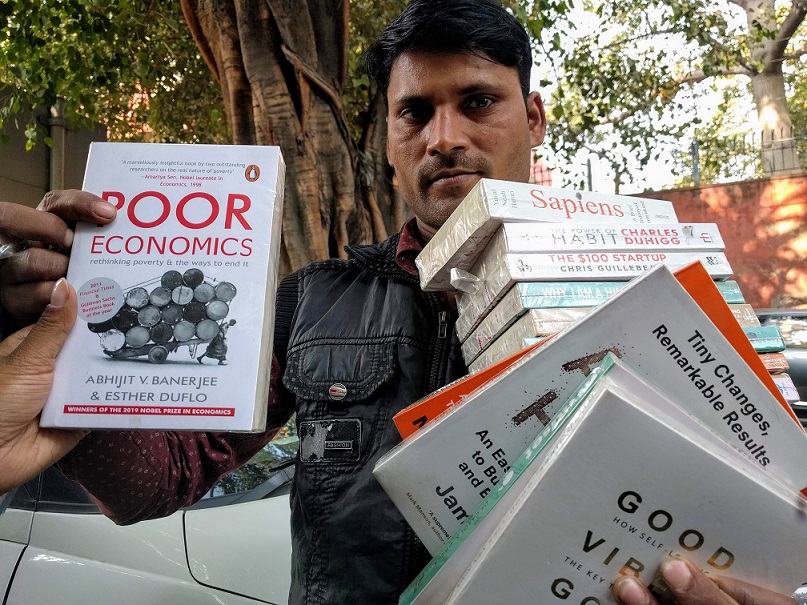
Sunday assorted links
10% *more* democracy?
John G. Matsusaka, in his new Princeton University Press book Let the People Rule: How Direct Democracy Can Meet the Populist Challenge, calls for the introduction of referenda at the national level in the United States. For instance he favors advisory referendums called by Congress, advisory referendums called by petition, advisory referendums required for specific issues, binding referendums for required issues, or called by petition, and constitutional amendments, proposed by petition (but not settled by a referendum itself). The United States in fact have never had a national referendum.
But do referenda defuse populist sentiment, or stoke it? Why is it that populism might be bad but referenda good? Don’t referenda give in to populism in some manner? Whether or not you favored Brexit as an outcome, was the process so smooth and wonderful? How much better could it have been? (the author does discuss this). Won’t money matter in politics more, and in the bad sense? Exactly which policy area would see superior concrete results through the use of national referenda? Won’t it mean we get madder at each other?
Switzerland aside, I am not convinced by the call for more referenda, but I am happy to see such fundamental questions raised anew.
The author lives in California.
What did Ireland just vote for?
Sinn Féin promises rent freezes and an expansion of public housing. It will tax corporations, particularly multinational companies. It offers a typical, left-of-centre shopping list, financed by borrowing and higher taxes on the rich.
And what about the IRA? In the past days, the connection between the IRA and Sinn Féin in the North has dominated headlines, but most voters in the Republic are weary of the past. One in four are prepared to give Sinn Féin a chance. It would be completely wrong to equate Sinn Féin’s votes with support for the IRA.
Here is more from the FT. There is close to a three-way tie at the top, but “31.8% of 18-24s voted Sinn Féin – more than FF and FG combined in that age group.” And: “According to the exit poll, Sinn Féin now the most popular party in every age group under 65.”
And that is from Ireland, one of the biggest neoliberal success stories. Martin Gurri something or other, yes, etc. yup, that’s right, Martin Gurri, etc.
Coronavirus multilateral insurance markets in everything
As financial markets fretted over the spread of a coronavirus outbreak in China this week, one security was in the firing line more directly than any other. Holders of the World Bank’s pandemic bond will lose principal if the disease spreads by a sufficient amount, writes Jasper Cox.
The World Bank’s pandemic bond, issued in 2017, provides funding for the development bank’s Pandemic Emergency Financing Facility (PEF) if an outbreak of one of six viruses meets certain conditions.
Here is the link (gated), here is a more detailed John Dizard FT story:
The event triggers were calculated on a complex formula based on deaths in the country of origin, a smaller number of deaths in neighbouring countries, and a relatively rapid increase in infection and mortality. Interest charges were assumed by rich-country donors including Germany and Japan. The riskier bonds pay 11.5 per cent over Libor, since they required only 250 deaths to reach the trigger. Not bad, considering the “expected loss” for the tranche was only 7.74 per cent. The less risky tranche required 2,500 deaths, so only paid 6.9 per cent over Libor, compared with an expected loss of 3.57 per cent.
Here is a pre-coronavirus discussion of the bonds, mostly with reference to Ebola.
Pollution in India and the World
 I spoke on the negative effects of air pollution on health and GDP at Brookings India in Delhi. The talk was covered by Indian media. The Print had a good overview:
The long-held belief that pollution is the cost a country has to pay for development is no longer true as bad air quality has a measurable detrimental impact on human productivity that could in turn reduce GDP, Canadian-American economist Alex Tabarrok said.
…“There is this old story that pollution is bad, but it increases GDP… When the United States and Japan were developing, they were polluted. So India and China also have to go through that stage of pollution — so that they get rich, and then they can afford to reduce pollution,” Tabarrok said.
“I want to say that that story is wrong. What I want to argue is that a lot of the new research indicates that we may be in a situation where we could be both healthier and wealthier at the same time by reducing pollution,” he said.
…At the seminar, Tabarrok pointed out that expecting people to make sacrifices for the sake of future generations is not a politically fruitful way to deal with pollution.
Citing the issue of crop burning in India, he said farmers are not going to be inclined to change their behaviour if they are told to stop stubble burning for the sake of Delhi residents.
“However, if these farmers are made aware of how the crop burning harms them and their families and affects their soil quality, they are more likely to participate in mitigation measures,” he said.
I was pretty tough on government policy as Business Today India reported:
More than half of India’s population lives in highly polluted areas. Research by Greenstone et al (2015) proves that 660 million people live in areas that exceed the Indian Ambient Air Quality Standard (NAAQS) for fine particulate pollution. In this context, having measures such as banning e-cigarettes and having odd-even days for vehicles to solve the problem of air pollution seems ridiculous, says Alex Tabarrok, Professor of Economics at the George Mason University and Research Fellow with the Mercatus Centre. “These are not appropriate solutions to the scale and the dimensions of the problem,” he says.
Saturday assorted links
1. MIE: have someone buy a car for you.
2. Ross Douthat on decadence (a window into his new book, NYT).
3. On some Islamic views of speech.
4. Michael Kimmelman on the war against architectural diversity (NYT).
Cruise ship markets in everything
As the ongoing coronavirus epidemic disrupts cruise operations throughout Asia, Lindblad Expeditions, the cruise operator for National Geographic Expeditions, announced Thursday that it has become “the first self-disenfecting fleet in the cruise industry.”
The company has implemented a disinfectant coating solution developed by Danish company ACT.Global, which uses the photocatalytic properties of titanium dioxide to generate free radicals from airborne water molecules. When exposed to light, the coating converts airborne H20 into OH- ions, which break down bacteria, viruses, mold, airborne allergens and volatile organic compounds (VOCs). The coating can be applied to all surfaces to give them self-disinfecting qualities, including food-contact surfaces.
According to Lindblad, ACT.Global’s coating creates a cleaner, healthier ship while reducing impact on the environment. The antibacterial spray is transparent and odorless, and it purifies and deodorizes the air for up to one year.
Here is the full story, via Anecdotal.
A simple argument for state capacity libertarianism
Again and again—and in countries all over the world—declines in trust of government correlate strongly with calls for more government regulation in more parts of our lives. “Individuals in low-trust countries want more government intervention even though they know the government is corrupt,” explain the authors of a 2010 Quarterly Journal of Economics paper. That’s certainly the case in the United States, where the size, scope, and spending of government has vastly increased over exactly the same period in which trust and confidence in the government has cratered. In 2018, I talked with one of the paper’s authors, Andrei Shleifer, a Harvard economist who grew up in the Soviet Union before coming to America. Why do citizens ask a government they don’t believe in to bring order? “They want regulation,” he said. “They want a dictator who will bring back order.”
Counterintuitively, the relative size and spending of government in the United States actually flattened or dipped during periods when trust and confidence in government picked up…
That is Nick Gillespie, via Arnold Kling.
Friday assorted links
1. Does the quality of blog comments deteriorate? (MR post from 2008)
2. Is local news really dying?
3. America’s favorite architecture?
4. Africa has 1.2 billion people and only six labs that can test for coronavirus. And “We find that expansions of transportation networks have significant health costs in increasing the spread of viruses, and that propagation rates are pro-cyclically sensitive to economic conditions and increase with inter-regional trade.”
5. Vulnerability to disgust does not predict social conservatism very well.
*Seven Worlds, One Planet*
That is the new David Attenborough BBC nature show, available on streaming or buy the discs from the UK. Believe it or not it has better footage than the earlier BBC nature shows, while remaining inside the basic template of what such shows attempt to accomplish. Here is a very good Guardian review. Here is a somewhat snotty NYT review, bemoaning Attenborough’s tone of “polite optimism.” Strongly recommended.
U.S. nurse conservation fact of the day
In the period 2010–17 the number of NPs in the US more than doubled from approximately 91,000 to 190,000. This growth occurred in every US region and was driven by the rapid expansion of education programs that attracted nurses in the Millennial generation. Employment was concentrated in hospitals, physician offices, and outpatient care centers, and inflation-adjusted earnings grew by 5.5 percent over this period. The pronounced growth in the number of NPs has reduced the size of the registered nurse (RN) workforce by up to 80,000 nationwide.
Here is the underlying research, via the excellent Kevin Lewis. Given the growth of the health care sector, should not the number of nurses, broadly construed, be rising at a higher rate?
Via the excellent Kevin Lewis.