The best argument for the gold standard
No, I do not favor a gold standard, for reasons explained in this Bloomberg column. Still, it is sad/funny to watch the mood affiliation circus of those trying to suggest, in more or less the same breath, that Trump’s Fed picks are dangerous and terrible, and also that the gold standard is the worst idea ever. Here is one point of mine:
Historical data indicates that industrial production volatility was not higher before 1914, when the U.S. was on the gold standard, compared to after 1947, when it mostly wasn’t. And there are similar results for the volatility of unemployment. That’s not quite an argument for the gold standard, but it should cause opponents of the gold standard to think twice. Whatever the imperfections of a gold standard might be, monetary authorities make a lot of mistakes, too.
And here is the closer:
Most generally, I still think central bank governance can do a better job than a gold-based system that sometimes creates excess deflationary pressures.
Nonetheless, the contemporary world is always testing my belief in central banking. Exactly how will matters unfold when so many world leaders are not behaving as responsibly as they should? Might that irresponsibility seep into monetary policy? After all, populations are aging and debt is accumulating. Surely it is reasonable to worry that some of these governments will seek to monetize their debts and move toward excessively easy money.
Oh, but wait — I forgot one big new argument in favor of a gold standard: President Trump himself. Perhaps his management of central bank affairs is somewhat … erratic? Might it not be a good idea to have the operation of monetary policy protected by a greater reliance on rules? My personal preference is for a nominal GDP rule, but the irony is this: At the end of the day, the advocates of the gold standard, and their possible presence on the Federal Reserve Board, are themselves the best argument for … the gold standard.
Interesting throughout.
Tuesday assorted links
1. Will space colonization be fully automated?
3. Earlier 20th century criticisms of the Electoral College, maybe not what you think.
4. “Two-thirds of roads in Sweden are privately operated and managed by local Private Road Associations (PRAs).” Link here.
5. High-speed rail Addis Ababa to Djibouti (NYT, recommended).
Wall Street Journal reviews *Big Business*
By George Melloan, here is one bit:
So Mr. Cowen’s book is timely, and his writing style is a refreshing contrast to the strident left-wing declamations that are so common today. He is calm and conversational, splashing cool water on the firebrands. He writes: “All of the criticisms one might mount against the corporate form—some of which are valid—pale in contrast to two straightforward and indeed essential virtues. First, business makes most of the stuff we enjoy and consume. Second, business is what gives most of us jobs. The two words that follow most immediately from the world of business are ‘prosperity’ and ‘opportunity.’”
Here is the full review, very well done in my admittedly biased view.
Better Police, Less Crime in Camden, NJ
Camden NJ has thrice been named the most dangerous city in America. Camden suffered not only from high crime but from poor policing under a rigid union contract. Jim Epstein described the situation in 2014:
Camden’s old city-run police force abused its power and abrogated its duties. It took Camden cops one hour on average to respond to 911 calls, or more than six times the national average. They didn’t show up for work 30 percent of the time, and an inordinate number of Camden police were working desk jobs. A union contract required the city to entice officers with extra pay to get them to accept crime-fighting shifts outside regular business hours. Last year, the city paid $3.5 million in damages to 88 citizens who saw their convictions overturned because of planted evidence, fabricated reports, and other forms of police misconduct.
In 2012, the murder rate in Camden was about five times that of neighboring Philadelphia—and about 18 times the murder rate in New York City.
In May of 2013, however, the entire police department was disbanded nullifying the union contract and an entirely new county police department was put into place.
The old city-run force was rife with cops working desk jobs, which Cordero saw as a waste of money and manpower. He and Thomson hired civilians to replace them and put all uniformed officers on crime fighting duty. Boogaard says she didn’t see a single cop during the first year she lived in the city. “Now I see them all the time and they make friendly conversation.” Pastor Merrill says the old city-run force gave off a “disgruntled” air, and the morale of Metro police is noticeably better. “I want my police to be happy,” he says.
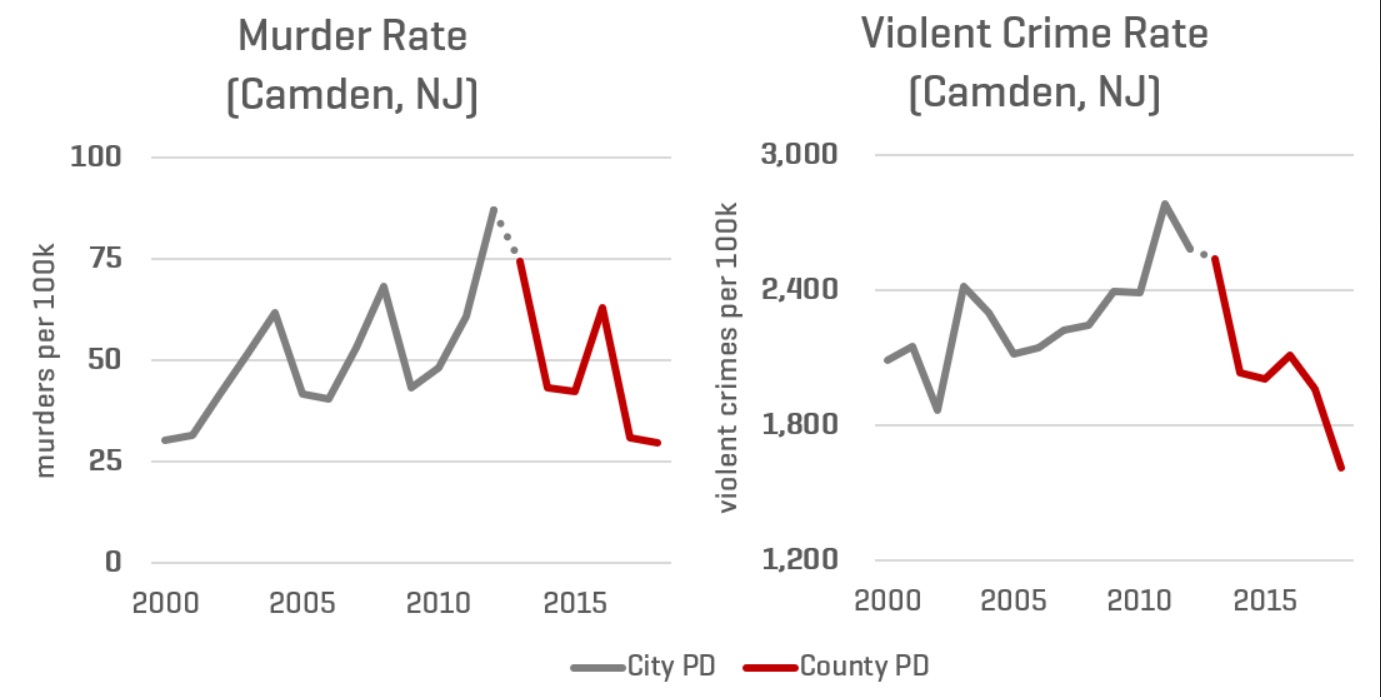
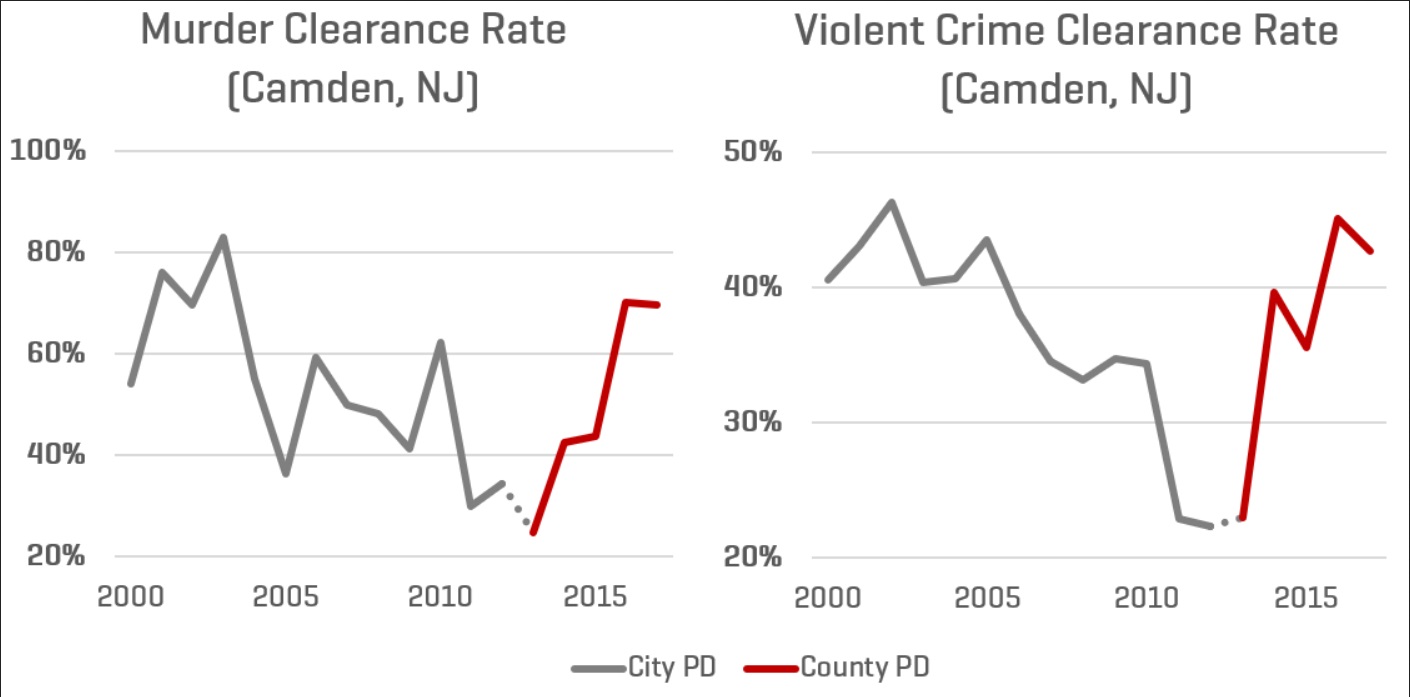
Without the expensive union contracts the new force added officers and also introduced more technology such as Shotspotter. So what has been the result? Violent crime is down and clearances are up (charts from Daniel Bier, who also notes that the fall in violent crime and increase in convictions far exceed that in comparison to New Jersey more generally or Philadelphia.)
As I have long argued, we need more police and better policing in America.
Genes, income, and happiness
Significant differences between genetic correlations indicated that, the genetic variants associated with income are related to better mental health than those linked to educational attainment (another commonly-used marker of SEP). Finally, we were able to predict 2.5% of income differences using genetic data alone in an independent sample. These results are important for understanding the observed socioeconomic inequalities in Great Britain today.
That is from a new paper by W. David Hill, et.al. And from Abdel Abdellouai’s summary:
Educational attainment shows a larger genetic overlap with subjective wellbeing than IQ does (rgs = .11 & .03, respectively), while income shows a larger genetic overlap with subjective wellbeing than both education or IQ (rg = .32).
All via Richard Harper.
Monday assorted links
Using Nature to Understand Nurture
An excellent new working paper uses genetic markers for educational attainment to track students through the 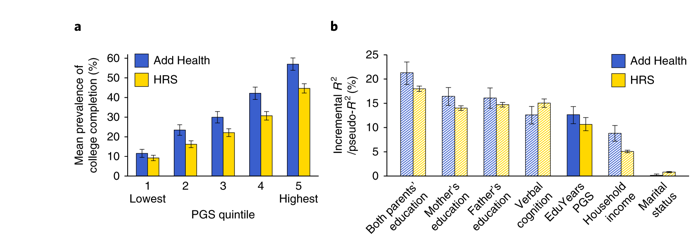 high school math curriculum to better understand the role of nature, nurture and their interaction in math attainment. The paper begins with an earlier genome wide association study (GWAS) of 1.1 million people that found that a polygenic score could be used to (modestly) predict college completion rates. Panel (a) in the figure at right shows how college completion is five times higher in individuals with an education polygenic score (ed-PGS) in the highest quintile compared to individuals with scores in the lowest quintile; panel b shows that ed-PGS is at least as good as household income at predicting college attainment but not quite as good as knowing the educational level of the parents.
Of the million plus individuals with ed-PGS, some 3,635 came from European-heritage individuals who were entering US high school students in 1994-1995 (the Add Health sample). Harden, Domingue et al. take the ed-PGS of these individuals and match them up with data from their high school curricula and their student transcripts.
What they find is math attainment is a combination of nature and nurture. First, students with higher ed-PGS are more likely to be tracked into advanced math classes beginning in grade 9. (Higher ed-PGS scores are also associated with higher socio-economic status families and schools but these differences persist even after controlling for family and school SES or looking only at variation within schools.) Higher ed-PGS also predicts math persistence in the following years. The following diagram tracks high ed-PGS (blue) with lower ed-PGS (brown) over high school curricula/years and post high-school. Note that by grade 9 there is substantial tracking and some cross-over but mostly (it appears to me) in high-PGS students who fall off-track (note in particular the big drop off of blue students from Pre-Calculus to None in Grade 12).

Nature, however, is modified by nurture. “Students had higher returns to their genetic propensities for educational attainment in higher-status schools.” Higher ed-PGS students in lower SES schools were less likely to be tracked into higher-math classes and lower-SES students were less likely to persist in such classes.
It would be a mistake, however, to conclude that higher-SES schools are uniformly better without understanding the tradoffs. Lower SES schools have fewer high-ability students which makes it difficult to run advanced math classes. Perhaps the lesson here is that bigger schools are better, particularly bigger schools in poorer SES districts. A big school in a low SES district can still afford an advanced math curriculum.
The authors also suggest that more students could take advanced math classes. Even among the top 2% of students as measured by ed-PGS only 31% took Calculus in the high-SES schools and only 24% in the low SES schools.It’s not clear to me, however, that high-PGS necessitates high math achievement. Notice that many high-PGS students take pre-calc in Grade 11 but then no math in Grade 12 but they still go on to college and masters degrees. Lots of highly educated people are not highly-educated in math. Still it wouldn’t be a surprise if there were more math talent in the pool.
There is plenty to criticize in the paper. The measure of SES status by school (average mother’s educational attainment) leaves something to be desired. Moreover, there are indirect genetic effects, which the authors understand and discuss but don’t have the data to test. An indirect genetic effect occurs when a gene shared by parent and child has no direct effect on educational capacity (i.e. it’s not a gene for say neuronal development) but has an indirect “effect” because it is correlated with something that parent’s with that gene do to modify the environment of their children. Nevertheless, genes do have direct effects and this paper forces us to acknowledge that behavioral genetics has implications for policy.
Should every student be genotyped and tracked? On the one hand, that sounds horrible. On the other hand, it would identify more students of high ability, especially from low SES backgrounds. Genetics tells us something about a student’s potential and shouldn’t we try to maximize potential?
For homework, work out the equilibrium for inequality, rewatch the criminally underrated GATTACA and for an even more horrifying picture of the future, pay careful attention to the Mirrlees model of optimal income taxation.
Bryan Caplan *Open Borders* launch day
From Bryan:
Dear friends: Monday, April 8 isn’t just my birthday. It’s also the official launch date for *Open Borders*!
URL for ordering the book: https://www.amazon.com/gp/product/1250316960/ref=as_li_tl?ie=UTF8&camp=1789&creative=9325&creativeASIN=1250316960&linkCode=as2&tag=bryacaplwebp-20&linkId=1ed2cdfe4a1c0cd2a62e942a39f87b9d
URL for an introductory post on the book: https://www.econlib.org/pre-order-open-borders-the-science-and-ethics-of-immigration/
U.S.A. fact of the day, *Jump-Starting America*
The United States, as of 2014, spends 160 times as much exploring space as it does exploring the oceans.
That is from the new and interesting Jump-Starting America: How Breakthrough Science Can Revive Economic Growth and the American Dream, by Jonathan Gruber and Simon Johnson, two very eminent economists. And if you are wondering, I believe those numbers are referring to government efforts, not the private sector. I am myself much more optimistic about the economic prospects for the oceans than for outer space.
Most of all this book is a plea for radically expanded government research and development, and a return to “big science” projects.
Overall, books on this topic tend to be cliche-ridden paperweights, but I found enough substance in this one to keep me interested. I do, however, have two complaints. First, the book promotes a “side tune” of a naive regionalism: “here are all the areas that could be brought back by science subsidies.” Well, maybe, but it isn’t demonstrated that such areas could be brought back in general, as opposed to reshuffling funds and resources, and besides isn’t that a separate book topic anyway? Second, too often the book accepts the conventional wisdom about too many topics. Was the decline of science funding really just a matter of will? Is it not at least possible that federal funding of science fell because the return to science fell? Curing cancer seems to be really hard. Furthermore, some of the underlying problems are institutional: how do we undo the bureaucratization of society so that the social returns to science can rise higher again? Will a big government money-throwing program achieve that end? Maybe, but the answers on that one are far from obvious. This is too much a book of levers — money levers at that — rather than a book on complex systems. I would prefer a real discussion of how today science has somehow become culturally weird, compared say to Mr. Spock and The Professor on Gilligan’s Island. The grants keep on going to older and older people, and we are throwing more and more inputs at problems to get at best diminishing returns. Help!
Still, I read the whole thing through with great interest, and it covers some of the very most important topics.
Sunday assorted links
U.S.A. fact of the day
As President Trump threatened to shut down the U.S.-Mexico border in recent days, his Department of Homeland Security nearly doubled the number of temporary guest worker visas available this summer.
The Homeland Security and Labor departments plan to grant an additional 30,000 H-2B visas this summer on top of the 33,000 they had already planned to give out, the agencies confirmed.
The H-2B visa allows foreign workers to come to the United States legally and work for several months at companies such as landscapers, amusement parks or hotels. About 80 percent of these visas went to people from Mexico and Central America last year, government data shows…
With the additional visas, the Trump administration is on track to grant 96,000 H-2B visas this fiscal year, the most since 2007, when George W. Bush was president.
Here is more by Heather Long at WaPo, via Anecdotal.
What should I ask Ezekiel J. Emanuel?
I will be doing a Conversations with Tyler with him, no associated public event. So what should I ask him? Here is his Wikipedia page.
Why is insulin so expensive?
Why aren’t we seeing more companies making insulin? There are many reasons for this, but patent evergreening is a big one. Patents give a person or organization a monopoly on a particular invention for a specific period of time. In the USA, it is generally 20 years. Humalog, Lantus and other previous generation insulins are now off patent, as are even older animal based insulins. So what’s going on? Pharmaceutical companies take advantage of loopholes in the U.S. patent system to build thickets of patents around their drugs which will make them last much longer (evergreening). This prevents competition and can keep prices high for decades. Our friends at I-MAK recently showed that Sanofi, the maker of Lantus, is no exception. Sanofi has filed 74 patent applications on Lantus alone, that means Sanofi has created the potential for a competition-free monopoly for 37 years.
More here, and yes there are a multiple of reasons, not just that one. Such as this:
… it is actually legal for one insulin producer to pay another one not to enter the market. A few years ago the company Merck announced plans to sell a biosimilar version of Sanofi’s Lantus. Sanofi sued, and eventually Merck announced that it was no longer pursuing it’s biosimilar, presumably due to payments from Sanofi to stay away.
Here is another relevant source. And this:
…Sanofi has filed lawsuits against both Merck and Mylan to prevent them from going to market with a generic lantus insulin (the Sanofi blockbuster drug).
Here is Vox coverage. Furthermore, fewer restrictions on foreign importation could solve much of the problem:
According to the Food and Drug Administration, “in most circumstances, it is illegal for individuals to import drugs into the United States for personal use.”
New bills by Peter Welch, Elijah Cummings, and Bernie Sanders would ease those restraints. It seems easy enough to address this problem without having systematic government purchases of pharmaceuticals. Insulin prices have risen as much as threefold over the last ten years, but that doesn’t have to be the case.
Saturday assorted links
1. The productivity slowdown was Transatlantic.
2. Dominic Cummings splat starts with Soviets ends with drones.
3. The agency fight, explained (NYT).
4. Robin Hanson on trusting big business.
5. Cats know their name, but don’t really care.
6. Vitalik Buterin on collusion.
7. Good pro-Fortnite piece, mentions in passing that Fortnite is another social network competing with Facebook (NYT).
How much would a wealth tax raise?
From Larry Summers and Natasha Sarin:
We reasoned as follows: The existing estate tax is a wealth tax levied at the time of death. If 2 percent of wealthy families experience a death and intergenerational transfer (rather than a spousal transfer) each year, then the current 40 percent estate tax should roughly be the equivalent of a wealth tax of 40 percent multiplied by 2 percent — or a 0.8 percent wealth tax — assuming equivalent definitions of wealth and the same threshold for taxation. Since most wealth is held by fairly elderly people, and the mortality rate of 70-year-olds is above 2 percent, we suspect that 2 percent mortality is a conservative estimate. So the actual wealth-tax equivalent of the estate tax is likely greater than 0.8 percent.
The IRS reports that for 2017, the most recent year for which data is available, the estate tax raised around $10 billion from estates over $50 million — and this included tax collected on the first $50 million of estate tax value, so it overestimates the conceptually appropriate figure. Therefore, if this is what the revenue yield would be from a 0.8 percent wealth tax, the implication is that a 2 percent wealth tax would raise a total of $25 billion. That’s around one-eighth of the Saez and Zucman estimate.
There is much more of interest at the link.