Raising the status of Chow Yun Fat
He is one of my favorite actors, so I was pleased to read this:
Chow Yun Fat plans to give his entire net worth of $714m to charity.
As reported by Jayne Stars, Hong Kong movie legend Chow Yun Fat will give his entire net worth of $5.6 billion HKD ($714m USD) to charity.
Despite his gargantuan wealth, Fat remains rather frugal. Only spending $800 HKD ($1o2 USD) per month, Fat is often seen taking public transport and doing charity work.
He used his first Nokia phone for over 17 years, only switching to a smartphone two years ago. Fat is known for shopping at discount stores. “I don’t wear clothes for other people. As long as I think it’s comfortable, then it’s good enough for me,” he said.
Fat often spends his free time hiking and jogging, instead of splashing out.
Here is the full story, via the excellent Benjamin Copan. And if you don’t know his performances in The Killer, a John Woo film, now is the time to check it out.
What should I ask Daniel Kahneman?
I will be having a Conversation with him on November 12, unfortunately the GMU event is already sold out. In the meantime, what do you suggest? What should I ask him?
That was then, this is now
A Cincinnati newspaper printed a malevolent editorial proclaiming that [Andrew] Jackson’s mother was a common prostitute brought to this country by British soldiers. thereupon she married a mulatto man with whom she had several children, among them Andrew Jackson. Apprised of this far-fetched, scandalous tale, [John Quincy] Adams thought it absurd, but cynically went on to comment that even if proved true it would probably not hurt Jackson. The course of the campaign seemed to substantiate all Adams’s apprehensions that fervent partisanship was demolishing reasonableness, a slugfest of calumny and lies replacing political civility. Vice was triumphing over virtue. And the cynicism expressed in his reaction to the malignant piece regarding Jackson’s mother and his birth signaled that he had begun to doubt the probity of the republic and its citizens.
That is from the very good book by William J. Cooper, The Lost Founding Father: John Quincy Adams and the Transformation of American Politics.
On hitchhiking, circa 1969, from the comments
I hitchhiked across the U.S. twice in 1969. Here’s what my 18-year-old white, male, hippie self learned:
1. Expect to get picked up and propositioned by homosexuals.
2. Everybody is really interested in drugs and wants to get their hands on some.
3. Drugs quickly went from being the pastime of a small, hip elite, to becoming the obsession of trashy, low-class types.
4. Cowboys or anyone who identified with them wants to kill hippies.
5. Mexicans want to kill hippies.
6. It’s possible to sleep in an empty lot in Seattle or Portland, but in L.A., you will be harassed.
6. Panhandling is the world’s most humiliating activity.
7. Day labor is shockingly arduous.
8. America’s roadsides are a continuous scroll of accidental beauty, dramatic vignettes, and surreal occurrences.
9. Even a single night in a small town jail is awful enough to dissuade any sane person from ever committing or coming close to committing an imprisonable offense.
10. Jesus communes and Hare Krishna people will take you in and feed you when no one else will. But they have their own problems.
11. Iowa is surprisingly beautiful.
12. We thought because we all had long hair, we were all on the same wavelength – we weren’t.
12. There are lots of smart, interesting normal people out there, and from them you learn that the best thing in life is to follow the straight and narrow, observe social conventions, work a steady job, and avoid extremes.
That is from Faze.
Words of wisdom
Lant Pritchett’s new working paper, “Alleviating Global Poverty: Labor Mobility, Direct Assistance, and Economic Growth” should be required reading for every Effective Altruist. Bottom line: Virtually all poverty reduction comes from economic growth and migration – not redistribution or philanthropy.
That is from Bryan Caplan.
Wednesday assorted links
Convergence, Big Time
In his influential 1997 paper, Divergence, Big Time, Lant Pritchett estimated:
…that from 1870 to 1990 the ratio of per capita incomes between the richest and the poorest countries increased by roughly a factor of five and that the difference in income between the richest country and all others has increased by an order of magnitude.
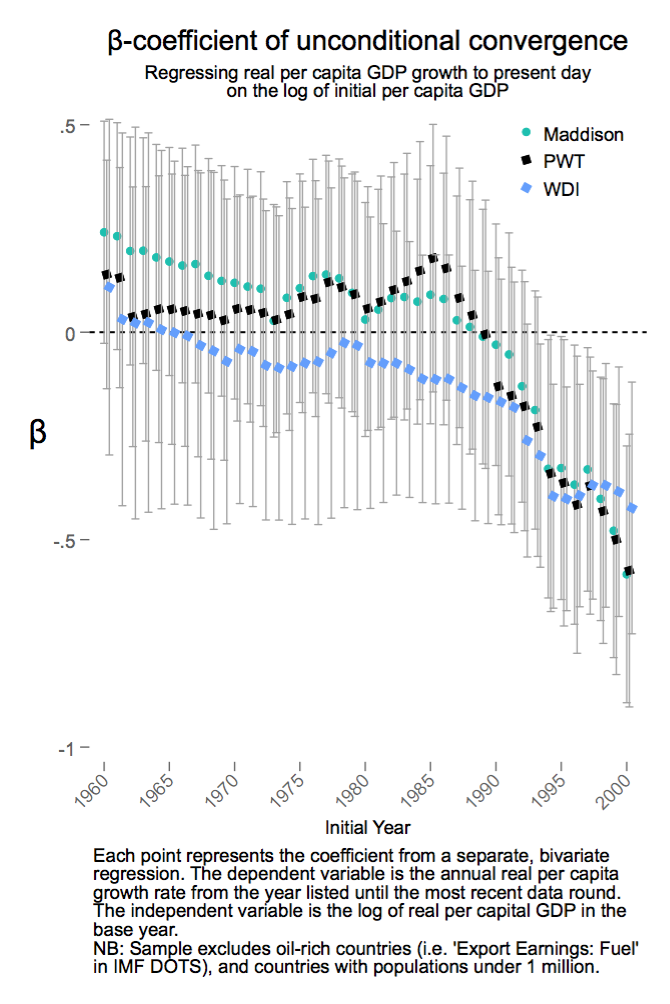
Pritchett was correct but Patel, Sandeful and Subramanian show that just where Pritchett’s study ended, convergence began!
While unconditional convergence was singularly absent in the past, there has been unconditional convergence, beginning (weakly) around 1990 and emphatically for the last two decades.
The figure above plots the coefficient (“beta”) from the plain vanilla unconditional convergence regression (relating average growth of real per capita GDP over the long run to its initial level). A statistically significant negative beta denotes convergence and divergence otherwise. Since we know from Johnson et al. (2013) that growth rates vary widely across datasets, we plot the annual betas for three such sets: the Penn World Tables (PWT), the World Development Indicators, and the Maddison Project (Bolt et al. 2014).[1] While the point estimates vary across datasets, the consistent pattern across them all is a statistically significant negative beta since around 1995 (unconditional convergence) and its lack prior to that (see also Roy, Kessler and Subramanian, 2016).
Our basic point doesn’t require regressions. Looking at the 43 countries the World Bank classified as “low income” in 1990, 65 percent have grown faster than the high-income average since 1990. The same is true for 82 percent of the 62 middle-income countries circa 1990.
Neo-liberalism has been incredibly successful, essentially delivering on all of its promises of economic growth, declines in poverty, and peace. Yet, the ideas behind what Andrei Shleifer called The Age of Milton Friedman are now under attack and in retreat.
Why intellectuals should not be afraid to like sports
That is the topic of my latest Bloomberg column, with a focus on the NBA. Here is one excerpt:
Earlier three-point innovators were called crazy, and maybe they were. The Phoenix Suns tried a fast-break, three-point offense from 2004 to 2010, and they didn’t break through with it. It was persistent foreign competition that finally drove the three points home, when European and other foreign teams, which tended to take more three-point shots, did surprisingly well against U.S. teams in the Olympics. Basketball thus teaches that innovation is not automatic, and it often pays to look abroad for inspiration, even if you are the top performer at any particular moment.
In addition to being a good default conversation topic, sports also keep us in touch with strands of American life that many of us may not encounter otherwise. Following basketball gives me new entry points into rap music, sneaker contracts, college athletics, gifs, the economics of television, even Twitter; it also helped me diagnose an injury a few years ago, when I pulled both of my rotator cuffs and knew immediately how to deal with it. A lot of the American debate over race, and over protest and proper public behavior, has played out through the medium of sports.
By the way, I have no forecasts for the NBA this year other than the trivial. As for the Lakers and LBJ, I suppose I pick them to come in seventh or so, but to go down in the first round of the playoffs.
Does law and economics matter?
This paper provides a quantitative analysis of the effects of the law and economics movement on the U.S. judiciary. Using the universe of published opinions in U.S. Circuit Courts and 1 million District Court criminal sentencing decisions linked to judge identity, we estimate the effect of attendance in the controversial Manne economics training program, an intensive two-week course attended by almost half of federal judges. After attending economics training, participating judges use more economics language, render more conservative verdicts in economics cases, rule against regulatory agencies more often, and render longer criminal sentences. These results are robust to adjusting for a wide variety of covariates that predict the timing of attendance. Comparing non-Manne and Manne judges prior to program start and exploiting variation in instructors further assuage selection concerns. Non-Manne judges randomly exposed to Manne peers on previous cases increase their use of economics language in subsequent opinions, suggesting economic ideas diffused throughout the judiciary. Variation in topic ordering finds that economic ideas were portable from regulatory to criminal cases.
That is from Elliott Ash, Daniel L. Chen, and Suresh Naidu, via Rethinking Economics and also S.
Tuesday assorted links
1. Twenty questions with Chris Kraus.
3. Me on NPR on Planet Money, including on Stubborn Attachments.
4. Are China’s provincial boundaries misaligned?
Robert Wiblin’s Conversation with Tyler Cowen
This was two and a half hours (!), and it is a special bonus episode in Conversations in Tyler, here is the text and audio. The starting base of the discussion was my new, just today published book Stubborn Attachments: A Vision of a Society of Free, Prosperous, and Responsible Individuals, but of course we ranged far and wide. Here are a few excerpts:
WIBLIN: Speaking of Tetlock, are there any really important questions in economics or social science that . . . What would be your top three questions that you’d love to see get more attention?
COWEN: Well, what’s the single question is hard to say. But in general, the role of what is sometimes called culture. What is culture? How does environment matter? I’m sure you know the twin studies where you have identical twins separated at birth, and they grow up in two separate environments and they seem to turn out more or less the same. That’s suggesting some kinds of environmental differences don’t matter.
But then if you simply look at different countries, people who grow up, say, in Croatia compared to people who grow up in Sweden — they have quite different norms, attitudes, practices. So when you’re controlling the environment that much, surrounding culture matters a great deal. So what are the margins where it matters and doesn’t? What are the mechanisms? That, to me, is one important question.
A question that will become increasingly important is why do face-to-face interactions matter? Why don’t we only interact with people online? Teach them online, have them work for us online. Seems that doesn’t work. You need to meet people.
But what is it? Is it the ability to kind of look them square in the eye in meet space? Is it that you have your peripheral vision picking up other things they do? Is it that subconsciously somehow you’re smelling them or taking in some other kind of input?
What’s really special about face-to-face? How can we measure it? How can we try to recreate that through AR or VR? I think that’s a big frontier question right now. It’d help us boost productivity a lot.
Those would be two examples of issues I think about.
And this:
COWEN: I think most people are actually pretty good at knowing their weaknesses. They’re often not very good at knowing their talents and strengths. And I include highly successful people. You ask them to account for their success, and they’ll resort to a bunch of cliches, which are probably true, but not really getting at exactly what they are good at.
If I ask you, “Robert Wiblin, what exactly are you good at?” I suspect your answer isn’t good enough. So just figuring that out and investing more in friends, support network, peers who can help you realize that vision, people still don’t do enough of that.
And:
COWEN: But you might be more robust. So the old story is two polarities of power versus many, and then the two looks pretty stable, right? Deterrents. USA, USSR.
But if it’s three compared to a world with many centers of power, I don’t know that three is very stable. Didn’t Sartre say, “Three people is hell”? Or seven — is seven a stable number? We don’t know very much. So it could just be once you get out of two-party stability, you want a certain flattening.
And maybe some parts of the world will have conflicts that are undesirable. But nonetheless, by having the major powers keep their distance, that’s better, maybe.
Recommended!
The Big Push Failed
In 2004, Jeff Sachs and co-authors revived an old theory to explain Africa’s failure to develop, the poverty trap, and an old solution, the big push.
Our explanation is that tropical Africa, even the well-governed parts, is stuck in a poverty trap, too poor to achieve robust, high levels of economic growth and, in many places, simply too poor to grow at all. More policy or governance reform, by itself, will not be sufficient to over-come this trap. Specifically, Africa’s extreme poverty leads to low national saving rates, which in turn lead to low or negative economic growth rates. Low domestic saving is not offset by large inflows of private foreign capital, for example foreign direct investment, because Africa’s poor infrastructure and weak human capital discourage such inflows. With very low domestic saving and low rates of market-based foreign capital inflows, there is little in Africa’s current dynamics that promotes an escape from poverty. Something new is needed.
We argue that what is needed is a “big push” in public investments to produce a rapid “step” increase in Africa’s underlying productivity, both rural and urban.

As the title of the blog might suggest, I was skeptical. But even if a big push wasn’t exactly the right idea, I’m all in favor of Big Ideas and Sachs pursued his Big Idea with tremendous skill and media savvy. Pilot programs were soon up and running and then quickly expanded into full programs. In June 2010, the Millennium Villages Project released its first public evaluation and that is when things started to fall apart.
The initial MVP evaluation claimed great success but simply compared some development indicators before and after in the treated villages without comparing to trends elsewhere. In 2010 such a study was completely out of step with contemporary practices in impact evaluation. Red flag! Clemens and Demombynes showed that comparing to trends elsewhere significantly moderated the impact. A second MVP paper was published in the Lancet but then was quickly retracted when Bump, Clemens, Demombynes and Haddad demonstrated that it had significant errors. Clemens and Demombynes wrote a summary piece on the controversy then in an astounding and under-reported scandal the MVP tried to stifle Clemens and Demombynes. The MVP, with Jeff Sachs at the head, also sicced their lawyers on Nina Munk and her book, The Idealist: Jeffrey Sachs and the Quest to End Poverty. More red flags.
Yet, despite all of this controversy and bad behavior, the MVP project continued to move ahead and in 2012, the UK Department for International Development (DFID) funded US $11 million into an MVP in Northern Ghana that ran until December 2016. Under the auspices of the DFID, we now finally have the first in-depth, independent evaluation of one MVP project and it doesn’t look great. The project did some good but the big push failed and the good that was done could have been done at lower cost.
Overall, the MVP in northern Ghana did not achieve the overall MDG target to reduce extreme poverty and hunger at the local level. Where there are attributable changes to the MDG targets, these tended to be the more limited changes than those that will fundamentally improve people’s health, educational and other outcomes. For instance, the project did increase attendance at primary school (Goal 2) but did not go beyond this MDG and improve the learning outcomes of children; the project did increase the proportion of births attended by professionals and women said to be using contraceptive methods (MDG indicators), but it is not possible to assess the effect on maternal health (Goal 5); and the project did increase the number of toilets (a target under Goal 7), but not beyond this MDG in terms of hygiene and sanitation practices. There are, however, exceptions. The project had a remarkable impact on stunting, which is a long-term health indicator and a predictor of socioeconomic outcomes in adulthood.
So the MVP had some good effects on some indicators:
But is this impact sufficient given the size of the investment? And, by doing everything together, is there a synergistic effect that offers greater value for money than would arise through implementing individual sector-based interventions? In our cost-effectiveness analysis, we demonstrate that the project has so far not yielded sufficiently positive results, and what has been achieved could have been attained at a substantially lower cost (even when we take account of investments made for future usage). As such, the project seems to have fallen short of producing a synergistic effect; and the impact is not large enough for the project to be regarded as cost-effective, even when each sector is assessed independently of the others. Of course, in the longer run, the MVP may produce welfare gains. Importantly the investments in improving the health care service may enhance health outcomes later on; or other considerable investments in infrastructure (roads, health and school facilities) may have an impact on future outcomes.
Perhaps then, the most concerning findings are the early indications that the MVP approach will be difficult to be sustained by district institutions and at the community level; and there are signs that any gains made under the project are already being undermined.
Addendum: Andrew Gelman and co-authors, including Jeff Sachs, offer a broadly similar although less negative in tone evaluation of the entire MVP project.
Marijuana in Canada
Dispensaries selling various strains of marijuana and high-potency extracts, called budder and shatter, have opened on main streets. Regular pop-up markets like the one in Hamilton have sprouted, to the point vendors can attend five a week in the Toronto area.
Cannabis lounges have expanded, offering not just a place to smoke and take hits, but classes on growing cannabis at home and making cannabis creams. Cannabis-infused catering has gone so mainstream that the national association of food service businesses, Restaurants Canada, is hosting a seminar on it. Cannabis tour companies have opened, as have cannabis “bud-and-breakfasts.”
Universities and colleges across the country have introduced courses on cannabis business, investing, retail and cultivation.
Newspapers, which have hired full-time cannabis reporters, have published cannabis sections, filled with editorial ads by government-licensed producers advertising lines of cannabis-infused beverages, coffee and dog chew toys they are developing for when such products become legal.
…Ms. Roach see cannabis becoming almost like corn in its derivative form, threaded through everyday Canadian consumer products. Although people eat a minimal amount of corn each day, she said, “there’s corn syrup in everything.”
That is from Catherine Porter at the NYT. I increasingly believe that decriminalization will prove a more stable solution than outright legalization.
How streaming has changed song structures
From Martin Connor, here is a list of seven mechanisms, you can read the explanations at the link:
1. Streamings’ Data Collection Makes Songs Simpler
2. Streaming Sites’ Social Media Makes Songs Confessional
3. Small Streaming Profits Make Songs Shorter
4. Streaming’s Customizability Makes Songs Built To Order
5. Content Digitization Makes Songs More Diverse [TC: does that contradict some of the other general claims?]
6. Free Content Makes Songs More Collaborative [TC: and here’s the explanation for this one:]
Artistic competition is so fierce nowadays that artists need to constantly release music. One way to do this is to make songs shorter and simpler; another way is to get a producer to make the beat, a singer to make the chorus, and another rapper for the second verse. This leads to Migos member Offset, DJ Khaled, Justin Bieber, Chance The Rapper, and Lil Wayne all appearing on the same 2017 song, “I’m The One.” It also means that fans start to see credits like those from Cardi B’s new album “Invasion of Privacy”. The 13 tracks on the album features 104 total writing credits, meaning 8 people per track. Its single “Be Careful” has 17 alone.
7. Video’s Increasing Dominance Makes Songs Into Soundtracks
Via the excellent Samir Varma.
*Stubborn Attachments* blurbs
You can find them here, note you may need to click on the right to read the furthest right-hand side of the page. Here are excerpts from those blurbs:
Tim Harford: “His best, most ambitious and most personal work.”
Cardiff Garcia: “I think you’ll find that following the logic in Stubborn Attachments is as fun as it is intellectually provocative.”
Mason Hartman: “The book invites you to fight it.”
Cass Sunstein: “It’s a book for right now, and a book for all times. A magnificent achievement.”
Tomorrow is publication date for the book, you can order here, and here is some background on Stubborn Attachments: A Vision for a Society of Free, Prosperous, and Responsible Individuals.
Note I am donating all of the proceeds to a man in Ethiopia.