When fiscal policy might make matters worse
From the new 4th edition of Cowen and Tabarrok, Modern Principles of Economics:
Increased spending and tax cuts have to be paid for. Thus, increased spending and tax cuts today will tend to be followed by decreased spending or tax increases tomorrow. When tomorrow comes and spending is reduced and taxes rise, aggregate demand will fall—this is one reason why long-run or net multipliers are smaller than short-run multipliers. Ideal fiscal policy will increase AD in bad times and pay off the bill in good times, as we show in Figure 37.5. Overall, if we can spend more in bad times when the multiplier is big and tax more in good times when the multiplier is small, the net effect will lead to higher GDP overall. Economists say that the ideal fiscal policy is counter-cyclical because when the economy is down the government should spend more, and when the economy is up the government should spend less.
Although counter-cyclical fiscal policy makes sense to economists, it often
doesn’t make sense to politicians or to voters. The views of economists violate a kind of “common sense” or folk wisdom, which says that in bad times the government should spend less and only in good times should the government spend more. After all, you and I spend less when times are bad and more when times are good, so shouldn’t the government behave similarly? If the government follows the “common sense” view, however, it will tend to make recessions deeper and booms larger, thereby making the economy more volatile, again as shown in Figure 37.5.
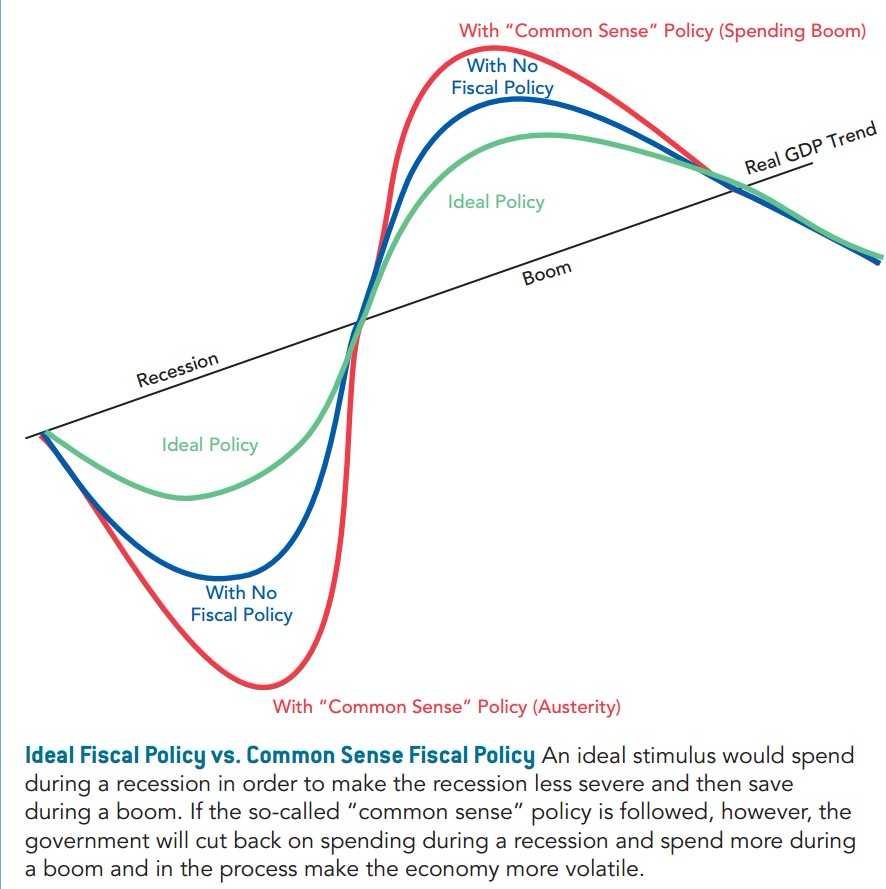
…Even when governments do spend more in recessions, as economists suggest, they often don’t follow through on the second half of the prescription, which is to spend less during booms…This usually means that there is less room for expansionary fiscal policy when it is needed.
The 4th edition is just out, here is more information.
The advantages of organizing knowledge in terms of country and place
When a child is looking at a map, he or she is probably organizing some of the associated knowledge in terms of location or plac — “Hmm…so there’s a boot-shaped country at the bottom of Europe.”
If you say “I don’t know much about Algeria. I should read Alastair Horne on the country, watch Battle of Algiers, and try to speak with some Algerians,” you are again organizing knowledge, and your quest for knowledge, in terms of place.
Alternatively, you might organize your knowledge in terms of historical eras, of fields of science, or in terms of people you know — “that’s Johnny’s view of the world!” Of course we all use some combination of these methods and others.
I find that people who travel a great deal often organize their knowledge in terms of physical location. For instance, they might be curious about visiting parts of the world they have had no previous exposure to, or alternatively they might decide “I am going to specialize in Brazil.”
I see a few advantages from organizing knowledge in terms of place:
1. It encourages objectivity, as most of us do not have strong political or partisan opinions about most other countries. In contrast, if you set out to study “Does industrial policy work?”, you will approach your study of each place with a higher degree of bias. Instead, just study each place, and let your conclusions about industrial policy come to you. Quite literally, it has a useful “distancing” effect.
2. As I have mentioned, almost everyone in the world becomes an interesting potential partner in your quest for knowledge. Even if a person doesn’t know much theory, or is not a good storyteller, almost certainly they can teach you something about the places they have lived in.
3. There are many places, so you will never feel you know so much. And you can always be imagining the next quest.
4. Increasing returns to scale will drive your curiosity, much as one might seek to capture stones in the game of Go. Imagine knowing all the countries that surround Uzbekistan, but never having visited Uzbekistan itself. Oh how the passions would rise!
5. Even if distant travel is not available to you, you can study so many social science questions by comparing parts of your city, or by considering adjacent towns and their differences.
6. Folding over pages in a book, leaving books in piles on the floor, and trying to remember “where in a book you read something” are all methods of using space to better organize your knowledge. Subsequent innovations in VR and AR may help us advance on these techniques.
Organizing knowledge in terms of place does not always encourage theoretical reasoning or thinking in terms of models. It is therefore especially useful for people who tend to be systematizers in the first place.
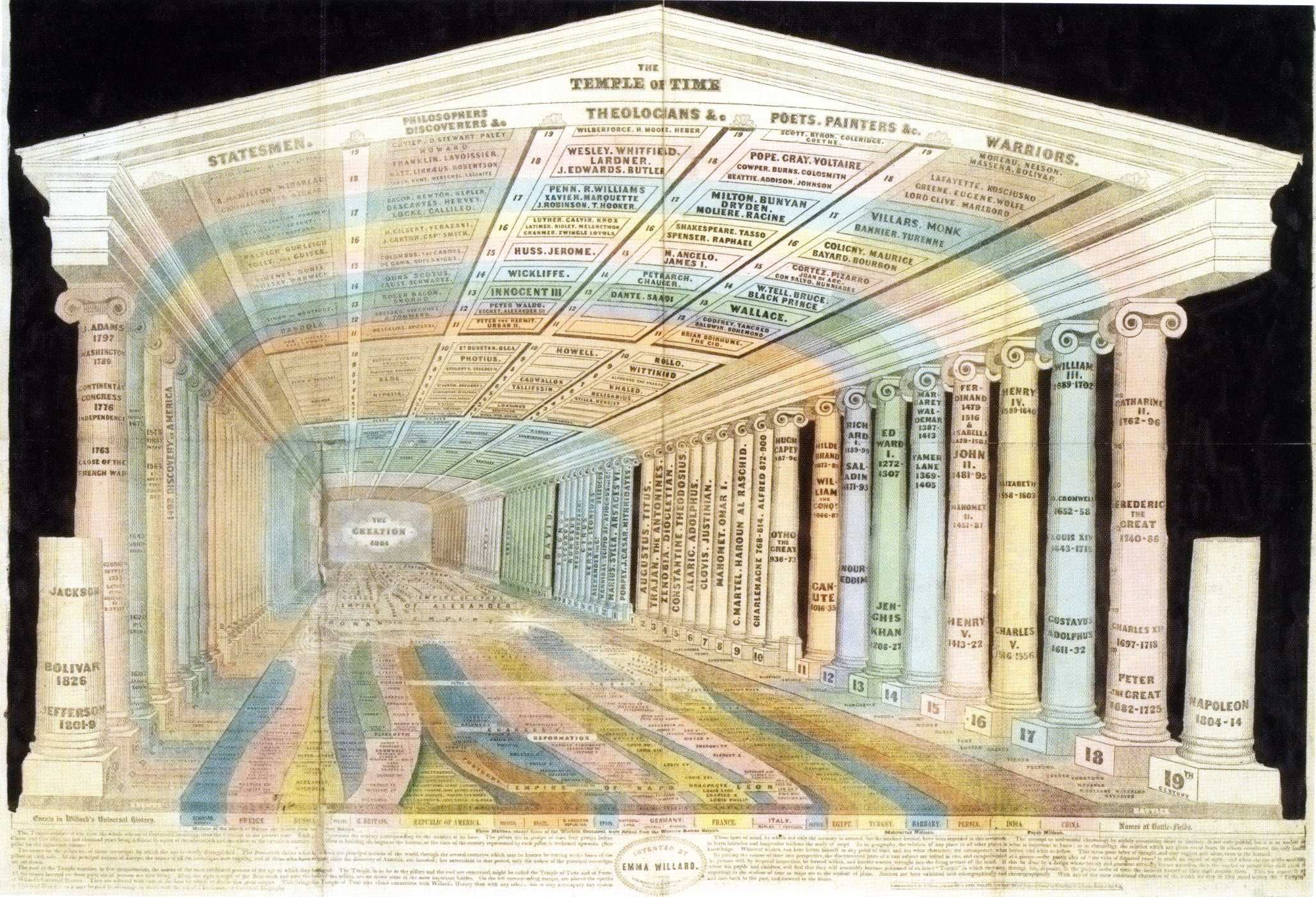
In general, I believe that many people have a quite underdeveloped sense of how to use physical space as a cognitive tool. You may recall that many medieval and Renaissance memory systems (pre-Google!) instructed the user to imagine all of the information arrayed at different points in physical space, such as in a sequence along a road, or as rooms in a house.
Similarly, if you organize your knowledge of the arts, music, and economics by country and place, many of the underlying study objects may become much more vivid to you.
Where the money is going
Defense spending most of all, but there is also this, by Heather Long and Jeffrey Stein:
“There are a ton of unmet needs out there because of federal cuts: job training, low-income assistance programs, help for students with Pell Grants, child care assistance,” said David Reich, a senior fellow of the Center on Budget and Policy Priorities, a left-leaning think tank. “This is the opportunity to make some progress with those needs. Money here will help.”
Meeting a key Democratic priority, the agreement funnels billions of dollars for several key health-care priorities — funding community health centers for two years, extending the Children’s Health Insurance Program for an additional four years (on top of six years that had been previously authorized), and staving off several cuts to Medicare and Medicaid that would have been triggered had the caps not been lifted.
“All I can say is the obvious: It’s great to get the funding for these finally nailed down,” said Tim Jost, a health-care expert at the Washington and Lee University School of Law. “It finally brings stability to some very important health-care programs.” About $7 billion will be spent on the community health centers, which provided care to 26.5 million Americans in 2016.
No, Trump and the Republicans never were going to “gut Medicare.” Overall, so many commentators on the left are fooled into thinking elected Republicans are far more ideological, and far less majoritarian and less sensitive to public opinion, than in fact they are. Oddly, or perhaps not so, they are fooled in many of the ways that many of the Fox News viewers are fooled too.
By the way, have I told you my “gut” rule? If you read an article or tweet these days, where “gut” is used as a verb in a non-self-reflective way, it is almost always a bad piece or tweet. That is what my gut says at least.
Friday assorted links
1. The implicit theology of Jordan Peterson: “No one has come to save you; you will have to save yourself.”
2. Comedy complaints about Facebook.
3. Not a very satisfying abstract, but what was I expecting?
4. A claim that Irish border solutions are possible.
5. Will the UK simply stop building museums? If so, what does this say about us?
6. Can the Catholic Church become Silicon Valley once again? “That the Catholic Church should put Silicon Valley—or any other institution or culture—to shame when it comes to world-changing innovation is not some tantalizing yet naïve prospect. It should be the baseline expectation for any educated Catholic.” And indeed that once was the case.
Bias in Advertising vs Subscription Driven Media
The excellent Andrew Potter at In Due Course writes:
When I was a student journalist, it was axiomatic that advertising was the biggest threat to independent media. Putting your livelihood in the hands of capitalists meant, ipso facto, doing their bidding.
Experience is a great teacher though, and when I started working as an editor at a newspaper, I was pleasantly surprised to discover that you didn’t wake up every day to a swarm of calls from outraged advertisers threatening to pull their campaigns if we didn’t smarten up….presumably because they didn’t really care. What they wanted was our audience, not the content.
But you know who does complain a lot? Subscribers do, endlessly.
Today, the great hope for mainstream news organizations is that subscribers will start doing something they’ve never done, which is pay for news. The New York Times seems well on its way to bending that revenue curve and replacing ad dollars with subscribers at a 1:1 ratio, and there’s similar hopes for the Washington Post, the FT, and maybe the Wall Street Journal….
…My suspicion is that [this] will lead to an increasingly polarized media environment, through more or less the same mechanism that leads to group polarization in social psychology. When a news organization relies almost entirely on its readership for its revenue, it will inevitably start to cater to what the owners perceive to be the political centre of gravity of that readership. And the readership will in turn make demands on the editors to shape the coverage in certain ways, which will tend to gradually shift that centre of gravity away from the middle, and towards the political extremes.
I’d add one more factor to Potter’s analysis. Since the advertisers care about eyeballs, advertisement-funded media are incentivized to produce more eyeballs. Such incentives tends to encourage lowest-common-denominator entertainment but also more political balance. Subscription-funded media, in contrast, face a tradeoff: subscribers want content that supports their world view so moderating the content to appeal to a larger audience will likely reduce the price that any one reader is willing to pay. Revenues are therefore larger with a smaller but more political extreme audience.
Addendum: Potter and philosopher Joseph Heath write at In Due Course infrequently but are always interesting. Here, for example, is a superb long-read by Heath, nominally about Iain Bank’s culture series but actually about more and well worth reading even if you don’t know the novels.
Toward a Jungian theory of Amish fertility?
At least in the Geauga, Ohio Amish settlements, the decline in fertility followed national fertility trends very closely. Here’s a fun fact: the Amish don’t use most forms of birth control or abortion.
Now, this doesn’t mean Amish fertility fell as low as U.S. general fertility; it simply means that Amish fertility fell as much as U.S. general fertility.
…Cuz what I’m seein’ is that Amish fertility is pretty well correlated with U.S. TFR on the whole.
Scroll down through this Lyman Stone essay to see the graphs of the data (which won’t reproduce for me here, alas). Here are some pictures in tweet form, if you don’t like scrolling.
My favorite things Poland
No, I am not there now, but Adam D. emails me and requests this, so here goes:
1. Novel: Stanislaw Lem, Solaris, all about identity and erotic guilt. Next in line would be any number of Isaac Singer novels, I don’t have a favorite offhand. Soon I will try The Family Moskat. Gombrowicz is probably wonderful, but I don’t find that it works for me in translation. Quo Vadis left me cold.
2. Chopin works: The Preludes, there are many fine versions, and then the Ballades. The Etudes excite me the most, the Mazurkas and piano sonatas #2 and #3 are most likely to surprise me at current margins of listening. I find it remarkable how I never tire of Chopin, in spite of his relatively slight output.
3. Painter: This one isn’t as easy as it ought to be.
4. Architect: Daniel Libeskind was born in Poland. But more generally one can cite Krakow, and I suspect the older versions of Gdansk.

The wooden churches and folk art of southern Poland also deserve mention.
5. Political thinker: Czesław Miłosz, The Captive Mind, about the capitulations of artists to communism, though subtler than just an anti-state polemic. He once stated: ” I have never been a political writer and I worked hard to destroy this image of myself.” I do not feel I can judge his poetry, though last year’s biography of him was a good book.
6. Astronomer and originator of the quantity theory of money: Copernicus.
7. Television show: The Decalogue, perhaps #4 is my favorite. Here is good NPR coverage.
8. Movie: Any of the Andrzej Wajda classics would do, maybe start with Kanal or Ashes and Diamonds. More recently I would opt for Ida. I like Kieślowski’s TV more than his films, and prefer Hollywood Polanski to Polish Polanski.
9. Classical pianist: There are many, but I will cite Kristian Zimerman over Artur Rubinstein. The former plays the piano better. Josef Hofmann deserves mention, but there are dozens of picks here.
10. Jazz musician: Trumpeter Tomasz Stańko.
11. Economists: There is Kalecki, Hurwicz, the now-underrated Oskar Lange (doesn’t Singaporean health care work fine?), and Victor Zarnowitz. I had thought Mises was born in Poland, but upon checking it turned out to be Ukraine.
Overall the big puzzle is why there isn’t more prominence in painting, given Poland’s centrality in European history.
That was then, this is now, rent control vs. building deregulation edition
By early 1919 many New Yorkers — even many who held that the long-term solution to the housing problem was “to build more homes and build them now” — had come to believe that neither private enterprise nor public authority could do much to alleviate the housing shortage in the near future. From this belief it was only a short step to the conclusion that the state legislature had to take action to stop the city’s rapacious landlords from raising the rent…
Here you will find a recent WSJ article (or read this ungated) about municipalities once again turning to rent control…
The above passage is from the highly useful and deeply comprehensive The Great Rent Wars: New York, 1917-1929, by Robert M. Fogelson. Note that back then both rent control and “building more” won. As for today, Megan has a relevant column.
Thursday assorted links
Why is idiosyncratic stock market volatility so low?
We find that the historically low IR [idiosyncratic risk] can be explained by the changes in firm characteristics that take place since the 1990s.
…the number of listed firms has fallen dramatically and the composition of listed firms has changed considerably, with public firms becoming larger and older. We show that there is a stable relation between firm-level idiosyncratic risk and firm characteristics…we find no evidence that IR increases with institutional ownership…
That is from Bartram, Brown, and Stulz, in the NBER working paper series.
Is legal marijuana more potent?
Yes, here is Keith Humphreys from Wonkblog:
Although some people believe prohibiting drugs is what makes their potency increase, the potency of marijuana under legalization has disproved that idea. Potency rises in both legal and illegal markets for the simple reason that it conveys advantages to sellers. More potent drugs have more potential to addict customers, thereby turning them into reliable profit centers.
In other legal drug markets, regulators constrain potency. Legal alcohol beverage concentrations are regulated in a variety of ways, including through different levels of tax for products of different strengths as well as constraints on labeling and place of sale. In most states, for a beverage to be marketed and sold as “beer,” its alcohol content must fall within a specified range. Similarly, if wine is distilled to the point that its alcohol content rises too high, some states require it be sold as spirits (i.e., as “brandy”) and limit its sale locations.
As states have legalized marijuana, they have put no comparable potency restrictions in place, for example capping THC content or levying higher taxes on more potent marijuana strains. Sellers are doing the economic rational thing in response: ramping up potency.
How about the Netherlands?:
The study was conducted in the Netherlands, where marijuana is legally available through “coffee shops.” The researchers examined the level of delta-9-tetrahydrocannabinol (THC), the main intoxicant in marijuana, over a 16-year period. Marijuana potency more than doubled from 8.6 percent in 2000 to 20.3 percent in 2004, which was followed by a surge in the number of people seeking treatment for marijuana-related problems. When potency declined to 15.3 percent THC, marijuana treatment admissions fell thereafter. The researchers estimated that for every 3 percent increase in THC, roughly one more person per 100,000 in the population would seek marijuana use disorder treatment for the first time.
The Dutch findings are relevant to the United States because high THC marijuana products have proliferated in the wake of legalization. The average potency of legal marijuana products sold in the state of Washington, for example, is 20 percent THC, with some products being significantly higher.
I believe that marijuana legalization has moved rather rapidly into being an overrated idea. To be clear, it is still an idea I favor. It seems to me wrong and immoral to put people in jail for ingesting substances into their body, or for aiding others in doing so, at least provided fraud is absent in the transaction. That said, IQ is so often what is truly scarce in society. And voluntary consumption decisions that lower IQ are not something we should be regarding with equanimity. Ideally I would like to see government discourage marijuana consumption by using the non-coercive tools at its disposal, for instance by making it harder for marijuana to have a prominent presence in the public sphere, or by discouraging more potent forms of the drug. How about higher taxes and less public availability for more potent forms of pot, just as in many states beer and stronger forms of alcohol are not always treated equally under the law?
What is a non-mood-affiliated way to get up to speed on climate change issues?
That query was messaged to me, so I thought I would pass it along to all of you for your non-mood-affiliated feedback. I thank you all in advance. Do note this is for a person of very high IQ and objectivity.
Wednesday assorted links
1. Swedish summer seminar in classical liberalism. And Bryan Caplan says something nice about me (I am not suggesting this is rare, though).
2. Personal bests act as reference points.
3. “In the inner London borough of Wandsworth, a home measuring just 91 inches across is on the market for about $1.4 million (£1 million).” Link here.
4. Who will be the next PM of Singapore?
5. Jerry Z. Muller on the tyranny of metrics.
6. Vincent Geloso’s nominations for the best economic history papers of 2017.
The signaling start-up culture that is Finland
Intrepid entrepreneurs have plunged into icy Finnish water in an eccentric contest to win funding for their business ideas.
Polar Bear Pitching allows start-up firms to put forward their projects to investors for as long as they can stand in the freezing temperatures.
The final of the Dragon’s Den-style competition will see a dozen companies put their plans under the noses of investors.
The winner of the two-day contest — which takes place in frozen sea near Oulu on February 6 and 7 — will receive €10,000.
Start-ups who have secured funding say standing in such cold water helps convince investors they are serious.
Here is the article and photo, via Danica Porobic.
The Uber Pay Gap
Using data on over one million Uber drivers and millions of trips, Cody Cook, Rebecca Diamond, Jonathan Hall, John A. List, and Paul Oyer show that female Uber drivers earn 7% less than male drivers. What makes this paper new, however, is that UBER’s extensive data lets the authors understand in great detail why the pay gap exists. It’s not discrimination:
Uber uses a gender-blind algorithm and drivers earn according to a transparent formula based on the time and distance of trips. There are no negotiated pay rates or convex returns to long hours worked, factors that have been shown to open a gender earnings gap in other settings. Our research also finds that both average rider ratings of drivers and cancellation rates are roughly equivalent between genders and we find no evidence that outright discrimination, either by the app or by riders, is driving the gender earnings gap.
The authors find that three factors explain the gap; driving speed, experience, and choices about where to drive.
First, driving speed alone can explain nearly half of the gender pay gap. Second, over a third of the gap
can be explained by returns to experience, a factor which is often almost impossible to evaluate
in other contexts that lack high frequency data on pay, labor supply, and output. The remaining
∼20% of the gender pay gap can be explained by choices over where to drive.
Male Uber drivers, like other males, drive a bit faster than female drivers, about 2.2% faster after controlling for experience and location. Since Uber pays by time as well as by distance the returns to speed are not very high and the difference in speed is small but overall this results in an increase in pay for males of about 50 cents an hour.
Drivers learn by doing and more men than women have driven for Uber for years:
A driver with more than 2,500 lifetime trips completed earns 14% more per hour than a driver who
has completed fewer than 100 trips in her time on the platform, in part because she learn where
to drive, when to drive, and how to strategically cancel and accept trips. Male drivers accumulate
more experience than women by driving more each week and being less likely to stop driving with
Uber.
Overall, female and male Uber drivers behave remarkably similarly but small differences aggregated over large samples produce a small but systematic gender gap in wages of about 7%. The gap, however, is an artifact, a social construct that has no implications for “social justice,” drivers are treated equally.
The author’s conclude:
Overall, our results suggest that, even in the gender-blind, transactional, flexible environment
of the gig economy, gender-based preferences (especially the value of time not spent at paid work
and, for drivers, preferences for driving speed) can open gender earnings gaps. The preference
differences that contribute to pay differences in professional markets for lawyers and MBA’s also
lead to earnings gaps for drivers on Uber, suggesting they are pervasive across the skill distribution
and whether in the traditional or gig workplace.