Results for “age of em” 17246 found
*Enlightenment Now*, the new Steven Pinker book
1. He is more likely right than wrong on the major points of optimism and progress and science.
2. The book is very clearly written, and it would do most of the world good to read it.
3. Contrary to Pinker, inframarginally I see the Enlightenment as a strong complement to Christianity/faith, even though the two at the margin often will clash. The same is true for nationalism.
4. The Counterenlightenment, as Pinker calls it, is intellectually much stronger than he gives it credit for. It’s time for yet another reread of Gulliver’s Travels.
5. I am uncomfortable with statements such as “Intellectuals hate progress.” That sentence opens chapter four. I know that he explains and qualifies it, but it is not how I like to organize concepts.
6. It is not a good book for understanding the Enlightenment.
7. Overall my main difference with Pinker might be this: I believe there is a certain amount of irreducible “irrationality” (not my preferred term, but borrowing his schema for a moment) in people, and it has to be “put somewhere,” into some doctrine or belief system. That is what makes the whole bundle sustainable. It also means that a move toward greater “Enlightenment” is never without its problematic side, and that a “Counterenlightenment” can be more progressive than it might at first appear. In contrast, I read Pinker as believing that Enlightenment simply can beat ignorance more and more over time.
The book’s subtitle is The Case for Reason, Science, Humanism, and Progress. And here is my earlier discussion with Pinker, video, podcast, and transcript.
What Should be Done About Bulgaria’s Population Decline?
Bulgaria has the fastest declining population in the world. From a peak of nearly 9 million around the time of the communist fall in 1990 Bulgaria’s population is 7 million today and projected to fall to around 5 million over the next generation. Entire villages have been depopulated, especially in the poorer Northern region.
A correspondent wrote me asking what to do. I responded what’s the problem? Of course, there are plenty of things one could do to make Bulgaria a richer and better place to live, some of which Bulgaria has been doing and some of which they have not. The more fundamental question, however, is why the number of a particular type of people located in a particular geographically proscribed area should be a measure of welfare?
Instead of focusing on Bulgaria let’s focus on Bulgarians. One of the reasons the population of Bulgaria has been falling is that Bulgarians have been leaving for better lives elsewhere in the European Union. Over one million Bulgarians live abroad. It is not always easy to move nor to stay in a village that is bereft of young people. But how fortunate is that those young people could move elsewhere. Instead of thinking of them just as Bulgarians lets think of them as citizens of the European Union. Problem solved. The EU population is increasing!
Is that a facile answer? Perhaps but note that in the United States great swaths of the country have seen declining populations since the 1930s or even earlier. We tend not to regard this as a big deal. In part because many of the areas with declining populations were small to begin with but also because we regard it as a good thing that Americans can move about the country. Indeed, because people have been free to move to opportunity the people remaining have not seen big declines in their standard of living. Ghosts are better than zombies.
Addendum: Bulgaria has some great beaches and historic sites at very reasonable prices!
The side effects of the decline of men
That is the topic of my latest Bloomberg column, and it is not just about male wage stagnation:
The researchers Guido Matias Cortes, Nir Jaimovich and Henry E. Siu split jobs into categories, with “cognitive” occupations relying on brain power corresponding closely to what many call white-collar jobs. Their worrying result for men is this: In 1980, 66 percent of college-educated men worked in these cognitive occupations. By 2000, that had fallen to 63 percent. Those three percentage points may not sound like a major change, but that’s over a 20-year period when the American economy became wealthier and more Americans became educated. Men also grew older as a group during this time, which should have propelled them into more white-collar jobs. Relative to those expectations of improvement, the retrogression is startling.
…One possible reason for this shift is that more jobs demand good social skills. The data show that the growing demand for social skills, as measured by job characteristics and employment ads, has matched where women have gained relative to men in the workplace. The researchers suggest the scientific evidence shows that women have on average stronger skills in empathy, communication, emotion recognition and verbal expression, and corporate America is valuing those qualities all the more.
There is much more at the link.
What I’ve been reading
1. Kathryn Lomas, The Rise of Rome: From the Iron Age to the Punic Wars. A very thorough, reasonable, and well-researched account and synthesis of what we know about the origins of the Roman empire. By my standards it is insufficiently concerned with generalizations, but I do understand how many might consider that an advantage.
2. Michael E. Hobart, The Great Rift: Literacy, Numeracy, and the Religion-Science Divide. I wanted to love this book, and I still think it is quite important and worthy, but I don’t love reading this book. Yet here is the first and marvelous sentence of the preface: “This book uses the history of information technology — in particular, the shift from alphabetic literacy to modern numeracy — to narrate and explain the origins of the contemporary rift between science and religion.” After that it is dense.
3. Robert Irwin, Ibn Khaldun: An Intellectual Biography. The most interesting material concerns Khaldun’s history as a Sufi. Which brings me to Alexander Knysh’s Sufism: A New History of Islamic Mysticism, which I enjoyed. Overall I find this a fruitful area to study, and I benefited from some parts of Alexander Bevilacqua’s The Republic of Arabic Letters: Islam and the European Enlightenment.
4. David Hockney and Martin Gayford, A History of Pictures. How artists have thought about space and light over the centuries, consistently interesting and insightful, wonderful color plates too. I am not persuaded by all of Hockney’s claims about art history, but overall he is much underrated as a writer and thinker, including on the nature and import of photography.
5. Ran Abramitzky, The Mystery of the Kibbutz: Egalitarian Principles in a Capitalist World, covers the economics of the Kibbutz.
6. Jeffrey C. Stewart, The New Negro: The Life of Alain Locke. I don’t have the time to make my way through the details of this 900+pp. book, but upon browsing it appears to be a work of incredible quality, scope, and original research.
7. Matthew Restall, When Montezuma Met Cortés: The True Story of the Meeting that Changed History. A radical revision of the usual story, based on a careful reexamination of Spanish and Nahuatl stories. Restall seems to be mostly correct, but I will add two points: a) I never took the older account very seriously anyway, and b) I am more interested in the new macro-story than the micro-revisions of the march and the encounter and surrender and so on. One big difference seems to be there was more early resistance to Cortés than the common accounts would have you believe. And outright slaughter and starvation were more important for the war in the short run than we used to think, relative to smallpox and other maladies. In any case, this is an important book for anyone who follows this area.
The distribution of cities, then and now
In today’s developed countries, cities are thus scattered across historically important agricultural areas; as a result, there is a relatively higher degree of spatial equality in the distribution of resources within these countries. By contrast, in today’s developing countries, cities are concentrated more on the coast where transport conditions, compared to agricultural suitability, are more favorable.
That is from Henderson, Squires, Storeygard, and Weil in the January 2018 QJE, based on light data measured by satellites. Overall, I view this regularity as a negative for the prospects for liberalism and democracy in emerging economies, as urban concentration can encourage too much rent-seeking and kleptocracy. It also reflects the truly amazing wisdom of (some of) our Founding Fathers, who saw a connection between liberty and decentralized agrarianism. It suggests a certain degree of pessimism about China’s One Belt, One Road initiative. The development of the hinterland in the United States may not be a pattern that today’s emerging economies necessarily should or could be seeking to replicate. Which makes urban economics and Henry George all the more important.
Direct Instruction: A Half Century of Research Shows Superior Results
What if I told you that there is a method of education which significantly raises achievement, has been shown to work for students of a wide range of abilities, races, and socio-economic levels and has been shown to be superior to other methods of instruction in hundreds of tests? Well, the method is Direct Instruction and I first told you about it in Heroes are Not Replicable. I am reminded of this by the just-published, The Effectiveness of Direct Instruction Curricula: A Meta-Analysis of a Half Century of Research which, based on an analysis of 328 studies using 413 study designs examining outcomes in reading, math, language, other academic subjects, and affective measures (such as self-esteem), concludes:
…Our results support earlier reviews of the DI effectiveness literature. The estimated effects were consistently positive. Most estimates would be considered medium to large using the criteria generally used in the psychological literature and substantially larger than the criterion of .25 typically used in education research (Tallmadge, 1977). Using the criteria recently suggested by Lipsey et al. (2012), 6 of the 10 baseline estimates and 8 of the 10 adjusted estimates in the reduced models would be considered huge. All but one of the remaining six estimates would be considered large. Only 1 of the 20 estimates, although positive, might be seen as educationally insignificant.
…The strong positive results were similar across the 50 years of data; in articles, dissertations, and gray literature; across different types of research designs, assessments, outcome measures, and methods of calculating effects; across different types of samples and locales, student poverty status, race-ethnicity, at-risk status, and grade; across subjects and programs; after the intervention ceased; with researchers or teachers delivering the intervention; with experimental or usual comparison programs; and when other analytic methods, a broader sample, or other control variables were used.
It is very unusual to see an educational method successfully replicate across such a long period of time and across so many different margins.
Direct Instruction was pioneered by Siegfried Engelmann in the 1960s and is a scientific approach to teaching. First, a skill such as reading or subtraction is broken down into simple components, then a method to teach that component is developed and tested in lab and field. The method must be explicitly codified and when used must be free of vagueness so students are reliably led to the correct interpretation. Materials, methods and scripts are then produced for teachers to follow very closely. Students are ability not age-grouped and no student advances before mastery. The lessons are fast-paced and feedback and assessment are quick. You can get an idea of how it works in the classroom in this Thales Academy promotional video. Here is a math lesson on counting. It looks odd but it works.
Even though Direct Instruction has been shown to work in hundreds of tests it is not widely used. It’s almost as if education is not about educating.
Some people object that DI is like mass-production. This is a feature not a bug. Mass-production is one of the few ways yet discovered to produce quality on a mass scale. Any method will probably work if a heroic teacher puts in enough blood, sweat and tears but those methods don’t scale. DI scales when used by mortals which is why it consistently beats other methods in large scale tests.
Many teachers don’t like DI when first exposed to it because it requires teacher training and discipline. Teachers are not free to make up their own lesson plans. But why should they be? Lesson plans should be developed by teams of cognitive psychologists, educational researchers and other experts who test them using randomized controlled trials; not made up by amateurs who are subject to small-sample and confirmation bias. Contrary to the critics, however, DI does leave room for teachers to be creative. Actors also follow a script but some are much better than others. Instructors who use DI enjoy being effective.
Quoting the authors of the meta-analysis:
Many current curriculum recommendations, such as those included within the Common Core, promote student-led and inquiry-based approaches with substantial ambiguity in instructional practices. The strong pattern of results presented in this article, appearing across all subject matters, student populations, settings, and age levels, should, at the least, imply a need for serious examination and reconsideration of these recommendations (see also Engelmann, 2014a; Morgan, Farkas, & Maczuga, 2015; Zhang, 2016). It is clear that students make sense of and interpret the information that they are given—but their learning is enhanced only when the information presented is explicit, logically organized, and clearly sequenced. To do anything less shirks the responsibility of effective instruction.
Sunday assorted links
1. Good summary article on management and productivity.
2. Now this is definitely signaling — but shouldn’t they be having sex instead?
3. How to induce Russian public goods provision.
4. Should psychology become more of a predictive science? (research paper on machine learning)
When fiscal policy might make matters worse
From the new 4th edition of Cowen and Tabarrok, Modern Principles of Economics:
Increased spending and tax cuts have to be paid for. Thus, increased spending and tax cuts today will tend to be followed by decreased spending or tax increases tomorrow. When tomorrow comes and spending is reduced and taxes rise, aggregate demand will fall—this is one reason why long-run or net multipliers are smaller than short-run multipliers. Ideal fiscal policy will increase AD in bad times and pay off the bill in good times, as we show in Figure 37.5. Overall, if we can spend more in bad times when the multiplier is big and tax more in good times when the multiplier is small, the net effect will lead to higher GDP overall. Economists say that the ideal fiscal policy is counter-cyclical because when the economy is down the government should spend more, and when the economy is up the government should spend less.
Although counter-cyclical fiscal policy makes sense to economists, it often
doesn’t make sense to politicians or to voters. The views of economists violate a kind of “common sense” or folk wisdom, which says that in bad times the government should spend less and only in good times should the government spend more. After all, you and I spend less when times are bad and more when times are good, so shouldn’t the government behave similarly? If the government follows the “common sense” view, however, it will tend to make recessions deeper and booms larger, thereby making the economy more volatile, again as shown in Figure 37.5.
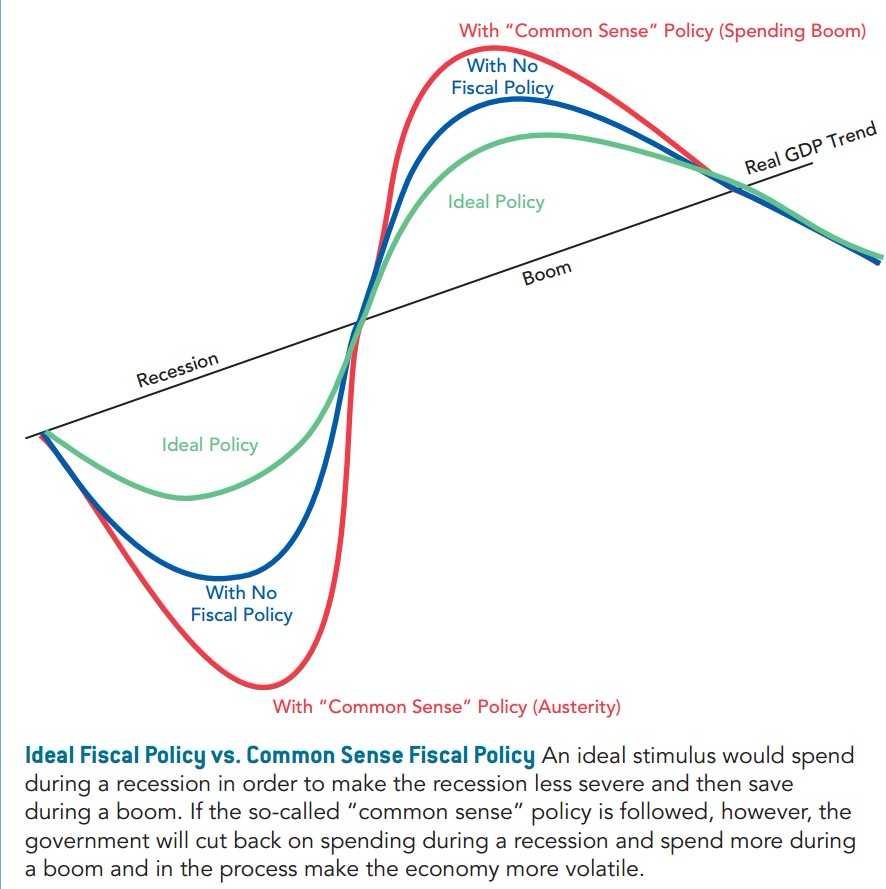
…Even when governments do spend more in recessions, as economists suggest, they often don’t follow through on the second half of the prescription, which is to spend less during booms…This usually means that there is less room for expansionary fiscal policy when it is needed.
The 4th edition is just out, here is more information.
Where the money is going
Defense spending most of all, but there is also this, by Heather Long and Jeffrey Stein:
“There are a ton of unmet needs out there because of federal cuts: job training, low-income assistance programs, help for students with Pell Grants, child care assistance,” said David Reich, a senior fellow of the Center on Budget and Policy Priorities, a left-leaning think tank. “This is the opportunity to make some progress with those needs. Money here will help.”
Meeting a key Democratic priority, the agreement funnels billions of dollars for several key health-care priorities — funding community health centers for two years, extending the Children’s Health Insurance Program for an additional four years (on top of six years that had been previously authorized), and staving off several cuts to Medicare and Medicaid that would have been triggered had the caps not been lifted.
“All I can say is the obvious: It’s great to get the funding for these finally nailed down,” said Tim Jost, a health-care expert at the Washington and Lee University School of Law. “It finally brings stability to some very important health-care programs.” About $7 billion will be spent on the community health centers, which provided care to 26.5 million Americans in 2016.
No, Trump and the Republicans never were going to “gut Medicare.” Overall, so many commentators on the left are fooled into thinking elected Republicans are far more ideological, and far less majoritarian and less sensitive to public opinion, than in fact they are. Oddly, or perhaps not so, they are fooled in many of the ways that many of the Fox News viewers are fooled too.
By the way, have I told you my “gut” rule? If you read an article or tweet these days, where “gut” is used as a verb in a non-self-reflective way, it is almost always a bad piece or tweet. That is what my gut says at least.
Bias in Advertising vs Subscription Driven Media
The excellent Andrew Potter at In Due Course writes:
When I was a student journalist, it was axiomatic that advertising was the biggest threat to independent media. Putting your livelihood in the hands of capitalists meant, ipso facto, doing their bidding.
Experience is a great teacher though, and when I started working as an editor at a newspaper, I was pleasantly surprised to discover that you didn’t wake up every day to a swarm of calls from outraged advertisers threatening to pull their campaigns if we didn’t smarten up….presumably because they didn’t really care. What they wanted was our audience, not the content.
But you know who does complain a lot? Subscribers do, endlessly.
Today, the great hope for mainstream news organizations is that subscribers will start doing something they’ve never done, which is pay for news. The New York Times seems well on its way to bending that revenue curve and replacing ad dollars with subscribers at a 1:1 ratio, and there’s similar hopes for the Washington Post, the FT, and maybe the Wall Street Journal….
…My suspicion is that [this] will lead to an increasingly polarized media environment, through more or less the same mechanism that leads to group polarization in social psychology. When a news organization relies almost entirely on its readership for its revenue, it will inevitably start to cater to what the owners perceive to be the political centre of gravity of that readership. And the readership will in turn make demands on the editors to shape the coverage in certain ways, which will tend to gradually shift that centre of gravity away from the middle, and towards the political extremes.
I’d add one more factor to Potter’s analysis. Since the advertisers care about eyeballs, advertisement-funded media are incentivized to produce more eyeballs. Such incentives tends to encourage lowest-common-denominator entertainment but also more political balance. Subscription-funded media, in contrast, face a tradeoff: subscribers want content that supports their world view so moderating the content to appeal to a larger audience will likely reduce the price that any one reader is willing to pay. Revenues are therefore larger with a smaller but more political extreme audience.
Addendum: Potter and philosopher Joseph Heath write at In Due Course infrequently but are always interesting. Here, for example, is a superb long-read by Heath, nominally about Iain Bank’s culture series but actually about more and well worth reading even if you don’t know the novels.
My favorite things Poland
No, I am not there now, but Adam D. emails me and requests this, so here goes:
1. Novel: Stanislaw Lem, Solaris, all about identity and erotic guilt. Next in line would be any number of Isaac Singer novels, I don’t have a favorite offhand. Soon I will try The Family Moskat. Gombrowicz is probably wonderful, but I don’t find that it works for me in translation. Quo Vadis left me cold.
2. Chopin works: The Preludes, there are many fine versions, and then the Ballades. The Etudes excite me the most, the Mazurkas and piano sonatas #2 and #3 are most likely to surprise me at current margins of listening. I find it remarkable how I never tire of Chopin, in spite of his relatively slight output.
3. Painter: This one isn’t as easy as it ought to be.
4. Architect: Daniel Libeskind was born in Poland. But more generally one can cite Krakow, and I suspect the older versions of Gdansk.

The wooden churches and folk art of southern Poland also deserve mention.
5. Political thinker: Czesław Miłosz, The Captive Mind, about the capitulations of artists to communism, though subtler than just an anti-state polemic. He once stated: ” I have never been a political writer and I worked hard to destroy this image of myself.” I do not feel I can judge his poetry, though last year’s biography of him was a good book.
6. Astronomer and originator of the quantity theory of money: Copernicus.
7. Television show: The Decalogue, perhaps #4 is my favorite. Here is good NPR coverage.
8. Movie: Any of the Andrzej Wajda classics would do, maybe start with Kanal or Ashes and Diamonds. More recently I would opt for Ida. I like Kieślowski’s TV more than his films, and prefer Hollywood Polanski to Polish Polanski.
9. Classical pianist: There are many, but I will cite Kristian Zimerman over Artur Rubinstein. The former plays the piano better. Josef Hofmann deserves mention, but there are dozens of picks here.
10. Jazz musician: Trumpeter Tomasz Stańko.
11. Economists: There is Kalecki, Hurwicz, the now-underrated Oskar Lange (doesn’t Singaporean health care work fine?), and Victor Zarnowitz. I had thought Mises was born in Poland, but upon checking it turned out to be Ukraine.
Overall the big puzzle is why there isn’t more prominence in painting, given Poland’s centrality in European history.
That was then, this is now, rent control vs. building deregulation edition
By early 1919 many New Yorkers — even many who held that the long-term solution to the housing problem was “to build more homes and build them now” — had come to believe that neither private enterprise nor public authority could do much to alleviate the housing shortage in the near future. From this belief it was only a short step to the conclusion that the state legislature had to take action to stop the city’s rapacious landlords from raising the rent…
Here you will find a recent WSJ article (or read this ungated) about municipalities once again turning to rent control…
The above passage is from the highly useful and deeply comprehensive The Great Rent Wars: New York, 1917-1929, by Robert M. Fogelson. Note that back then both rent control and “building more” won. As for today, Megan has a relevant column.
Thursday assorted links
Is legal marijuana more potent?
Yes, here is Keith Humphreys from Wonkblog:
Although some people believe prohibiting drugs is what makes their potency increase, the potency of marijuana under legalization has disproved that idea. Potency rises in both legal and illegal markets for the simple reason that it conveys advantages to sellers. More potent drugs have more potential to addict customers, thereby turning them into reliable profit centers.
In other legal drug markets, regulators constrain potency. Legal alcohol beverage concentrations are regulated in a variety of ways, including through different levels of tax for products of different strengths as well as constraints on labeling and place of sale. In most states, for a beverage to be marketed and sold as “beer,” its alcohol content must fall within a specified range. Similarly, if wine is distilled to the point that its alcohol content rises too high, some states require it be sold as spirits (i.e., as “brandy”) and limit its sale locations.
As states have legalized marijuana, they have put no comparable potency restrictions in place, for example capping THC content or levying higher taxes on more potent marijuana strains. Sellers are doing the economic rational thing in response: ramping up potency.
How about the Netherlands?:
The study was conducted in the Netherlands, where marijuana is legally available through “coffee shops.” The researchers examined the level of delta-9-tetrahydrocannabinol (THC), the main intoxicant in marijuana, over a 16-year period. Marijuana potency more than doubled from 8.6 percent in 2000 to 20.3 percent in 2004, which was followed by a surge in the number of people seeking treatment for marijuana-related problems. When potency declined to 15.3 percent THC, marijuana treatment admissions fell thereafter. The researchers estimated that for every 3 percent increase in THC, roughly one more person per 100,000 in the population would seek marijuana use disorder treatment for the first time.
The Dutch findings are relevant to the United States because high THC marijuana products have proliferated in the wake of legalization. The average potency of legal marijuana products sold in the state of Washington, for example, is 20 percent THC, with some products being significantly higher.
I believe that marijuana legalization has moved rather rapidly into being an overrated idea. To be clear, it is still an idea I favor. It seems to me wrong and immoral to put people in jail for ingesting substances into their body, or for aiding others in doing so, at least provided fraud is absent in the transaction. That said, IQ is so often what is truly scarce in society. And voluntary consumption decisions that lower IQ are not something we should be regarding with equanimity. Ideally I would like to see government discourage marijuana consumption by using the non-coercive tools at its disposal, for instance by making it harder for marijuana to have a prominent presence in the public sphere, or by discouraging more potent forms of the drug. How about higher taxes and less public availability for more potent forms of pot, just as in many states beer and stronger forms of alcohol are not always treated equally under the law?
The Uber Pay Gap
Using data on over one million Uber drivers and millions of trips, Cody Cook, Rebecca Diamond, Jonathan Hall, John A. List, and Paul Oyer show that female Uber drivers earn 7% less than male drivers. What makes this paper new, however, is that UBER’s extensive data lets the authors understand in great detail why the pay gap exists. It’s not discrimination:
Uber uses a gender-blind algorithm and drivers earn according to a transparent formula based on the time and distance of trips. There are no negotiated pay rates or convex returns to long hours worked, factors that have been shown to open a gender earnings gap in other settings. Our research also finds that both average rider ratings of drivers and cancellation rates are roughly equivalent between genders and we find no evidence that outright discrimination, either by the app or by riders, is driving the gender earnings gap.
The authors find that three factors explain the gap; driving speed, experience, and choices about where to drive.
First, driving speed alone can explain nearly half of the gender pay gap. Second, over a third of the gap
can be explained by returns to experience, a factor which is often almost impossible to evaluate
in other contexts that lack high frequency data on pay, labor supply, and output. The remaining
∼20% of the gender pay gap can be explained by choices over where to drive.
Male Uber drivers, like other males, drive a bit faster than female drivers, about 2.2% faster after controlling for experience and location. Since Uber pays by time as well as by distance the returns to speed are not very high and the difference in speed is small but overall this results in an increase in pay for males of about 50 cents an hour.
Drivers learn by doing and more men than women have driven for Uber for years:
A driver with more than 2,500 lifetime trips completed earns 14% more per hour than a driver who
has completed fewer than 100 trips in her time on the platform, in part because she learn where
to drive, when to drive, and how to strategically cancel and accept trips. Male drivers accumulate
more experience than women by driving more each week and being less likely to stop driving with
Uber.
Overall, female and male Uber drivers behave remarkably similarly but small differences aggregated over large samples produce a small but systematic gender gap in wages of about 7%. The gap, however, is an artifact, a social construct that has no implications for “social justice,” drivers are treated equally.
The author’s conclude:
Overall, our results suggest that, even in the gender-blind, transactional, flexible environment
of the gig economy, gender-based preferences (especially the value of time not spent at paid work
and, for drivers, preferences for driving speed) can open gender earnings gaps. The preference
differences that contribute to pay differences in professional markets for lawyers and MBA’s also
lead to earnings gaps for drivers on Uber, suggesting they are pervasive across the skill distribution
and whether in the traditional or gig workplace.