The Hockey Stick of Human Prosperity
We are pleased to announce a brand new course at MRUniversity, Everyday Economics. The new course will cover some of the big ideas in economics but applied to everyday questions. The first section, premiering now and rolling out over the next several weeks, features Don Boudreaux on trade. Tyler will appear in a future section on food. You can expect more from me as well. Indeed, you may spot both Tyler and I in some cameos (ala Stan Lee) in some of Don’s videos!
Here’s the first video on trade and the hockey stick of human prosperity.
How Not to Bet
Tim Harford writes of bets:
Pundits who make wagers may look grubby but at least they are accepting a cost for failure. A more subtle advantage is that betting encourages forecasts that are specific and quantifiable.
Exactly, but not all bets are well considered. Consider the following from Christopher Keating:
I have heard global warming skeptics make all sorts of statements about how the science doesn’t support claims of man-made climate change. I have found all of those statements to be empty and without any kind of supporting evidence. I have, in turn, stated that it is not possible for the skeptics to prove their claims. And, I’m willing to put my money where my mouth is.
I am announcing the start of the $10,000 Global Warming Skeptic Challenge. The rules are easy:
1. I will award $10,000 of my own money to anyone that can prove, via the scientific method, that man-made global climate change is not occurring;
…5. I am the final judge of all entries but will provide my comments on why any entry fails to prove the point.
This is a poorly constructed bet. Notice first that the preamble, “empty”, “without any kind of supporting evidence”, “prove,” is simply unscientific bluster. Scientific thinking is Bayesian. (Appropriately, I first saw Keating’s bet flagged on the blog Prior Probability.) In contrast, this talk is suggestive of someone who doesn’t weigh evidence, a point of some importance given that he writes “I am the final judge of all entries…”. Keating is really betting that no one will change his mind and that’s not a bet that I would want to take.
Second, what counts as proof? And what does it mean to say that man-made global climate change is not occurring. How much is man made? How fast is it occurring? What are the costs? What are the benefits? Keating’s challenge is vague and poorly worded.
For an example of a much better bet consider the Caplan-Bauman bet on temperature change over the next 15 years. Caplan has agreed to pay Bauman $333.33 if the average temperature over the period 2015-2029 is more than .05C greater than the average temperature over 2000-2014 as measured by the National Climatic Data Center. If the average temperature increase over that time frame is less than .05c then Bauman will pay Caplan $1000.
The Caplan-Bauman bet is quantifiable and specific and it contains odds, as it should since Bauman expresses much greater certainty in his belief than Caplan.
Keating seems even more certain in his beliefs than Bauman. But how certain? Will he accept my offer of the same bet at 5:1 odds?
Sentence to Ponder and Ponder and Ponder
Does any sentence better illustrate the human condition in all its political, social and biological complexities than this sentence?
New York state lawmakers have passed a bill banning residents from taking “tiger selfies” — a rising trend on dating websites in which single men post photos of themselves posing with the ferocious felines in hopes of impressing potential mates.
Dissertations are waiting to be written.
The Anti-Nanny State
A new report from the Migration Policy Institute calculates that:
The US government spends more on its immigration enforcement agencies than on all of its principal criminal federal law enforcement agencies combined. In FY 2012, spending for CBP, ICE and US-Visit reached nearly $18 billion. This amount exceeds by nearly 24% total spending by the FBI, Drug Enforcement Agency (DEA), Secret Service, US Marshals Service, and Bureau of Alcohol, Tobacco, Firearms and Explosives (ATF) which stood at $14.4 billion in FY 2012.
In other words, the Federal government spends more on preventing trade than on preventing murder, rape and theft. I call it the anti-nanny state. It’s hard to believe that this truly reflects the American public’s priorities.

Supreme Court Limits Software Patents (Reasonably)
In Ill-Conceived, Even If Competently Administered: Software Patents, Litigation, and Innovation Shawn Miller and I recounted the logic by which software patents had gotten out of control.
The subject matter of a patent is supposed to be a process, a machine, a manufacture, a composition of matter, or a design. Patents are supposed to protect inventions, not ideas. A pharmaceutical patent, for example, protects a specific set of closely related chemical structures, but you cannot patent a particular means of curing cancer as “any means by which cancer is cured” and thereby exclude every other means of curing cancer. In theory, the same rules apply to software, but in practice the courts have allowed software patents to be much broader and much more abstract than in other areas.
…Consider U.S. Patent #5,930,474 (Dunworth, Veenstra, and Nagelkirk 1999). The patent’s primary claim is simply “A system which associates on line information with geographic areas.” The patent gives this example of what they intend to patent: “[I]f a user is interested in finding an out-of-print book, or a good price on his favorite bottle of wine, but does not want to travel outside of the Los Angeles area to acquire these goods, then the user can simply designate the Los Angeles area as a geographic location for which a topical search is to be performed” (ibid.). In any ordinary reading the patentee has a patent on an abstract idea, thus gaining the right to exclude others from using such an idea. In any other area of patent law, this type of patent would not be allowed. It is allowed for software, however, because software patents such as this one go on to detail the means of implementing such a function. Namely,
A…system comprising: a computer network wherein a plurality of computers have access to said computer network; and an organizer executing in said computer network, wherein said organizer is configured to receive search requests from any one of said plurality of computers, said organizer comprising: a database of information organized into a hierarchy of geographical areas wherein entries corresponding to each one of said hierarchy of geographical areas is further organized into topics…. (ibid.)
In other words, the means of the patent is the Internet. By merely adding some entirely nugatory terms such as computer, database, and display—nugatory because any modern method would use these devices—the patentee has turned an unpatentable idea into a patentable, and potentially very profitable, method.
The Supreme Court has today in ALICE v. CLS decisively rejected this process:
…the mere recitation of a generic computer cannot transform a patent-ineligible abstract idea into a patent-eligible invention. Stating an abstract idea “while adding the words ‘apply it’” is not enough for patent eligibility. Mayo, supra, at ___ (slip op., at 3). Nor is limiting the use of an abstract idea “‘to a particular technological environment.’” Bilski, supra, at 610–611. Stating an abstract idea while adding the words “apply it with a computer” simply combines those two steps, with the same deficient result. Thus, if a patent’s recitation of a computer amounts to a mere instruction to “implemen[t]” an abstract idea “on . . . a computer,” Mayo, supra, at ___ (slip op., at 16), that addition cannot impart patent eligibility.
I see this ruling as a big win for Mark Lemley who focused on the functional claiming issues of software patents and also as a loss in prestige for the Federal Circuit. It’s evident that the Supreme Court thinks, as Dourado and I argued, that the Federal Circuit has become ideologically captured by the patent bar and in a series of cases the SC has imposed its less parochial view and reasserted its dominance over patent law.
All hail Khan!
Congratulations to Razib Khan, the noted genetics blogger, on the birth of his son. Born just last week, Razib’s son is already making the news:
An infant delivered last week in California appears to be the first healthy person ever born in the U.S. with his entire genetic makeup deciphered in advance.
Razib, a graduate student at a lab at UC Davis in California, had some genetic material from his in-womb son from a fairly standard CVS test.
When Khan got the DNA earlier this year, he could have ordered simple tests for specific genes he was curious about. But why not get all the data? “At that point, I realized it was just easier to do the whole genome,” he says. So Khan got a lab mate to place his son’s genetic material in a free slot in a high-speed sequencing machine used to study the DNA of various animal species. “It’s mostly metazoans, fish, and plants. He was just one of the samples in there,” he says.
The raw data occupied about 43 gigabytes of disk space, and Khan set to work organizing and interpreting it. He did so using free online software called Promethease, which crunches DNA data to build reports—noting genetic variants of interest and their medical meaning. “I popped him through Promethease and got 7,000 results,” says Khan.
Promethease is part of an emerging do-it-yourself toolkit for people eager to explore DNA without a prescription. It’s not easy to use, but it’s become an alternative since the FDA cracked down on 23andMe.
Craig Venter was the first person to have his genome sequenced, that was in 2007. Now, just seven years later, costs have fallen by a factor of 10,000. Personal genome sequencing is going to become routine regardless of the FDA.
Tesla Says “All Our Patent Are Belong To You”
Big news from Tesla. Elon Musk writes:
Yesterday, there was a wall of Tesla patents in the lobby of our Palo Alto headquarters. That is no longer the case. They have been removed, in the spirit of the open source movement, for the advancement of electric vehicle technology.
Tesla Motors was created to accelerate the advent of sustainable transport. If we clear a path to the creation of compelling electric vehicles, but then lay intellectual property landmines behind us to inhibit others, we are acting in a manner contrary to that goal. Tesla will not initiate patent lawsuits against anyone who, in good faith, wants to use our technology.
When I started out with my first company, Zip2, I thought patents were a good thing and worked hard to obtain them. And maybe they were good long ago, but too often these days they serve merely to stifle progress, entrench the positions of giant corporations and enrich those in the legal profession, rather than the actual inventors. After Zip2, when I realized that receiving a patent really just meant that you bought a lottery ticket to a lawsuit, I avoided them whenever possible.
…We believe that Tesla, other companies making electric cars, and the world would all benefit from a common, rapidly-evolving technology platform.
Technology leadership is not defined by patents, which history has repeatedly shown to be small protection indeed against a determined competitor, but rather by the ability of a company to attract and motivate the world’s most talented engineers. We believe that applying the open source philosophy to our patents will strengthen rather than diminish Tesla’s position in this regard.
I believe that this announcement will be discussed in business schools for years to come much like Henry Ford’s announcement of the $5 a day wage.
The Moral Inversion of Economic Thinking
In a delightful, short article on Economics and Morality, Timothy Taylor asks why economics has a reputation for leading to corruption:
Political science, history, psychology, sociology, and literature are often concerned with aggression, obsessiveness, selfishness, and cruelty, not to mention lust, sloth, greed, envy, pride, wrath, and gluttony. But no one seems to fear that students in these other disciplines are on the fast track to becoming sociopaths. Why is economics supposed to be so uniquely corrupting?
Arnold Kling gives one answer:
I think that economics is singled out for opprobrium because of the way that it challenges the intention heuristic. The intention heuristic says that if the intentions of an act are selfless and well-meaning, then the act is good. If the intentions are self-interested, then it is not good.
I would put the point more directly. Economics is detested because it doesn’t just study vice it shows that some vices have good consequences. The moral inversion of economic thinking begins early, in Mandeville’s scandalous and wicked book the Fable of the Bees, which aimed to show how private vices can lead to public benefits. Later, of course, Adam Smith would make a similar point in The Wealth of Nations with his metaphor of the invisible hand and his famous admonition that “It is not from the benevolence of the butcher, the brewer, or the baker, that we expect our dinner, but from their regard to their own interest.”
The private vice, public virtue theme is not limited to self-interest and microeconomics. Keynes was an admirer of Mandeville as an early discover of the paradox of thrift. Namely, that in some situations the virtuous behavior of saving can lead to public ruin and the vice of consumption can lead to riches. Paul Krugman continues to make this point today with his admonition that economics is not a morality play. Krugman offends traditional morality when he writes:
As I’ve said repeatedly, this is a situation in which virtue becomes vice and prudence is folly; what we need above all is for someone to spend more, even if the spending isn’t particularly wise.
Economists understand composition fallacies: a sum of light feathers is not necessarily light, a sum of bad actions isn’t necessarily bad and a sum of good actions isn’t necessarily good.
It’s no surprise that Hayek was another fan of Mandeville and also an opponent of traditional morality (also here) because Hayek recognized that nominally bad actions and beliefs can lead to good outcomes (“spontaneous order”) and that nominally good actions and beliefs can lead to bad outcomes (“the atavism of social justice”).
Even more recently we see Tim Geithner making the argument against morality:
“…in a panic, to rescue people from the risk of mass unemployment, you’re going to be doing things that look like you’re helping the arsonists…”
Standard morality, as Kling argues, often stops at intentions while economists are interested in consequences. Consequentialist philosophers also look at consequences but economists have the tools to trace interactions as they sort themselves into an equilibrium. Equilibrium outcomes may be very far from intentions. As a result, we find that economists often places themselves and their discipline in opposition to standard morality.
NASA is Looking for a Few Good Economists
NASA has a call for research in the economics of space exploration:
This NRA seeks empirical economic research projects, historical analog research, concepts for
encouraging further economic activity in space, and unique stimulatory activities that promote
novel private/commercial uses of space, new private/commercial space opportunities, and
emerging private/commercial capabilities in suborbital, orbital or deep space environments that
enable discoveries, development and applications from these environments.
Specific topics of interest include:
- Historical Economic Studies in the following areas:
- Economic history of NASA programs;
- Long term historical impact of the space program;
- Economic and business histories of American private sector space enterprises (including companies, societies, and projects);
- Economic histories of historical analog activities for space exploration (including detailed investigations into the financing of historical expeditions, settlements, and transportation infrastructure projects).
- Current and Near-Term Trends, Analyses and Concepts for accelerating American space development, in the following areas:
- Utilizing market mechanisms, private sector partnerships, and expanding markets to serve non-traditional commercial entities;
- Promoting broader uses of space for public and/or economic benefit, including job creation and/or workforce development, and maintaining American leadership in the global space marketplace;
- Encouraging engagement on space activities from citizen makers, crowd-funders, citizen explorers, and participation of innovators from non-traditional sectors that can have a transformative effect on future private/commercial space developments;
- Identifying and evaluating economic applications of space systems design to earth-scale economic analysis, including integrated modeling of globalized economic systems and earth systems science;
- Examining competitive stresses, potentials for public benefit, and issues affecting NASA or the nation in the commercial space arena;
- Monitoring, investigating and reporting on opportunities enabled by the rapidly growing national and international entrepreneurial space communities;
- Assessing the adequacy of economic assessment and evaluation tools and methods for space architectures;
- Conducting case studies of space development projects that can be used to inform NASA on the opportunities and impediments to economic development in space.
- Economics, Systems Analysis, and Projections, in orbital and deep space development; lunar development, asteroid development, and Mars development.
Non Compete Clauses Reduce Innovation
The NYTimes has a good piece today on the increasing use of noncompete clauses, clauses that say that if you leave a firm you cannot work for a competitor typically for a period of 1 or more years.
Noncompete clauses are now appearing in far-ranging fields beyond the worlds of technology, sales and corporations with tightly held secrets, where the curbs have traditionally been used. From event planners to chefs to investment fund managers to yoga instructors, employees are increasingly required to sign agreements that prohibit them from working for a company’s rivals.
Non competes agreements (NCAs) are dangerous in my view because they put firms into a prisoner’s dilemma: Non competes benefit firms but harm industries by reducing innovation.
Today we all know about Silicon Valley but in the 1950s and 1960s the place for technology was Route 128 in Massachusetts which Business Week called “the Magic Semicircle”. The magic semicircle contained technological leaders like DEC and Raytheon and intellectual powerhouses like Harvard and MIT – this was at a time when Silicon Valley was mostly fruit trees.
When William Shockley left Bell Labs for the Valley it was not considered a promising move. And indeed something strange happened. Shockley wasn’t a very nice person, he couldn’t get any of his former colleagues to come work for him, and within a year of starting his firm in Mountain View, eight of Shockley’s researchers, who called themselves the “traitorous eight,” resigned. The traitorous eight, started Fairchild Semiconductor. Two of them, Robert Noyce and Gordon E. Moore, later left Fairchild to form Intel Corporation. Other people leaving Fairchild Semiconductor started National Semiconductor and Advanced Micro Devices. So it was in this branching off process of new firm creation that Silicon Valley was born.
Now here is the point, if Shockley had started his firm in Massachusetts or in pretty much any other state, the traitorous eight probably would not have left to start their own firm because they would have signed a standard non-compete agreement prohibiting them from competing with their former employer for 18 to 24 months. In California, however, the courts have consistently refused to enforce non-compete agreements. An employee who leaves one company can join a new company and start work the next day and they can do so regardless of any agreement.
Silicon Valley could not operate if non-compete agreements were enforced. Silicon Valley is a hyper-mobile workforce. Moreover, it’s precisely in the circulation of workers that Silicon Valley has one of its advantages the diffusion of new ideas. The key to Silicon Valley and much innovation today is the diffusion, the combination, the integration of different sorts of knowledge and worker mobility has been a big part of this. Not just worker mobility between firms in Silicon Valley but also immigrants, circulation between different countries, university-firm partnerships and so forth.
Firms who come to Silicon Valley know that they cannot use NCA to protect their innovations but they come anyway because the opportunity to learn from other people exceeds the costs of other people learning from you. Thus, worker mobility and the inability to protect IP by restricting mobility is bad for an individual firm but good for the industry as a whole, good for innovation, good for workers and good for consumers.
(Drawn from a talk I gave at a Google Big Tent event in Korea.) Hat tip to Loweeel in comments for some edits.
Chimps Rock at Game Theory
Economics assumes that people are rational, self-interested, lightning fast calculators. Obviously a bad assumption as we are constantly told. Chimps, on the other hand, are rational, self-interested, lightning fast calculators. That is the surprising conclusion to a great paper by Colin Camerer and co-authors. Camerer had chimps play versions of the matching pennies game also called the cat and mouse game. In the cat and mouse game each player can go left or go right. The cat wins when cat and mouse choose the same strategy. The mouse wins when they choose different strategies. In the simple version the best strategy is 50:50, toss a coin. When the payoffs change, however, the optimal strategies still involve randomization but they change in surprising and nonobvious ways.
Chimps play the cat and mouse game very well. First, the chimps converge on the Nash Equilibrium strategies. In one set of games the Nash equilibrium strategies had randomization frequencies of .5, .75 and .8 and the chimps played .5, .73 and .79. Second, when payoffs change the chimps adapt their strategies very quickly simply by observation of outcomes.
Camerer et al. also tested humans in similar games and they found that humans often deviate from NE play and they adjust their strategies more slowly when payoffs change, i.e. they learn more slowly! The only thing that Camerer didn’t do was to play humans against chimps in the same game. That would have been awesome!
If you want to understand how chimps are able to play these games so well check out this video. When you see what this chimp is doing you will be amazed!
Depreciating Capital
Brad DeLong attacks Krusell and Smith for using in some of their thought experiments a depreciation rate of 10%, which is probably too high. Fair point but in my post I assumed a depreciation of just 5% and showed that Solow and Piketty give very different predictions about how the K/Y ratio will change with a change in g.
Furthermore, having read DeLong’s comment, I went to the BEA and compared gross and net domestic product which gives capital depreciation as a fraction of GDP of around 15% in recent decades. At a K/Y ratio of 4 that’s a depreciation rate of 3.75%. Similarly, Inklaar and Timmer in constructing capital stocks for the Penn World Tables estimate a depreciation rate for the U.S. of 4.1%. I reran my simple Excel chart with the lower number, 3.75%.
As you can see, the numbers are very similar to earlier and the key point is still that a decrease in g increases K/Y much more in the Piketty model than in the Solow model. 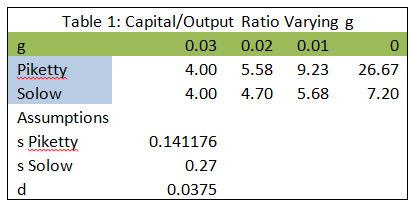 Krusell responds to DeLong here making the additional point that their thought experiments show that Piketty’s assumption about savings is implausible at any depreciation rate (see also Hamilton on this point).
First: if the net rate of saving remains positive as the economy’s growth rate falls toward zero, as Piketty assumes in his second fundamental law of capitalism, the gross saving rate in the economy must approach 100%. This observation is a way of illustrating how unreasonable the behavioral assumptions underlying his theory of saving really are.
Second: according to standard, and much more reasonable, saving theory (based either on the standard textbook Solow growth model or on the permanent-income model), the net saving rate must fall with the rate of growth, and become zero when growth is zero.
…These points are key because Piketty’s predictions are all about what happens as growth falls during the 21st century, as he argues it will.
…both of these results hold no matter what the depreciation rate is (so long as it is positive).
The heart of Piketty’s theory is his expression for the capital share of income in the long run, α = r × s/g with the prediction that if g falls the capital share will rise tremendously. This is a good opportunity to summarize some of the recent points about the theory.
There are no contradictions but many a slip ‘twixt the cup and the lip. Namely, will g fall? If g does fall, will K/Y increase? If K/Y increases will capital’s share of income increase? My answers:
Will g fall? Uncertain. Piketty’s forecast is as good as anyone’s. My own view is that at the global level g has been increasing for several centuries and that this will continue, especially because in this century we will see a massive increase in the number of scientists and engineers as China and then India devote increased human capital to the research frontier.
If g does fall, will K/Y increase? Yes, but probably less than Piketty estimates and more in line with Solow.
If K/Y increases will capital’s share of income increase? Uncertain but more likely no than yes. It depends on the elasticity of substitution between K and L and as Rognlie and Summers argue, the elasticity that Piketty needs is higher than current estimates suggest is the case.
Rating the FDA by Division: Comparison with EMA
Reporters have been asking the FDA about my paper with DiMasi and Milne, AN FDA REPORT CARD. As you may recall, the upshot of that paper is that there is wide variance in the performance of FDA divisions. Here, for example, is the mean time to approval across divisions. 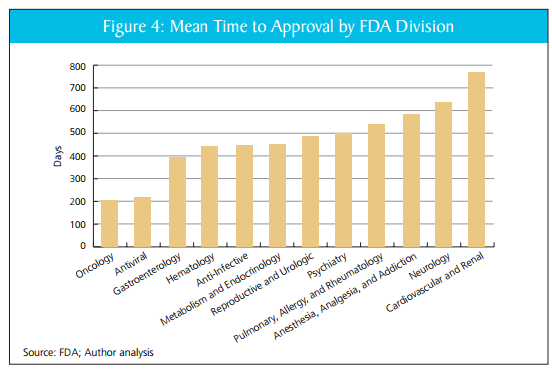
Our simple index, discussed in the paper, suggests that these differences are not easily explained by factors such as resources, complexity of task or differences in safety tradeoffs across divisions. In responding to our paper, however, the FDA has said that similar differences in time to approval by drug type are seen at other drug approval agencies. If true, that would be an important criticism.
Fortuitously, some relevant data crossed our desk recently. The Center for Innovation in Regulatory Science (CIRS), a UK based research consortium, compared median review times at the FDA to the next most important drug regulatory agency in the world, the European Medicines Agency (they also look at the Japanese agency). To their credit, the FDA is faster on average than the EMA (thanks PDUFA!). What is relevant for our purposes, however, is to compare differences across divisions.
The CIRS breaks drugs into broader classes than we used but the story they tell for the FDA is similar to ours; anti-cancer drugs, for example, are approved much more quickly than neurology drugs. The story for the EMA, however, is very different than for the FDA. For the EMA all types of drugs are approved in roughly the same amount of time.
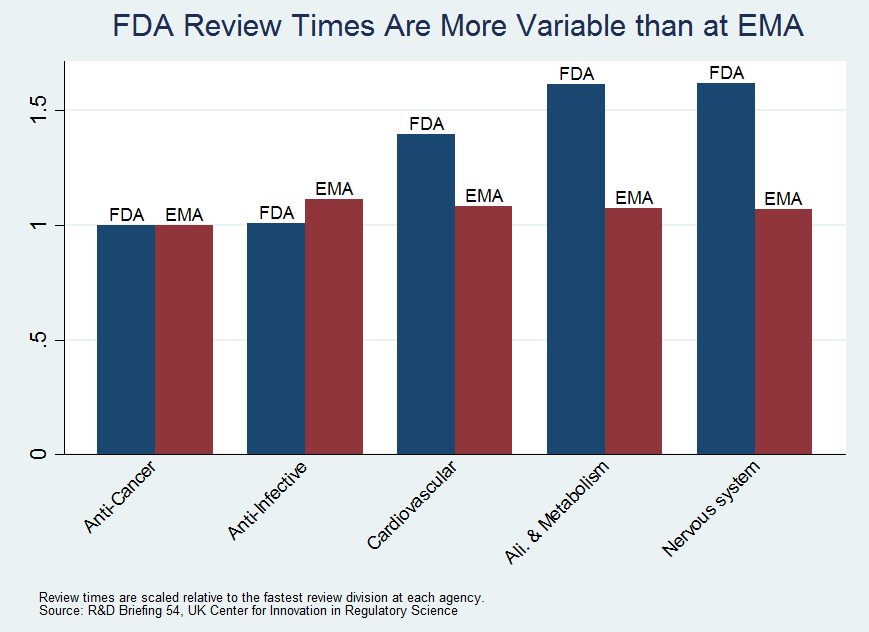
We have argued that the wide variance in performance at the FDA is suggestive of differences in productivity. The fact that we do not see the same wide variance in performance at the EMA is supportive of our argument. Our goal and conclusion still stand:
We support further study to identify the policies and procedures that are working in high-performing divisions, with the goal of finding ways to apply them in low-performing divisions, thereby improving review speed and efficiency.
The Authors Alliance vs. The Authors Guild
I am a founding member of the Authors Alliance.
[The Alliance represents] authors who create to be read, to be seen, and to be heard. We believe that these authors have not been well served by misguided efforts to strengthen copyright. These efforts have failed to provide meaningful financial returns to most authors, while instead unacceptably compromising the preservation of our own intellectual legacies and our ability to tap our collective cultural heritage. We want to harness the potential of global digital networks to share knowledge and products of the imagination as broadly as possible. We aim to amplify the voices of authors and creators in all media who write and create not only for pay, but above all to make their discoveries, ideas, and creations accessible to the broadest possible audience.
The Authors Guild (a nice medieval name) isn’t happy with the Alliance. Board member T.J. Stiles warns writers not to join the Alliance which he says is for academics and hobbyists and not for real authors like himself. I could reply but let me turn it over to full time professional writer and editor Virginia Postrel:
…the guild has for years actively undermined my interests while claiming in federal court to speak in my name. It channels commercial authors’ understandable anxieties about piracy threats and increasing competition into unjustified attacks on institutions and practices, such as fair use and computer indexing, that help us create new works and promote existing ones. It feeds authors’ fears while working to make it harder to write and sell books.
…In his blog post, Stiles invoked “people who copy and distribute your work without your permission.” You might assume he was talking about plagiarists and pirates. But what he really meant was the scanning, search and snippets offered by Google Books, or the digital preservation and indexing provided by the nonprofit HathiTrust. The Authors Guild has been fighting these projects in court. It claims that scanning books in order to make them searchable constitutes a copyright violation, even if the only thing shared with the public is a tiny bit of text (Google) or the page numbers on which a search term appears (HathiTrust)….
Last November, U.S. Circuit Judge Denny Chin dismissed the Authors Guild suit against Google. His ruling emphatically affirmed the “significant public benefits” of Google Books — including the benefits for authors and publishers — and declared the service easily within the legal definition of fair use. The Authors Guild said it would appeal the ruling. It is also appealing a 2012 circuit court ruling against it in the HathiTrust suit.
If the Authors Guild fears losing its members it has no one to blame but itself for supporting these ridiculous and counter-productive lawsuits.
Piketty v. Solow
Krusell and Smith lay out the Solow and Piketty growth models very nicely but perhaps not in a way that is immediately transparent if you are not already familiar with growth models. Thus, in this note I want to lay out the differences using the Super Simple Solow model that Tyler and I developed in our textbook. The Super Simple Solow model has no labor growth and no technological growth. Investment, I, is equal to a constant fraction of output, Y, written I=sY.
Capital depreciates–machines break, tools rust, roads develop potholes. We write D(epreciation)=dK where d is the rate of depreciation and K is the capital stock.
Now the model is very simple. If I>D then capital accumulates and the economy grows. If I<D then the economy shrinks. Steady state is when I=D, i.e. when we are investing just enough each period to repair and maintain the existing capital stock.
Steady state is thus when sY=dK so we can solve for the steady state ratio of capital to output as K/Y=s/d. I told you it was simple.
Now let’s go to Piketty’s model which defines output and savings in a non-standard way (net of depreciation) but when written in the standard way Piketty’s saving assumption is that I=dK + s(Y-dK). What this means is that people look around and they see a bunch of potholes and before consuming or doing anything else they fill the potholes, that’s dK. (If you have driven around the United States recently you may already be questioning Piketty’s assumption.) After the potholes have been filled people save in addition a constant proportion of the remaining output, s(Y-dk), where s is now the Piketty savings rate.
Steady state is found exactly as before, when I=D, i.e. dK+s(Y-dK)=dK or sY=sdK which gives us the steady level of capital to output of K/Y=s/(s d).
Now we have two similar looking expressions for K/Y, namely s/d for Solow and s/(s d) for Piketty. We can’t yet test which is correct because nothing requires that the two savings rates be the same. To get further suppose that we now allow Y to grow at rate g holding K constant, that is over time because of better technology we get more Y per unit of K. Since Y will be larger the intuition is that the equilibrium K/Y ratio will be lower, holding all else the same. And indeed when you run through the math (hand waving here) you get expressions for the Solow and Piketty K/Y ratios of s/(g+d) and s/(g+sd) respectively, i.e. a simple addition of g to the denominator in both cases (again bear in mind that the two s’s are different.)
We can now see what the models predict when g changes–this is a key question because Piketty argues that a fall in g (which he predicts) will greatly increase K/Y. Here is a table showing how K/Y changes with g in the two models. I assume for both models that d=.05, for Solow I have assumed s=.3 and for Piketty I have calibrated so that the two models produce the same K/Y ratio of 3.75 when g=.03 this gives us a Piketty s=.138.

As g falls Piketty predicts a much bigger increase in the K/Y ratio than does Solow. In Piketty’s model as g falls from .03 to .01 the capital to output ratio more than doubles! In the Solow model, in contrast, the capital to output ratio increases by only a third. Remember that in Piketty it’s the higher capital stock plus a more or less constant r that generates the massive increase in income inequality from capital that he is predicting. Thus, the savings assumption is critical.
I’ve already suggested one reason why Piketty’s saving assumption seems too strong–Piketty’s assumption amounts to a very strong belief that we will always replace depreciating capital first. Another way to see this is to ask where does the extra capital come from in the Piketty model compared to Solow? Well the flip side is that Solow predicts more consumption than Piketty does. In fact, as g falls in the Piketty model so does the consumption to output ratio. In short, to get Piketty’s behavior in the Solow model we would need the Solow savings rate to increase as growth falls.
Krusell and Smith take this analysis a few steps further by showing that Piketty’s assumptions about s are not consistent with standard maximizing behavior (i.e. in a model in which s is allowed to vary to maximize utility) nor do they appear consistent with US data over the last 50 years. Neither test is definitive but both indicate that to accept the Piketty model you have to abandon Solow and place some pretty big bets on a non-standard assumption about savings behavior.