Open Borders Day!
Today, March 16, is Open Borders Day, a day to celebrate the right to emigrate and the right to immigrate; to peacefully move from place to place. It is a day worth celebrating everywhere both for what has been done already and for the tremendous gains in human welfare that can but are yet to be achieved. It is also a day to reflect on the moral inconsistency that says “No one can be denied equal employment opportunity because of birthplace, ancestry, culture, linguistic characteristics common to a specific ethnic group, or accent” and yet at the same time places heavily armed guards at the border to capture, imprison, turn back and sometimes kill immigrants.

The Cost of Aging Infrastructure
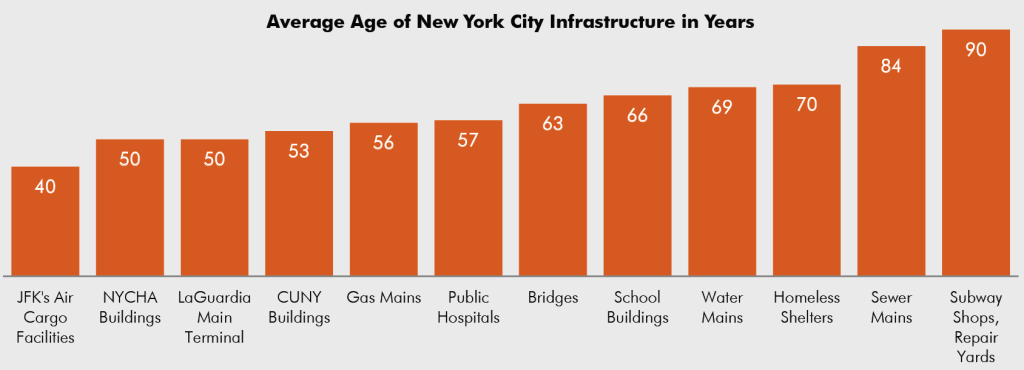
The complete destruction of a building in NYC from a gas explosion makes this report (pdf, summary here), from which the graphic is drawn, from the Center for an Urban Future timely. The Center also reports that the cost of building infrastructure in NYC has risen by 50% since 2000 alone. As I said in Launching the Innovation Renaissance:
Building in the United States today, for example, requires navigating a thicket of environmental, zoning and aesthetic regulations that vary not only state by state but county by county. If building a house is difficult, try building an airport. Passenger travel has more than tripled since deregulation in 1978, but in that time only one major new airport has been built: Denver’s. That airport is now the fourth busiest in the world. Indeed the top seven busiest airports are all in the United States, not so much because we are big but because without new construction we are forced to overcrowd our existing infrastructure. The result is delays and inefficiency. Meanwhile, China is building 50 to 100 new airports over the next 10 years.
…Our ancestors were bold and industrious. They built a significant portion of our energy and road infrastructure more than half a century ago. It would be almost impossible to build that system today. Could we build the Hoover Dam today? We have the technology. We seem to lack the will. Unfortunately, we cannot rely on the infrastructure of our past to travel to our future.
Government’s Empty Buildings Are Costing Taxpayers Billions

The boarded up building in the photo sits a mere 6 blocks from the White House on prime real estate but it’s been empty for 30 years! What’s the problem? The building is owned/controlled by the Federal government which often doesn’t even know what it owns, lacks the incentive to control costs and whose bureaucratic strictures make selling difficult even when motivation exists.
From an excellent piece on NPR:
Government estimates suggest there may be 77,000 empty or underutilized buildings across the country. Taxpayers own them, and even vacant, they’re expensive. The Office of Management and Budget believes these buildings could be costing taxpayers $1.7 billion a year.
…But doing something with these buildings is a complicated job. It turns out that the federal government does not know what it owns.
…even when an agency knows it has a building it would like to sell, bureaucratic hurdles limit it from doing so. No federal agency can sell anything unless it’s uncontaminated, asbestos-free and environmentally safe. Those are expensive fixes.
Then the agency has to make sure another one doesn’t want it. Then state and local governments get a crack at it, then nonprofits — and finally, a 25-year-old law requires the government to see if it could be used as a homeless shelter.
Many agencies just lock the doors and say forget it.
The NPR article is excellent but it vastly underestimates the size of the problem. In addition to empty buildings, the Federal government owns/controls millions of acres of land that are worth hundreds of billions and perhaps even trillions of dollars. The land is not being used to its full value or potential even though maintenance costs runs in the tens of billions annually.
The SAT, Test Prep, Income and Race
The announcement of the new, new SAT has created a lot of hand-wringing about SAT scores and their correlations with income and also race. Wonkblog, the New York Times and many others all feature a table or chart showing how SAT scores increase with income. Wonkblog says these charts “show how the SAT  favors rich, educated families,” and the NYTimes says about the SAT, “A Test of Knowledge or Income?” The consensus explanation for these “shocking” results is the evil of test prep as summarized by NBCNews:
…there is also mounting criticism as to whether students who can afford expensive SAT test preparation courses have an unfair advantage, especially given a strong correlation between family income level and test results.
Similarly, Chris Hayes blames test prep for inequality:
We’ve had…the growth of this tremendous testing and test prep industry in New York, along with the massive rise in inequality and it has produced a system in which the school is now admitting only three, four, five black and Latino students. The students they are admitting are almost entirely white, affluent kids with tutors or second generation, first generation immigrants from Queens and other places where the parents pay for test prep. You end up with a system where who you are really letting in are the kids with access to test prep, the kids with access to resources.
All of this is almost entirely at variance with three facts, all of which are well known among education researchers.
First, test prep has only a modest effect on test scores, on the order of 20-40 points combined for a commercial test preparation service. More expensive services such as a private tutor are towards the high of this range, cheaper sources such as a high-school course towards the lower. Buchmann et al., for example, estimate that private tutors increase scores by 37 points while a high school course increases scores by 26 points.
The average SAT score among those with a family income of $20,000-$40,000 is 1402 while the average score among those with an income $100,000 higher, $120,000-$140,000, is 1581 for a 179 point difference. Even if every rich family had a private tutor and none of the poor families had any test prep whatsoever, test prep would explain only 20% of the difference 37/179. If rich families rely on tutors and poor families rely on high school courses, the difference in test prep would explain only 6% (11/179) of the difference in score.
The second surprising fact about test prep is that it doesn’t vary nearly as much by income as people imagine. In fact, some studies find no effect of income on test prep use while others find a positive but modest effect. The latter study finding (what I call) a modest effect finds that in their sample a 2-standard deviation increase in income above the mean increases the probability of using a private test prep course less than whether “Parent encouraged student to prep for SAT (yes or no).”
Since test prep differs by income only modestly and since test prep increases scores only modestly, the effect of income on test scores through test prep is small, Modest*Modest=Small. Contrary to the consensus, test prep can in no way account for the large differences in SAT score by income.
The third fact is that test prep varies by race in the opposite way that people imagine. In the quote above, Chris Hayes suggests that whites use test prep much more than blacks. In fact, blacks use test prep more than whites, as is well documented among education researchers (e.g. here, here, here), e.g. from the first link:
…blacks and Hispanics are more likely than whites from comparable backgrounds to utilize test preparation. The black-white gap is especially pronounced in the use of high school courses, private courses and private tutors.
Indeed, since blacks use test prep more than whites and blacks have lower SAT scores than whites the effect of test prep is to reduce not increase the black-white gap in scores. Of course, the net reduction in the gap is small.
The Great Divide over Market Efficiency
Clifford Asness and John Liew have an excellent piece in Institutional Investor on Fama, Shiller and The Great Divide over Market Efficiency. Asness and Liew are both students of Fama so you might expect them to come down squarely on the side of market efficiency but they are also co-founders of AQR Capital, an asset management firm ($100 billion under management) with an unusually empirically driven approach to investing. In addition to publishing and using its own research, for example, AQR sponsors the AQR Insight Award which:
…recognizes important, unpublished papers that provide the most significant, new practical insights for tax-exempt institutional or taxable investor portfolios.
The Insight award is worth up to $100,000 so the firm is serious in thinking that research can be profitable.
Asness and Liew argue that just a few anomalies are robust across time, countries, and asset markets, notably momentum and value. On value, they note that a trading strategy of high minus low, that is long a portfolio of cheap stocks (high book value to price) and short a portfolio of expensive stocks (low book value to price) has generated consistently high returns relative to (CAPM) risk over time, albeit not without occasional terrifying episodes.
The efficient market explanation is that book value to price is a stand-in for a non-diversifiable risk factor. The behavioral story is that “a lot of individuals and groups (particularly committees) have a strong tendency to rely on three-to five-year performance evaluation horizons.” As a result, they chase “winners” and flee “losers” over a 3-5 year horizon which generates momentum and the mispricing that makes the value strategy successful. As Asness and Liew put it “investors act like momentum traders over a value time horizon.”
Asness and Liew then follow up with a very astute counter-argument to the risk-factor story:
Also, many practitioners offer value-tilted products and long-short products that go long value stocks and short growth stocks. But if value works because of risk, there should be a market for people who want the opposite. That is, real risk has to hurt. People should want insurance against things like that. Some should desire to give up return to lower their exposure to this risk. However, we know of nobody offering the systematic opposite product (long expensive, short cheap)…the complete lack of such products is a bit vexing for the pure rational based risk-based story.
Lots of other history and insights.
Constitutions Quantified
The Comparative Constitutions Project has collected data from 720 of the 800 or so constitutions written since 1789. The shortest constitution, for example, is that of Jordan at 2,270 words while the longest is that of India which at 146,385 words is more than twice as long as the next longest constitution and considerable longer than the US  constitution at 7,762 words. The New Zealand constitution grants the fewest rights, namely zero, while the Bolivian constitution grants the most rights at 88.
Among the rights in the Bolivian constitution are “Every person has the right to health.” That does seem ambitious, although I cannot guarantee the translation perhaps it says health care in the original? There are also rights to homes, sewers, and telecommunication services. I cannot go along with those but I do think this is an advance:
Neither the public authority, nor any person or body may intercept private conversations or communications by an installation that monitors or centralized them.
Venezuela offers almost as many rights in its constitution as Bolivia, 81 according to the data. Nevertheless, I think I would feel more secure in my rights living in New Zealand than Bolivia or Venezuela. A constitution with a long list of rights is a bit like a prenup with a long list of rights, looks good on parchment but parchment does not a marriage or a constitution make.
Markets in Everything: Prostitution for Beginners
The Guardian: An enterprising association of sex workers in Barcelona has angered some of Spain’s most prominent feminists by offering an “intro to prostitution” course in response to what its members say is a growing number of women turning to sex work in the wake of Spain’s financial crisis.
…Four hours was too little time, she said, to cover a list of topics such as dealing with the stigma of prostitution, sex tricks, filing tax returns and marketing. A second day will be held this month because of high demand. “Nobody else can teach these things,” said Borrell. “Not psychologists, anthropologists or political scientists – only prostitutes.”
In related stories, this piece on the legal, mega-brothels of Germany is well produced.
What I worry about
LATimes: A 30,000-year-old giant virus has been revived from the frozen Siberian tundra, sparking concern that increased mining and oil drilling in rapidly warming northern latitudes could disturb dormant microbial life that could one day prove harmful to man.
The original research is here. Have a nice day.
Software Patents are Not Good Property Rights
A good system of property rights establishes clear borders. Clear borders reduce disputes, encourage investment and promote efficient trade. Software patents, however, often fail to define clear borders. I am one of the amici in a amici curiae brief to the Supreme Court (regarding Alice Corp. v. CLS Bank) on software patents that makes this point:
Such abstract claims as “displaying data in
frames,” “recommending media based on past choices,” “reproducing information in material objects at a
point of sale,” or, as in the present case, using “a third
party . . . to eliminate ‘counterparty’ or ‘settlement’
risk,” simply cannot be reliably construed to define a
reasonable area of covered technology. See Wang, 197
F.3d at 1379; Interactive Gift, 256 F.3d at 1323; Pinpoint, 369 F. Supp. 2d at 995; cf. CLS Bank Int’l v.
Alice Corp. Pty. Ltd., 717 F.3d 1269, 1274 (Fed. Cir.
2013).A general counsel at a technology startup
would be hard-pressed to describe any concrete
bounds or permissible follow-on innovations to her
fellow engineers in the face of such claims. Any
software that resulted in a similar functional result
could be construed as infringing, and any investment
in the commercialization of those technologies could
inevitably carry liabilities, risks, and costs whose
magnitudes are impossible to predict in advance.
Thus, the property system that ostensibly exists to
assure investors that long-term rents are secure does
the very opposite, casting a pall of uncertainty over
the viability of any commercial product that happens
to be adjacent to a lurking abstract claim.
Eli Dourado and I note that the Federal Circuit seems to have quite willfully disregarded the intent of the Supreme Court regarding patents on abstract ideas and I think this case may provide further pushback from the SC.
Public Choice Outreach 2014!
I write to ask your help recruiting promising undergraduate or graduate students for our annual Public Choice Outreach Conference. The 2014 Conference will be held on June 6 – 8, 2014 at the Hyatt Arlington conveniently located close to the National Mall and Georgetown areas of Washington DC. Applications are now available and are due on Friday, April 11, 2014.
The Public Choice Outreach Conference is designed as a “crash course” in Public Choice for students planning careers in academia, journalism, law, or public policy. Graduate students and advanced undergraduates are eligible to apply. Many graduates of the Outreach seminar have gone on to notable careers in academia, law and business. Students majoring in economics, history, international studies, law, philosophy, political science, psychology, public administration, religious studies, and sociology have attended past conferences as have a few mayors and other politicians! Applicants unfamiliar with Public Choice and students from outside of George Mason University are especially encouraged.
A small stipend is available and meals and rooms will be provided by the conference (for non-locals). Space, however, is very limited.
More information here.
P.S. Tyler and myself will both be speaking along with an all-star cast of scholars!
Markets in Everything: Protest Rights
At the Olympics if you want to protest a decision, you must have cash:
The reason that Mathieu — and many other coaches across most Olympic sports — make certain they always have a specific amount of cash on hand is that if they want to protest an official decision during competition, they need more than just a strong opinion and an angry yell.
They also need money.
…Depending on the sport, the fee varies: for luge, it is 50 euros (about $67). Cross-country skiing, like snowboard and Alpine skiing, demands 100 Swiss francs (about $112) but stipulates that all protests must be submitted in English. Bobsled and skeleton are among the most expensive: they require a deposit of 100 euros before any protest will even be considered. If multiple countries want to make a similar protest, sharing the tab is allowed.
Hat tip to the excellent PriorProbability who also points out that if your protest is successful you get your money back so these payments are also protest bets.
Indirect Bribing with Plausible Deniability
From a new working paper by Stefano Della Vigna, Ruben Durante, Brian Knight, and Eliana La Ferrara
We examine the evolution of advertising spending by firms over the period 1994 to 2009, during which Silvio Berlusconi was prime minister on and off three times, while maintaining control of Italy’s major private television network, Mediaset. We predict that firms attempting to curry favor with the government shift their advertising budget towards Berlusconi’s channels when Berlusconi is in power. Indeed, we document a significant pro-Mediaset bias in the allocation of advertising spending during Berlusconi’s political tenure. This pattern is especially pronounced for companies operating in more regulated sectors…
In the United States, Lyndon Johnson made his fortune, working through Lady Bird, in similar ways. As Robert Caro wrote in Means of Ascent:
As one businessman puts it: “Everyone knew that a good way to get Lyndon to help you with government contracts was to advertise over his radio station.”
Jack Shafer, drawing on Caro, summarizes the details in The Honest Graft of Lady Bird Johnson.
Hat tip: John van Reenen.
The Moral Is the Practical
Tyler concedes the moral high ground to advocates of open borders but argues that the proposal is “doomed to fail and probably also to backfire in destructive ways.” In contrast, I argue that the moral high ground is tactically the best ground from which to launch a revolution. In Entrepreneurial Economics I wrote:
No one goes to the barricades for efficiency. For liberty, equality or fraternity, perhaps, but never for efficiency.
Contra Tyler, the lesson of history is that few things are as effective at launching a revolution as is moral argument. Without the firebrand Thomas “We have it in our power to begin the world over again“ Paine, the American Revolution would probably never have happened. Paine’s Common Sense, the most widely read book of its time, is about as far from Tyler’s synthetic, marginalist argument as one can imagine and it was effective.
 When in 1787 Thomas Clarkson founded The Society for the Abolition of the Slave Trade a majority of the world’s people were held in slavery or serfdom and slavery was considered by almost everyone as normal, as it had been considered for thousands of years and across many nations and cultures. Slavery was also immensely profitable and woven into the fabric of the times. Yet within Clarkson’s lifetime slavery would be abolished within the British Empire. Whatever one may say about this revolution one can certainly say that it was not brought about by a “synthetic and marginalist” approach. If instead of abolition, Clarkson had settled on the goal of providing for better living conditions for slaves on the voyage from Africa it seems quite possible that slavery would still be with us today.
In more recent times, civil unions have gone nowhere while equality of marriage has succeeded beyond all expectation. The problem with civil unions, and with the synthetic and marginalist approach more generally, is that even though it offers everyone something that they want, it concedes the moral high ground–perhaps there is something different about gay marriage which makes it ok to treat it differently–and for that reason it attracts few adherents. Moreover, the argument for civil unions doesn’t force the opposition to enunciate the moral arguments for their opposition and when the moral ground of the opposition is weak that is a strategic failure.
The moral argument for open borders is powerful. How can it be moral that through the mere accident of birth some people are imprisoned in countries where their political or geographic institutions prevent them from making a living? Indeed, most moral frameworks (libertarian, utilitarian, egalitarian, and others) strongly favor open borders or find it difficult to justify restrictions on freedom of movement. As a result, people who openly defend closed borders sound evil, even when they are simply defending what most people implicitly accept. When your opponents occupy ground that they cannot–even on their own moral premises–defend then it is time to attack.
The Return of Command and Control
I spoke earlier this week at a conference on markets and the environment at the R Street Institute (I spoke about prizes). Many of the speakers were Reagan era politicians and appointees who are proud of Reagan and Bush’s successful approach to the environment and decry the inability to make progress today.
Back then, Republican’s were willing to accept environmental goals so long as they were achieved efficiently using market means and Democrats were willing to accept markets means to achieve environmental goals. Today, the Republicans are no longer willing to accept the environmental goals regardless of the means. The result, however, hasn’t been the ending of the goals it’s been that Democrats no longer accept market means.
Jeffrey Frankel argues that the net effect has been a disastrous return to command and control.
In the United States, the highly successful cap-and-trade system for sulfur-dioxide emissions has effectively vanished. In Europe, the Emissions Trading System (ETS), the world’s largest market for carbon allowances, has become increasingly irrelevant as well. On both sides of the Atlantic, market-oriented environmental regulation has in effect been superseded over the last five years by older “command-and-control” approaches, by which the government dictates who should use which technologies, in what amounts, to reduce which emissions.
As recently as 2008, the Republican candidate for US president, Senator John McCain, had sponsored legislative proposals to use cap and trade to address emissions of carbon dioxide and other greenhouse gases.
But Republican politicians now seem to have forgotten that this approach was once their policy. In 2009, they worked to defeat climate-change legislation by relying on anti-regulation rhetoric that demonized their own creation. This left only less market-friendly alternatives – especially after court cases upheld the validity of the 1970 Clean Air Act. Though such alternatives are less efficient, they are again the operative regime.
…government attempts to address market failures can themselves fail. In the case of the environment, command-and-control regulation is inefficient, discourages innovation, and can have unintended consequences (like Europe’s growing reliance on coal).
Improving GDP
Under EU rules Britain will add illegal drug sales and prostitution to its calculations of GDP:
HPost: Britain makes £10 billion a year thanks to drug dealers and prostitutes, the government’s statistics watchdog is set to confirm.
The Office for National Statistics is expected to comply with new EU rules by revealing its first estimates for the size of the illegal industries and how it has reached these calculations as soon as March or April.
Prostitution in Britain is set to be valued at around £3 billion a year while the drug dealing sector is set to be valued at £7 billion, with both of them factored into the UK’s £1.6 trillion gross domestic product, according to the Times.