Pi.rate
The latest example of Intellectual Privilege running out of control is a guy who trademarked the symbol Pi with a period afterwards. Here is Jez Kemp:
Designers are in uproar and filing counter notices after print company Zazzle upheld a man’s claim to own the pi symbol on clothing.
Paul Ingrisano, a pirate living in Brooklyn New York, filed a trademark under “Pi Productions” for a logo which consists of this freely available version of the pi symbol π from the Wikimedia website combined with a period (full stop). The conditions of the trademark specifically state that the trademark includes a period.
The trademark was granted in January 2014 and Ingrisano has recently made trademark infringement claims against a massive range of pi-related designs on print-on-demand websites including Zazzle and Cafepress.
Surprisingly, Zazzle accepted his claim and removed thousands of clothing products using this design, emailing designers that their work was infringing Pi Productions’ intellectual property – even designs not using a full stop.
At first Zazzle’s Content Review team responded to their very angry designers and store keepers with generic emails, suggesting they file counter notices if they felt aggrieved.
But now Zazzle’s latest response is that they are acting to protect Paul Ingrisano’s “intellectual property” from “confusingly similar” designs as under the Lanham Act 1946 – including designs which do not even contain the pi symbol, but just the word “pi” in their design name.
I don’t expect this particular outrage to last but as with absurd patents the real outrage is that this does accurately represent the law as it exists today.
The Invisible Hand of Eco-nomics
Cap and trade is going nowhere at the federal level but the California program is large and expanding and the CA program allows for properly monitored and regulated offsets to be purchased from anywhere in the United States. As a result, a price on carbon is being established nationally. As the NYTimes indicates in a very good article, once a market and a price have been established, contentious politics turns into mutually beneficial economics.
Experts who support cap and trade contend that a market mechanism can reach more deeply into the economy than any other approach, changing the behavior even of people and companies that might not necessarily care about global warming.
The Wisconsin dairymen perhaps serve as an example of that.
Even as the methane-powered generator roared on his property, John T. Pagel said he was not convinced that the climatic changes happening in the United States were a result of human emissions. He suspects they might be part of a natural cycle. But with Californians dangling cash in exchange for his willingness to cut emissions, he jumped at the chance to build his digester.
“We are doing exactly what they asked us to do to get paid to reduce carbon,” Mr. Pagel said. “If somebody else believes in it enough to put up the money, that’s all I need to know.”
Financial Literacy
Consider the following three questions (from Lusardi and Mitchell):
1. Suppose you had $100 in a savings account and the interest rate was 2% per
year. After 5 years, how much do you think you would have in the account if you
left the money to grow.More than $102. Exactly $102,. Less than $102? Do not know. Refuse to answer.
2. Imagine that the interest rate on your savings account was 1% per year and
inflation was 2% per year. After 1 year, would you be able to buy.More than, exactly the same as, or less than today with the money in this account? Do not know. Refuse to answer.
3. Do you think that the following statement is true or false? ‘Buying a single
company stock usually provides a safer return than a stock mutual fund.’T. F. Do not know. Refuse to answer.
Sadly, most Americans rate themselves high on financial acuity but they cannot answer all three questions correctly.
Only about a third of Americans answer all three questions correctly (and that figure is inflated somewhat due to guessing). The Germans and Swiss do significantly better (~50% all 3 correct) on very similar questions but many other countries do much worse. In New Zealand only 24% answer all 3 questions correctly and in Russia it’s less than 5%.
Some of the variation can be explained by experience. The Japanese, for example, don’t have much experience with inflation in recent decades and they perform poorly on that question. The questions, however, can hardly be considered esoteric and a large literature indicates that the ability to answer these questions correlates with the ability to intelligently make real and important financial decisions regarding mortgage refinancing, credit card borrowing, and retirement planning.
Most states now require that financial literacy be taught to high school students and there is some evidence that teaching financial literacy improves financial outcomes later in life but the evidence is not strong and most teachers still feel that they are unqualified to teach the basic concepts.
In my opinion, improving financial literacy is one of the areas in which principles of economics teachers can make a great contribution to their students. Modern Principles, my text with Tyler, contains extensive material on these topics including a chapter on stock markets and personal finance but more needs to be done.
Addendum: Take the quiz here (with a few more questions). Hat tip: PD Shaw and Tim Ogden for an added link.
A Critique of Tabarrok on Bundling
In my MRUniversity video on the economics of bundling I argue that bundling raises total surplus and that requiring the Cable TV companies to price by the channel is unlikely to reduce most people’s cable bill (see also Does Cable TV Ripoff People Who Don’t Like Sports?). Pragmatarianism offers an excellent critique. Here is one bit from a longer post worth reading in full:
The flaw in Tabarrok’s logic is that it completely ignores the necessity of determining what the actual demand is for the individual components in the bundle. For example, when I subscribed to cable…Charter had no idea how much I valued the Discovery Channel. Neither did the Discovery Channel. But is my valuation relevant? According to Tabarrok…it really isn’t. Uh, what?
How could the Discovery Channel and Charter and Tabarrok not care what the actual demand is for the Discovery Channel? In the absence of consumer valuation…how could society’s limited resources be put to their most valuable uses?
Tabarrok is basically arguing that we don’t need accurate information in order to efficiently allocate resources. Except, does he really believe that? Let me consult my magic database…The most valuable public goods are constantly changing, just as the most valuable private goods are constantly changing. The signal provided by prices and mobility is therefore of great importance. – Alexander Tabarrok, in The Voluntary City
Huh. Hmmm. Is the Discovery Channel a private good? Yes. Is its value constantly changing? Yes. So…according to Tabarrok…it’s of great importance that the Discovery Channel should have its own price. But this sure wasn’t what he said in his video.
An excellent point that was made most forcefully by Ronald Coase in The Marginal Cost Controversy. Coase argued that pricing goods with high fixed cost at marginal cost would generate static efficiency but at the price of dynamic efficiency because we would not be able to say with assurance that the total value of the product exceeded total cost. Similarly we lose some information with bundling, perhaps especially so because marginal cost in this case is zero. With bundling, we know that the total value of the bundle exceeds the total cost but we are less certain that the total value of each bundle component (channel) exceeds the total cost of each component.
But this cannot be the whole story because in another paper, The Nature of the Firm, Coase pointed out that sometimes we choose not to use prices. Firms, for example, are islands of central planning in a market ocean (see Yglesias for a good discussion).
A channel such as HBO is itself a bundle of dramas, comedies and documentaries. Should Girls and Game of Thrones always be priced and sold separately and not through the HBO bundle? HBO certainly learns something from individually priced downloads on iTunes and that information helps HBO to improve its service. But how much is this information worth?
In 2002 should HBO have individually priced episodes of the Sopranos and sold them through AOL? Individual pricing generates value but it also has costs. Tradeoffs are everywhere. And, to the crux of the issue, if a law had been passed in 2002 requiring HBO to sell The Sopranos on an episode by episode basis would that have resulted in better and more programming at lower prices? I think not. Similarly, I see few reasons to think that welfare would be improved by a law requiring cable TV companies to price by channel.
More generally, the price system is embedded in the larger field of the market economy which includes non-price institutions such as firms; and the market economy is embedded in the larger field of civil society which includes non-profits and non-market institutions such as the family. Economists often focus on the virtues of the price system but that should not blind us to the many virtues and many margins on which a free society operates.
China Fact of the Day
In the course of making the case that China’s property bubble is popping the FT notes:
In just two years, from 2011 to 2012, China produced more cement than the US did in the entire 20th century, according to historical data from the US Geological Survey and China’s National Bureau of Statistics.
Copyright Control to Major Tom
Copyright control to Major Tom
commencing countdown
permissions gone
There’s something wrong
Can you hear me, Major Tom?
Background here.
Should the Future Get a Vote?
Philosopher Thomas Wells argues that future citizens need the vote today:
…future generations must accept whatever we choose to bequeath them, and they have no way of informing us of their values. In this, they are even more helpless than foreigners, on whom our political decisions about pollution, trade, war and so on are similarly imposed without consent. Disenfranchised as they are, such foreigners can at least petition their own governments to tell ours off, or engage with us directly by writing articles in our newspapers about the justice of their cause. The citizens of the future lack even this recourse.
The asymmetry between past and future is more than unfair. Our ancestors are beyond harm; they cannot know if we disappoint them. Yet the political decisions we make today will do more than just determine the burdens of citizenship for our grandchildren. They also concern existential dangers such as the likelihood of pandemics and environmental collapse. Without a presence in our political system, the plight of future citizens who might suffer or gain from our present political decisions cannot be properly weighed. We need to give them a voice.
But how can we solve this problem? Wells has some very good insights:
If current citizens can’t help but be short-sighted, perhaps we should consider introducing agents who can vote in a far-seeing and impartial way. They would need to be credibly motivated to defend the basic interests of future generations as a whole, rather than certain favoured subsets, and they would require the expertise to calculate the long-term actuarial implications of government policies.
But then his solution turns laughable:
Such voters would have to be more than human. I am thinking of civic organisations, such as charitable foundations, environmentalist advocacy groups or non-partisan think tanks.
Well’s solution (give these groups votes) is so tied to his conception of what the “enlightened” future will bring that it clearly fails the far-seeing, impartiality, credibly motivated and expertise requirements that he outlines as desirable. We need not conclude, however, that Well’s plea is disingenuous or impossible but we do need a better implementation.
Robin Hanson’s government of prediction markets (“futarchy“) is a better approach. It is know well understood that relative to other institutions prediction markets draw on expertise to produce predictions that are far seeing and impartial. What is less well understood is that through a suitable choice of what is to be traded, prediction markets can be designed to be credibly motivated by a variety of goals including the interests of future generations.
To understand futarchy note that a prediction market in future GDP would be a good predictor of future GDP. Thus, if all we cared about was future GDP, a good rule would be to pass a policy if prediction markets estimate that future GDP will be higher with the policy than without the policy. Of course, we care about more than future GDP; perhaps we also care about environmental quality, risk, inequality, liberty and so forth. What Hanson’s futarchy proposes is to incorporate all these ideas into a weighted measure of welfare. Prediction markets would then be used to predict and make policy choices based on future welfare. Incorporated within the measure of welfare could be factors like environmental quality many years into the future.
Note, however, that even this assumes that we know what people in the future will care about. Here then is the final meta-twist. We can also incorporate into our measure of welfare predictions of how future generations will define welfare. We could, for example, choose a rule such that we will pass policies that increase future environmental quality unless a prediction market in future definitions of welfare suggests that future generations will change their welfare standards. It sounds complicated but then so is the problem.
In short, more than any other form of government, futarchy is based on far seeing, impartial, expertise driven and credibly motivated predictions of future welfare and it is flexible enough to allow for a wide definition of welfare including taking into account the interests of future generations.
Hat tip: Carl Close.
Vegetable Eggs
Technology Review: Hampton Creek’s CEO, Josh Tetrick, wants to do to the $60 billion egg industry what Apple did to the CD business. “If we were starting from scratch, would we get eggs from birds crammed into cages so small they can’t flap their wings, shitting all over each other, eating antibiotic-laden soy and corn to get them to lay 283 eggs per year?” asks the strapping former West Virginia University linebacker. While an egg farm uses large amounts of water and burns 39 calories of energy for every calorie of food produced, Tetrick says he can make plant-based versions on a fraction of the water and only two calories of energy per calorie of food — free of cholesterol, saturated fat, allergens, avian flu, and cruelty to animals. For half the price of an egg.
At present, Hampton Creek is focusing on finding vegetable proteins than can substitute for eggs in cakes, salad dressings, mayo and so forth rather than replacing the over-easy at the diner. As with in-vitro meat, however, vegetable eggs pursued for economic reasons will end up greatly supporting the 21st movement for vegetarianism.
Type I and Type II Errors Simplified
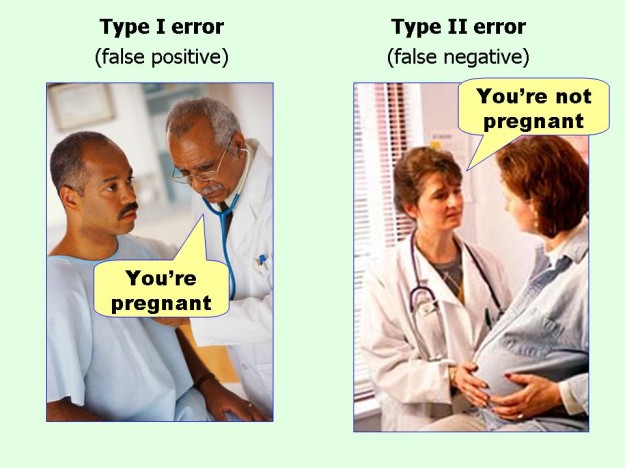
Hat tip: Flowing data. Original?
Make Work Bias
Here is our colleague Bryan Caplan with a great video on the Luddite fallacy or make work bias:
The Piketty Bubble?
Piketty’s Capital is not very clear on how to distinguish greater physical capital from higher asset prices. For the most part, Piketty discusses capital as something that builds up over time through savings. The increase in physical capital then generates large returns to rentiers and those returns increases the capital share of income. When it comes to measuring capital, however, this has to be done in money terms which means that we need the price of capital. But the price of capital can vary significantly; as a result, Piketty’s capital stock can vary significantly even without changes in physical capital or savings. When capital increases because of changes in its price, however, the implications are quite different from a physical increase in capital.
Consider an asset that pays a dividend D forever; at interest rate r the asset is worth P=D/r. As r falls, the price of the asset rises. An asset that pays $100 forever is worth $1000 at an interest rate of 10% (.1) but $2000 at an interest rate of 5%. Piketty measures a higher P as more capital but notice that P is high only because r is low. You can’t, therefore, multiply P by some fixed r and conclude that rents have increased. Indeed, in this case rents, the dividend, haven’t increased at all. For the most part, Piketty simply ignores this issue (at least in the book) by arguing that changes in the price of capital wash out over long time periods but that does not appear to be the case in his data.
According to four French economists, Piketty’s measure of the capital stock is greatly influenced by the Europe-US housing bubble that preceded the financial crisis (Tyler earlier pointed to the French version of this paper, this is the English version). Since Piketty’s theory is based on rents from physical capital, the authors suggest that measures of housing capital based on prices should be corrected using the rent to price ratio. In other words, if the rentiers aren’t getting more rents then their capital hasn’t really increased. When measured in this way, the authors find little to no increase in the capital stock in either France or the United States.
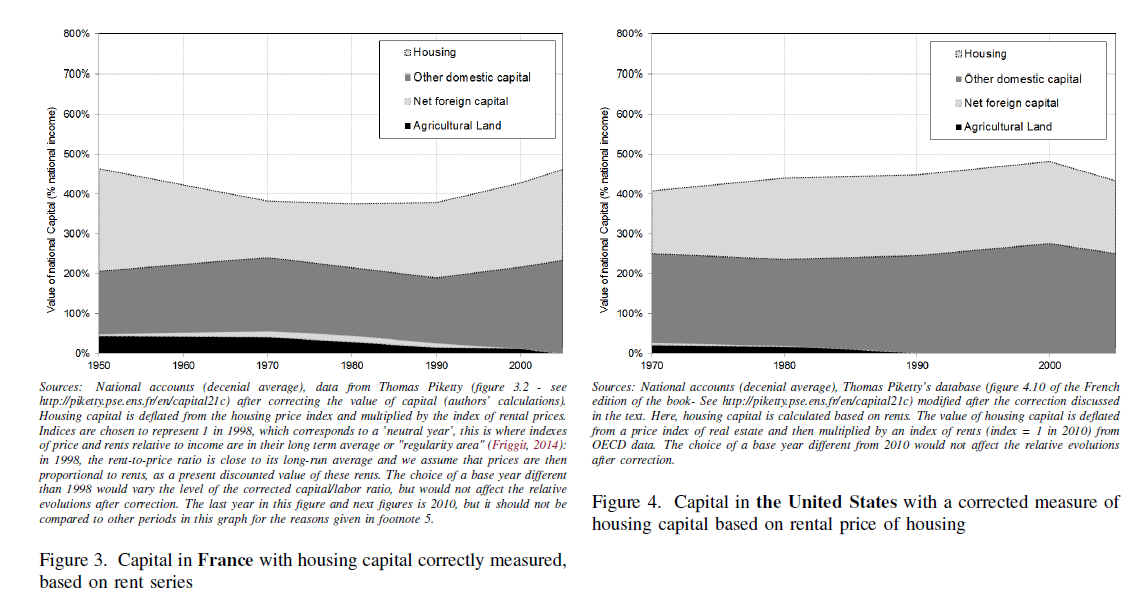
Addendum: Do note that the debate here is not about income inequality but rather the source of income inequality and the implications for the future that Piketty draws from a (possibly not) rising capital stock.
Two Surefire Solutions to Inequality
Here is a surefire solution to inequality–Increase fertility among the rich. If the rich had more children, capital would grow more slowly across the generations and perhaps not at all. If r=4 and g=2 then capital doubles as a share of the economy in 35 years (using the rule of 70). That figure is actually too low as it assumes that the wealthy save all of their capital income but let’s stick with 35 years and call that a generation. Wealth per rich person, however, only doubles if every wealthy family has just 2 children. If every wealthy family has 4 children, wealth per person doesn’t increase and so inequality does not increase even when r>g. If the wealthy consume about 20% of their capital income (still a very high savings rate) and have just 3 children then again we have approximate balance and no increase in inequality over the generations. With a more reasonable figure on r-g or with more children, wealth per person actually declines.
Thus, Piketty’s “patrimonial capital” contains its own internal contradiction. The more patrimony the less capital.
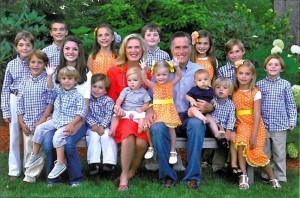 So how can we increase fertility among the rich? Mormon fertility is higher than average so capital inequality could decline if more rich people will be or become Mormons. Had we elected a President Romney (5 children and some 22 grandchildren! Or is it 23? Romney has lost count), perhaps that would have encouraged greater fertility among the rich.
It’s an evolutionary puzzle why the rich don’t have more children as the costs to them are low and at very high levels of wealth there is no quantity-quality tradeoff. Perhaps this is a temporary response to the shock of birth control. If so, the effect of the shock is likely to fade over time as evolution works its logic.
In Selfish Reasons to Have More Kids Bryan Caplan notes that we overestimate the effect of parental investment on children and we underestimate the pleasures of grandchildren, in both cases choosing too few children. The rich should read Bryan’s book.
In these calculations I have assumed that primogeniture won’t make a comeback, that seems solid. Assortative mating, however, will slow wealth dispersion. I have also assumed that savings and fertility are independent which is unlikely to be the case. Becker and Barro (1988) suggest that more children will increase savings but less than proportionally so the logic continues to hold. Note also that this works both ways, wealthy people with fewer children will save less. Bill Gates has three children but has already given away a substantial fraction of his fortune and he has pledged to give away much more. Even parental altruism has its limits and Bill Gates has decided that on the margin he would rather give money to poor children in Africa than to his own children. Bill Gates’s shadow will not eat our future.
So what is the second surefire method to reduce capital inequality? Reduce fertility among the rich! If the rich as a class have fewer than 2 children then it follows inexorably that their time is numbered, albeit without first creating a small number of very rich people.
The logic of r-g turns out to be highly dependent on savings behavior, fertility decisions and the nature of altruistic bequests.
Why Vampires Live So Long
NYTimes: Two teams of scientists published studies on Sunday showing that blood from young mice reverses aging in old mice, rejuvenating their muscles and brains. As ghoulish as the research may sound, experts said that it could lead to treatments for disorders like Alzheimer’s disease and heart disease.
 The key papers are here and here and here. Some of the papers are pointing to a specific protein but the last paper suggests that simple transfusions also work and that raises a number of issues of public policy. As Derek Lowe notes:
Since blood plasma is given uncounted thousands of times a day in every medical center in the country, this route should have a pretty easy time of it from the FDA. But I’d guess that Alkahest is still going to have to identify specific aging-related disease states for its trials, because aging, just by itself, has no regulatory framework for treatment, since it’s not considered a disease per se.
…You also have to wonder what something like this would do to the current model of blood donation and banking, if it turns out that plasma from an 18-year-old is worth a great deal more than plasma from a fifty-year-old. I hope that the folks at the Red Cross are keeping up with the literature.
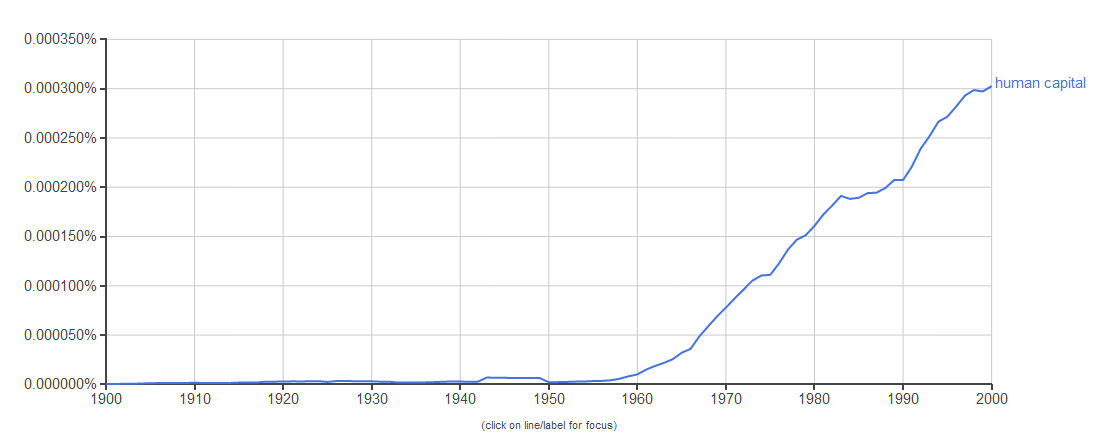
The Rise of Human Capital
No economist was more responsible for the appreciation, understanding and analysis of the fact that people invest in improving their productivity than was Gary Becker.
The Son Also Rises
Economist and Australian politician Andrew Leigh has a very informative review of Gregory Clark’s The Son Also Rises:
If you want to know who made up Australia’s elite in the nineteenth century, a useful place to look is the Australian Dictionary of Biography. In its many volumes, you’ll find business leaders, scientists, media barons and politicians who have featured among the upper echelons of Australian society.
Now, suppose we take the first cohort of significant Australians – those who died before 1880 – and identify those with unusual surnames like Ebden or Maconochie. People with those names were overrepresented among the elite in the nineteenth century. Are they still at the top of society, or are they mixed through?
The answer to this question will depend on the level of social mobility we have in Australia.
…For Australia, it turns out that if we look at the register of modern-day medical practitioners, we find the privileged names of the nineteenth century overrepresented by a factor of nearly three. In other words, if your ancestor was at the top of Australian society six generations ago, you are three times more likely to be a doctor today than the average Australian.
…if we accept Gregory Clark’s methodology, his results imply a very static society. For Britain, the United States, India, Japan, Korea, China, Taiwan, Chile and even Sweden, he concludes that the intergenerational elasticity is between 0.7 and 0.9. This would mean that social status is at least as hereditable as height. It suggests that while the ruling class and the underclass are not permanent, they are extremely long-lasting. Erasing privilege takes not two or three generations, but ten to fifteen generations.
Read the whole thing.