Microsoft, Security and the NSA

New from The Guardian:
Microsoft has collaborated closely with US intelligence services to allow users’ communications to be intercepted, including helping the National Security Agency to circumvent the company’s own encryption, according to top-secret documents obtained by the Guardian.
…The NSA has devoted substantial efforts in the last two years to work with Microsoft to ensure increased access to Skype, which has an estimated 663 million global users.
One document boasts that Prism monitoring of Skype video production has roughly tripled since a new capability was added on 14 July 2012. “The audio portions of these sessions have been processed correctly all along, but without the accompanying video. Now, analysts will have the complete ‘picture’,” it says.
The Cashless Society
I send my kids their weekly allowance ($5-$10) to a bank account via PayPal. The bank account links to a debit card which the kids use to make purchases from Amazon and Steam.
How the Dismal Science Got Its Name
Here is How the Dismal Science Got Its Name, one of my favorite videos from the Great Economists course at MRUniversity.
http://youtu.be/OkecTDf9Vh0
The Opportunity Cost of Streets
Here from Alain Bertaud and the Urbanization Project is another way of thinking not just about the high cost of free parking but also the opportunity cost of streets. In New York City, a place with some of the most valuable real estate in the world, 26.6% of the land is devoted to unpriced streets (and an even larger percentage once we include parking). In Manhattan we go to great expense and effort to make it possible for hundreds of people to use the same 10*10 square feet of land, we build skyscrapers, and yet at the same time similar quantities of land are being taken up by a few people and their cars.

Hat tip: Brandon Fuller.
Differential Pricing in University Education
Traditionally universities have charged every student the same tuition/price regardless of major. Under budget pressure, however, differential pricing is becoming more common. Differential pricing is tending to reduce the peculiar cross-subsidies that currently exist as pointed out in a new working paper by Kevin Stange (earlier version):
Higher education in the United States is heavily subsidized, both through direct support for institutions by state governments and private donors, and through federal and state support
directly to students. There are also substantial differences in the extent of subsidization across
institutions and sectors, with students at selective private institutions more heavily subsidized
than those at less selective institutions(Winston 1999). Less commonly noticed, however, is that
there are also large cross-subsidies between students within the same institutions due to the
conventional practice of charging similar tuition fees to all undergraduate students regardless of
the cost of instructing them. The cost of instruction differs tremendously between upper and
lower division coursework and across programs even within institutions. For instance, recent
analysis of cost data from four large state post-secondary systems (Florida, Illinois, New York‐
SUNY, and Ohio) indicated that upper division instruction costs approximately 40% more per
credit hour than lower division instruction, and that upper-division engineering, physical science,
and visual/performing art was approximately 40% more costly than the least costly majors
(SHEEO, 2010). In fact, an earlier but more extensive cost study found that more than three-fourths of the variance in instructional cost across institutions is explained by the disciplinary
mix within an institution (U.S. Department of Education 2003). The consequence is that lower division students subsidize upper-division students and students in costly majors are subsidized
by those in less expensive ones.This pattern of cross-subsidization generally runs counter to differences in post-schooling
earnings and ability to pay. Lower division includes many students who eventually drop out,
while students that have advanced to upper division are more likely to graduate and earn more.
Engineering, science, and business majors tend to earn more and have higher returns than
education and humanities majors, even after controlling for differential selection of major by
ability (Arcidiacono 2004).
I have argued for targeting education subsidies to the majors that are most likely to have the greatest positive spillovers. Differential pricing moves prices closer to costs which opens up the possibility for more rational pricing but notice that it can in some cases move prices away from optimal subsidy levels.
Hat tip: Dubner at Freakonomics.
Bets and Beliefs
I fear that Tyler’s latest post on bets and beliefs will obfuscate more than clarify. Let’s clarify. There are two questions, do portfolios reveal beliefs? Do bets reveal beliefs?
Tyler has argued that portfolios reveal beliefs. This is false. If transaction costs were zero and there were an asset for every possible future state of the world then this would be true. Since transaction costs are not zero and there are many more states of the world than there are assets–even when we combine assets–portfolios do not reveal beliefs. Portfolios might reveal a few coarse beliefs but otherwise no go. Since most people have lots of beliefs about the future but don’t even have a portfolio (beyond human capital) this should be obvious.
Do bets reveal beliefs? Usually but not necessarily. Two people made bets with Noah Smith. Each thought Noah was an idiot for making the bet. Noah, however, had arbitraged so that he couldn’t lose. Clever Noah! Noah’s bets, either alone or in conjunction, did not reveal his beliefs. But is this the usual situation? No.
For the same reasons that portfolios don’t reveal beliefs, high transaction costs and few assets relative to states of the world, it’s going to be difficult to arbitrage all bets. Many bets in effect create a new and unique asset that can’t be easily duplicated and arbitraged away in other markets. I once bet Bryan as to what an expert would answer when asked a particular question. Hard to arbitrage that away.
I also agree with Bryan that the question is empirical and not simply theoretical. When I say that a bet is a tax on bullshit the implication is not just that bullshitters are more likely to lose their bets but also that a tax on bullshit reduces its supply. The betting tax causes people to think more carefully and to be more precise. When people are more careful and precise the quality of communication increases. As Adam Ozimek writes:
In a lot of writing in blogs it is unclear specifically what the writer is trying to say, and they seem to wish to convey an attitude about a certain position without actually having to make a particular criticism of it, or by making a much actual narrower criticism than rhetoric implies…It is useful to have betting because deciding clearly resolvable terms of a bet leads to specific claims…
Tyler argues that under some conditions betting won’t change what people say (under a wide range of portfolios…a matter of indifference… bets won’t be authentic) but Tyler doesn’t give us a specific, testable prediction. The empirical evidence, however, is that small bets do cause people to change what they say. This is one of the reasons why even small-bet, prediction markets work well.
Tyler has his reasons for not liking to bet but if you think one of those reasons is that he has already revealed his beliefs then you are surely not a loyal reader.

Superconducting Levitation
You have probably seen a super-cool levitation video before but this one has a nice explanation of the effect and a Mobius strip.
Hat tip: Boing Boing.
Cash Transfers to the Poor
Chris Blattman, author of one of the key papers on cash transfers to the poor, takes a page from Albert Hirschman’s book and practices a bit of self-subversion.
First, the message can be misunderstood. It is not, “Cash transfers to the poor are a panacea.” More like, “They probably suck less than most of the other things we are doing.” This is not a high bar.
Second, cash transfers work in some cases not others. If a poor person is enterprising, and their main problem is insufficient capital, terrific. If that’s not their problem, throwing cash will not do much to help. I recommend the paper for details….
Third, a cash transfer to help the poor build business is like aspirin to a flesh wound. It helps, but not for long. The real problem is the absence of firms small and large to employ people productively. The root of the problem is political instability, economic uncertainty, and a country’s high cost structure, among other things. A government’s attention is properly on these bigger issues.
If I were an enterprising young researcher looking for an idea and experiments that will prove powerful in five years, I would try to find the stake I can drive into the heart of the cash transfer movement.
…That is not depressing. That is science. We should welcome it.
In that spirit: I look forward to the stake-wielders.
Luck, Investment and the One Percent
Jon Chait criticizes Mankiw’s defense of the 1% for focusing on productivity as a reason why the rich earn more:
Mankiw’s essay is a sprawling mess, but it hinges on a few key premises. One is that market wealth reflects a person’s productivity. Higher taxes on the rich, he writes, would take from “the most productive members” of society and give to “society’s less productive citizens,” and he uses “productive” and rich” as synonyms throughout….
But there are lots and lots of ways that a person’s income does not measure his contribution to society. Many of us see them every day. We all know people in our field who earn too much, or too little, because of social connections, or race, or gender, or luck, or willingness to cut ethical corners of one variety or another.
But later in that same article and in a followup he argues that greater productivity is an important explanation for inequality:
Krugman noted (as did I) that more affluent parents spend far more than poor children do on “enrichment expenditures” — “books, computers, high-quality child care, summer camps, private schooling, and other things that promote the capabilities of their children.” (ital added)
Mankiw’s response is that this enrichment spending is all wasted.
…Really — high-quality child care, private schools, camps — it’s all just for fun?…There is, in fact, an enormous amount of research on this very question. And the findings overwhelmingly suggest that nonschool enrichment matters an enormous amount. A huge portion of the achievement gap between poor and nonpoor children is attributable to summer vacation.
The first claim is that the wealthy aren’t more productive than the less wealthy and the latter claim is that they are more productive but that this is unfair. The two claims are in tension (perhaps a synthesis is possible but none is offered). Note also that the two claims have quite different implications. In the former case the rich are lucky and you can tax them without generating large incentive problems. In the latter case the rich have benefited from investment and taxing the benefits is likely to reduce such investment.
Addendum: Mankiw, of course, takes the opposite end of the stick, productive people but unproductive summer camps. Mankiw, however, is not inconsistent as he offers another explanation for productivity, namely earlier developed talents and capabilities possibly even genetic in origin. I don’t want to discuss that issue in this post but here is one relevant earlier post with a bit more here for those interested .
The Tabarrok Curve in the WSJ
Matt Ridley covers patents and the Tabarrok Curve in the WSJ:
The economist Arthur Laffer is reputed to have drawn his famous curve—showing that beyond a certain point higher taxes generate lower revenue—on a paper napkin at a dinner with Dick Cheney and Donald Rumsfeld in the Washington Hotel in 1974.
Another economist, Alex Tabarrok of George Mason University, last year drew a similar curve on a virtual napkin to argue that, beyond a certain point, greater protection for intellectual property causes less innovation. He thinks that U.S. patent law is well beyond that optimal point.
Last week the Supreme Court came out against the patenting of genes, on the grounds that they are discoveries, not inventions, though it did allow that edited copies of the DNA of a breast cancer gene should be seen as invented diagnostic tools. Dr. Tabarrok thinks that decision and other recent rulings are nudging patent law back in the right direction after a protectionist drift in the 1980s and ’90s.
Jude Wanniski and the Wall Street Journal made the Laffer curve famous so I have high hopes!
No One is Innocent
I broke the law yesterday and again today and I will probably break the law tomorrow. Don’t mistake me, I have done nothing wrong. I don’t even know what laws I have broken. Nevertheless, I am reasonably confident that I have broken some laws, rules, or regulations recently because its hard for anyone to live today without breaking the law. Doubt me? Have you ever thrown out some junk mail that came to your house but was addressed to someone else? That’s a violation of federal law punishable by up to 5 years in prison.
Harvey Silverglate argues that a typical American commits three felonies a day. I think that number is too high but it is easy to violate the law without intent or knowledge. Most crimes used to be based on the common law and ancient understandings of wrong (murder, assault, theft and so on) but today there are thousands of federal criminal laws that bear no relation to common law or common understanding. The WSJ illustrates:
Last September (2011), retired race-car champion Bobby Unser told a congressional hearing about his 1996 misdemeanor conviction for accidentally driving a snowmobile onto protected federal land, violating the Wilderness Act, while lost in a snowstorm. Though the judge gave him only a $75 fine, the 77-year-old racing legend got a criminal record.
Mr. Unser says he was charged after he went to authorities for help finding his abandoned snowmobile. “The criminal doesn’t usually call the police for help,” he says.
Or how about this:
In 2009, Mr. Anderson loaned his son some tools to dig for arrowheads near a favorite campground of theirs. Unfortunately, they were on federal land….
There is no evidence the Andersons intended to break the law, or even knew the law existed, according to court records and interviews. But the law, the Archaeological Resources Protection Act of 1979, doesn’t require criminal intent and makes it a felony punishable by up to two years in prison to attempt to take artifacts off federal land without a permit.
The Anderson’s didn’t even find any arrowheads but the attempt to find was punishable by imprisonment. Under statutes such as the Lacey Act one can even face criminal prosecution for violating the laws of another country. Ignorance of another country’s laws is no excuse.
If someone tracked you for a year are you confident that they would find no evidence of a crime? Remember, under the common law, mens rea, criminal intent, was a standard requirement for criminal prosecution but today that is typically no longer the case especially under federal criminal law .
Faced with the evidence of an non-intentional crime, most prosecutors, of course, would use their discretion and not threaten imprisonment. Evidence and discretion, however, are precisely the point. Today, no one is innocent and thus our freedom is maintained only by the high cost of evidence and the prosecutor’s discretion.
One of the responses to the revelations about the mass spying on Americans by the NSA and other agencies is “I have nothing to hide. What me worry?” I tweeted in response “If you have nothing to hide, you live a boring life.” More fundamentally, the NSA spying machine has reduced the cost of evidence so that today our freedom–or our independence–is to a large extent at the discretion of those in control of the panopticon.
Google Interview Questions
The famous Google interview questions? They don’t work. Here’s Laszlo Bock, senior vice president of people operations at Google:
On the hiring side, we found that brainteasers are a complete waste of time. How many golf balls can you fit into an airplane? How many gas stations in Manhattan? A complete waste of time. They don’t predict anything. They serve primarily to make the interviewer feel smart.
Instead, what works well are structured behavioral interviews, where you have a consistent rubric for how you assess people, rather than having each interviewer just make stuff up.
Behavioral interviewing also works — where you’re not giving someone a hypothetical, but you’re starting with a question like, “Give me an example of a time when you solved an analytically difficult problem.” The interesting thing about the behavioral interview is that when you ask somebody to speak to their own experience, and you drill into that, you get two kinds of information. One is you get to see how they actually interacted in a real-world situation, and the valuable “meta” information you get about the candidate is a sense of what they consider to be difficult.
Industry of Mediocrity
AP: Washington: The nation’s teacher-training programs do not adequately prepare would-be educators for the classroom, even as they produce almost triple the number of graduates needed, according to a survey of more than 1,000 programs released Tuesday.
The National Council on Teacher Quality review is a scathing assessment of colleges’ education programs and their admission standards, training and value.
Not surprisingly the report is being criticized by the teacher’s unions who complain that evaluators “did not visit programs or interview students or schools that hired graduates.” Most of the teacher’s colleges, however, refused to cooperate with the evaluators with some even instructing their students not to cooperate. Do you think the non-cooperators were of better quality than the programs that did cooperate?
According to the report, “some 239,000 teachers are trained each year and 98,000 are hired” suggesting a poor return for the potential teachers. One wonders about the quality of the teachers not hired.
In any case, the report is consistent with a wide body of research that shows teacher quality is not high and has declined over time, see Launching the Innovation Renaissance for details.
Meanwhile, on the every cloud has a silver lining front, Neerav Kingsland, Chief Strategy Officer for the important non-profit New Schools for New Orleans argues that the great stagnation will increase the supply of high-quality teachers:
Unfortunately, international trade and technology will continue to eliminate middle-class jobs. Personally, I’m worried that our political system will not adequately ease the pain of this transition. However, this economic upheaval will increase the quality of human capital available to schools. The education sector will likely capture some of this talent surplus, so long as schools are well managed. Moreover, if tech progress reduces the amount of educators we need, we may be in a situation where we have both (a) higher quality applicant pools and (b) less education jobs. I do not view the hollowing out of middle-class jobs as a positive economic development, but it will positively affect education labor…
The Great Canadian Sperm Shortage
As I was researching yesterday’s post on The Oocyte Cartel I came across an old MR post from 2003 on plans in Canada to restrict the import of American sperm:
The US is a world leader in sperm exports primarily because sperm banks in the U.S. are run on a for-profit basis. As a result, US sperm is reckoned to be of high quality particularly because the US version comes with a background on the vitals of the donor. Denmark also exports a lot of sperm because of high standards and demand for that blond, blue-eyed look.
Exports to Canada have increased in recent years because of a scandal involving poorly screened Canadian sperm. Canadians also import a lot of US eggs. The Canadian government, however, is apparently miffed as a new law is being readied that would forbid donations involving a paid donor. The law would not only make paid donation illegal in Canada it would make it illegal to use any paid-for sperm. Canadian couples seeking fertility options will suffer and who will benefit? I cannot think that this law is anything but spiteful and ridiculous. Is paying for sperm an original sin?
So what happened? In 2004, Canada made it a criminal offense to compensate sperm and egg donors. Loyal readers will not be surprised by the results (as of 2011)
…currently, in the entire country, there are only 35 active sperm donors. Over the last decade, our government has made its donation system so thoroughly unappealing that this ubiquitous fluid is almost impossible to obtain through official channels. There is a single operating sperm bank in all of Canada.
…If 35 national donors is an ugly statistic for the most removed observer, it’s especially devastating for the women and couples who have come to rely on our lone sperm bank in order to have a child.
Ironically, it’s been easier to prevent payments to Canadian donors than it has been to police sperm and egg imports because it is still technically legal to use paid-for sperm just not to buy sperm. As a result, the importation of US sperm has increased:
Patients here obtain more than 90% of semen from the United States, and the federal government appears to turn a blind eye to the fact they buy it from mostly for-profit sperm banks — a criminal offence in this country.
Addendum: Some readers may find all this talk of sex and sperm to be risque but do remember this is a family-friendly blog.
The Oocyte Cartel
The Society for Assisted Reproductive Technology (SART) represents more than 85 percent of the assisted reproduction industry. SART requires that its members work only with agencies that limit compensation to egg-donors to around $5000 or a maximum of $10,000 (figures decided upon by the ethics committee of an affiliated organization, The American Society for Reproductive Medicine (ASRM)). In other words, ASRM-SART acts as a buyer’s cartel.
In 2011, Lindsay Kamakahi launched a class action suit against ASRM-SART challenging their horizontal price-fixing agreement as per se illegal under the Sherman Antitrust Act. ASRM-SART tried to have the case dismissed but a judge recently denied the dismissal in the process making it clear that the plaintiffs have a good case.
ASRM-SART argue that their maximum price is really about protecting women and that compensation “should not be so excessive as to constitute undue inducement.” Egg donation does involve extensive screening, time and some health risks. One would think, however, that the proper response for those interested in protecting women would be to ensure that the women are fully informed and that they are paid high wages not low wages.
The paternalistic policy of the ASRM-SART especially rankles because it applies only to women, sperm donations are not regulated. Of course, sperm donation isn’t risky but we also don’t see laws limiting the wages of miners to protect miners (mostly men) from “undue inducement.” The societal expectation seems to be that men are appropriately motivated by self-interest but women may be appropriately motivated only by altruism.
I am in agreement with Kimberly D. Krawiec who writes in her excellent paper Sunny Samaritans and Egomaniacs: Price-Fixing in the Gamete Market:
It is ASRM’s paternalistic and misguided attempts to control oocyte donor compensation through the same type of professional guidelines that courts have rejected when employed by engineers, lawyers, dentists, and doctors that should raise an ethical red flag.
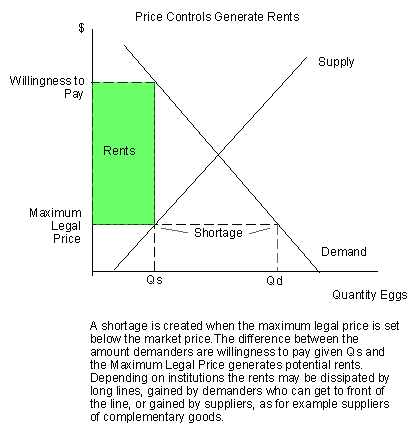 ASRM-SART surely believe that they are doing good but I think it no accident that they also do well from a policy that reduces the price of their inputs. A price controlled below the market price generates rents. In the traditional analysis, the rents are dissipated away by long-lines, a form of rent seeking (see Modern Principles–first edition now a bargain!). It’s also possible, however, for suppliers to grab up the rents, especially suppliers of complementary goods.
For example, it’s often been pointed out that in the organ donor market the hospitals, surgeons and executives all get paid and paid well; the only person not getting paid is the person who provides the transplant organ. But we can say more–one of the reasons the hospitals, surgeons and executives get paid well is precisely that the donor is not paid. The shortage created by the price control drives the demander’s willingness to pay upward and some of the difference between the willingness to pay and the maximum legal price is captured by the suppliers of complementary inputs. How do we know? In the 1990s, entry into the transplant business grew much faster than did the supply of transplant organs. In fact, transplants were so profitable there was a rush to transplant that increased the number of centers but drove down center volume thereby reducing patient survival rates.
Similarly, by limiting egg-supply the suppliers of assisted reproductive services may be able to increase their share of the total gains from trade.
Although ASRM-SART may profit from restricting donor compensation there is another issue at large, the repugnance constraint. The repugnance and disgust centers of the brain are old and deep and often revolve around issues of body integrity, body products, hygiene, sex and death. Birth treads uneasily in many of these waters already and egg donation adds to this volatile mix issues of gender, personhood, identity and genetics all of which prime for a repugnance storm. The plaintiff’s case is sound but if the antitrust laws prevent ASRM-SART from limiting prices–or saying that they limit prices–and if egg donation were to become even more of a market in everything might there not be a backlash and an outright ban on compensated donors, as is the case in many other countries and for transplant organs in this country? I hope not but it is a real possibility.
The ban on compensated transplant organ donation has led to hundreds of thousands of excess deaths. A ban on compensated sperm and egg donation would lead to a dearth of lives.