Smart Phone Ethics
Here is David Pogue, an excellent technology reporter but a lousy economist, reviewing the Moto X in the NYTimes:
You get your customized phone within four days, courtesy of Feature 2: it’s assembled right here in these United States. The components are still made in Asia, but they’re put together in Texas — you can lose less sleep worrying about underpaid Chinese workers.
David does not explain how a decrease in the demand for Chinese workers increases Chinese wages. Hint: It doesn’t. Perhaps, however, I have done David a disservice; although his argument fails as economics it succeeds as psychology. People who buy American probably will worry less about underpaid Chinese workers. Out of sight, out of mind.
Addendum: Adam Smith’s thoughts on China and ethics, most notably the importance of using reason not emotion to make ethical decisions, remain relevant.
Creative Destruction in the News
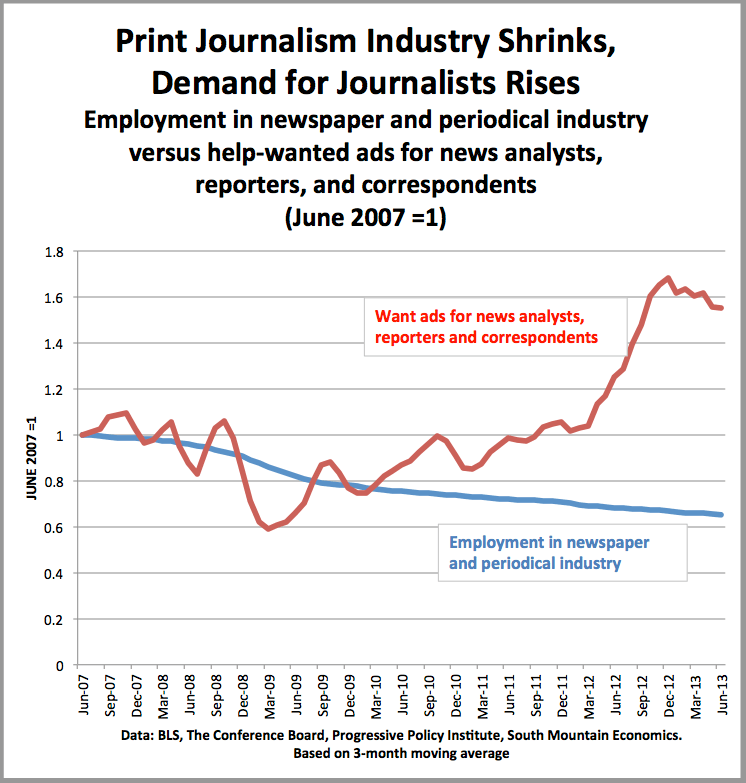
From Michael Mandel who notes:
According to data from The Conference Board, the number of want ads for news analysts, reporter, and correspondents more than doubled from early 2010 to today! Moreover, it is noteworthy that the BLS annual series show a 25% gain in the number of working journalists from 2009 to 2012 (not shown on chart)
Now, let’s be realistic. I’m not saying that the true demand for journalists doubled between the beginning of 2009 and today, although given that no one was hiring in the depths of the recession, that statement might be literally true. In fact, the help-wanted series is an example of naturally-generated ‘big data’, meaning that it can be affected by changes in business practices, such as the way jobs are posted. The nature of journalism jobs may also be changing.
However, there seems little doubt that technology and innovation in journalism is creating new jobs in different industries even as the old companies and old industries are being undermined. I’m pretty sure that jobs at Politico are not being reported in the same industry as jobs at the Washington Post, even if Politico hires a WaPo reporter to cover more or less the same things.
As innovation accelerates, we’ll see more examples of this kind of divergence: Declining old industries, growing new jobs.
Liberalization Increases Growth
In Assessing Economic Liberalization Episodes: A Synthetic Control Approach (wp version), Billmeier and Nannicni evaluate economic liberalizations, defined as “comprehensive reforms that extend the scope of the market, and in particular of international markets,” over the period 1963-2005. The authors compare real per-capita GDP in treatment countries with that in a synthetic control, a weighted average of similar countries with the weights optimized so that the synthetic control matches as well as possible a variety of pre-treatment characteristics including secondary school enrollment, population growth, and the investment share as well as GDP. The results are often impressive, for example.
[In Indonesia] the average income over the years before liberalization is literally identical to that of the synthetic control, which consists of Bangladesh (41%), India
(23%), Nepal (23%), and Papua New Guinea (13%). After the economic liberalization in 1970, however, Indonesian GDP per capita takes off and is 40% higher than the estimated counterfactual after only five years and 76% higher after ten years.
Here is a selection of figures (see the paper for more). In each case the solid line is the liberalizing country and the dashed line the synthetic control.

To be sure, not all liberalizations are successful. In particular, liberalizations in Africa especially after 1991 appear to be less successful. Whether this is because these liberalizations were half-hearted, were not combined with other institutional improvements or because countries that liberalized earlier were better able to link to global supply chains, is unclear. See the paper for more discussion.
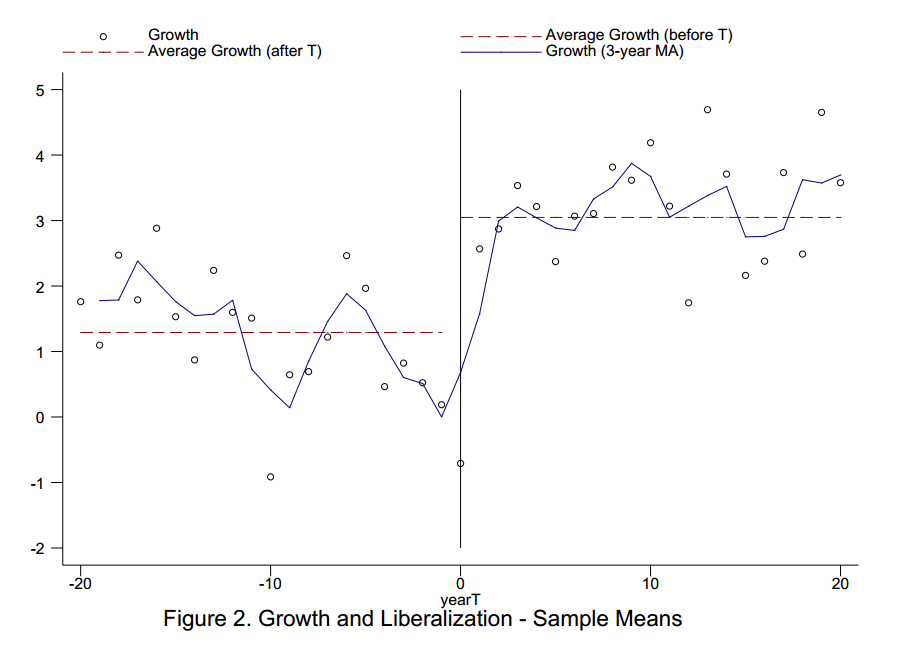
These results bolster similar earlier findings from Warciarg and Welch (2008) who, using different methods, examined the average effect of liberalizations on growth from a wide variety of countries over a 50 year period. They found that on average growth increased after liberalization by a remarkable 1.5 percentage points. Here is the key figure.
See Development and Trade: The Empirical Evidence, a video from MRU, for more on the WW study as well as other types of evidence.
Superstar Teachers
In Why Online Education Works I wrote:
… the market for teachers will become more like the market for actors, a winner-take-all market with greater inequality and very big payments at the top…. Bigger markets support larger salaries, so the best teachers will earn much more in an online world.
Evidence for just how much some teachers could earn in the online world comes from Amanda Ripley writing in the WSJ about South Korea’s private education market:
Kim Ki-hoon earns $4 million a year in South Korea, where he is known as a rock-star teacher—a combination of words not typically heard in the rest of the world. Mr. Kim has been teaching for over 20 years, all of them in the country’s private, after-school tutoring academies, known as hagwons. Unlike most teachers across the globe, he is paid according to the demand for his skills—and he is in high demand.
…The bulk of Mr. Kim’s earnings come from the 150,000 kids who watch his lectures online each year. (Most are high-school students looking to boost their scores on South Korea’s version of the SAT.) He is a brand name, with all the overhead that such prominence in the market entails. He employs 30 people to help him manage his teaching empire and runs a publishing company to produce his books.
Online Therapy as Good as Face to Face
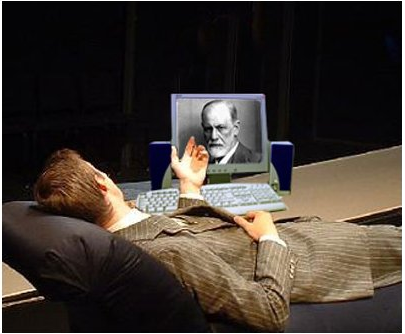
A small study suggests that online therapy is as effective as face to face.
Online psychotherapy is just as efficient as conventional therapy. Three months after the end of the therapy, patients given online treatment even displayed fewer symptoms.
Six therapists treated 62 patients, the majority of whom were suffering from moderate depression. The patients were divided into two equal groups and randomly assigned to one of the therapeutic forms. The treatment consisted of eight sessions with different established techniques that stem from cognitive behavior therapy and could be carried out both orally and in writing. Patients treated online had to perform one predetermined written task per therapy unit – such as querying their own negative self-image. They were known to the therapist by name.
“In both groups, the depression values fell significantly,” says Professor Andreas Maercker, summing up the results of the study. At the end of the treatment, no more depression could be diagnosed in 53 percent of the patients who underwent online therapy – compared to 50 percent for face-to-face therapy. Three months after completing the treatment, the depression in patients treated online even decreased whereas those treated conventionally only displayed a minimal decline: no more depression could be detected in 57 percent of patients from online therapy compared to 42 percent with conventional therapy.
If therapy works well online imagine what else might work online?
The High Costs of Travel Visas
U.S. citizens are fortunate in that most European and South American countries no longer require a visa for US travelers. It’s surprising, however, how many countries continue to make it difficult to visit. Some countries don’t want visitors, of course, but even a country like India, a democracy that relies a lot on tourism, still requires costly and time-consuming visas. A new paper from Robert Lawson and Saurav Roychoudhury estimates that the cost of these restrictions can be quite large.
Using a travel visa data set developed by Lawson and Lemke (2012) and travel flow data from the World Bank and the UN’s World Tourism Organization (UNWTO), we investigate the deterrent effect of travel visa requirements on travel flows. At the aggregate level, a one standard deviation more severe travel visa regime, as measured, is associated with a 30 percent decrease in inbound travel. At the bilateral level, having a travel visa requirement on a particular country is associated with a 70% reduction in inbound travel from that country. The gains associated with eliminating travel visas appear to be very large.
Oh for the days prior to 1914 when Keynes wrote that a person could travel “without passport or other formality” throughout much of the world.
Wildcatting
Wildcatting is a stripper’s guide to boom towns like Williston, North Dakota. It’s insightful on the principal-agent problem, why natural resources aren’t a geographic blessing even when they aren’t a curse, selection effects and immigration (” I never met a boring stripper in Williston.”) and small town life.
I am thinking of asking my IO students to explain why stripper pay structure changed with the boom:
It took a long time for things to quickly change. First, Whispers started booking four dancers. Then a second club, Heartbreakers, opened right next door, and they didn’t even cap the number of dancers that could work. Not only that, they didn’t pay the dancers — and instead charged them a whopping $120 flat stage fee. Whispers upped their game by going to six dancers at some point in 2011. The last time I got a paycheck from them was in February 2012, and then the owner told me they weren’t going to pay dancers at all anymore.
So starting in 2012, instead of getting paid $250–500 a week, depending on the booking, we paid Whispers $120 a night. Instead of keeping $15 from each dance, dancers kept the whole $20.
Strippers are not immune to the great stagnation:
The American worker has never been so efficient in terms of output over hours worked. At the same time, real wages and benefits have plummeted. Prospects are shitty for college graduates and non-graduates alike. Layoffs and cutbacks in previously solid industries protect the profits of an ever-smaller class at the expense of those who produce value. In stripper terms, here’s what that looks like: Lap dances in many places still start at $20, the same price they were in 1990. Customers expect ever-higher levels of contact and performance skill, meaning strippers work harder to earn the $20 or the dollar stage tip that is worth a lot less than it used to be.
…The one big advantage you have if you’re a stripper, though, is the ability to travel to greener pastures. If you would like to have a job in another town, as long as you look good enough for the club’s standards, you’re hired. So those who can, move. When the level of bullshit is too high or the earnings too low, they the hit the road. Same as the men who wind up traveling to work in the oil fields. If you can make $30,000 more a year driving heavy equipment in North Dakota instead of in Louisiana, and you need that money, you go. Is this the logical progression of a service economy? It looks like migrant labor.
…Mobility giveth and mobility taketh away, and while I was grateful to have the freedom to come to the boomtown, I was even more thankful to have the freedom to leave.
The piece is also of interest when read at the meta level.
Detroit Taxes and the Laffer Curve
Detroit’s Emergency Manager Kevyn Orr has issued a clearly written report that outlines Detroit’s situation and its improvement plan. Here are a few highlights on taxes:
- [The] per capita tax burden on City residents is the highest in Michigan. This tax burden is particularly severe because it is imposed on a population that has relatively low levels of per capita income.
- The City’s income tax… is the highest in Michigan.
- Detroit residents pay the highest total property tax rates (inclusive of property taxes paid to all overlapping jurisdictions; e.g., the City, the State, Wayne County) of those paid by residents of Michigan cities having a population over 50,000.
- Detroit is the only city in Michigan that levies an excise tax on utility users (at a rate of 5%).
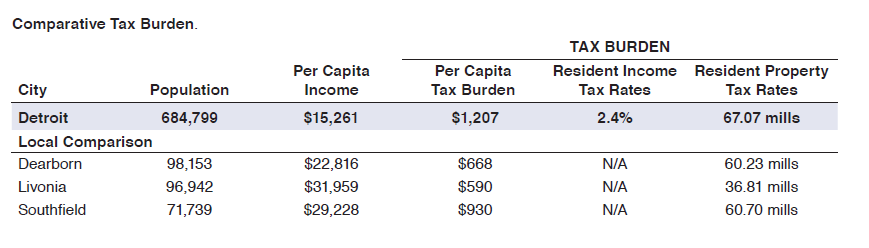
Detroit taxes are high not only relative to per-capita income but also, of course, relative to the delivery of services. Forty percent of Detroit’s street lights aren’t working, the violent crime rate is the highest in the country (for cities over 200,000) and fire and police services are slow and outdated. Although taxes are high they often aren’t paid. Only 53% of city property owners, for example, paid their 2011 property taxes.
As the report notes, Detroit is probably on the wrong end of the Laffer curve–lower rates would increase revenues in the long run.
Hat tip: Brian Blase.
Sentence of the Day
By the fall of 2009, toward the end of Barack Obama’s first year as president, the Air Force was training more drone-joystick pilots than airplane-cockpit pilots.
From Fred Kaplan’s The World as Free-Fire Zone.
Drug Shortages are Killing
The shortages of injectable drugs that I have been writing about since 2011 (e.g. here and here) are continuing and they are extending to ordinary nutrients needed by premature babies:
Because of nationwide shortages, Washington hospitals are rationing, hoarding, and bartering critical nutrients premature babies and other patients need to survive.
..At the time of this writing—some shortages come and go by the week—Atticus’s hospital is low on intravenous calcium, zinc, lipids (fat), protein, magnesium, multivitamins, and sodium phosphate; it’s completely out of copper, selenium, chromium, potassium phosphate, vitamin A, and potassium acetate. And so are many other hospitals and pharmacies in the country, leading to complications usually seen only in the developing world, if ever.
The article in the Washingtonian covers problems with GMP regulations and the FDA, as I did earlier. The article also makes the following point. Many of these products, especially the simpler ones, are available in Europe but it is illegal to import them to the United States.
Many doctors are pinning their immediate hopes on Congress’s forcing the FDA to form a global pipeline to import an emergency supply. “I have friends in other countries who could get me some, but that would be illegal,” one doctor says. In fact, pharmacists note that the phosphorous Europe uses is a better product than that in the US because it’s organic and doesn’t interact with calcium in the PN, meaning more phosphorous could be included in the IV bag.
When Miguel Sáenz de Pipaón, a neonatologist at a prominent hospital in Madrid, arrived in the US for a research visit, he was stunned by the nutrition shortages.
“It’s crazy,” he says. “That doesn’t happen in Europe.” He noted that the US relies on a 25-year-old lipid emulsion, which is in shortage, while European hospitals use a newer version that’s readily available. Rather than import the newer emulsion, the US has left many patients without any lipids at all.
Hat tip: Kurt Schuler.
The Rise of Artificial Intelligences
Here is a well done video from PBS on artificial intelligence(s). Robin Hanson is excellent and is featured around 3:27-5:30.
The Puzzling Return of Glass-Steagall
I am puzzled by the renewed demand for the return of Glass-Steagall. I am puzzled not because Glass-Steagall might be bad policy but because it is so clearly a policy that doesn’t deal with the problems that created the financial crisis. If one had to sum the crisis up in one sentence it would be hard to do better than “a run on the shadow banking system.” The shadow banking system is that collection of mostly non-bank financial intermediaries who base their credit creation not on deposits but on repo, money market funds, SIVs, asset backed securitizations and other financial structures. The big new fact that I learned from the financial crisis and that I thought someone like Elizabeth Warren would surely also have learned is that the shadow banking system is larger than the regular banking system.
Separate commercial and investment banking? Please. The problem was that investment banking, in the form of shadow banking, become so separated from commercial banking that the Fed no longer had any idea where a majority of credit was being generated. Credit creation separated from banking as understood by the Fed, and moved into the shadows, hence, the term shadow banking.
Compare Glass-Steagall with the Gorton-Metrick proposal to reform banking. GM would in essence extend deposit insurance to the shadow bank system, i.e. instead of separating commercial and investment banking, Gorton and Metrick would erase the distinction entirely by making all credit creators regulated commercial banks. (I exaggerate, but only slightly). If you don’t like that idea then consider Larry Kotlikoff’s limited purpose banking. Kotlikoff, in essence, goes the full Rothbard–separate lending from money warehousing (i.e. transaction-cost reducing money services) (Tyler offers some criticisms here).
Now whether you think the Gorton-Metrick or Kotlikoff proposals are good ideas, and I am not arguing for either, these ideas at least addresses the important issues. In contrast, Glass-Steagall would merely shuffle around organizational boxes in the less important regulated banking sector. Indeed, why would anyone think that 1930s policy is the solution to a 21st century problem?
Addendum: Here are previous MR posts on Glass-Steagall. FYI, my paper on the public choice aspects of Glass-Steagall showed that the public reasons for the original Glass-Steagall were not the private reasons. Is something like this going on today?
The Property Rights of Private Communities
I am one of the amicus curiae, along with Richard Epstein, James W. Ely, Donald Kochan, Adam Mossoff, and Ilya Somin, in an amicus brief urging the Supreme Court to hear Mariner’s Cove Townhomes Association v. United States. The case is about whether the right that a homeowner’s association has to collect dues is a compensable right in a government taking. The U.S. Court of Appeals for the Fifth Circuit held that “the right to collect assessments, or real covenants generally” is not a compensable right under the Takings clause. The brief, consistent with many lower court rulings, argues that it is a compensable right. The case is important as Ilya Shapiro and Trevor Burrus explain:
The U.S. housing market has seen a major shift in the past 30 years: the rise of the community association. In 1970, only 1 percent of U.S. homes were community association members; today, more than half of new housing is subject to association membership, including condominium buildings.
…Such associations often shoulder the burden of providing and maintaining infrastructure, services, and utilities, which allows for more diverse and customizable amenities for homeowners than if those decisions were left with remote municipal governments. Because of these benefits, and because they increase the tax base, local governments are increasingly requiring developers to structure developments as community associations.
…The perverse implications of the Fifth Circuit’s ruling are clear: it would allow for local governments to require the creation of a community association, benefit from the resulting private delivery of services while collecting taxes from its members, and later take the property without even paying back the very fees that enabled the government’s benefit.
…The ruling also clashes with the Supreme Court’s recent decision in Koontz v. St. John’s River Water Management District: that an income stream from real property is a compensable interest under the Fifth Amendment. For these reasons, we urge the Supreme Court to take the case and to recognize the compensable property rights of the Mariner’s Cove Townhomes Association and the millions of other Americans choosing—and paying—to live in a community association.
Income Inequality and the Servant Boom
Inequality is likely to drive increased jobs in the service sector as appears to be the case in London:
The number of domestic servants is booming across central London: wherever the multiple between the wages of the rich and the poor grows, so does the number of servants. Much of the time, the towering Georgian and Victorian terraced houses of Belgravia now have only servants living in them – their masters and mistresses are drifting around the world, from yacht to schloss to Park Avenue apartment, in search of pleasure or tax avoidance. Drive round the area at night, and it’s often only the lights in the attics and the basements – the servants’ quarters – that are on.
But it’s not just in the gilt-edged parts of Britain that the service industry is flourishing. According to the Work Foundation, there are now more than two million part-time or full-time domestic workers across the country. All told, 10 per cent of households now employ some sort of domestic help.
The Economist concurs:
According to Britain’s Office for National Statistics (ONS), household expenditure on domestic service hit a low point in 1978, since when it has quadrupled in real terms. It estimates there are as many domestic workers in London now as in Victorian times.
The idea of working as a personal servant strikes many people as distasteful. Indeed, there is much to be said for working for a faceless corporation or for selling directly to the impersonal market. Many jobs in the personal service sector, however, do offer significant autonomy and room for creativity–for example, personal chefs, gardeners, high-end nannies, pilots, publicists and tutors. Service workers today are also less likely to be tied to a single employer, either a ready market is available to switch employers or they are already selling to a range of customers. Compared to jobs in manufacturing and in impersonal service, personal service jobs are also likely to be more immune to competition from the robots.
Hat tip: Tim Harford.
Patent Thugs
From the NYTimes:
In the last five years, IPNav has sued 1,638 companies, according to a recent report by RPX, a patent risk management provider, more than any other entity in the patent field. “To get companies to pay attention, in some percent of the market, you need to whack them over the head,” Mr. Spangenberg said. “In our system, you can’t duel, you can’t offer to fight in the street, which would be fine with me.”
…Mr. Spangenberg is likely to open the conversation on a diplomatic note, but if you put up enough resistance, or try to shrug him off, he can also, as he put it, “go thug.”
He demonstrated what that sounds like in a brief bit of role-play recently, sitting in the apartment he is renting for the summer in Paris near the Arc de Triomphe. His voice dropped, the curse words flowed, and he spoke with carefully modulated menace.
“Once you go thug, though, you can’t unthug,” he explained, returning to his warm and normal tone. “Actually, you can unthug, but if you do that, you can’t rethug. Then you just seem crazy.”
Hat tip: Donald Marron (twitter).