Average is Over
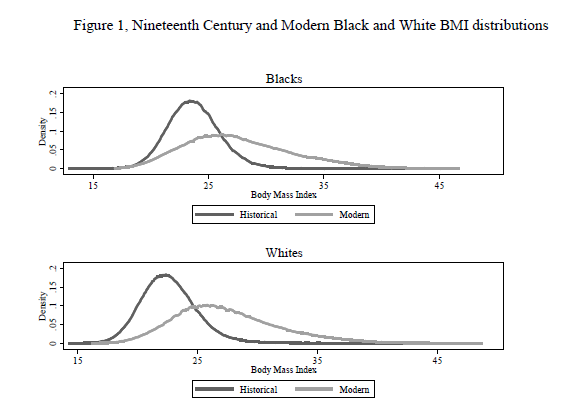
There has been an increase in the mean body-mass index since the 19th century but even more strikingly there has been an increase in the variance, what we might call an increase in weight inequality. More here.
Hat tip: Andrew Leigh.
BS Jobs and BS Economics
David Graeber’s peculiar article on bullshit jobs (noted earlier by Tyler) does have one redeeming feature, a great example of poor economic reasoning:
…in our society, there seems a general rule that, the more obviously one’s work benefits other people, the less one is likely to be paid for it. Again, an objective measure is hard to find, but one easy way to get a sense is to ask: what would happen were this entire class of people to simply disappear? Say what you like about nurses, garbage collectors, or mechanics, it’s obvious that were they to vanish in a puff of smoke, the results would be immediate and catastrophic. A world without teachers or dock-workers would soon be in trouble…
This, of course, is just the diamond-water “paradox”–why are diamonds, mere baubles, so expensive while water, a necessity of life, is so cheap?–the paradox was solved over a hundred years ago by…wait for it…can you guess?….the marginal revolution. Water is cheap and its value low because the supply of water is so large that the marginal value of water is driven down close to zero. Diamonds are expensive because the limited market supply keeps the price and marginal value high. Not much of a paradox. Note that, contra Graeber, there is nothing special about labor in this regard or “our society.”
Moreover, it’s good that prices are determined on the margin. We would be very much the poorer, if all useful goods were expensive and only useless goods were cheap.
Markets in Everything: Fake Articles
DISGUISED as employees of a gas company, a team of policemen burst into a flat in Beijing on September 1st. Two suspects inside panicked and tossed a plastic bag full of money out of a 15th-floor window. Red hundred-yuan notes worth as much as $50,000 fluttered to the pavement below.
Money raining down on pedestrians was not as bizarre, however, as the racket behind it. China is known for its pirated DVDs and fake designer gear, but these criminals were producing something more intellectual: fake scholarly articles which they sold to academics, and counterfeit versions of existing medical journals in which they sold publication slots.
…The pirated medical-journal racket broken up in Beijing shows that there is a well-developed market for publication beyond the authentic SCI journals. The cost of placing an article in one of the counterfeit journals was up to $650, police said. Purchasing a fake article cost up to $250. Police said the racket had earned several million yuan ($500,000 or more) since 2009. Customers were typically medical researchers angling for promotion.
From The Economist.
Hat tip: Derek Lowe.
None of the Above Wins!
NEW DELHI—Indians have a new choice when they go to the polls: None of the above.
On Friday, the Supreme Court said voters in the world’s largest democracy have the right to disapprove all candidates on the ballot, a step that could put pressure on parties to field better-qualified politicians.
“This judgment allows people to send a clear message to political parties,” said Mahi Pal Singh, national secretary of the People’s Union for Civil Liberties, which had petitioned the court for the change.
Activists said they hope the court’s ruling—ahead of five state elections this year and national polls due by the end of May—is a first step toward the establishment of a broader “right to reject.”
Excellent news. Bear in mind:
Nearly a third of the members of the lower house of Parliament are facing criminal charges, according to the Association for Democratic Reforms, a New Delhi-based advocacy group for transparency in governance.
Even if that were not the case, however, one of the problems of democracy is that there is too little feedback and information transmission, due both to rational ignorance and the bundle nature of politics. Allowing for “none of the above” provides, not a panacea, but a little bit more feedback. Many people vote but have to hold their noses to do so. Many others don’t vote but do they not vote because they are satisfied or dissatisfied? None of the above gives the dissatisfied a chance to reveal their views and in so doing it may encourage more and better candidates.
At present, voting none of the above is just informational, i.e. none of the above is never “elected” even if it gets a majority, although the option to vote NOTA may change the outcome of the election. In the future a NOTA majority might signal a new election.
India is the world’s largest democracy. It will be interesting to see how this plays out.
Hat tip: Reuben Abraham
Venezuelan Arbitrage
Flights out of Venezuela to anywhere are 100% sold out, months in advance. Yet many planes are flying half-empty. Why? The official exchange rate is 6.3 bolivars per dollar but the black market rate is more like 42 bolivars to the dollar. Few people are allowed to convert bolivars to dollars at the official rate but there is an exception for people with a valid airline ticket. As a result people with an airline ticket can convert bolivars to dollars at the official rate and then sell the dollars at the much higher black market rate. Reuters has the story:
“It is possible to travel abroad for free due to this exchange rate magic,” said local economist Angel Garcia Banchs.
The profit is realized from an arbitrage process known locally as “el raspao,” or “the scrape.”
Credit cards are used abroad to get a cash advance — rather than buying merchandise. The dollars are then carried back into Venezuela and sold on the black market for some seven times the original exchange rate.
The large profit margin easily absorbs the cost of flights and accommodation for a trip.
“I’ve been able to buy new clothes and give some cash to all my closest family members!” said one delighted Venezuelan lady, just back from a trip to Europe.
…Some Venezuelans do not even bother leaving the country, but merely send their credit cards to friends overseas, who swipe the cards and send the cash back to Venezuela.
“This is the reason many airlines are sending half-empty planes,” Ricardo Cusanno, head of a local tourism council, told Reuters, saying the government should cross-reference flight lists with those requesting foreign exchange to outwit the no-shows.
Hat tip: Carl Danner.
Do Awards Reduce Productivity?
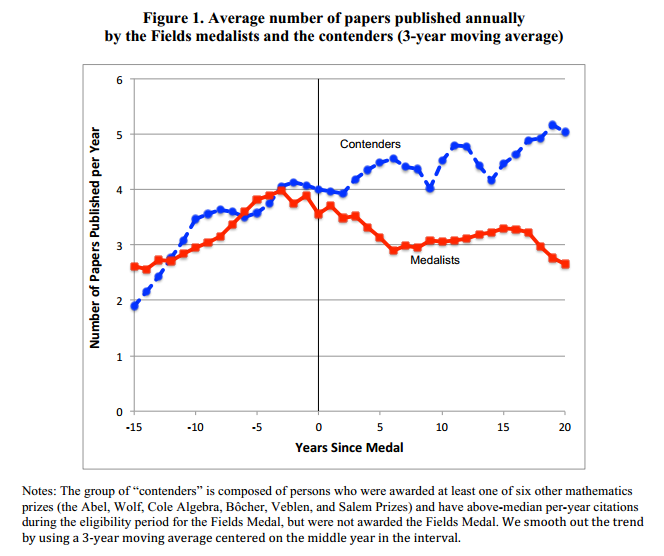 George J. Borjas and Kirk B. Doran find that the productivity of mathematicians who win the Fields Medal, the mathematics “Nobel” awarded to mathematicians under the age of 40, declines after they win. Borjas and Doran look at productivity on a number of margins including papers, citations, and graduate students mentored. At right is a graph of average number of papers compared to a contender group. Productivity falls by a statistically significant ~1 paper per year (in the regression that I think the strongest, in a few variants the decline is a bit more.)
Not all of the decline is due to resting on laurels. Borjas and Doran also find that mathematicians who win the Fields tend to branch out into other areas and this branching out requires them to learn new material which takes time. Steve Smale did work in economics and biology, for example, Rene Thom developed catastrophe theory and David Mumford works in vision and pattern theory. Exploring new topics can also lead to breakthroughs so branching out is not necessarily a negative effect. Borjas and Doran estimate that about half of the productivity effect is resting on laurels and half greater exploration.
(FYI, Borjas and Doran speak of prizes but I prefer to call them awards because awards such as the Fields or Clark Medal are quite different from prizes for purpose, such as the XPrizes, the H Prize or the historically important Orteig Prize, that I discuss in Launching as alternatives to patents.)
Winning the Fields is presumably good for the winner but even taking into account the enhanced incentive to explore it’s not obviously good for mathematics. The explicit purpose of the Fields was to increase not decrease achievement. What can be done?
The Fields Medal may be too important for its own good. In economics the closest thing to the Fields is the John Bates Clark award, given to that American economist under the age of 40 judged to have made the most significant contributions. Chan et al. (2013) find that recipients of the Clark award increase their productivity after winning. But the Clark award is widely seen as a future portent of the Nobel, thus it may have a more stimulative effect as the winner realizes that the next big award is within reach (see the final sentence). In a tournament, it’s important to tier the awards for multiple levels of ability.
In thinking about whether awards increase or decrease productivity on net. the precise counter-factual is important. Let us accept as Truth that winners of the Fields Medal decrease in productivity, even so that doesn’t mean that eliminating the Fields Medal would increase productivity let alone that eliminating all awards would increase productivity (remember, the productivity of the contenders may be more important than the productivity of the winners). Perhaps the most justifiable policy recommendation is that one shouldn’t give awards to young people, a Fields Medal for lifetime achievement, much as the economics Nobel is given, might encourage more achievement.
Paul Samuelson wrote of Chasing the Bitch Goddess of Success:
Scientists are as avaricious and competitive as Smithian businessmen. The coin they seek is not apples, nuts, and yachts; nor is it the coin itself, or power as that term is ordinarily used. Scholars seek fame.
But, paraphrasing Tyler, what price early fame?
Insect Gear
The only functional gears ever found in nature belong to a small insect. The gears lock the insect’s back legs together giving it a synchronized and powerful jump. The electron microscope picture of the gears is stunning:
The original paper is here and you can find a summary with more pictures of the gear in action here.
Physics Sentence of the Day
Physicists have discovered a jewel-like geometric object that dramatically simplifies calculations of particle interactions and challenges the notion that space and time are fundamental components of reality.
Interesting throughout.
Not From the Onion, No Really, *Not* From the Onion
CBS News uncovers a frightening new trend, unregulated dinner parties:
As you sit down to dinner, this story illustrates eating out like you have never experienced before. We are talking about super-secret, illegal dining experiences hosted in homes.
CBS 2 investigative reporter Tamara Leitner went undercover to see firsthand how this underground world works.
It may look like a dinner party, but it’s really an underground supper club.
The diners are a mix of New Yorkers and tourists. CBS 2’s undercover cameras captured one experience — eight people who didn’t know each other eating a meal in a stranger’s home.
Horrifying. CBS, however, missed an even bigger story. It’s one thing when adults subject themselves to danger but surely even libertarians with their heads stuck in the 19th century must recognize that it is something else again when the least powerful among us are subject to these same dangers without their consent. Intrepid economist Art Carden has the story of abuse and shame that has remained hidden for too long:
…children–children, mind you–are being fed food that’s prepared in unregulated, uninspected, and possibly less-than-sanitary conditions.
Sinister Statistics: Do Left Handed People Die Young?
In 1991 Halpern and Coren published a famous study in the New England Journal of Medicine which appears to show that left handed people die at much younger ages than right-handed people. Halpern and Coren had obtained records on 987 deaths in Southern California–we can stipulate that this was a random sample of deaths in that time period–and had then asked family members whether the deceased was right or left-handed. What they found was stunning, left handers in their sample had died at an average age of 66 compared to 75 for right handers. If true, left handedness would be on the same order of deadliness as a lifetime of smoking. Halpern and Coren argued that this was due mostly to unnatural deaths such as industrial and driving accidents caused by left-handers living in a right-handed world. The study was widely reported at the time and continues to be regularly cited in popular accounts of left handedness (e.g. Buzzfeed, Cracked).
What is less well known is that the conclusions of the Halpern-Coren study are almost certainly wrong, left-handedness is not a major cause of death. Rather than dramatically lower life expectancy, a more plausible explanation of the HC findings is a subtle and interesting statistical artifact. The problem was pointed out as early as the letters to the editor in the next issue of the NEJM (see Strang letter) and was also recently pointed out in an article by Hannah Barnes in the BBC News (kudos to the BBC!) but is much less well known.
 The statistical issue is that at a given moment in time a random sample of deaths is not necessarily a random sample of people. I will explain.
Over the 20th century, left handers have increased as a fraction of the population. Left handedness may be relatively fixed as a genetic matter but in the earlier decades of the 20th century children were strongly discouraged from exhibiting left-handedness. As a result, many “natural” lefties learned right-handed behavior and identified as right-handed adults. Over time, however, the cultural suppression of left-handedness declined and the proportion of adults exhibiting left-handedness increased, as the figure, at left, illustrates (fyi, I believe British data).
Now suppose you take a random sample of people who died in 1990. In this sample, some people will have died old and some young. Among those those who died old, however, fewer people will be identified as left-handed because the old grew up in a time when left-handedness was suppressed. As a result, the old deaths in your sample will tend to be have more right-handed people and the young deaths will tend to have more left-handed people causing you to incorrectly conclude that left-handed people die younger. Studies show that this statistical artifact can easily explain a 9 year difference in apparent mortality rates.
To make this crystal clear consider the following thought experiment (offered by Chris McManus). Imagine you take a sample of people who died recently and asked their surviving family members, Did the deceased ever read the Harry Potter novels? One would clearly find in such a sample that those who died tragically young (at age 12 let’s say) would have been much more likely to have read Harry Potter than those who died in their 90s. Despite what some might argue, however, we should not conclude that Harry Potter kills.
Hat tip: Tim Harford.
B.F. Skinner on Online Education
Skinner’s teaching machines didn’t catch on, perhaps because the technology of the time was not flexible enough, but he was right about most of the advantages of teaching machines including immediate feedback both for reinforcement and enthusiasm, individualized pacing, gamification and increases in learning speed.
The FTC vs. the DC Taxi Cab Commission
The FTC recently released a letter supporting competition in the DC Taxicab industry:
[The FTC] staff respectfully suggests that DCTC carefully consider the potential direct and indirect impact of its proposed regulations on competition. We believe that unwarranted restrictions on competition should be avoided, and any restrictions on competition that are implemented should be no broader than necessary to address legitimate subjects of regulation, such as safety and consumer protection, and narrowly crafted to minimize any potential anticompetitive impact.
In response, taxi commission chair Ron Linton suggested that Uber had a hand in writing the FTC letter. Regulators can sometimes be captured but not by firms launched in 2010! FTC commissioner Joshua Wright (formerly a colleague at GMU law) responds in the Washington Post with a telling point:
Linton’s uninformed comment tells us more about the commission’s approach to regulation than about the FTC’s. According to The Post, Linton described the commission’s regulatory role to that of a referee of competing interest groups.
Indeed, what competing groups is Linton talking about? Might it be producers and consumers? And what does it mean to “referee” the competition between producers and consumers if not to raise prices and incumbent profits?
Firefighter Hysteresis
The number of fires is down but the number of career firefighters is up, as I showed last year in my post firefighters don’t fight fires. Leon Neyfakh of the Boston Globe covers the situation in Boston:
…city records show that major fires are becoming vanishingly rare. In 1975, there were 417 of them. Last year, there were 40. That’s a decline of more than 90 percent. A city that was once a tinderbox of wooden houses has become—thanks to better building codes, automatic sprinkler systems, and more careful behavior—a much less vulnerable place.
As this has happened, however, the number of professional firefighters in Boston has dropped only slightly, from around 1,600 in the 1980s to just over 1,400 today. The cost of running the department, meanwhile, has increased by almost $43 million over the past decade, and currently stands at $185 million, or around 7.5 percent of the city’s total budget.
Later, I am quoted:
Alex Tabarrok, an economist at George Mason University who discussed the fire statistics on the blog Marginal Revolution, explains it in terms of what’s called the “March of Dimes problem.” When polio was defeated, the March of Dimes, started under Franklin Delano Roosevelt to combat the disease, suddenly had no reason to exist. “They were actually successful, and it was something they never planned for,” said Tabarrok. “But instead of disbanding the organization, they set it onto a whole bunch of other tasks…and so it’s kind of lost its focus. It’s no longer easy to evaluate whether it’s doing a good job or not.”
This, in Tabarrok’s view, is what happened to the country’s fire departments: At a certain point, they became an organization in search of a mission. “So they ended up doing things they’re not necessarily the optimal people to do, like responding to medical emergencies.”
Some cities are trying to change but as I said in my original piece, “it’s hard to negotiate with heroes”. The situation in Toronto illustrates. Paramedics were recently assigned to more emergency calls at the expense of firefighters who have responded with photos ops in front of burned homes and threats that if their budget is cut children will die. Not wanting to lose their newly found responsibilities, the paramedics have responded with a campaign of their own leading to an awesome cat fight between the two agencies.
I enjoyed Margaret Wente’s conclusion:
A powerful combination of fear-mongering and hero worship has made Canada’s fire departments largely immune to budget cuts. As a consequence, the citizens are getting hosed.
Quantitative Economics
Quantitative Economics is a new online text from John Stachurski and Thomas J. Sargent that looks phenomenal.
This website contains a sequence of lectures on economic modeling, focusing on the use of programming and computers for both problem solving and building intuition. The primary programming language used in the lecture series is Python, a general purpose, open source programming language with excellent scientific libraries.
…At this stage, the level of the lectures varies from advanced undergraduate to graduate, although we intend to add more elementary applications in the near future. The lectures are suitable for courses in quantitative methods and computational techniques, and also for self study and independent study groups. To aid self study, all exercises have solutions. Our solutions are not the last word on each exercise — instead they provide one approach that demonstrates good coding practices
If you work through the majority of the course and do the exercises, you will learn
- how to analyze a number of fundamental economic problems, from job search and neighborhood selection to optimal fiscal policy
- the core of the Python programming language, including the main scientific libraries
- good programming style
- how to work with modern software development tools such as debuggers and version control
- a number of mathematical topics central to economic modeling, such as
- dynamic programming
- finite and continuous Markov chains
- filtering and state space models
- Fourier transforms and spectral analysis
I recommend you take the advanced undergraduate bit with a grain of salt.
Hat tip: Nathan Palmer.
Coase and Spectrum Auctions
The Coase theorem was first presented by Coase in his 1959 work on the FCC and allocating radio spectrum (jstor). Radio stations interfered with one another (i.e. externalities). Yet Coase argued that with well-defined property rights, spectrum could be allocated in a market just like other goods. In this talk from our MRUniversity course, Economics of the Media, I discuss spectrum allocation, Coase’s triumph at the Chicago dinner and the much longer time to acceptance and application in the real world of the FCC and spectrum auctions.
http://youtu.be/Iq7Nc712LZ0