Labor Day and Open Borders
In honor of labor day here are a number of resources on the most pro-labor policy in the world, open borders.
1. OpenBorders.info, the uber-resource and the spearhead of the movement.
2. The Michael Clemens classic, Economics and Emigration: Trillion-Dollar Bills on the Sidewalk? (pdf) and Clemens interview with Russ Roberts.
3. Why Should We Restrict Immigration? (pdf), excellent Bryan Caplan article.
4. My interview on CBC radio making the case for open borders (starts around 3:18).
5. My article from 2000, Economic and Moral Factors in Favor of Open Immigration.
6. The Open Letter on Immigration from over 500 economists.
Hat tip: Daniel Lin.
North Korea Fact of the Day
North Korea is the only country in the world where it is legal to use, sell, transport and cultivate marijuana.
Immigration and wages
Matt Yglesias has a good post covering new research on immigration and wages:
… [a] new study of immigration to Denmak by Mette Foget and Giovanni Peri is one of the most detailed examinations of the issue that we’ve seen and it finds that Danish workers benefit from an inflow of complementary immigrants:
Using a database that includes the universe of individuals and establishments in Denmark over the period 1991-2008 we analyze the effect of a large inflow of non-European (EU) immigrants on Danish workers. We first identify a sharp and sustained supply-driven increase in the inflow of non-EU immigrants in Denmark, beginning in 1995 and driven by a sequence of international events such as the Bosnian, Somalian and Iraqi crises. We then look at the response of occupational complexity, job upgrading and downgrading, wage and employment of natives in the short and long run. We find that the increased supply of non-EU low skilled immigrants pushed native workers to pursue more complex occupations. This reallocation happened mainly through movement across firms. Immigration increased mobility of natives across firms and across municipalities but it did not increase their probability of unemployment. We also observe a significant shift in the native labor force towards complex service industries in locations receiving more immigrants. Those mechanisms protected individual wages from immigrants competition and enhanced their wage outcomes. While the highly educated experienced wage gains already in the short-run, the gains of the less educated built up over time as they moved towards jobs that were complementary to those held by the non-EU immigrants.
Tada! A lot of people have twisted themselves into a position where this kind of result strikes them as contrarian or counterintuitive. But if you think about population dynamics in a non-immigration context you’ll see that this is the conventional wisdom. If a deadly virus killed five percent of the population of Chicago, incomes would fall not rise. Chicago isn’t populated by subsistence farmers imperiled by land scarcity. Its residents participate in a 21st century service economy where they benefit from complex complementarities and an elaborate division of labor. That’s why big cities are engines of opportunity.
Ygelsias’s analogy to cities is a good one. Bryan Caplan has another way of explaining the point, “In a society of Einsteins, Einsteins take out the garbage, scrub floors, and wash dishes.” Thus, low-skilled immigration can increase wages by allocating talent to higher productivity jobs.
A Test of Dominant Assurance Contracts
The free rider problem is a challenge to the market provision of public goods. In my paper on dominant assurance contracts I use game theory to show how some public goods can be produced by markets using a special contract. In an assurance contract people pledge to fund a public good if and only if enough others pledge to fund the public good. Assurance contracts were not well known when I began to write on this topic but have now become common due to organizations like Groupon and Kickstarter which work on this principle (indeed, I have been credited with the ideas behind Groupon although sadly for my bank account I don’t think that claim would stand in a court of law). Since no money is paid unless the total pledges are high enough to fund the public good, assurance contracts remove the fear that your contribution will be wasted if other people fail to contribute. However, if you don’t believe that others will pledge there is no reason for you to pledge and if you don’t pledge others have no reason to pledge either so your beliefs will turn out to be accurate. With even low transaction costs the no pledge equilibrium seems quite likely.
What a dominant assurance contract adds is that the entrepreneur agreeing to produce the public good if k or more pledge also agrees that if fewer than k pledge he will pay a prize to those who did pledge. Pledging is now a no-lose proposition–if enough people pledge you get the public good and if not enough pledge you get the prize. A contract like this makes it a dominant strategy to pledge and so the public good is funded. (See the paper for details).
Recently Jameson Quinn tried the idea out with a campaign on Quora. The public good was to contribute to The Center for Election Science. Each pledger agreed to give $60 to the Center if 20 or more similarly pledged and Jameson agreed that if fewer than 20 pledged he would give each person who did pledge $5 and they would have to pay nothing. (This is the essence, Jameson actually modified the dominant assurance contract to offer slightly different terms at 19 and over 20. He has some interesting ideas on this score, see the post for details). So what happened?
Success! It was a nail-biter as the final 3 pledges came in only in the last half hour. Remarkably, the lure of $5 for nothing helped to produce a public good which the pledgers all wanted but might not have produced had the incentive to free ride not been counteracted.
Kickstarter has made assurance contracts familiar, perhaps the next evolution of funding mechanisms will do the same for dominant assurance contracts.
Asset Prices and Interest Rates
There has been a lot of discussion recently of Fed policy, tapering, and asset price “bubbles.” One point to bear in mind is that when interest rates are low even rationally determined asset prices may fluctuate wildly. Consider, the simplest Gordon model of asset prices in which future dividends are expected to be $100 forever, then the asset price is $100/r where r is the interest rate. If r is .1, for example, then the stock will be worth $1000. At an interest rate of 10% the price of an asset that pays $100 forever is just $1000 because the future is heavily discounted. If the interest rate were to fall to 9%, the asset price would rise to 1111.11 ($100/.09). The asset is worth more at a lower interest rate because the future counts for more but not that much more since the far future is still discounted to near zero. On the other hand, if the interest rate were .02 the asset would be worth $5000, much more since the future is discounted less heavily. Most importantly, notice that if the interest rate were to fall the same amount as before to .01 then the asset price doubles to $10,000. Thus, when interest rates are low we can expect very wide swings in asset prices. The figure illustrates:
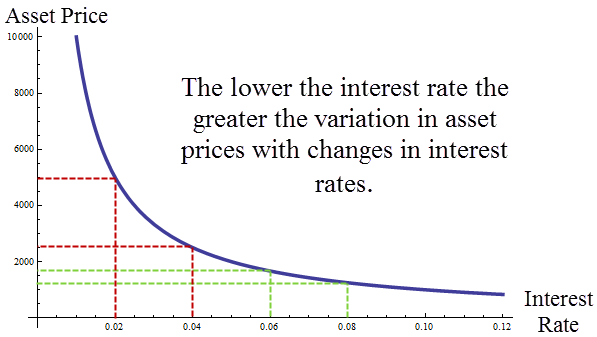
The Gordon model is simple, of course, but adding other factors such as possible variations in dividend growth rates tends to reinforce the conclusion. At low interest rates, for example, even small variations in dividend growth rates will also generate large swings in asset prices.
The lesson is that QE doesn’t have to generate bubbles to generate wide swings in asset prices it just has to lower interest rates.
Do Not Mock the Freshmen
Here from a 1495 Leipzig University Statute is some good advice for the first day of classes:
Statute Forbidding Any One to Annoy or Unduly Injure the Freshmen.
Each and every one attached to this university is forbidden to offend with insult, torment, harass, drench with water or urine, throw on or defile with dust or any filth, mock by whistling, cry at them with a terrifying voice, or dare to molest in any way whatsoever physically or severely, any, who are called freshmen, in the market, streets, courts, colleges and living houses, or any place whatsoever, and particularly in the present college, when they have entered in order to matriculate or are leaving after matriculation.
Hat tip: Jason Kuznicki.
The Value of a CEO
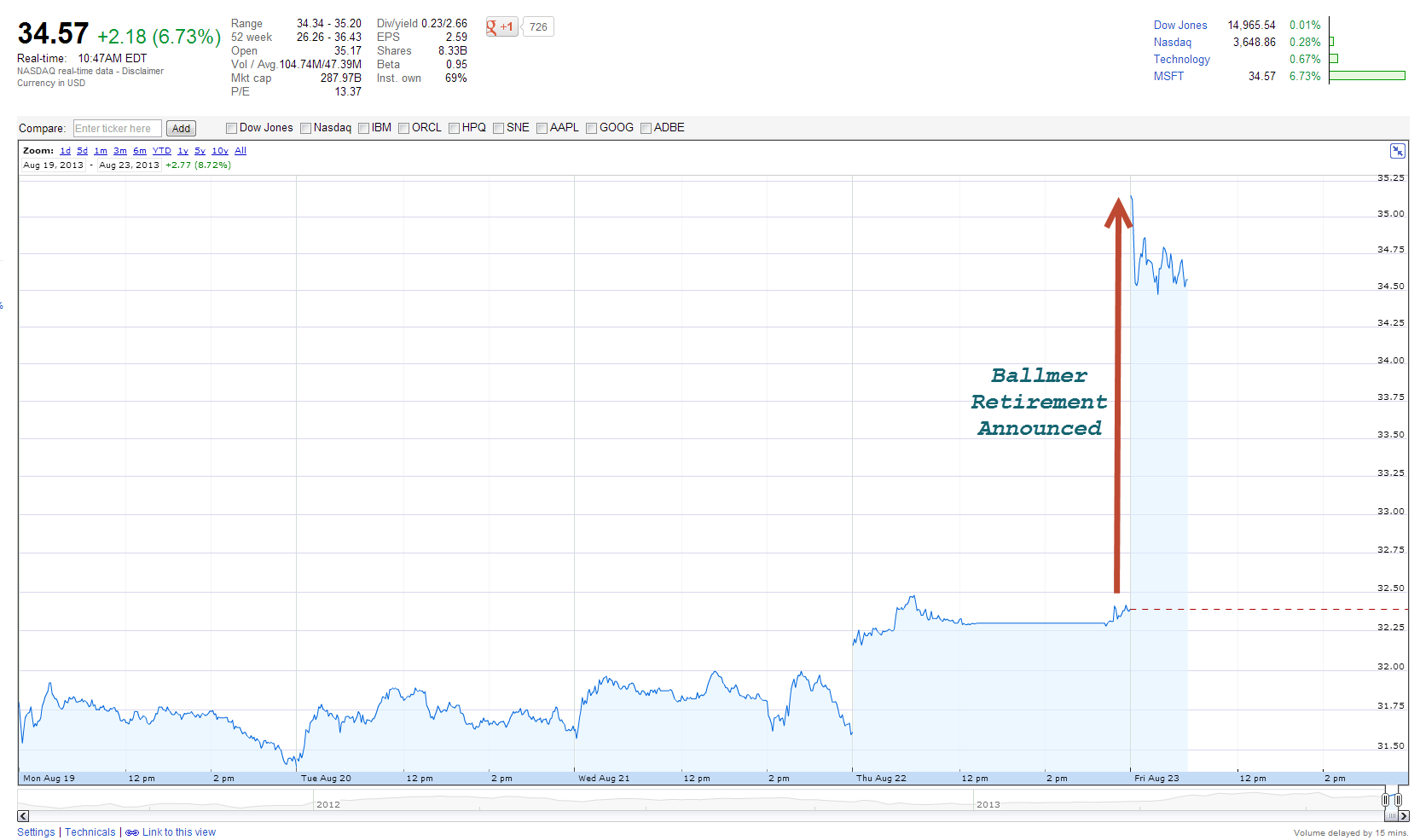
Steven Ballmer announced today that he would retire. Microsoft stock shot up immediately by ~$2.18 or 6-7%. Given 8.33 billion shares outstanding that’s an increase in value of about $18 billion dollars. Of course that’s embarrassing for Ballmer but the lesson cuts both ways. If Ballmer’s exit and replacement with an unknown is worth $18 billion then hiring the right CEO at $27 million annually, the average annual pay for the 100 highest paid CEOs in America, looks like a bargain. Small differences are a big deal for large corporations, you know like a marginal… something or other.
Hat tip: Justin Wolfers.
The Government Profits from Student Debt Defaults
Matt Taibbi’s expose of Federal educational loan programs is over-the-top and not balanced but it does have some shockers. Most importantly, according to Taibbi, the Federal government makes a profit on student defaults.
While it’s not commonly discussed on the Hill, the government actually stands to make an enormous profit on the president’s new federal student-loan system, an estimated $184 billion over 10 years, a boondoggle paid for by hyperinflated tuition costs and fueled by a government-sponsored predatory-lending program that makes even the most ruthless private credit-card company seem like a “Save the Panda” charity.
…In 2010, for instance, the Obama White House projected the default recovery rate for all forms of federal Stafford loans (one of the most common federally backed loans for undergraduates and graduates) to be above 122 percent. The most recent White House projection was slightly less aggressive, predicting a recovery rate of between 104 percent and 109 percent for Stafford loans.
The government claims the net after costs is less than 100%:
..Still, those recovery numbers are extremely high, compared with, say, credit-card debt, where recovery rates of 15 percent are not uncommon…. After the latest compromise, the 10-year revenue projection for the DOE’s lending programs is $184,715,000,000, or $715 million higher than the old projection – underscoring the fact that the latest deal, while perhaps rescuing students this coming year from high rates, still expects to ding them hard down the road.
The loans are profitable even when the student defaults because the government has ways of making people pay:
…”Student-loan debt collectors have power that would make a mobster envious” is how Sen. Elizabeth Warren put it. Collectors can garnish everything from wages to tax returns to Social Security payments to, yes, disability checks. Debtors can also be barred from the military, lose professional licenses and suffer other consequences no private lender could possibly throw at a borrower.
The upshot of all this is that the government can essentially lend without fear, because its strong-arm collection powers dictate that one way or another, the money will come back. Even a very high default rate may not dissuade the government from continuing to make mountains of credit available to naive young people.
The government has also made sure that many laws, such as the Truth in Lending law, do not apply to student loans.
Some student debt can make sense but when 40% of students drop out of college, when even the graduates do not graduate with the degrees that pay and when the job market is weak, student debt can be life-crippling:
…Bottomless credit equals inflated prices equals more money for colleges and universities, more hidden taxes for the government to collect and, perhaps most important, a bigger and more dangerous debt bomb on the backs of the adult working population.
The Microeconomics of Export Restrictions
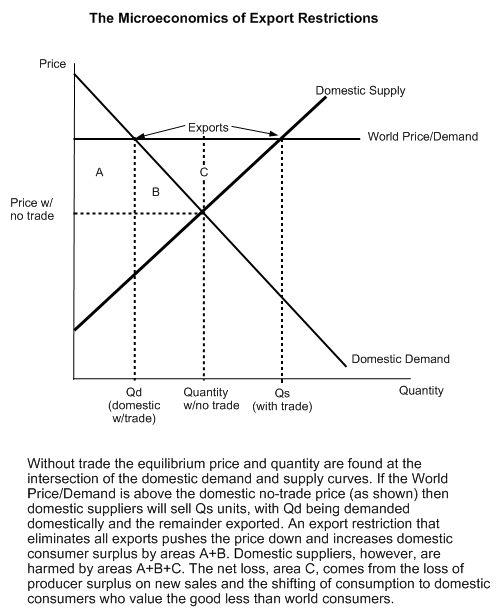
The typical protectionist measure is a limit on imports such as a tariff or a quota. Restrictions on exports are less common and less discussed but proposals to restrict the exports of natural gas have been in the news recently so perhaps a quick refresher on the protectionism of export restriction is in order. Restrictions on imports harm domestic demanders and benefit domestic suppliers but the harm is greater than the benefit so restrictions on imports create a net social loss. The basic result on export restrictions is similar, export restrictions benefit domestic demanders and harm domestic suppliers but the harm is greater than the benefit so restrictions on exports create a net social loss. The figure gives the analysis. As with import restrictions, the arguments for export restrictions soon turn to spillovers, networks effects, and other second round arguments. Without dismissing these in any particular case, the basic analysis suggest we should be wary of such arguments–the transfer always creates political opposition and any second round gains would have to be larger than the first round net benefits.
Addendum: Matt Yglesias comments. In brief he argues for the tax on Georgist grounds. Just because natural gas comes from land, however, doesn’t make a tax on natural gas equivalent to a tax on land. It’s the value of unimproved land that should be taxed not the value of the improvements, namely the extraction of the gas.
Raising Rival’s Costs and Reform in the Public Interest
How can we achieve reform in the public interest when the public is rationally ignorant and unorganized while the special interests are informed, organized and well funded? Matt Yglesias draws some interesting lessons and hope (!) from my paper on The Separation of Commerical and Investment Banking: The Morgans vs. the Rockefellers (pdf).
Yglesias offers a brief summary of the paper:
The basic story is that the Depression led to a lot of public outrage about the financial system and the outrage was—as outrage tends to be—a little bit inchoate and not really focused on the fine-grained details of public policy. Meanwhile, the Rockefeller family and the Morgan family had some longstanding business conflicts between their respective empires. And the Glass-Steagall bill was essentially an effort by the Rockefellers to channel that inchoate public outrage in a direction that would harm the Morgans:
More than anyone else, Winthrop Aldrich, representative of the Rockefeller banking interests, was responsible for the separation of commercial and investment banking. With the help of other well-connected anti-Morgan bankers like W. Averell Harriman, Aldrich drove the separation of commercial and investment banking through Congress. Although separation raised the costs of banking to the Rockefeller group, separation hurt the House of Morgan disproportionately and gave the Rockefeller group a decisive advantage in their battle with the Morgans.
He then draws an interesting conclusion:
Tabarrok notes that when this kind of regulatory strategy is pursued in a given industry “the industry as a whole will shrink” even while one firm gains an advantage over its rivals. And here we have actually an answer to a question that’s troubled me for years: How, given political realities, can the financial sector ever be brought to heel?… It shows a way that smart and savvy would-be regulators can find ways to undermine sector-level political solidarity. Not just in ways that favor one firm against another (which would be pointless) but even in ways that shrink the sector as a whole.
Here’s the big picture. Under certain conditions, free markets channel self-interest towards the social good – that is the meaning of the invisible hand theorem. Unfortunately, there is no invisible hand theorem for politics. There are institutions, such as democracy, checks and balances and an independent judiciary, which help to channel political self-interest if not to the public good then at least away from the public evil. Even given the right macro institutions, however, breaking the iron triangle of politics is difficult. Industry self-interest and the public interest will typically align only accidentally. Universities are not less self-interested than any other actors but support for basic research is (arguably) in the public interest. The usual situation, however, is that industry self-interest pushes well beyond the point of alignment with the public interest. At current spending levels, lobbying by defense firms does not benefit the public even if national defense is a public good.
Yglesias is interested in the most difficult case when the public interest favors not a larger but a smaller industry. Will industry self-interest every align with a smaller industry? Rarely but if public anger against an industry is high then some industry participants may see that a smaller industry is consistent with their self-interest if their share of the industry grows enough as the industry shrinks–a bigger share of a smaller pie. This is the theory of raising rival’s costs that I argue led to the Glass-Steagall Act. Other examples of raising rival’s costs are firms like Costco, that already pay high wages advocating for increases in the minimum wage.
Could we apply this strategy to the provision of other public goods? Here’s an idea. The best political strategy to combat global climate change may be to bring the cleaner parts of the energy industry into a coalition with environmentalists to support a carbon tax. That means bringing the environmentalists together with the nuclear, hydro-electric and fracking part of the energy industry in a play to raise the relative costs of coal and foreign oil. Could this happen? It is unlikely but not inconceivable. As Yglesias says it would take “a smart and savvy” regulator and, I would add, a public-interested regulator (a small but let’s be charitable and say not a zero intersection) to bring the coalition together. You can see why I am less optimistic than Yglesias that the theory can be used to support the public interest but no one said that smart, savvy, public interested regulators would have it easy.
A Puzzle in Divorce Law
It’s easy to see why a divorce law might arise that allows men relatively easy divorce, as in the Old Testament which lets men divorce almost at will (as written, interpretations differ) but gives women no right to divorce at all. It is also easy to see why a society might adopt mutual consent under which both parties must agree in order to get a divorce or no-fault unilateral rules in which either party can get a divorce without the consent of the other. What is difficult to understand, however, is why a society would adopt divorce laws that make it difficult to get a divorce even when both parties want a divorce. Who benefits from such rules? And yet this was the common situation in England and the United States up until say the end of the 19th century. In England, for example, it took an Act of Parliament to get a divorce. One might argue that such rules benefit children but aside from the questionability of the premise this view would also have to answer how it is that children have political power?
Hat tip to Sasha Volokh for bringing the question to mind with an apropos quote on divorce from a 19th century British judge.
Hayek in the 1930s
Paul Krugman on Hayek’s influence in the 1930s:
…back in the 30s nobody except Hayek would have considered his views a serious rival to those of Keynes…
Alvin Hansen reviewing Hayek’s Prices and Production in 1933 in the American Economic Review.
The present volume is, it seems to me, the only book of recent years which at all approaches Keynes’s A Treatise on Money in the impetus it has given to renewed interest and discussion of business-cycle theory.
This in itself is high praise. Altogether aside from the soundness of its
conclusions, the value of the book and its important place in the recent
literature of cycle theory is unquestioned.
von Hayek’s contributions in the field of economic theory are both profound and original. His scientific books and articles in the twenties and thirties aroused widespread and lively debate. Particularly, his theory of business cycles and his conception of the effects of monetary and credit policies attracted attention and evoked animated discussion. He tried to penetrate more deeply into the business cycle mechanism than was usual at that time. Perhaps, partly due to this more profound analysis, he was one of the few economists who gave warning of the possibility of a major economic crisis before the great crash came in the autumn of 1929.
To be clear, it is true that Keynes’s General Theory eclipsed Hayek but to say that Hayek was not a serious rival to Keynes in the 1930s is a Whiggish misreading of the history of economic thought.
Addendum: Don Boudreaux also comments noting that Hicks specifically referred to the great Hayek-Keynes rivalry of the 1930s. See also Greg Ransom’s citations from Hicks and Coase in the comments.
Do note that reading Hayek out of the debate diminishes Hayek but perhaps even more it diminishes Keynes who clearly won over the profession.
Is the Fourth Amendment Now Illegal?
In my view the fourth amendment is routinely being violated by the federal government. But is the fourth amendment, in particular the right to be secure in one’s papers, now illegal? Maybe. Violations of the fourth amendment by the federal government encourage the use of encryption but that avenue may now being blocked. Lavabit, the secure email service used by Edward Snowden, has suddenly and mysteriously closed with the creator leaving this message:
I have been forced to make a difficult decision: to become complicit in crimes against the American people or walk away from nearly ten years of hard work by shutting down Lavabit. After significant soul searching, I have decided to suspend operations. I wish that I could legally share with you the events that led to my decision. I cannot. I feel you deserve to know what’s going on–the first amendment is supposed to guarantee me the freedom to speak out in situations like this. Unfortunately, Congress has passed laws that say otherwise. As things currently stand, I cannot share my experiences over the last six weeks, even though I have twice made the appropriate requests.
Other secure email providers have also shut down.
Recently I asked for suggestions to add to the Bill of Rights. One of mine was:
Congress shall pass no law abridging the right of the people to encrypt their documents and effects. (Modern supplement to the fourth amendment.)
I guess that amendment isn’t going to pass. I should not be surprised. In 2003 I said the cyber-libertarians were naive to dream of a new world of privacy and liberty built on the foundations of the internet and public key cryptography. Sadly, I got that one right.
Hat tip: Lynne Kiesling.
Addendum: Here is a longer account of what may be going on with Lavabit. Key graph:
There are already two theories as to what a FISA order against Lavabit may have looked like. First, FISA could have ordered Lavabit to insert spyware or build a back door for the N.S.A., as American and Canadian courts reportedly did to the encrypted e-mail service Hushmail, in 2007. Second, FISA could have ordered Lavabit to permit the N.S.A. to intercept users’ passwords. But the truth may never come out.
The Animals are Also Getting Fat
In a remarkable paper Allison et al. (2011) gather data on the weight at mid-life from 12 animal populations covering 8 different species all living in human environments. Dividing the sample into male and female they find that in all 24 cases animal weight has increased over the past several decades.
Cats and dogs, for example, both increased in weight. Female cats increased in body weight at a rate of 13.6% per decade and males at 5.7% per decade. Female dogs increased in body weight at a rate of 3% per decade and males at a rate of 2.2% per decade.
One ready, although not necessarily correct explanation, is that fat people feed their cats and dogs more and exercise them less. Thus, the authors also looked at animals not directly under human control such as rats.
…For the 1948–2006 time period, male rats trapped in urban
Baltimore experienced a 5.7 per cent increase in body
weight per decade from 1948 to 2006 and a nearly
20 per cent increase in the odds of obesity. Similarly,
female rats trapped in urban Baltimore experienced a
7.22 per cent per decade increase in body weight, along
with a 26 per cent increase in the odds of obesity.
that too has a ready, although not necessarily correct, explanation:
… just as human real wealth and food
consumption have increased in the United States, rats
which presumably largely feed on our refuse, may also
be essentially richer.
To counter both of these objections the authors do something very clever, they gather data on the weight of control mice used in many different experiments over decades.
Among mice in control groups in the National Toxicology
Programme (NTP), there was a 11.8 per cent
increase in body weight per decade from 1982 to 2003
in females coupled with a nearly twofold increase in the
odds of obesity. In males there was a 10.5 per cent
increase per decade.
Control mice are typically allowed to feed at will from a controlled diet that has not varied much over the decades, making obvious explanations less plausible. Could mice have gained weight due to better care? Possibly although that is speculative.
More generally, there are specific explanations for the weight gain in each of the animal populations, just as there are for humans. Each explanation looks plausible taken on its own but is it plausible that each population is gaining weight for independent reasons? Could there instead be a unifying explanation for the weight gain in all populations? No one knows what that explanation is: toxins? viruses? epigenetic factors? I am not ready to jump on any of these bandwagons and in some cases the author’s samples are small so I am not yet fully convinced of the underlying facts, nevertheless this is intriguing and important research.
Hat tip: David Berreby writing in Aeon about The Obesity Era.
Smart Phone Ethics
Here is David Pogue, an excellent technology reporter but a lousy economist, reviewing the Moto X in the NYTimes:
You get your customized phone within four days, courtesy of Feature 2: it’s assembled right here in these United States. The components are still made in Asia, but they’re put together in Texas — you can lose less sleep worrying about underpaid Chinese workers.
David does not explain how a decrease in the demand for Chinese workers increases Chinese wages. Hint: It doesn’t. Perhaps, however, I have done David a disservice; although his argument fails as economics it succeeds as psychology. People who buy American probably will worry less about underpaid Chinese workers. Out of sight, out of mind.
Addendum: Adam Smith’s thoughts on China and ethics, most notably the importance of using reason not emotion to make ethical decisions, remain relevant.