xkcd on Efficient Markets
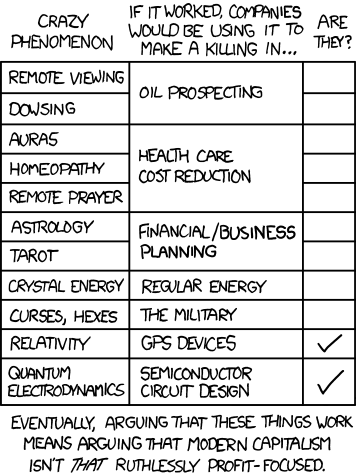
Not to mention that there is an easy $1,000,000 lying on the sidewalk for the true practitioner of the paranormal, supernatural, or occult.
Hat tip: Brad DeLong.
The Wisdom of Garett Jones
Satellite dishes amid the tin-roofed shacks of El Salvador. So much for Maslow's hierarchy.
I laughed and told Garett he should twitter this.
Run for the Border
By perceiving state borders to be physical barriers that keep disaster at bay, people underestimate the severity of a disaster spreading from a different state, but not the severity of an equally distant disaster approaching from within a state. We call this bias in risk assessment the border bias.
More here. Amusingly, the authors show that making the border more salient by darkening the border lines on a map can make people feel even more protected.
Hat tip: Paul Kedrosky.
Insider Trading is Legal for Congressional Insiders
Bloomberg: Your senator learns that a much- maligned weapons system now has enough votes for funding. Before the news gets to a reporter, he buys shares in the arms manufacturer for a quick, handsome profit.
What’s wrong with this picture? Nothing, according to the law…
U.S. senators, representatives and congressional staffers routinely attend high level, closed briefings or engage in conversations where secrets are disclosed that might send shares climbing or slumping if widely known.
That access lets them buy low and sell high based on material, non-public information, and they can do it without concern that their remarkable prescience will alert federal investigators of possible wrong doing.
Insider trading in Congress is not new. In 2004, I wrote about a study showing that the portfolios of US Senators "outperformed the market by an average of 12 per cent a year in the five years to 1998."
Hat tip: The Browser.
Why Has TV Replaced Movies as Elite Entertainment?
Edward Jay Epstein, The Hollywood Economist, has a good post on the economics of movies and television and how this has contributed to a role reversal:
Once upon a time, over a generation ago, The television set was commonly called the “boob tube” and looked down on by elites as a purveyors of mind-numbing entertainment. Movie theaters, on the other hand, were con sidered a venue for, if not art, more sophisticated dramas and comedies. Not any more. The multiplexes are now primarily a venue for comic-book inspired action and fantasy movies, whereas television, especially the pay and cable channels, is increasingly becoming a venue for character-driven adult programs, such as The Wire, Mad Men, and Boardwalk Empire.
Why? Epstein’s explanation is the rise of Pay-TV. You can understand what has happened with some microeconomics. Advertising supported television wants to maximize the number of eyeballs but that often means appealing to the lowest common denominator (this is especially true when there are just three television stations). The programming that maximizes eyeballs does not necessarily maximize consumer surplus.
See the diagram.
Pay-TV changes the economics by encouraging the production of high consumer-surplus television because with Pay-TV there is at least some potential for trading off eyeballs for greater revenue. In addition, as more channels become available, lowest common denominator television is eaten away by targetted skimming. Thus, in one way or another, Pay-TV has come to dominate television.
The movies, however, have become more reliant on large audiences–at least relative to television. Note that even though the movies are not free, a large chunk of the revenue is generated by concessions–thus the movie model is actually closer to a maximizing mouths model than it might first appear (see also my brother’s comments on how flat movie pricing makes it difficult for indie films to compete). Finally, the rise of international audiences for movies has fed a lowest common denominator strategy (everyone appreciates when stuffs blows up real good). As a result, the movies have moved down the quality chain and television has moved up.
Hat tip: Tyler.
Prison
This long series of posts by an inmate who just got out of prison after doing two years for armed robbery is riveting. Lots of great material most of which cannot be printed here. Seems real to me but you be the judge. The number of murders he says to have witnessed seems awfully high.
So I just got out of prison
…and fuck it if I've forgotten how to work a mouse and hit the submit button too soon.
Shit [sic] has changed. So many boards now. I don't know what the fuck is going on. Where do I start? Two years inside and it's like the whole world has changed. Just wanted a board where things stayed the same….who the fuck if Justin Bieber?
Is. Is Justin Bieber. Lost my ability to spell….My cable got cancelled while I was away so I can't even find out. Thank fuck for wireless internet, I swear to God it's faster now too. Seriously, it's like I've traveled through time. Fucking iPads look like shit out the future. Feel like I've missed a decade…
—
I joked to my cell mate on the first day that at least the GFC [Global Financial Crisis, AT] couldn't fuck us inside. He'd been done for assaulting a cop when his house got taken by the bank. But within months 'GFC___' became the standard reply to any query as to how black market prices were suddenly going through the roof. The price of a deck of smokes tripled. There was an actual economic reason about this. I went away in Michigan, where a lot of people lost their houses, mostly poor people already. When they had to move away from the prison, it meant they couldn't bring their loved ones as much contraband group, which meant the price of what there was sky rocketed….Bet you didn't read about that one in the Wall Street Journal.
—-
My first time in solitary was during a mass transfer, which is when our pen would be filled with extra inmates from another pen over night before being moved on. I was there for three days. The first day wasn't so bad. In the beginning, I thought 'this is interesting' at least. And I kind of enjoyed being alone. I jacked off a lot. The second day, I read the bible. Which is the only book allowed in ad seg. The third day… I began to imagine I'd been forgotten about, and I started to panic. Like Mau-dib says "Fear is the Mind Killer". Once you start down the road, there is no going back. You think you can handle it, like being alone isn't so bad, like it's almost a relief… But they make the room just the slight little bit too small. You lose track of time. You can't see the light or figure out what day it is. You resort to counting out loud the seconds. You can't distract yourself anymore and you start pacing but there isn't enough room to pace and it just makes it worse. I'd never had a panic attack before, so I didn't know what to expect. My heart just started pounding out of my chest and I felt like I was going to faint. I wanted to faint, so I could at least sleep and waste some time. But I couldn't. I ended up by stay in ad seg screaming for help, until they came in and tasered me. I woke up back in my old cell.
The next morning, they pulled me out of bed, and said because I fucked up in ad seg… I'd be put back in ad seg. For a week. I screamed and tried to get away on my way back so they put leg cuffs on me and didn't take them off. I got tasered again. This just made it worse.
That was when I decided to get some dope as soon as I was out.
On the plus side, I now have scary accurate recall of obscure biblical passages.
Two unemployment puzzles
The first puzzle about unemployment when thought about from within the search-matching framework is that unemployment rates are highest among the least skilled and most homogeneous skills, i.e. among those worker/jobs with the easiest matches. It's hard to believe that it takes a year to match a construction worker to a job.
Closely related is the issue of how much uncertainty is holding back employment. The case for uncertainty is that hiring a worker is like exercising an option–once you hire, there are sunk costs of hiring (and potentially firing) that go beyond the wage such as administrative and training costs.
Note that you may not need a lot of uncertainty (i.e. you may not need regime uncertainty) to reduce hiring because you don't have to explain why firms aren't hiring only why they aren't hiring this day. Even if we assume, for example, that hiring would be profitable, all else equal, it doesn't take much uncertainty to make it worthwhile to delay hiring a little bit, to wait and see. It's precisely when sales are low and unemployment is high that firms don't mind waiting because uncertainty may resolve in due course and the workers aren't going away.
Ok, that's the positive case for uncertainty but the second puzzle is that uncertainty should matter most when hiring and firing costs are high and once again these costs are lowest for those workers with the greatest unemployment rates. It's one thing not to hire when you can't fire but when firing is easy what's the risk? Moreover, unemployment has increased more in the United States than in Europe even though hiring and firing costs are higher in Europe.
Search-matching models of unemployment have a lot to add but don't necessarily overthrow the importance of AD shocks, sticky wages and prices and other sources of unemployment.
Gay Sex Statistics
OKTrends has another great post, gay sex v. straight sex, analyzing data on millions of customers who use the dating site OKCupid. Here is one piece of the long post that I found surprising.
Another common myth about gay people is that they sleep around, but the statistical reality is that gay people as a group aren't any more slutty than straights.
- straight men: 6
- gay men: 6
- straight women: 6
- gay women: 6
Here's how the distribution curves compare:

- 45% of gay people have had 5 or fewer partners (vs. 44% for straights)
- 98% of gay people have had 20 or fewer partners (vs. 99% for straights)
It turns out that a tiny fraction of gays have single-handedly two-handedly created the public image of gay sexual recklessness–in fact we found that just 2% of gay people have had 23% of the total reported gay sex, which is pretty crazy.
Economic Misconceptions
Students typically come to an economics class with many misconceptions, not just random errors but systematic biases (see especially Caplan 2002).
Bill Goffe recently (2009) surveyed one of his macro principles classes and found, for example, that the median student believes that 35% of workers earn the minimum wage and a substantial fraction think that a majority of workers earn the minimum wage (Actual rate in 2007: 2.3% of hourly-paid workers and a smaller share of all workers earn the minimum wage, rates are probably somewhat higher today since the min. wage has risen and wages have not).
When asked about profits as a percentage of sales the median student guessed 30% (actual rate, closer to 4%).
When asked about the inflation rate over the last year (survey was in 2009) the median student guessed 11%. Actual rate: much closer to 0%. Note, how important such misconceptions could be to policy.
When asked by how much has income per person in the United States changed since 1950 (after adjusting for inflation) the median student said an increase of 25%. Actual rate an increase of about 248%, thus the median student was off by a factor of 10.
I would add that there are also theoretical misconceptions that are probably even more important than factual misconceptions. For example, I think it would be useful to ask questions such as:
1. A number of new furniture manufacturers open in North Carolina, since the new competition forced existing manufacturers to reduce prices the effect of this additional competition was to reduce wages for workers in the furniture industry.
Rate this argument on a 1 to 10 scale from least to most plausible or likely.
2. Competition from Korean automobile manufacturers caused US manufacturers to cut quality in order to reduce their costs. Rate this argument on a 1 to 10 scale from least to most plausible or likely.
3. A law that prevents supermarkets from advertising the prices of their products will reduce the supermarket costs and in turn this will reduce prices to consumers. Rate this argument on a 1 to 10 scale from least to most plausible or likely.
Note that the point here is not to say that an answer is wrong but to understand the implicit models that students are using. It can help a teacher to know what these conceptions and misconceptions are in advance so that they can be addressed.
To further this research, Bill Goffe is putting together a colloborative database on economic misconceptions that teachers are welcome to contribute towards. See also Bill's page on the large literature on teaching in physics much of which is also relevant to economics.
A Prize for Unemployment
The 2010 Nobel Prize awarded to Peter A. Diamond, Dale T. Mortensen, Christopher A. Pissarides can be thought of as a prize for unemployment theory.
A key breakthrough was to realize that the problem was not how to explain unemployment per se but rather how to explain hiring, firing, quits, vacancies and job search and to think of unemployment as the result of all of this underlying microeconomic behavior. Notice that the underlying behavior involves not just workers looking for jobs but also employers looking for workers so explaining unemployment would require a theory of job search, worker search and matching and each aspect of the theory would have to be consistent with every other aspect; i.e. how much workers search depends on how much employers are searching (e.g. advertising) and vice-versa and also on the quality of matching and all of these considerations need to be addressed together. It was Mortensen and Pissarides in particular, building on work by Diamond, who built just such a consistent model.
A very surprising empirical fact helped to motivate this perspective: even in a recession millions of jobs are being created every month. The figures we usually hear about the number of jobs created is the net figure but in the United States in August, for example, there were 4.1 million hires (and 4.2 million separations). Thus, as noted above, understanding unemployment requires understanding these much larger flows of job creation and destruction.
Calibrating the (Diamond)-Mortensen-Pissarides model and embedding it in a dynamic real business cycle model to see if it can match the facts has been a key aim of recent work (see also here and Robert Shimer's work).
Search theory has been applied extensively to the labor market but the same type of theory can be used to understand any issue in which matching is important such as marriage markets and the housing market.
See Tyler for many more details on Diamond, Mortensen and Pissarides.
Maurice Allais
French physicist and economic Nobel Laureate Maurice Allais has died at age 99. Allais is best known among American economists for the Allais paradox but Allais was a polymath with contributions (and JSTOR here) in a huge number of areas many of which were often overlooked because his work was not translated into english (an unfortunate fact which is still true today).
One thing that few people know about Allais was that he was a big proponent of the gold standard and Austrian business cycle theory, even citing Mises and Rothbard in some of his work. See in particular his paper in English, The Credit Mechanism and its Implications (1987) in Feiwel (ed), Arrow and the Foundations of the Theory of Economic Policy. See also here for further citations in french.
As might be expected from a polymath, Allais's views are difficult to pigeonhole. He was a strong proponent of private property and the market economy, for example, but to create the consensus necessary to produce such a society he also favored immigration restrictions and protectionism.
Amazingly, Allais also conducted ground breaking experiments on pendulums which earned him the 1959 Galabert Prize of the French Astronautical Society and which may have revealed an anomaly in general relativity that physicists refer to as the Allais effect.
The Singularity is Near: Robot with Rat Brain
Tyler and I argued recently about whether or not humans will be recognizably human in 500 years. Some data is provided in this video from Wired Science and more discussion in this paper.
Perhaps most important to note is that the robot with rat brain was created by a proto-cyborg.
CA Organ Donor Law
California has a new law creating a live donor registry for kidney transplants and requiring California drivers to say yay or nay on whether they want to be organ donors when they renew their drivers' licenses. The law was passed with the prodding of Steve Jobs who last year had a liver transplant.
The live donor registry is very good. The required declaration is mixed but I hope it works. I see it as follows. The benefit is that if a potential donor has said yes to organ donation then next of kin almost always agree to their wishes so if more people positively affirm that is good. The cost, however, is that now "no" really means "no" and next of kin will presumably agree to that as well. Previously, next of kin might have said yes to non-signatories. Let's use some back of the envelope figures:
100 potential donors
20 signed organ donor cards
80 do not sign but, among these, half the families say yes so 40.
Total: 60 donors.
So with declaration you need more than 60 to agree to be organ donors, i.e. a huge increase in those saying yes. It could happen if what people say on surveys about supporting organ donation is true but I would have been much happier with even a small incentive to sign. How about a free iPhone for signatories? Or at least some more minutes!
See here for more on incentives and organ donation.
Addendum: Nudge blog has some helpful comment–the law appears to be closer to mandated ask than mandated choice.
Markets in Everything
Costco is selling "Thrive," a one year supply of dehydrated and freeze-dried food for $799.99. I find the pairing of capitalist efficiency in advertising and distribution with end of the world preparation oddly disconcerting.
Nazi Nudging
Dan Ariely probably isn't doing his field of behavioral economics any favors when he points out that before he pushed, Hitler was not averse to using a nudge. Still, this 1938 voting ballot which reads, "Do you agree with the reunification of Austria with the German Reich that was enacted on 13 March 1938 and do you vote for the party of our leader; Adolf Hitler?; Yes; No,” is quite amusing as an early example of primitive nudge technology.