Category: Books
The life of Edith Penrose
That is the subtitle, the title is No Ordinary Woman, and the author is Angela Penrose, daughter-in-law of Edith. Here is one sentence:
Pen also wrote to Edith of his deepening love for her and how he wished she had remained in Virginia with him.
What a dramatic and eventful book. Edith Penrose (1914-1996) is a not so well-known but highly underrated economist, with her major contributions coming in the theory of the firm and industrial organization. As a girl, she survived only because her father shot a rattlesnake about to kill her. Later, her first husband was murdered, right before their first child was born. She and her second husband, working in Switzerland, helped Jews escape from Germany, and she later did food planning during the war in England. In 1948 the couple lost one of their three children, right before his third birthday. Later she received a doctorate in economics from Johns Hopkins, studying under Fritz Machlup. Machlup at one point wrote a ten-page letter to her, with the top proclaiming: “I implore you to shut off your hypersensitivity and to overlook it if I sound condescending, arrogant or otherwise unpleasant. I just want to be helpful.”
She headed the Owen Lattimore Defense Fund. Later, she did not feel entirely comfortable teaching at Johns Hopkins (she was treated badly and not tenured) and so she ended up teaching in Baghdad and Beirut and was also an important early faculty member at INSEAD, perhaps their first world class hire. She became an expert on energy economics and multinationals, traveling and advising around the world more or less without stopping. Drawing on her doctoral work, she also published on IP problems for developing economies, an area where she was well ahead of her time.
She enjoyed writing poems and limericks for her own pleasure. She also was known for her “direct questions” and her “disconcerting remarks.”
I would describe her work as halfway between economics and the business school tradition, broadly in the Austrian school but more descriptive and without the political slant of Mises and Hayek. Her contributions include:
1. She insisted that models ought to consider where firms were in the midst of a disequilibrium process, rather than assuming perfect competition or some other smoothly honed end-state. History matters.
2. She was the founding thinker behind “resource-based” theories of the firm, whereby firms are best understood in terms of what resources they have access to, rather than their products. This was a dominant approach from the 1980s onward, though she received only marginal credit for her seminal role. She also focused on which were the slack resources of a firm or not, as a means of ascertaining where the firm was headed, and ran all this analysis through a lens of expectations and perceptions, reflecting her studies with Machlup. She thought in terms of what a firm’s “moat” might be, as you might expect from a contemporary Silicon Valley analyst.
3. She developed a theory of how some firms would grow very large, but based on “economies of growth” rather than economies of scale per se. She tried to explain how there was a lumpiness to the growth process itself. Difficulties of coordination serve as the ultimate limit on firm size.
4. In her theories knowledge creation drives economic growth, and that occurs largely within firms. The cohesive shell of the firm helps to integrate knowledge.
I would describe her style as “every sentence tries to have some insight,” rather than “forcing you to come away with definite conclusions.” Those of you who are used to models or data may find it frustrating to read her, though every sentences reeks of intelligence.
It does not seem she marketed her work very hard, but rather she was content to work out puzzles and pointers for her own satisfaction. I read her work as an undergraduate, as it was recommended to me by some of the Austrian economists, and my recent rediscovery of it has been a pleasant surprise.
My Conversation with Ross Douthat
I think Ross, along with Steven Pinker, received the hardest (though never hostile) questions from me, but of course that is a measure of respect. Plus serious questions about God are difficult by their nature. Here is how the summarizers described the ground covered:
…Douthat’s views on religion and theology, but then moves on to more earth-bound concerns, such as his stance on cats, The Wire vs The Sopranos, why Watership Down is the best modern novel for understanding politics, eating tofu before it was cool, journalism as a trade, why he’s open to weird ideas, the importance of Sam’s Club Republicans, the specter of a Buterlian Jihad, and more.
Not to mention Reformicons, CRISPR, Thiel/Girard, Godwin’s Law, euthanasia, what Ross learned his mother, and the dangers of too much smart phone use. Ross responded in fine form, here is the audio and transcript. Here is one excerpt:
DOUTHAT: I suppose that I’m drawn to the idea that the truth about human existence lies in what can seem like paradoxical formulations, and this is of course very Catholic in certain ways. Certainly a G. K. Chestertonian idea, so I’m just stealing it from other people. But the idea that various heresies of Christianity, Calvinism included — with apologies to my Calvinist friends — tend to take one particular element of you that’s supposed to be in synthesis and possibly in tension, and run with it. And therefore the truth about things lies in a place that may seem slightly contradictory.
And I think this is borne out in many ways in everyday experience. This both-and experience of human existence. The idea that you can’t split up grace and works in any kind of meaningful way. It’s connected to larger facts about the nature of human existence. The tension between determinism and free will that persists in any philosophical system. You can get rid of God and stop having these Jansenist Jesuit arguments about predestination and so on, but you’re still stuck with the free will–determinism debate. That debate doesn’t go away.
So, yeah, there’s a point at the intersection of different ideas that is as close to the truth as our limited minds can get and in Christian thought, we call that point orthodoxy. Now, how that is connected to my political views is a really good question.
And:
COWEN: We all know the Marcionite heresy: the view, from early Christianity, that the Old Testament should be abandoned. At times, even Paul seems to subscribe to what later was called the Marcionite heresy. Why is it a heresy? Why is it wrong?
DOUTHAT: It’s wrong because it takes the form . . . It’s wrong for any number of reasons, but in the context of the conversation we’re having, it’s wrong because it tries to basically take one of the things that Christianity is trying to hold in synthesis and run with it to the exclusion of everything else, and essentially to solve problems by cutting things away.
The Marcionite thesis is, basically, if you read the New Testament, Jesus offers you a portrait of God that seems different from the portrait of God offered in Deuteronomy; therefore, these things are in contradiction. Therefore, if you believe that Jesus’s portrait of God is correct, then the Deuteronomic portrait of God must be false; therefore, the God of the Old Testament must be a wicked demiurge, etc., etc. And the next thing you know, you’re ascribing to, again, a kind of . . . What is the Aryan Christianity of the Nazis, if not the Marcionite heresy given form in the 1930s and 1940s?
And so the orthodox Christian says, “No, any seeming tension between the Old Testament and the New, any seeming contradiction, is actually suggesting that we need to look for a kind of synthesis between them, and for a sense in which there is not contradiction, but fulfillment in some way, which —
COWEN: Bringing us back to Hegelian Douthat.
DOUTHAT: Yes, yes.
And:
I think it’s probably fair to say that Chesterton’s Father Brown stories had as much influence on my worldview as his more sort of polemical and argumentative writings. And, again, I think therein lies some important insight that I haven’t thought through, but I think you’re correctly gesturing at, about a particular way of thinking about God and theology that isn’t unique to Christianity, but that is strongly suggested by just the structure of the revelation that we have. Marilynne Robinson has a line, I think in Gilead, about — one of the characters is imagining that this life is like the epic of heaven. That we’re living in the Iliad or the Odyssey of heaven. This is the story that will be told in the streets.
And:
COWEN: When you see how much behavior Islam or some forms of Islam motivate, do you envy it? Do you think, “Well, gee, what is it that they have that we don’t? What do we need to learn from them?” What’s your gut emotional reaction?
On another topic:
I’ve been always disappointed that there hasn’t been a kind of sustained Watership Down revival because it’s such a great book and it’s a book about — essentially, it’s about a founding.
It’s connected, in a sense, to the kind of things that the Straussians are always arguing about and so on. What does the founding mean, and so on? But you have a group of rabbits who go forth and encounter different models of political order, different ways of relating to humankind, that shadow over rabbit-kind at any point.
You have a warren that has essentially surrendered itself to humanity and exists as a kind of breeding farm, and you have a warren that’s run as a fascist dictatorship essentially. And then you have this attempt to form a political community that is somewhere in between the two, getting back to the Hegelian synthesis and so on. And you have sort of this primal narrative where the problem is of course that they don’t have any females, and so there’s this competition, this competition for reproductive power that’s carried out between these different warrens where the rabbits from the good warren have to literally — not kidnap, because the does come willingly — but steal women from the fascist dictatorship, which maintains a ruthless control over reproduction.
So there’s just a lot of fascinating stuff there, and then it’s all interspersed with storytelling. There’s the sort of rabbit folktales that Richard —
COWEN: So, narrative again.
DOUTHAT: Narrative again.
Strongly recommended, and I do thank Ross for putting up with me. Do read or listen to the whole thing.
And I very much enjoyed reading Ross’s forthcoming book To Change the Church: Pope Francis and the Future of Catholicism, which I found totally engrossing.
Modern Principles, 4th ed!
Tyler and I are thrilled to announce the release of the 4th edition of our principles of economics textbook, Modern Principles. In the new edition we have fully integrated the microeconomics and macroeconomics videos that we have been producing for MRUniversity. No other textbook has anything like this wealth of supplementary material–putting it all together makes Modern Principles a new kind of textbook. We have also added a lot of new questions, Ask FRED questions, that use data from the FRED database, more material on health and economic welfare, more material on financial crises and fires sales and much more.
No other textbook has our super simple Solow model which for the first time makes the Solow model accessible to principles students. Modern Principles also has a balanced treatment of Keynesian and Real Business Cycle models, lots of material on modern topics like price discrimination including bundling and tying, a chapter on managing incentives (piece rates, salaries, tournaments) that’s great for MBA students and of course the best guide to understanding the marvels of the price system.
Check out the video!
Naomi Schaefer Riley reviews Bryan Caplan’s *The Case Against Education*
From the WSJ, here is one excerpt:
“Put yourself in the shoes of a Martian sociologist,” Mr. Caplan writes in “The Case Against Education.” “Your mission: given our curriculum, make an educated guess about what our economy looks like.” You might well “leap from one erroneous inference to another.” Given the amount of time teachers spend on novels and poetry, for instance, there must be a “thriving market in literary criticism,” he writes, adding that most of the subjects that students try to master in school—from history and algebra to foreign languages—will be of little use in their salary-earning lives.
After surveying the research on the “transfer of learning,” Mr. Caplan concludes: “Students learn only the material you specifically teach them . . . if you’re lucky.” Generally, they don’t know how to transfer their reasoning from one topic to a related one. As to informal reasoning—the ability to come up with arguments for or against a particular proposition—education’s effect, he says, has been “tiny.” He similarly dispenses with the claim that schools teach common values or civic education. As college attendance has skyrocketed, he notes, voter turnout has declined.
Here is the full review, which also covers Susan Wise Bauer’s Rethinking School. You can buy Bryan’s book here.
Why it is fun to travel around China
I submit that really every part of China is worth seeing, not just Shenzhen, Shanghai, and Beijing. Sichuan, Guizhou, and Yunnan are very different from Guangdong and Fujian, which are not at all the same as Heilongjiang, Jilin, and Liaoning, which are so distinct from the Jiangnan, and on and on, to say nothing of the far west. Each Chinese province has roughly the population of an EU country; there may not be as many differences between each province as there are between European countries, but they’re still huge.
One can’t so easily find accounts of how much fun it is to travel around China. Those who haven’t ventured far beyond Shenzhen, Shanghai, and Beijing underestimate the sheer number of totally random stuff that happens to you. In stores, traffic, restaurants, and on the streets, I regularly come across behaviors and fixtures that I had no idea were a thing. You might be driving along miles of farmland, when suddenly a massive high-tech factory with the logo of a well-known foreign company looms up on the horizon; in a restaurant, I was asked one time to help with the cooking because chefs had to go out to buy more ingredients; you never know who might come up to you and tell you an interesting story. The lack of professionalism in nearly all things is sometimes frustrating but mostly hilarious.
That is from Dan Wang’s “What I learned in 2017,” many more topics at the link, including learning and books.
That was then, this is now — Henry George edition
It took Dr. Edward Taylor’s inside perceptions to say, on publication: “It is not merely an American book, but a California book. We do not mean merely that it is a book written in California by a Californian, but that it is distinctively and peculiarly Californian, for not only are its illustrations drawn from this coast, but the freshness of its views bespeak the novel and suggestive circumstances that have been presented in California.”
That is from Charles Albro Barker’s Henry George, still a useful biography. Barker points out, by the way, that the notion of a “single tax” on land barely appears in Progress and Poverty, as at that time George was more focused on land nationalization. The single tax idea became more prominent a bit later in the 1880s.
*Elephant in the Brain* — what is really going on in this book?
Not long ago, over lunch, I asked Robin who he wanted to see rise and fall in status, as a result of his book with Kevin Simler. As for who should rise, he cited the book’s epigram to me:
To the little guys, often grumbling in a corner, who’ve said this sort of thing for ages: you were right more than you knew. —Robin
So yes the little guys, but I also stress the cynics as well, or maybe it is the gentle cynics who go through life with a smile.
And who should decline in status? Robin’s lunch answer was again to the point: policy analysts. Policy analysis, while it often incorporates behavioral considerations, when studying say health care, education, and political economy, very much neglects the fact that often both the producers and consumers in these areas have hypocritical motives. For that reason, what appears to be a social benefit is often merely a private benefit in disguise, and sometimes it is not even a private benefit. Things that feel good aren’t always good for you, or for the broader world. Here is Robin’s take on that:
Our new book, The Elephant in the Brain, can be seen as taking one side in a disagreement between disciplines. On one side are psychologists (among others) who say of course people try to spin their motives as being higher than they are, especially in public forums. People on this side find our basic book thesis, and our many specific examples, so plausible that they fear our book may be too derivative and unoriginal.
On the other side, however, are most experts in concrete policy analysis. They spend their time studying ways that schools could help people to learn more material, hospitals could help people get healthier, charities could better assist people in need, and so on. They thus implicitly accept the usual claims people make about what they are trying to achieve via schools, hospitals, charities, etc. And so the practice of policy experts disagrees a lot with our claims that people actually care more about other ends, and that this is why most people show so little interest in reforms proposed by policy experts. (The world shows great interest in new kinds of physical devices and software, but far less interest in most proposed social reforms.)
In ignoring hypocrisy, policy analysts are themselves hypocritical, and thus Robin wishes to downgrade their status, perhaps doubly so. Sorry people!
I find these status questions to be a useful means of thinking about many non-fiction books, sometimes fiction too. I would note it is sometimes hard to market books with the “group X ignores well-known truth from field Y” spin, but perhaps that also means there are intellectual arbitrage gains to be had from studying such works.
What is the best book about each country?
I believe it was Dan Wang who loved the Robert Tombs book The English and Their History and asked for more books of that nature. Another reader wrote in and wanted to know what was the best book about each country.
To count, the book must have some aspirations to be a general survey of what the country is or to cover much of the history of the country. So your favorite book on the French Revolution is not eligible, for instance, nor is Allan Janik’s and Stephen Toulmin’s splendid Wittgenstein’s Vienna. I thought I would start with a list of some nominees, solicit your suggestions in the comments, and later produce a longer post with all the correct answers.
1. England/Britain: Robert Tombs, The English and Their History. Here is MR coverage.
2. Germany: Peter Watson, The German Genius: Europe’s Third Renaissance, the Second Scientific Revolution, and the Twentieth Century.
3. Italy: Luigi Barzini, The Italians. Or David Gilmour, The Pursuit of Italy: A History of a Land, its Peoples, and their Regions.
4. Spain: John Hooper, The Spaniards.
5. France: Graham Robb: The Discovery of France: A Historical Geography.
6. Portugal: Barry Hatton, The Portuguese: A Modern History.
7. Ireland: Thomas Bartlett, Ireland: A History.
8. Russia: Geoffrey Hosking, Russia and the Russians. One of the very best books on this list.
9. Ukraine: Serhii Plokhy, The Gates of Europe: A History of Ukraine.
10. The United States: Louis Hartz, The Liberal Tradition in America. Or de Tocqueville? John Gunther’s Inside U.S.A.?
11. Canada: ????. Alex?
12. Mexico; Alan Riding, Distant Neighbors: A Portrait of the Mexicans. Even though it, like the Barzini book, is out of date.
13. Caribbean: Joshua Jelly-Schapiro, Island People: The Caribbean and the World.
I’ll give South America further thought, Africa and the Middle East too.
14. Cambodia: Sebastian Strangio, Hun Sen’s Cambodia.
15. India: Edward Luce, In Spite of the Gods: The Rise of Modern India. Or India, by Michael Wood.
16. Pakistan: Anatol Lieven, Pakistan: A Hard Country.
17. China: ???? I find this to be a tough call.
18. Singapore and Malaysia: Jim Baker, Crossroads: A Popular History of Malaysia and Singapore.
19. Japan: In the old days I might have suggested Karel von Wolferen, but now it is badly out of date. What else?
Joe Studwell, How Asia Works: Success and Failure in the World’s Most Dynamic Region gets tossed in somewhere too.
All of those are subject to revision.
Do leave your suggestions in the comments, and at some point I’ll publish an expanded and updated version of this post, with additional countries too, or perhaps split into multiple posts by region.
Here 22 ambassadors recommend one book to read before visiting their country, mostly mediocre selections. Here is a suggested list of the most iconic book from each country. Don’t take me as endorsing those.
What should I ask Charles C. Mann?
I will be doing a Conversation with Charles (no public event), what should I ask him? Charles is one of my favorite writers, as he is the author of 1491, 1493, and the new and excellent The Wizard and the Prophet: Two Remarkable Scientists and Their Dueling Visions to Shape Tomorrow’s World.
Here is yet another excerpt from the latter book:
Rodale died in 1971 — bizarrely, on a television talk show, suffering a heart attack minutes after declaring “I never felt better in my life!” and offering his host his special asparagus boiled in urine.
I thank you all in advance for your wisdom and inspiration. Here is Charles’s home page, he also has many excellent magazine articles.
*The Polarizers*
The author is Sam Rosenfeld and the subtitle is Postwar Architects of Our Partisan Era. Here is the bottom line:
Today’s pundits wring their hands about polarization and yearn for the halcyon days of bipartisan comity. Yet pundits of the mid-twentieth century saw that very bipartisanship as the key problem in American politics. They argued that the lack of clarity between the parties stifled progress while blurring accountability to the voters. Polarization was their solution to this problem. They thought making parties “real” in the sense that Roosevelt had meant — unified behind distinct policy agendas that were clear to voters — would invigorate democracy and improve policymaking. Their ideas influenced the views of key political actors on both the left and right in the ensuing decades.
This book is the story of how that happened, and it is a useful corrective for those who thinks greater partisanship is something quite recent.
*The Wizard and the Prophet*
The author is Charles C. Mann, and the subtitle is Two Remarkable Scientists and Their Dueling Visions to Shape Tomorrow’s World. What a splendid book, this is, all rolled into one the reader receives two distinct biographies, a history of mid-20th century environmental science, a book on technological progress in agriculture, and one of the best overall frameworks for thinking about environmentalism.
Oh how many good sentences there are:
Until I visited post-Katrina New Orleans I did not realize that rebuilding a flooded modern city would involve disposing of several hundred thousand refrigerators.
Here is one fun bit:
So ineradicable was the elitist mark on conservation that for decades afterward many on the left scoffed at ecological issues as right-wing distractions. As late as 1970, the radical Students for a Democratic Society protested the first Earth Day as Wall Street flimflam meant to divert public attention from class warfare and the Vietnam War; left-wing journalist I.F. Stone called the nationwide marches a “snow job.”
By the way, as for the subjects of the dual biographies:
The two people are William Vogt and Norman Borlaug.
Here is the framing of the book:
…the dispute between Wizards and Prophets has, if anything, become more vehement. Wizards view the Prophets’ emphasis on cutting back as intellectually dishonest, indifferent to the poor, even racist (because most of the world’s hungry are non-Caucasian). Following Vogt, they say, is a path toward regression, narrowness, and global poverty. Prophets sneer that the Wizards’ faith in human resourcefulness is unthinking, scientifically ignorant, even driven by greed…Following Borlaug, they say, at best postpones an inevitable day of reckoning — it is a recipe for what activists have come to describe as “ecocide.”
Where along the Wizards-Prophets spectrum should one be?
This will end up as one of the very best books of this year.
*The Elephant in the Brain: Hidden Motives in Everyday Life*
The authors are Kevin Simler and Robin Hanson, and now it is out!
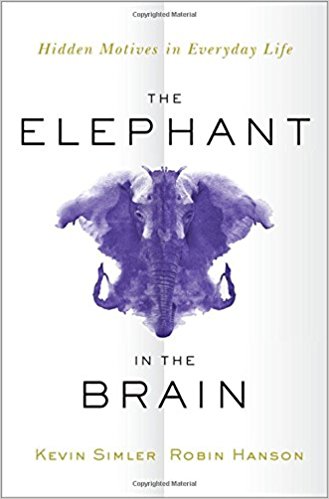
Robin reports:
On press coverage, back in July Publishers Weekly had a paragraph on it, the Boston Globe did an interview of me back then that they just released, Vice interviewed me recently so I expect that out soon, and I’m told that a Wall Street Journal review is forthcoming. Amazon now has 5 reviews, Goodreads has 7, and 2 reviews have appeared on blogs.
I am pleased to be doing a Conversation with Robin about the book, and other matters too. But don’t forget — conversations aren’t about talking!
My Law and Literature reading list 2018
The New English Bible, Oxford Study Edition [not all of it]
Guantanamo Diary, by Mohamedou Ould Slahi
Petina Gappah, The Book of Memory
Glaspell’s Trifles, available on-line.
Year’s Best SF 9, edited by David G. Hartwell and Kathryn Cramer, used or Kindle edition is recommended
The Metamorphosis, In the Penal Colony, and Other Stories, by Franz Kafka, edited and translated by Joachim Neugroschel.
In the Belly of the Beast, by Jack Henry Abbott.
Sherlock Holmes, The Complete Novels and Stories, Sir Arthur Conan Doyle, volume 1, also on-line.
I, Robot, by Isaac Asimov.
Juan Gabriel Vasquez, Reputations
The Pledge, Friedrich Durrenmatt.
Ian McEwan, The Children Act
Shakespeare, The Tempest, Folger edition
Margaret Atwood, Hag-Seed
Curtis Dawkins, The Graybar Hotel
Movies: To be determined.
How to understand modern India
I could just rewrite my post How to understand modern China, but change the examples. But you can do that mental exercise yourself, and besides it is easier to access information about India in the English language. So let me try a very specific recommendation for India:
Study Indian textiles and their history
I found this the single most useful way to get a handle on Indian history, a bit less on contemporary India. Here’s why:
1. The artistic side of textile history gives you a clear sense of regional differences, and also Islamic influence, or lack thereof.
2.. It focuses your attention rather immediately on the role of women and women’s work, and also how this interacted with industrialization.
3. In the early 18th century, India was a world leader at cloth production, but it lost this position by the early 19th century. Studying textiles and cloth production offers an excellent window on their major story of economic decline, and how British import penetration, backed by colonialism, contributed to Indian deindustrialization.
4. Relatively poor and neglected regions of India, such as Bihar and Orissa, have a strong presence in Indian folk textile traditions, and you will learn plenty about them.
5. Books on textiles will explain the accompanying information about Indian history in a clearer way than will actual history books about India.
6. People who write books on textiles tend to be both clear and careful I have found, perhaps because they love and collect something delicate.
7. Studying textiles and cloth also brings you right to Gandhi’s “Swadeshi’ movement.
8. Unless your income is really quite modest, you can afford to buy and regularly view some pretty high-quality Indian textiles. In India I’ve found some excellent pieces for as cheap as $200-$250.
9. Studying textiles also will bring to your attention India’s tribes and indigenous peoples. And it ties in readily to India’s broader cultural influence throughout Southeast Asia.
10. Textile books have many pretty pictures.
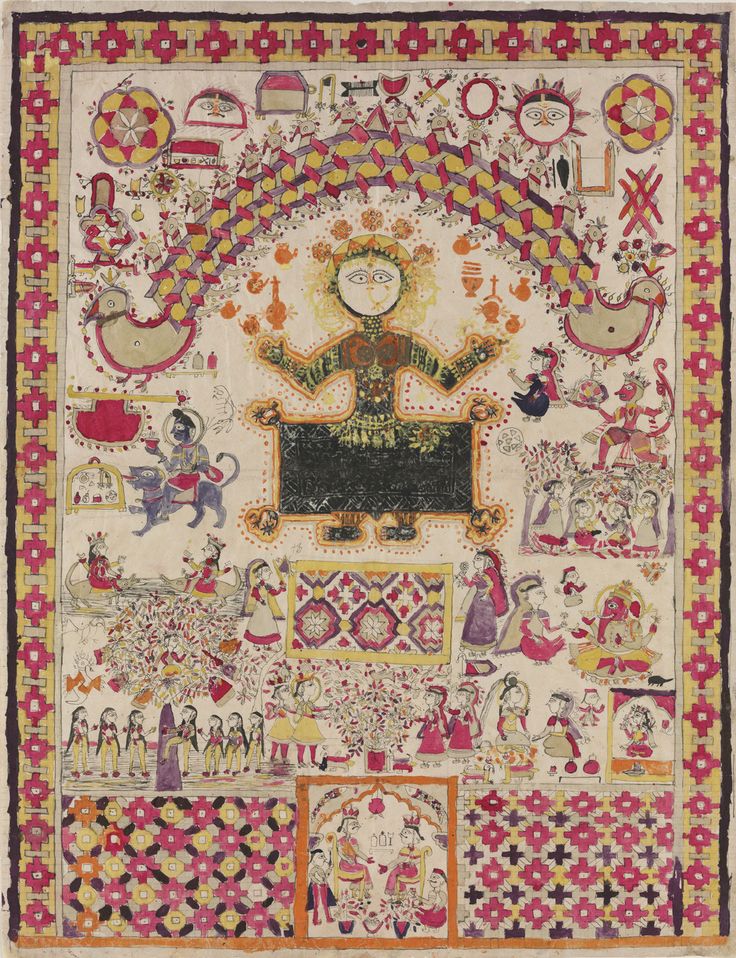
My favorite books on Indian textiles are cited in my discussion of that topic in Creative Destruction: How Globalization is Changing the World’s Cultures. But it’s more a question of reading a bunch of them, rather than picking out a select few. Simple, direct searches will get you to where you need to go.
My favorite collection of Indian textiles is in the Victoria & Albert museum in London. Sadly, I’ve yet to get to the Calico textiles museum in Ahmedabad, though it is very highly regarded.
My Conversation with Andy Weir
Andy was great, here is the text and audio, here is the introductory summary:
Before writing a single word of his new book Artemis, Andy Weir worked out the economics of a lunar colony. Without the economics, how could the story hew to the hard sci-fi style Weir cornered the market on with The Martian? And, more importantly, how else can Tyler find out much a Cantonese meal would run him on the moon?
In addition to these important questions of lunar economics, Andy and Tyler talk about the technophobic trend in science fiction, private space efforts, seasteading, cryptocurrencies, the value of a human life, the outdated Outer Space Treaty, stories based on rebellion vs. cooperation, Heinlein, Asimov, Weir’s favorite episode of Star Trek, and the formula for finding someone else when stranded on a lonely planet.
My favorite part was this, which Andy answered with no hesitation:
COWEN: What if there were two immortal people, let’s say it’s the two of us, placed on opposite sides of the Earth, an Earth-like planet, and we can wander freely with no constraints but just foot speed. How long does it take us to find each other?
WEIR: Can we collude in advance in any way?
COWEN: No, we cannot.
WEIR: OK.
COWEN: But we know we’re trying to find each other.
WEIR: We know we’re trying to find each other. Well, we should both — but can we have a — are we both rational actors and we —
COWEN: We’re as rational as you and I are; take that as you wish.
WEIR: So, no?
[laughter]
COWEN: No.
WEIR: I think the best thing to do would be for both of us to pick an arbitrary great circle to walk, around the planet, and leave markings along the way denoting what direction you’re walking. So I would arbitrarily pick a direction to go and I would just go that direction with the intention of circumnavigating the entire globe, and I would walk at maybe half what is a comfortable speed for me. And you would do the same thing. Now, somewhere, our two — in fact, in two points — our great circles will intersect.
COWEN: Right.
WEIR: And when one of us reaches the other one’s, then they start following the markers at full speed, and then you get the guy. Right?
COWEN: And what’s your best guess as to how long that would take?
WEIR: Well, if you pick two points, I’m guessing one of us would have to walk probably about a quarter of the way around the planet before we found the other one’s great circle. And then you’d have to walk again. So in terms of circumnavigation times, it would take you 2x to get all the way around the planet, because my initial plan was you’d walk half-speed. So I’m guessing it would be a quarter of that, so one-half x to get to your great circle, and then a quarter x to find you along your great circle, on average, I’m guessing. So one-half plus a quarter, so .75x. So three-quarters of the time that it would take to circumnavigate the planet.
COWEN: OK, great answer.
WEIR: That’s my guess.
Do read/listen to the whole thing…