Category: Books
What I’ve been reading
1. Mike Jay, Wireheads: An Unnatural History of Technology in the Brain. Much of this story is told through the lens of the accompanying science fiction and non-neuro trends in other parts of science. An excellent book, substantive on every page, and it will make you want to read some of the works he cites.
2. Vasily Grossman, From the Front Line, Stalingrad-Treblinka-Berlin 1941-1945. Self-recommending, the best third of this volume is just stunningly good. You do not have to read the whole thing, as there is some degree of repetition.
3. Forough Farrokhzad, Let Us Believe in the Beginning of the Cold Season. She died in a car crash in 1967 at the age of thirty-three, but it turns out she was an amazing poet. I usually do not enjoy poetry in translation, but this is so fiery and full of passion that I am happy to recommend it. Surely in the original Farsi it is better (and quite different?) yet.
4. André Breton, Nadja. It is short, and fun enough to read. But one learns most books from the past are not masterpieces, and that surrealism as a movement — most of all in painting — was more important than the literary outputs of surrealism. Nadja, to me, sounds like a drag. Which is fine. But. What does Breton really think he is immortalizing here? At the end he writes “Beauty will be CONVULSIVE or not at all.” I do appreciate Breton for his understanding of Mexico, and for his cultivation of Haitian art.
5. Emma Southon, Servus: How Slavery Made the Roman Empire. A very good and aggressively readable book about how terrible slavery was in the Roman Empire. A useful corrective to other sources as well. While my general view is that interpretative disputes over antiquity are difficult to resolve, I find her interpretations more intuitive and more convincing than the other side of the debate.
My excellent Conversation with Julia Ioffe
Here is the audio, video, and transcript. Here is from the episode summary:
Julia joined Tyler to discuss why so many of Russia’s great constructivist painters were women, why the tsarist government established women’s medical courses in 1872, changing attitudes towards abortion and birth control in the 20th century, why the Soviet regime turned prudish, how Khrushchev’s plan to “replace the dead” institutionalized single motherhood, Russian superwomen, why Jewish men were a prized commodity amid rampant antisemitism, the cultural significance of flowers, why a few Russian names still dominate, why Russian women think Western feminists have their priorities backwards, how gender attitudes and autocracy feed into each other, three underrated Russian novels, what she wants to write about next, and more.
Excerpt:
COWEN: I’m sure you’ve noticed that quite a few American men will marry Russian or Soviet women, but not so many American women want to marry Russian or Soviet men. It’s a kind of market test, right? Why exactly are the men so bad? Why are they such louts? Maybe that’s a rude way to put it, but surely in one’s mind, one asks that question, right?
IOFFE: It’s a question that a lot of us who were living in Moscow in the late aughts and the teens were asking that all the time. I remember a friend of mine, a male Western TV correspondent, saying, “The women are so gorgeous here, but the men are so ugly and unfashionable.” He had lived all over the place and worked all over the place, and he said, “I’ve never seen such disparity,” and it was true.
The women like me, Western women who were living and working in Moscow at the time, said, “We’ll just wait till we get home.” I think it’s because of what I talked about before, or what you and I talked about before, which is that so many men were killed in the first half of the 20th century, and so few demands were placed on them because they were seen as an endangered species, in general. They were a resource to be fought over and protected.
In 1968, when the West was undergoing a sexual revolution, and women were fighting for more rights, more equality, the Soviets were talking about saving the men, protecting the men, and saying, “We’ve done enough for the women, but our men die young.” That’s after a lifetime of alcohol abuse, smoking, being largely irrelevant in the home, and obviously politically, because it’s a totalitarian system, so let’s work on protecting them.
Soviet men, and then Russian men, became these coddled, spoiled children essentially, where on one hand, so little was asked of them that it’s the bigotry of low expectations. So little was asked of them, and very little was expected of them, and they rose to meet those very low expectations.
On top of that, the idea of what made a man a manly man in Russia is he’s physically strong, but he dies a young death, or he dies an early death. He drinks a lot, he smokes a lot, he’s reckless, he’s careless, and takes a lot of risk, and that usually means an early death. If you have fewer men to begin with, and as a Russian woman, you see them dying early, and you’re fighting over them, what is the impetus for men to take care of themselves, to act better, be better, if there’s always going to be a beautiful, super competent woman to take him if you don’t want him?
COWEN: These points you’re raising, historically, do you feel it’s been quite different for Soviet and Russian Jews or the same?
IOFFE: I think it’s a little bit different. The caveat is, and I hate that I have to say this, Jews are people too, and subject to the same social forces that everybody else is, but culturally, Soviet Jews were more educated as a rule, more urban, and culturally came from a very family-centric tradition. Russian women, actually, for all the intense antisemitism in the Soviet Union, in Russia, Jewish men were actually a prized commodity for Russian women.
COWEN: With ethnic Russian women?
IOFFE: Yes. Ethnic Ukrainian women, you name it, because the cultural stereotype was that Jewish men don’t drink, they don’t hit you, they are family-focused, family-oriented, they’re involved fathers, they bring their money home, they don’t waste it at the bar or on bottles of vodka with their buddies. That’s the kind of man you would want as a husband. Ironically, the same polls that will tell you that Russians would want their daughters to marry a Jew will tell you that they don’t want their president to be a Jew.
One of my favorite episodes of the year, interesting throughout, and I very much enjoyed Julia’s book Motherland: A Feminist History of Modern Russia.
*Rome’s Age of Revolution*
The author is Tim Whitmarsh and the subtitle is Augustus, Empire and the Making of Christianity. This is the most important book on the history of Christianity I have read in a long time, and it is also an important work in Roman history. Yet also fun and extremely readable. Excerpt:
The story I have told so far has emphasised the fit between Christianity and the Greek world of the early Roman Empire; I have given relatively little space to conflict. That has been quite deliberate. One of the commonest misconceptions about the early Roman Empire is that it was a time of ceaseless and inevitable suppression of virtuous Christians by a brutal governmental machine. This is a myth that has roots in antiquity itself, and has been pumped systematically into western popular culture since the nineteenth centuury. It is a remarkably durable myth, because it is both emotionally seductive and ideologically powerful. The idea that virtuous Christians were engaged in endless conflict with the Roman state makes for great narrative. But the reality is more banal: most Christians were fully integrated into Roman society, and no more or less harassed than anyone else…
My argument has been, rather, that Christianity could not have come into being in anything like the form we know it without the revolutionary impact of Augustus’ political reforms. It was this seismic change that fundamentally transformed Mediterranean thought…The most dramatic effect of the Augustan swirl was Christianity itself: a breakaway Judaean sect led by brilliant entrepreneurs who understood the opportunities offered by the new political dispensation, and rapidly reshaped their ideas to suit new audiences.
Definitely recommended, and not only to Christians and Romans.
*Redefining Global Health in the 21st Century*
While donor-driven programs undoubtedly saved millions of lives, they also created unintended distortions in national health priorities. Many governments in sub-Saharan Africa and parts of Asia actually scaled back domestic health investments, as donor program filled key gaps in HIV/AIDS, maternal and child health, and infectious disease control. In some cases, domestic health budgets shrank in real terms, even as external funding increased. This phenomenon, often referred to as “fiscal substitution,” led to national health systems that were heavily donor-dependent, externally managed, and vulnerable to funding shocks. Notably, this reliance emerged despite countries pledged to allocate at least 15% of their national budgets to health. More than two decades later, only a handful has met this target.
That is from the new and useful book by Michael John Alastair Reid and Eric Paul Goosby. But $150 for a not so thick volume!? If the authors believe in aid, as they should, perhaps they could consider giving this book away for free rather than turning it over to Elsevier…?
What should I ask Jared Diamond?
Yes, I will be doing a Conversation with him. His whole career is fair game, though many of my questions will cover his forthcoming book Profits, Prophets, Coaches, and Kings (When) Do Leaders Matter?
From the Amazon summary: “Now, in Profits, Prophets, Coaches and Kings, he studies leaders throughout time to answer the question: do the actions of individuals truly influence history? Or is humanity subject to larger historical, technological, cultural, geographical forces, far beyond the influence of individuals, no matter how powerful they may seem?”
So what should I ask him?
*Liberal Worlds: James Bryce and the Democratic Intellect*
A very good book, here is one excerpt that bears directly on a conversation I was just having:
He [Bryce] regretted the low quality of the Indian Civil Service: they were hard-working and motivated by a desire to promote the welfare of the Indian people, but ‘rather wanting in imagination and sympathy, less inspired by the extraordinary and unprecedented phenomena of the country than might have been expected.’ He went on: “Since the unhappy so-called Ilbert Bill there has been a marked change in the attitude of Europeans to natives, especially in Bengal; and the natives complain bitterly that the civilians as well as the military & the planters, treat them with arrogance & make them feel their social inferiority as well as political subordination.” He continued by saying that all he had seen made him certain that he had made the right decision in not pursuing a career in the Indian Civil Service.
The author is H.S. Jones, and I also learned a good deal about Bryce’s work on behalf of Armenia, a topic I had known nothing about. I am a big fan of Bryce’s The American Commonwealth book as an analysis of democracy, though of course I do not agree with all of the particulars. Bryce also was an early NIMBY proponent (even then), and played a large role in debates over the humanities, basically defending liberal education. He served as ambassador to the U.S. as well. His long (overlong?) Modern Democracies is in my Kindle queue to read.
Odysseus notes
The subsection of the Georgi Gospodinov novel runs like this:
The Shortest Novel About Odysseus After His Return Home
One night, now old and flabby and starting to forget, he leaves his home secretly. He’s sick of everything, so he heads back one last time to see the places, women, and wonders he had once encountered. To go back again into his draimed memory to see how it had been and who he had been. Because thanks to the bitter irony of old age, he has begun to transform into the Nobody, the name he had once cleverly used when introducing himself to the Cyclops.
Telemachus finds him in the evening, collapsed by the boat, only a hundred yards from home, with no idea what he is doing there and where he had been heading.
They take him back to a house with some woman he no longer remembers.
The novel is Time Shelter, and the premise is that refuges are built for people with Alzheimer’s, reflecting life from past decades, for instance the 1960s. But then people from the present start wanting to live in them.
What I’ve been reading
1. Christopher Priest and Nina Allan, The Illuminated Man: Life, Death and the Worlds of J.G. Ballard. Priest died before he finished this book, and his widow added material, including on Priest himself. This is in any case a good overview and introduction to the strange worlds of Ballard. There is only a UK edition so far.
2. Christian Kracht, Eurotrash, A Novel. I was put off by the title, but it turns out this is a fun and high-level short Swiss novel about driving around Switzerland with your semi-crazy eighty-year-old mother on a road trip. It helps to have some knowledge of both Switzerland and broader German-language literature.
3. Walter Kempowski, Alles Umsonst. From 2006, could this be the best German-language novel since Sebald? It is about the pending doom from the Russian army approaching on East Prussia in 1945, and how the different characters deal with that, set on a German estate. Applicable to many other real world situations as well. There is an English-language translation, I am not sure how good it is. In any case an important and very good work of fiction.
4. Lars Behrisch, Democracy’s Double Helix: Participation, Equality and Revolution in Early Modern Europe. A good book about how the roots of semi-democratic decision-making are found in 16th century Europe, and stemmed from new needs to assemble various military and fiscal coalitions. Looks at the problem more broadly, in geographic terms, than most comparable studies.
5. Katie Kitamura, Audition. A fun short novel, full of mystery and suspense, good for those who like puzzles in their writing.
My excellent Conversation with Andrew Graham-Dixon
Here is the audio, video, and transcript. From the episode summary:
Tyler and Andrew discuss whether it was inevitable we’d rediscover Vermeer, how that vanishingly rare sect left its fingerprints all over his life, why the Met has misread its own Allegory of the Catholic Faith, whether Vermeer painted for money or pointedly refused to, where the Gardner’s stolen Concert might be, why Dutch music never blossomed as much as Dutch painting did, how the Church of England rivaled the Cultural Revolution in wiping out British art, whether you can still spot an English painting on sight, the love that saturates late Rembrandt and the mystery of his soaring print prices, the nail on the wall that proves two Vermeer paintings are a pair, why the French are to blame for George Stubbs’ lack of status, whether we can still love Malevich, why Andrews calls recent Richter “almost like printing money,” why female artists and antique textiles remain absurdly cheap, why nobody builds beautiful neighborhoods any longer, and much more.
Excerpt:
COWEN: In what sense was Vermeer a liberal?
GRAHAM-DIXON: Well, the main discovery of my book is that Vermeer was among the very first pioneers of what we now call the liberal tradition.
COWEN: What we now call the Netherlands, then the Dutch Republic.
GRAHAM-DIXON: In the Dutch Republic, and the Dutch contribution to the Enlightenment, which is the origins of the liberal tradition, has been very much forgotten. That’s absolutely at the heart of my book, is an attempt to remember these people, to bring them back into the place in history that they deserve. I’m not only talking about Vermeer. I’m talking about his friends, his patrons, because that’s the discovery of the book, is that he and his friends were a remarkable group of people, and they have been completely forgotten, and what they believed has been largely forgotten too. We need to remember it now, probably more than ever.
COWEN: This was also a religious movement.
GRAHAM-DIXON: Yes.
COWEN: Doctrinally, how would they have been different from, say, Protestants in England? The Collegiants, the Remonstrants?
GRAHAM-DIXON: Yes. Vermeer’s patrons, it emerges, and Vermeer himself, were part of a Protestant sect in Holland called the Remonstrants. They had a more extreme manifestation called the Collegiants, and they were unique among all Christian denominations of that time in being utterly opposed to division, hostility, enmity. The only thing they wanted was to bring all Christians, indeed all people—they included Jewish people and Muslim people—they wanted to bring everyone together within a faith that only really cleaved to the essentials of what Jesus Christ said, particularly in the Sermon on the Mount.
They said, “If you actually follow Jesus properly, you can never make war. You can never persecute someone who differs from your opinion. You can never pick on somebody because they believe something different.” They were very, very tolerationist. They formed the first pacifist movement in European history. They lived in a time of appalling warfare, the Thirty Years’ War, probably the worst war in the history of the modern West. Fifteen million out of 20 million German people died in the course of 30 years, and the 5 million who were left, all the women had been violated, and all the men only have one arm or one leg. It was truly atrocious.
They’re responding to real traumatic historical events. They’re responding to what is going on around the corner from where they live. They come up with this very, very beautiful approach to life, full of optimism, full of idealism. For about 20 years, the Dutch Republic actually lives by these codes of belief to a great extent. It’s the only tolerant country in Europe.
And this:
COWEN: What makes George Stubbs such an underrated painter?
GRAHAM-DIXON: I think he’s been underrated forever because of his subject matter. I blame the French. The French in the 17th century invented a system for ranking works of art by their subject matter. Up at the top, you and I, we could put on some armor and confront each other with swords, and Poussin would paint us. That would be a history painting done from the life. That would be at the pinnacle. Then would be a painting of an event, maybe a meeting between great men. Then, below that, there would be a portrait.
You’d keep going down, and eventually you’d get to paintings of still lifes, like flowers and fruit, or paintings of animals. These were the lowest works of art because they featured the basest things. I think that Stubbs, to a certain extent, was the victim of that.
COWEN: Are we now able to see them properly?
GRAHAM-DIXON: Yes. It’s been no problem since Stubbs and Constable, more than anyone else, slightly controversial to say, but I think they paved the way for modernism because they showed, not necessarily deliberately, but they showed that anything could be painted, anything at all, like a piece of mud or a piece of a river could be painted in such a way as to touch on the very highest thoughts and ideas and beliefs and feelings that subject matter is completely, in a sense, irrelevant. Cézanne picked up on that when he said, “I want to stun Paris with an apple. I’ll paint an apple, and I’ll paint it with such astonishing concentration that you’ll see it as an epistemological challenge to all of your philosophy.”
I think that French art gets that from British art because British art has to be like that because that’s all the aristocrats are going to commission. They look down on people like Stubbs, in a sense. If I’m an aristocrat in the 18th century and I want a really important picture, I’ll go to Italy and I’ll buy one, thank you very much, and I’ll buy my history painting from Titian. You, sir, Stubbs, you just paint my horse. It’s my racehorse, and I’m very fond of him. Paint him well and don’t scare him.
Recommended, interesting throughout. And here is Andrew’s very interesting new book on Vermeer.
Markets in everything?
Peter Brook‘s five-hour-plus film adaptation of “The Mahabharata” is set for a BFI Blu-ray release on Aug. 10, presented in high definition from a new 4K restoration of the 1989 production.
The release centres on the triptych version of the film, running 332 minutes, which sits between Brook’s three-hour cinema cut and the six-hour television version he shot concurrently. Based on the ancient Hindu epic, the film was originally produced by Brook with screenwriters Jean-Claude Carrière and Marie-Hélène Estienne, and features an international cast drawn from 16 nationalities.
Here is the Variety article, but will there be a version suitable for U.S. players? The work is highly recommended, real genius. For the pointer I thank Sam Mendelsohn.
What should I ask Luis Garicano?
Yes I will be doing a Conversation with him. From Wikipedia:
Luis Garicano Gabilondo (pronounced [ˈlwis ɣaɾiˈkano]; born 1967) is a Spanish economist and politician who was a Member of the European Parliament (MEP) from 2019 to 2022. He was also vice president of Renew Europe and vice president of the European political party Alliance of Liberals and Democrats for Europe (ALDE Party). Before entering politics, he was a professor of strategy and economics at IE Business School in Madrid and at the London School of Economics (LSE). After leaving the European Parliament he has returned to academia as a visiting professor at Columbia Business School and at the University of Chicago Booth School of Business. In 2023, returned to LSE as full professor at the School of Public Policy.
He is one of the leading European economic liberals, here is his home page. Here is his Google scholar page. Here is Luis on Twitter. he also has a very good book coming out called Messy Jobs, co-authored with Jim Li and Yanhui Wu. So what should I ask him?
*The Odyssey*, the movie (no real spoilers)
I can’t say I loved it. The Circe scene was excellent, Cyclops was good, and the battles in Troy were well done. But most of the roles were miscast. I like Matt Damon, but he is too “Good Will Hunting” to play Odysseus. The character did not cohere. (Compare to Ralph Fiennes in the superior The Return.) Zendaya’s role was superfluous. Worst of all was Calypso, who reminded me of the kind of chick you might meet at a Tupperware party in the Hamptons. At least half of the dialogue was lame and contrary to the spirit of the Mycenaean world. Some of the sea and boat footage was good. I strongly disliked the changes made to the ending.
There is enough energy, effort, and money put into the thing to make it eminently watchable on the big screen. And if this were a new director, you would think he had great promise. But relative to both the reviews and where most expectations were placed, this has to count as a disappointment.
A Phone is a Cow
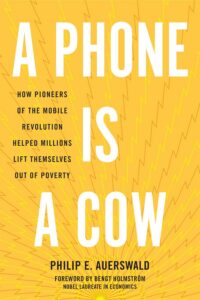 Philip Auerswald’s A Phone is a Cow is three books in one, it’s a history of the mobile phone, it’s a business biography of Iqbal Quadir, who brought the cell phone to Bangladesh at at time when that seemed quixotic and doomed to fail, and it’s a theory of economic growth. It succeeds on all three levels.
…relatively few technologies have managed to reach the majority of the world’s people. Fire. Writing. The cookpot. The portable radio. These all succeeded. Yet most people in the world have never flown in an airplane. Most do not own a car or a bicycle. And, until recently, most still did not have access to a safe, sanitary toilet in their home. The list goes on.
The mobile phone reached the global majority more rapidly than any technology that had come before. How did this happen?
The title, by the way, comes from Quadir’s insight that just as Grameen Bank lent to villagers so they could purchase productive assets like a cow, Grameenphone could lend villagers the money to buy a phone—which then became a revenue-generating asset in its own right.
Addendum: Auerswald on Econ Talk with Russ Roberts.
My excellent Conversation with Chase Koch
Here is the audio, video, and transcript. Here is part of the episode summary:
Chase and Tyler discuss if any of his father’s lessons never stuck, the guilt-trip letter his grandfather wrote three months after Charles was born, why Chase started throwing tennis matches, what Rafa’s grit taught him about stoicism, who he admired most from the 1992 Dream Team, whether the Spurs should jettison De’Aaron Fox, the David Gilmour solo that hooked him at eleven, what drew him to jam bands, how he built a boom-box business out of his parents’ garage, why his father interviewed Snoop on a Zoom call during Covid, why his band is named for the second law of thermodynamics, what it’s like working with MrBeast, how Koch Industries has evolved, what he learned from Marc Andreessen, the philosophy behind hiring the “farm team,” why he is teaching himself to code with Claude at his fourteen-year-old’s urging, where he’s traveling next, and much more.
Excerpt:
COWEN: N.W.A., are they good? I like them.
KOCH: I had my phases. My first business, Tyler, was when I was 15 years old and one of my best friends to this day, Askia Ahmad, he was wiring up car stereos and building custom boom boxes and all that. We basically built a business out of my parents’ garage because they had all the tools and materials and everything. Like, “Let’s build a business out of here. My parents hopefully will pay for the machinery, and then we can sell these boom boxes to our friends at high prices and capture a big margin.” Through that, I learned about the whole gangster rap. Your listeners may be surprised, but it started with me, Public Enemy, N.W.A., Eazy-E, of course—
COWEN: It’s so good.
KOCH: Dre.
COWEN: Snoop.
KOCH: Snoop.
COWEN: You know Snoop, right?
KOCH: It’s so good, so good. Yes.
COWEN: What’s Snoop like?
KOCH: Snoop? Okay. This goes back to what I was mentioning on the power of music to unify people. So I’ve been with Stand Together. For the listeners that don’t know, it’ll give context to your question. Stand Together is an organization that has really a community of like-minded leaders that all believe in one thing, in the power of human potential, and that every human has a gift.
We all know that there’s so many barriers in society that are holding people back, whether it’s barriers in education, barriers in regulation, so you can’t start a business, barriers in our criminal justice system, you name it. What Stand Together does is we have basically a comprehensive strategy that addresses everything from education to policy to bottom-up empowerment in communities to drive real social change. I’ve been a part of this for as long as I can remember.
My father’s been working on social change for 60 years. My passion for music, as you can see from your last line of questioning, with Stand Together and that whole community, we never tapped into culture. When I say culture and what the next generation pays attention to—sports, music, YouTube, entertainment, creators, media. During COVID, I had this idea that we’ve never tapped into music to drive social change.
And on one specific point:
Back to your question on energy, 4 percent of the overall capital consumed at Koch is in refining, which is basically where my grandfather started the company. I think that surprises a lot of people because I think a lot of people are still stuck in this, “Well, you’re this energy company.” No, we’re not. We touch the majority of the economy now, and we’re in everything from forest products, consumer products, software, as I described, glass manufacturing, to energy and fertilizers as well.
Interesting throughout.
Those new service sector jobs
It’s 85 years since Brian O’Nolan, better known as Flann O’Brien and Myles na gCopaleen, proposed a Book Handling Agency in The Irish Times.
On Sunday evening, Flann’s idea became reality. In a Berlin bar’s back room, Cabinet Magazine, a literary quarterly, assembled a crack team of white-coated literary experts to make your unread books look well-read – at moderate prices.
For €5 you could get an “essential” handling package including a “professional” spine-break for your book, “two commonplace page markers, 2 scholastic dog-ears; 4 underlined passages; 1 arbitrary yet discerning piece of marginalia; and 1 contextually appropriate piece of marginalia”.
The premier package added “mauling the edges” of the book with a drill and sand paper, thanks to the “vice-chiefs of abrasion (light, heavy)” as well as “one stain using cheap wine, coffee etc”, hand-applied by a “fluid dynamics specialist”.
There is a learning dimension as well:
“We learned that, to look authentic, coffee needs to be dropped at a different height than wine,” said Sina Najafi, editor-in-chief of Cabinet magazine, who organised the evening and took on the professional spine-breaking.
Here is the full story, via Benen Harrington.