Category: Economics
China’s Solyndra Problem
The NYTimes reports that China has a much bigger Solyndra problem than the United States ever did:
…China’s strategy is in disarray. Though worldwide demand for solar panels and wind turbines has grown rapidly over the last five years, China’s manufacturing capacity has soared even faster, creating enormous oversupply and a ferocious price war.
The result is a looming financial disaster, not only for manufacturers but for state-owned banks that financed factories with approximately $18 billion in low-rate loans and for municipal and provincial governments that provided loan guarantees and sold manufacturers valuable land at deeply discounted prices.
China’s biggest solar panel makers are suffering losses of up to $1 for every $3 of sales this year, as panel prices have fallen by three-fourths since 2008. Even though the cost of solar power has fallen, it still remains triple the price of coal-generated power in China, requiring substantial subsidies through a tax imposed on industrial users of electricity to cover the higher cost of renewable energy.
This bit also seemed familiar:
Mr. Li said in an interview that he wanted banks to cut off loans to all but the strongest solar panel companies and let the rest go bankrupt. But banks — which were encouraged by Beijing to make the loans — are not eager to acknowledge that the loans are bad and take large write-offs, preferring to lend more money to allow the repayment of previous loans. Many local and provincial governments also are determined to keep their hometown favorites afloat to avoid job losses and to avoid making payments on loan guarantees, he said.
New Videos: Leading Thinkers on Development
At MRUniversity we just released over 30 new videos on leading thinkers on development. We cover Amartya Sen (who gets three), Bela Belassa, Karl Polanyi, Adam Smith, Paul Romer, William Easterly and many others. In terms of the course these videos are optional, they are for dipping into as per one’s interest. In these videos, we sometimes provide a second perspective on issues we discuss in greater detail in forthcoming topic videos.
On Monday we will be releasing a new section of the Development Economics course, Food and Agricultural Productivity.
A third Industrial Revolution?
James Tien has a new paper:
The outputs or products of an economy can be divided into services products and goods products (due to manufacturing, construction, agriculture and mining). To date, the services and goods products have, for the most part, been separately mass produced. However, in contrast to the first and second industrial revolutions which respectively focused on the development and the mass production of goods, the next – or third – industrial revolution is focused on the integration of services and/or goods; it is beginning in this second decade of the 21st Century. The Third Industrial Revolution (TIR) is based on the confluence of three major technological enablers (i.e., big data analytics, adaptive services and digital manufacturing); they underpin the integration or mass customization of services and/or goods. As detailed in an earlier paper, we regard mass customization as the simultaneous and real-time management of supply and demand chains, based on a taxonomy that can be defined in terms of its underpinning component and management foci. The benefits of real-time mass customization cannot be over-stated as goods and services become indistinguishable and are co-produced – as “servgoods” – in real-time, resulting in an overwhelming economic advantage to the industrialized countries where the consuming customers are at the same time the co-producing producers.
Keywords: Big data, decision analytics, goods, adaptive services, digital manufacturing, value chain,
supply chain, demand chain, mass production, mass customization, industrial revolution
For the pointer I thank the excellent Kevin Lewis.
Hyperinflation in Iran
Steve Hanke estimates that Iran’s monthly inflation rate has reached 70%.
When President Obama signed the Comprehensive Iran Sanctions, Accountability, and Divestment Act, in July 2010, the official Iranian rial-U.S. dollar exchange rate was very close to the black-market rate. But, as the accompanying chart shows, the official and black-market rates have increasingly diverged since July 2010. This decline began to accelerate last month, when Iranians witnessed a dramatic 9.65% drop in the value of the rial, over the course of a single weekend (8-10 September 2012). The free-fall has continued since then. On 2 October 2012, the black-market exchange rate reached 35,000 IRR/USD – a rate which reflects a 65% decline in the rial, relative to the U.S. dollar.
The rial’s death spiral is wiping out the currency’s purchasing power. In consequence, Iran is now experiencing a devastating increase in prices – hyperinflation.

Iran’s hyperinflation is still well below world leader Hungary whose inflation rate in July of 1946 reached 4.19 × 10^16 percent per month or Zimbabwe’s more recent November of 2008 rate of 7.96 × 10^10 percent per month.
The new Fable of the Bees literature
From the American Journal of Agricultural Economics, there is a new paper by Randal R. Rucker, Walter N. Thurman, and Michael Burgett (Dept. of Entomology), here is the abstract:
The world’s most extensive markets for pollination services are those for honey bee pollination in the United States. These markets play important roles in coordinating the behavior of migratory beekeepers, who both produce honey and provide substitutes for ecosystem pollination services. We analyze the economic forces that drive migratory beekeeping and theoretically and empirically analyze the determinants of pollination fees in a larger and richer data set than has been studied before. Our empirical results expand our understanding of pollination markets and market-supporting institutions that internalize external effects.
This is a deep and thoughtful analysis which extends the tradition of Steven Cheung. There is an earlier ungated version here. Here is a related paper from UC Davis, and here is a related paper on the economics of honeybee pollination in Georgia. Here is a very good summary of the main piece.
For the pointer I thank Michelle Dawson.
What kind of austerity did Great Britain implement in the 1920s?
When it comes to the post-WWI period, Paul Krugman recently argued: “…Britain demonstrated a fairly awesome commitment to austerity…” (and see here today’s post).
The cited IMF report notes with disapproval:
…the U.K. government implemented a policy mix of severe fiscal austerity and tight monetary policy. The primary surplus was kept near 7 percent of GDP throughout the 1920s. This was accomplished through large expenditure decreases, courtesy of the “Geddes axe,” and a continuation of the higher tax levels introduced during the war.
Is this portrait true? I say yes and no. For 1918-1920, government spending plummets, mostly because of demobilization and the end of the war, source here.
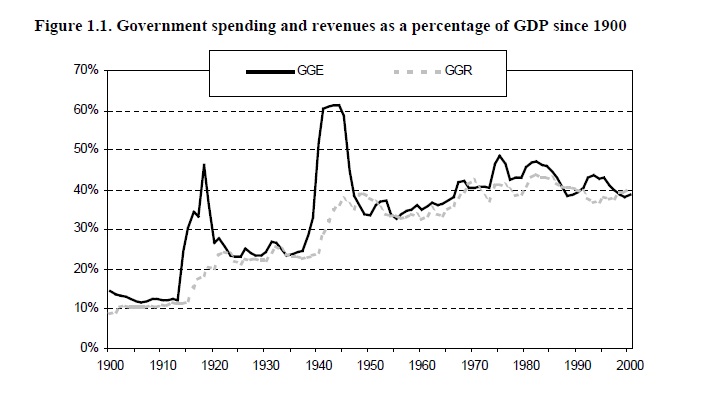
Yet there is an alternative perspective. Even after the demobilization is over, consider that in 1910 British government spending was about 10% of gdp and in the 1920s it runs near 25% of gdp. Is that such an awesome commitment to austerity?
If we consider a more finely grained approach, and focus on shorter-term rates of change, we do see real restraint on the spending side:
…spending was cut by 10% in real terms in two years, while tax as a share of GDP remained constant. The budget deficit was reduced from 7% GDP in 1920 to near balance in 1923, followed by a swift recovery. Defence bore the brunt of the cuts.
As mentioned in the quotation (“followed by a swift recovery”), this transition went reasonably well. If you read this very up to date, very careful with the data paper (try p.10), you see a notable gdp plunge from 1920-1921, mostly from a coal strike and a series of postwar shocks, and then solid growth from 1921 to 1926, running over and after the period when Britain was cutting government spending. It seems that policy was hardly a macroeconomic catastrophe. Things do go south in 1926, but it is well known that is from bad monetary and exchange rate policy, plus a major coal strike.
Or read Barry Eichengreen (pdf). He notes that Britain under-performs relative to other European nations in the first half of the 1920s, although he focuses much more on monetary policy and real factors, rather than fiscal policy. Furthermore, that’s hardly the only period when Britain was under-performing its rivals on the continent.
In other words, I don’t see how the episode as a whole supports the interpretative weight being placed upon it as an anti-austerity parable. Note that when it comes to the U.S. (switching from the UK for a moment), Krugman wrote the entirely defensible sentence: “…even a cursory examination of the available data suggests that 1921 has few useful lessons for the kind of slump we’re facing now.” If the UK in 1921 shows more relevance, that has yet to be shown.
*Information Wants to be Shared*
That is the new Harvard Business Review Press book by Joshua Gans, Amazon link here, $3.99, recommended. Here is Joshua’s blog.
The Evil of Pagination
I agree with Farhad Manjoo:
Splitting articles and photo galleries into multiple pages is evil. It should stop.
Pagination is one of the worst design and usability sins on the Web, the kind of obvious no-no that should have gone out with blinky text, dancing cat animations, and autoplaying music. It shows constant, quiet contempt for people who should be any news site’s highest priority—folks who want to read articles all the way to the end.
Pagination persists because splitting a single-page article into two pages can, in theory, yield twice as many opportunities to display ads—though in practice it doesn’t because lots of readers never bother to click past the first page. The practice has become so ubiquitous that it’s numbed many publications and readers into thinking that multipage design is how the Web has always been, and how it should be.
Neither is true: The Web’s earliest news sites didn’t paginate, and the practice grew up only over the past decade, in response to pressure from the ad industry. It doesn’t have to be this way—some of the Web’s most forward-thinking and successful publications, including BuzzFeedand the Verge, have eschewed pagination, and they’re better off for it.
Crowdsourcing the lowest fare
Travelers with complex travel plans may have noticed, however, that the search results aren’t necessarily consistent. This has created a business opportunity for Flightfox, a start-up company based in Mountain View, Calif., which uses a contest format to come up with the best fare that the crowd — all Flightfox-approved users — can find.
A traveler goes to Flightfox.com and sets up a competition, supplying information about the desired itinerary and clarifying a few preferences, like a willingness to “fly on any airline to save money” or a tolerance of “long layovers to save money.” Once Flightfox posts the contest, the crowd is invited to go to work and submit fares.
The contest runs three days, and the winner, the person who finds the lowest fare, gets 75 percent of the finder’s fee that the traveler pays Flightfox when setting up the competition. Flightfox says fees depend on the complexity of the itinerary; many current contests have fees in the $34-to-$59 range.
Here is more, and for the pointer I thank @ArikSharon.
Raj Chetty wins a MacArthur fellowship
The story and list of other winners is here. Here is Chetty on scholar.google.com.
Maybe today you should go visit MRUniversity.com
The link is here, and we thank you for your interest. Read Alex’s opening statement for more information:
Welcome to MRU! At right you will find our first course, Development Economics. Click the + to see the videos in each section. New sections will be released at the beginning of every week and there will be bonus sections released during the middle of some weeks. Practice questions for each video provide some simple feedback.
Anyone can watch videos and take the practice questions but to truly participate by asking and answering questions, posting material, partcipating in chats and so forth you will need to register. Please do register as this will also help us to plan for future courses. There is no charge for registering.
In order to make our material as widely available as possible the videos default to low resolution, 380p, but if you have good bandwidth we recommend bumping them up to 480p which will increase video and audio resolution. You can do this on many platforms (not all) by clicking near the bottom right of the video and then clicking the settings button.
The course is designed for videos but every lecture also includes a downloadable MP3 in the section Related Materials.
The “How to Use” section (link in bar at top), includes ideas such as flipping the classroom and some basic directions for making your own videos.
In coming weeks, we will be releasing new features and announcing virtual and live chats!
Women economists see the world differently
The biggest disagreement: 76% of women say faculty opportunities in economics favor men. Male economists point the opposite way: 80% say women are favored or the process is neutral.
As for politics:
Female economists tend to favor a bigger role for government while male economists have greater faith in business and the marketplace. Is the U.S. economy excessively regulated? Sixty-five percent of female economists said ‘no’ — 24 percentage points higher than male economists.
The story is here. The article is “Are Disagreements Among Male and Female Economists Marginal at Best? A Survey of AEA Members and Their Views on Economics and Economic Policy,” Ann Mari May, Mary G. McGarvey and Robert Whaples, Contemporary Economic Policy (forthcoming), but I can’t seem to find a copy on-line.
For the pointer I thank Daniel Klein.
Lottery Winners as Natural Experiments
The Detroit News: A Lincoln Park woman who won $1 million in the Michigan Lottery and was later convicted for still collecting state welfare died Saturday from an apparent drug overdose.
…Clayton isn’t the only Michigan Lottery winner to become notorious after making headlines.
In August, millionaire Freddie Young, of Detroit, was sentenced to 20 to 35 years in prison for fatally shooting his daughter’s landlord.
Young, 64, was convicted on second-degree murder and felony firearm charges in the May 2011 killing of Australian native Gregory McNicol.
Prosecutors said Young won an estimated $1.57 million share of a Michigan Lottery jackpot in February 2011. Three months later, he shot 45-year-old McNicol over $1,000 in back rent owed by his daughter.
Here is my previous post on this subject with more systematic data.
From the Institute for New Economic Thinking
We would like to introduce our new blog on the website of the Institute for New Economic Thinking (INET) entitled ‘Reading Mas-Colell’, which will initially run in the fall of 2012, alongside our teaching of a course which uses the textbook on microeconomics by Mas-Colell, Whinston and Green. We hope to make a modest contribution to economic thinking by engaging in selective close reading and commentary on a very influential text, which in certain ways has become a ‘Bible’.
Our goal is to help through the blog to change the way in which economics teaching is approached at the Ph.D. level (many agree that it is limited and limiting). We hope to generate a lively conversation on how economics is taught and practiced today.
You can find the blog on the INET website at:
http://ineteconomics.org/blog/reading-mas-colell
We very much hope that you and your readers will participate in the conversation that we hope to generate.
Best wishes,
Sanjay G. Reddy and Raphaele Chappe
The half-life of an economics book
9.38 years, measured in terms of citations over time.
That is from the new and excellent book by Samuel Arbesman, The Half-Life of Facts:Why Everything We Know Has an Expiration Date.