Category: History
What kind of austerity did Great Britain implement in the 1920s?
When it comes to the post-WWI period, Paul Krugman recently argued: “…Britain demonstrated a fairly awesome commitment to austerity…” (and see here today’s post).
The cited IMF report notes with disapproval:
…the U.K. government implemented a policy mix of severe fiscal austerity and tight monetary policy. The primary surplus was kept near 7 percent of GDP throughout the 1920s. This was accomplished through large expenditure decreases, courtesy of the “Geddes axe,” and a continuation of the higher tax levels introduced during the war.
Is this portrait true? I say yes and no. For 1918-1920, government spending plummets, mostly because of demobilization and the end of the war, source here.
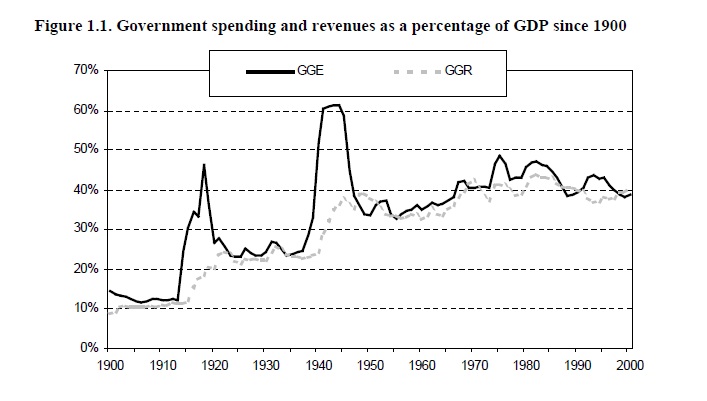
Yet there is an alternative perspective. Even after the demobilization is over, consider that in 1910 British government spending was about 10% of gdp and in the 1920s it runs near 25% of gdp. Is that such an awesome commitment to austerity?
If we consider a more finely grained approach, and focus on shorter-term rates of change, we do see real restraint on the spending side:
…spending was cut by 10% in real terms in two years, while tax as a share of GDP remained constant. The budget deficit was reduced from 7% GDP in 1920 to near balance in 1923, followed by a swift recovery. Defence bore the brunt of the cuts.
As mentioned in the quotation (“followed by a swift recovery”), this transition went reasonably well. If you read this very up to date, very careful with the data paper (try p.10), you see a notable gdp plunge from 1920-1921, mostly from a coal strike and a series of postwar shocks, and then solid growth from 1921 to 1926, running over and after the period when Britain was cutting government spending. It seems that policy was hardly a macroeconomic catastrophe. Things do go south in 1926, but it is well known that is from bad monetary and exchange rate policy, plus a major coal strike.
Or read Barry Eichengreen (pdf). He notes that Britain under-performs relative to other European nations in the first half of the 1920s, although he focuses much more on monetary policy and real factors, rather than fiscal policy. Furthermore, that’s hardly the only period when Britain was under-performing its rivals on the continent.
In other words, I don’t see how the episode as a whole supports the interpretative weight being placed upon it as an anti-austerity parable. Note that when it comes to the U.S. (switching from the UK for a moment), Krugman wrote the entirely defensible sentence: “…even a cursory examination of the available data suggests that 1921 has few useful lessons for the kind of slump we’re facing now.” If the UK in 1921 shows more relevance, that has yet to be shown.
A cultural guide for Afghanis
After eleven years, we are trying a new approach:
“Please do not get offended if you see a NATO member blowing his/her nose in front of you,” the guide instructs.
“When Coalition members get excited, they may show their excitement by patting one another on the back or the behind,” it explains. “They may even do this to you if they are proud of the job you’ve done. Once again, they don’t mean to offend you.”
This is news to me, though I would like to see it confirmed:
Fifty-one coalition troops have been killed this year by their Afghan counterparts. While some insider attacks have been attributed to Taliban infiltrators, military officials say the majority stem from personal disputes and misunderstandings.
Finally:
NATO’s coalition is described as a “work of art.”
For my house, I might rather have a Suzani.
The use of Robinson Crusoe in economics
From RM, I received this query:
I’m still trying to figure out when the Robinson Crusoe analogy entered the economic discussion in history.
I would have thought Karl Marx was the origin, or perhaps one of the utopian socialists. Any better ideas? Maybe this expensive book can tell us.
Eugene Genovese has passed away
Here is one appreciation, here is Wikipedia. You should read Roll, Jordan, Roll, if you have not already.
For the pointer I thank Peter Stearns.
Life extension that works?
Castration had a huge effect on the lifespans of Korean men, according to an analysis of hundreds of years of eunuch “family” records.
They lived up to 19 years longer than uncastrated men from the same social class and even outlived members of the royal family.
Caveat emptor! For the pointer (sans endorsement) I thank Mo Costandi.
Cambodian Genocide Denialism in Counterpunch
I was shocked by the latest issue of Counterpunch which includes a truly offensive article full of praise for one of the greatest mass murderers in human history, Pol Pot.
“The Pol Pot the Cambodians remember was not a tyrant, but a great patriot and nationalist, a lover of native culture and native way of life. He was brought up in royal palace circles; his aunt was a concubine of the previous king. He studied in Paris, but instead of making money and a career, he returned home, and spent a few years dwelling with forest tribes to learn from the peasants. He felt compassion for the ordinary village people who were ripped off on a daily basis by the city folk, the comprador parasites. He built an army to defend the countryside from these power-wielding robbers. Pol Pot, a monkish man of simple needs, did not seek wealth, fame or power for himself. He had one great ambition: to terminate the failing colonial capitalism in Cambodia, return to village tradition, and from there, to build a new country from scratch.
…St Francis and Leo Tolstoy would have understood him.
The Cambodians I spoke to pooh-poohed the dreadful stories of Communist Holocaust as a western invention.”
As if praise for Pol Pot were not enough, the author doubles down with support for Stalin and Mao.
“…To me, this recalled other CIA-sponsored stories of Red atrocities, be it Stalin’s Terror or the Ukrainian Holodomor. The people now in charge of the US, Europe and Russia want to present every alternative to their rule as inept or bloody or both. They especially hate incorruptible leaders, be it Robespierre or Lenin, Stalin or Mao – and Pol Pot.”
I consider this article to be on par with Holocaust denialism and praise for Hitler. Counterpunch is a leftist periodical but it is not without mainstream support and respect so I think this is worth calling out.
For the record, the most credible sources all estimate excess deaths under Pol Pot’s brutal regime of between 1.4 and 2.2 million people, approximately 20-25% of the entire population. The estimates come from three types of sources, 1) Interviews with survivors about relatives and neighbors killed, 2) Demographic estimates from before and after the Khmer Rouge which even today show massive discrepancies, especially for men of the relevant ages and 3) Surveys of mass graves. A good review is here. See also Yale’s Cambodian Genocide Project which does not overlook US involvement. None of this is especially controversial so Wikipedia is a good overview:
In power, the Khmer Rouge carried out a radical program that included isolating the country from foreign influence, closing schools, hospitals and factories, abolishing banking, finance and currency, outlawing all religions, confiscating all private property and relocating people from urban areas to collective farms where forced labour was widespread. The purpose of this policy was to turn Cambodians into “Old People” through agricultural labour. These actions resulted in massive deaths through executions, work exhaustion, illness, and starvation.
…Modern research has located 20,000 mass graves from the Khmer Rouge era all over Cambodia. Various studies have estimated the death toll at between 740,000 and 3,000,000, most commonly between 1.4 million and 2.2 million, with perhaps half of those deaths being due to executions, and the rest from starvation and disease.
The U.S. State Department-funded Yale Cambodian Genocide Project estimates approximately 1.7 million. R. J. Rummel, an analyst of historical political killings, gives a figure of 2 million.
A UN investigation reported 2–3 million dead, while UNICEF estimated 3 million had been killed. Demographic analysis by Patrick Heuveline suggests that between 1.17 and 3.42 million Cambodians were killed, while Marek Sliwinski estimates that 1.8 million is a conservative figure. Researcher Craig Etcheson of the Documentation Center of Cambodia suggests that the death toll was between 2 and 2.5 million, with a “most likely” figure of 2.2 million. After 5 years of researching grave sites, he concluded that “these mass graves contain the remains of 1,386,734 victims of execution”.
Go ask Ramsay MacMullen
It used to seem shocking that five of the ten richest counties in the United States were part of the DC Metropolitan Statistical Area, but the 2011 American Community Survey numbers released yesterday show that the DC suburbs now account for seven of the ten richest counties in America.
Loudon, Fairfax, and Arlington in Virginia lead the way followed by Hunterdon County, NJ then Howard County in Maryland; Somerset, NJ; Prince William and Fauquier in Virginia; Douglas, CO; and Montgomery County, MD.
Here is more. File under “Makers vs. Takers.” Here is Will Wilkinson on making vs. taking.
Does work or school boost your vocabulary more?
From the new James R. Flynn book:
It appears that the world of work, which follows university, has been the main force behind the adult vocabulary gains of the last half-century…Note that in 1953, low-IQ people enhanced their vocabularies over the ages of 17 to 22 far more than low-IQ people did in 2000. I suggest the hypothesis that they were more likely to be settled in apprenticeships or adult jobs in those days than today. Even the high-IQ people increased their vocabularies more between the ages of 17 to 22 in 1953 than in 2000. Apparently being placed in work was more potent than being in a tertiary institution.
Isn’t it also the case that we have been moving to a flatter, simpler English for a long time? Try reading some James Fenimore Cooper. Plus schools are less likely to make you memorize long, classic poems, which is another good way of building vocabulary.
Sir John Strachey’s *India: its Administration & Progress*
This is a fascinating and indeed highly readable book. The third edition dates from 1903 but it is based on some 1884 lectures. Here is one excerpt:
If the richer classes in China were deprived of Indian opium they would suffer as the richer classes in Europe would suffer if they were deprived of the choice vintages of Bordeaux and Burgundy, or as tobacco-smokers would suffer if not more cigars were to come from Cuba. In such a case, in our own country, the frequenters of public-houses would be conscious of no hardship, and the vast majority of the opium-smokers of China would be equally unconscious if they received no more opium from India [TC: China itself produced a lot of opium]. If, in deference to ignorant prejudice, India should be deprived of the revenue which she now obtains from opium, an act of folly and injustice would be perpetrated as gross as any that has ever been inflicted by a foreign Government on a subject country. India now possesses the rare fortune of obtaining from one of her most useful products a large revenue without the imposition of taxes on her own people…
Recommended, especially if you like to discover what people were really thinking at the time.
What is the smallest prime?
From Chris K. Caldwell and Yeng Xiong:
What is the first prime? It seems that the number two should be the obvious answer, and today it is, but it was not always so. There were times when and mathematicians for whom the numbers one and three were acceptable answers. To find the first prime, we must also know what the first positive integer is. Surprisingly, with the definitions used at various times throughout history, one was often not the first positive integer (some started with two, and a few with three). In this article, we survey the history of the primality of one, from the ancient Greeks to modern times. We will discuss some of the reasons definitions changed, and provide several examples. We will also discuss the last significant mathematicians to list the number one as prime.
The paper is here, hat tip goes to Natasha Plotkin.
Why 8 1/2 x 11?
Most books aren’t printed on 8 1/2 x 11 paper so why are these the standard paper dimensions? Paul Stanley offers an answer:
…we have ended up with paper sizes that were never designed or adapted for printing with 10-12 point proportionally spaced type. They were designed for handwriting (which is usually much bigger) or for typewriters. Typewriters produced 10 or 12 characters per inch: so on (say) 8.5 inch wide paper, with 1 inch margins, you had 6.5 inches of type, giving … around 65 to 78 characters: in other words something pretty close to ideal. But if you type in a standard proportionally spaced font (worse, in Times — which is rather condensed because it was designed to be used in narrow columns) at 12 point, you will get about 90 to 100 characters in the line.
The standard paper dimensions are thus not optimized for reading using printed fonts so typographers try to make adjustments. One adjustment is to abandon the standard paper size which is what books do. Another is to make the margins very wide which is the Latex default.
[Another] answer — which is what most wordprocessors did — was to stick to the standard “document design” (margins of an inch or so) and just use proportionally spaced fonts as if they were typewriter text. This produces very long lines, which are not comfortable to read. But that discomfort can be somewhat alleviated by increasing the space between lines (1.5 or double space), which helps prevent “doubling”, and by avoiding type sizes below about 11 or 12 points (depending very much on the design of the font).
Another possibility is to use the margins for marginalia, which I like. (Stanley points to the Latex tufte class as a way to do this.) One could also a two-column format or just make the text bigger.
Stanley concludes:
These are all potentially valid design choices. I happen to think that the most conventional one (stick with 1 inch margins, and add line spacing to prevent doubling) is probably the worst of them, and that it only seems “right” because we are accustomed to it. And it doesn’t generally save paper, because unless you use single spacing you lose vertically the extra space that you gain horizontally.
We need to fix this problem. Now is the time for a margin revolution.
Hat tip: John Cook at The Endeavour.
Fox and Mitchum on the Flynn Effect and how it works
James R. Flynn recommends this paper, by Fox and Mitchum, in his new book:
Secular gains in intelligence test scores have perplexed researchers since they were documented by Flynn (1984, 1987). Gains are most pronounced on abstract, so-called culture-free tests, prompting Flynn (2007) to attribute them to problem solving skills availed by scientifically advanced cultures. We propose that recent-born individuals have adopted an approach to analogy that enables them to infer higher-level relations requiring roles that are not intrinsic to the objects that constitute initial representations of items. This proposal is translated into item-specific predictions about differences between cohorts in pass rates and item-response patterns on the Raven’s Matrices, a seemingly culture-free test that registers the largest Flynn effect. Consistent with predictions, archival data reveal that individuals born around 1940 are less able to map objects at higher levels of relational abstraction than individuals born around 1990. Polytomous Rasch models verify predicted violations of measurement invariance as raw scores are found to underestimate the number of analogical rules inferred by members of the earlier cohort relative to members of the later cohort who achieve the same overall score. The work provides a plausible cognitive account of the Flynn effect, furthers understanding of the cognition of matrix reasoning, and underscores the need to consider how test-takers select item responses.
The paper is here (pdf).
Markets in everything
Remember “Murderer’s Park”? Wasn’t that Walter Block’s idea? Here is the summary of a new service:
It is Las Vegas’s latest thrill: absolute beginners flying aerobatic planes in aerial dogfights
The dogfighting sequences cost $999 and up, and the full story is here (FT$). Other links and ads for the service are here. I would have expected this first in New Zealand.
The rickshaw was (possibly) invented by a Westerner
The rickshaw was invented in 1868 by John Goble, an American missionary living in Tokyo.
The source is Frank Dikötter, Things Modern: Material Culture and Everyday Life in China, which is also a good book. Wikipedia offers a more complex story about the possible inventors, with some candidates for the inventor being Japanese. In any case, I had thought of it as a more ancient device than it turns out to be.
*The Revenge of Geography*
The author is Robert D. Kaplan and the subtitle is What the Map Tells Us About Coming Conflicts and the Battle Against Fate. I thought it was an excellent and also highly readable book, though without agreeing with every claim or the rather relentless method. Here is one excerpt:
China’s solution has been notably aggressive. This may be somewhat surprising: for in many circumstances, it can be argued that naval power is more benign than land power. The limiting factor of navies is that despite all of their precision-guided weapons, they cannot by themselves occupy significant territory, and thus it is said are no menace to liberty. Navies have multiple purposes beyond fighting, such as the protection of commerce. Sea power suits those nations intolerant of heavy casualties in fighting on land. China, which in the twenty-first century will project hard power primarily through its navy, should, therefore, be benevolent in the way of other maritime nations and empires in history, such as Venice, Great Britain, and the United States; that is, it should be concerned mainly with the free movement of trade and the preservation of a peaceful maritime system. But China has not reached that stage of self-confidence yet. When it comes to the sea, it still thinks territorially, like an insecure land power, trying to expand in concentric circles in a manner suggested by Spykman.
Here is one of the book’s bottom lines:
There is an arms race going on, and it is occurring in Asia. This is the world that awaits the United States when it completes its withdrawal from both Iraq and Afghanistan.
That point doesn’t get enough attention. My favorite parts of the book were those about China, the South China Sea, India, Pakistan, and Afghanistan. The sections on Turkey and the United States were less interesting. Here is a good critical review of the book.