Category: History
How long does a Roman emperor last for?
Of the 69 rulers of the unified Roman Empire, from Augustus (d. 14 CE) to Theodosius (d. 395 CE), 62% suffered violent death. This has been known for a while, if not quantitatively at least qualitatively. What is not known, however, and has never been examined is the time-to-violent-death of Roman emperors. This work adopts the statistical tools of survival data analysis to an unlikely population, Roman emperors, and it examines a particular event in their rule, not unlike the focus of reliability engineering, but instead of their time-to-failure, their time-to-violent-death. We investigate the temporal signature of this seemingly haphazardous stochastic process that is the violent death of a Roman emperor, and we examine whether there is some structure underlying the randomness in this process or not. Nonparametric and parametric results show that: (i) emperors faced a significantly high risk of violent death in the first year of their rule, which is reminiscent of infant mortality in reliability engineering; (ii) their risk of violent death further increased after 12 years, which is reminiscent of wear-out period in reliability engineering; (iii) their failure rate displayed a bathtub-like curve, similar to that of a host of mechanical engineering items and electronic components. Results also showed that the stochastic process underlying the violent deaths of emperors is remarkably well captured by a (mixture) Weibull distribution.
That is from a new paper by Joseph Homer Saleh. Via Patrick Moloney. And here are new results on why Roman concrete was so much more durable than the emperors.
ChatGPT and the revenge of history
I have been posing it many questions about Jonathan Swift, Adam Smith, and the Bible. Chat does very well in all those areas, and rarely hallucinates. Is it because those are settled, well-established texts, with none of the drama “still in action”?
I suspect Chat is a boon for the historian and the historian of ideas. You can ask Chat about obscure Swift pamphlets and it knows more about them than Google does, or Wikipedia does, by a long mile. Presumably it “reads” them for you?
When I ask about current economists or public intellectuals, however, more errors creep in. Hallucinations become common rather than rare. The most common hallucination I find is that Chat invents co-authorships and conference co-sponsorships like crazy. If you ask it about two living people, and whether they have worked together, the fantasy life version will be rather active, maybe fifty percent of the time?
Presumably that bug will be fixed, but still it seems that for the time being Chat has shifted some real intellectual heft back in antiquarian directions. Perhaps it is harder for statistical estimation to predict words about events that are still going on?
Here are some tips for using ChatGPT.
Of course Chat is already a part of my regular research and learning routine. Woe be unto those who cannot or do not use it effectively! I feel sorry for them, get with the program people…
Are scientific breakthroughs less fundamental?
From Max Kozlov, do note the data do not cover the very latest events:
The number of science and technology research papers published has skyrocketed over the past few decades — but the ‘disruptiveness’ of those papers has dropped, according to an analysis of how radically papers depart from the previous literature.
Data from millions of manuscripts show that, compared with the mid-twentieth century, research done in the 2000s was much more likely to incrementally push science forward than to veer off in a new direction and render previous work obsolete. Analysis of patents from 1976 to 2010 showed the same trend.
“The data suggest something is changing,” says Russell Funk, a sociologist at the University of Minnesota in Minneapolis and a co-author of the analysis, which was published on 4 January in Nature. “You don’t have quite the same intensity of breakthrough discoveries you once had.”
The authors reasoned that if a study was highly disruptive, subsequent research would be less likely to cite the study’s references, and instead cite the study itself. Using the citation data from 45 million manuscripts and 3.9 million patents, the researchers calculated a measure of disruptiveness, called the ‘CD index’, in which values ranged from –1 for the least disruptive work to 1 for the most disruptive.
The average CD index declined by more than 90% between 1945 and 2010 for research manuscripts (see ‘Disruptive science dwindles’), and by more than 78% from 1980 to 2010 for patents. Disruptiveness declined in all of the analysed research fields and patent types, even when factoring in potential differences in factors such as citation practices…
The authors also analysed the most common verbs used in manuscripts and found that whereas research in the 1950s was more likely to use words evoking creation or discovery such as, ‘produce’ or ‘determine’, that done in the 2010s was more likely to refer to incremental progress, using terms such as ‘improve’ or ‘enhance’.
Here is the piece, and here is the original research by Michael Park Erin Leahey, and Russell J. funk.
A new paper on the Industrial Revolution
I have not yet read it, but surely it seems of importance:
Although there are many competing explanations for the Industrial Revolution, there has been no effort to evaluate them econometrically. This paper analyzes how the very different patterns of growth across the counties of England between the 1760s and 1830s can be explained by a wide range of potential variables. We find that industrialization occurred in areas that began with low wages but high mechanical skills, whereas other variables, such as literacy, banks, and proximity to coal, have little explanatory power. Against the view that living standards were stagnant during the Industrial Revolution, we find that real wages rose sharply in the industrializing north and declined in the previously prosperous south.
That is by Morgan Kelly, Joel Mokyr, and Cormac Ó Gráda, forthcoming in the JPE. Here are earlier versions of the paper.
Top MR Posts of 2022
Here are the top MR posts by views from 2022. Biggest post was Tyler’s
1. Classical liberalism vs. The New Right
followed up by two posts by me on Biden’s student loan plan
2. The Student Loan Giveaway is Much Bigger Than You Think
3. Taxing Mechanical Engineers and Subsidizing Drama Majors
and further posts by me on FTX and the probability of a nuclear war.
5. What is the Probability of a Nuclear War, Redux
I said ProPublica was putting their reputation on the line with the lab-leak report but nevertheless I was too credulous. Much of the factual reporting remains correct, however. Lab leak is very much in play.
6. A “Safety Emergency” Happened at the Wuhan Institute of Virology in November of 2019
Tyler comes in next with a post on criticizing other people in private.
7. How much should you criticize other people?
and two posts on the Russian-Ukraine conflict.
9. How did the IR community get Russia/Ukraine so wrong?
Finally Tyler offers some advice:
Rounding out the top were Best Books of 2022, What Caused the 2020 Spike in Murders and How to Elect Republicans.
What were your favorite MR posts of 2022. What should we revisit?
(Dutch) *Pioneers of Capitalism*
The subtitle is The Netherlands 1000-1800, and the authors are Maarten Prak and Jan Luiten van Zanden. An excellent book, here is one excerpt:
…between 1454 and 1500 the Netherlands appears to have printed more than double the European average number of books, with the Hanseatic town of Deventer as the most important center of this new industry. In the sixteenth century, book printing in the Low Countries was originally concentrated in Antwerp, but after 1585 production in the northern Netherlands skyrocketed, reaching an average per capita output that was consistently three to more than four times that of Europe as a whole. During the seventeenth century, Holland became the “bookshop of the world.” Exports of books were important, but the domestic demand for print was equally large.
You can buy it here.
The Great Barrington Plan: Would Focused Protection Have Worked?
A key part of The Great Barrington Declaration was the idea of focused protection, “allow those who are at minimal risk of death to live their lives normally to build up immunity to the virus through natural infection, while better protecting those who are at highest risk.” This was a reasonable idea and consistent with past practices as recommended by epidemiologists. In a new paper, COVID in the Nursing Homes: The US Experience, my co-author Markus Bjoerkheim and I ask whether focused protection could have worked.
Nursing homes were the epicenter of the pandemic. Even though only about 1.3 million people live in nursing homes at a point in time, the death toll in nursing homes accounted for almost 30 per cent of total Covid-19 deaths in the US during 2020. Thus we asked whether focusing protection on the nursing homes was possible. One way of evaluating focused protection is to see whether any type of nursing homes were better than others. In other words, what can we learn from best practices?
The Centers for Medicaire and Medicaid Services (CMS) has a Five-Star Rating system for nursing homes. The rating system is based on comprehensive data from annual health inspections, staff payrolls, and clinical quality measures from quarterly Minimum Data Set assessments. The rating system has been validated against other measures of quality, such as mortality and hospital readmissions. The ratings are pre-pandemic ratings. Thus, the question to ask is whether higher-quality homes had better Covid-19 outcomes? The answer? No.
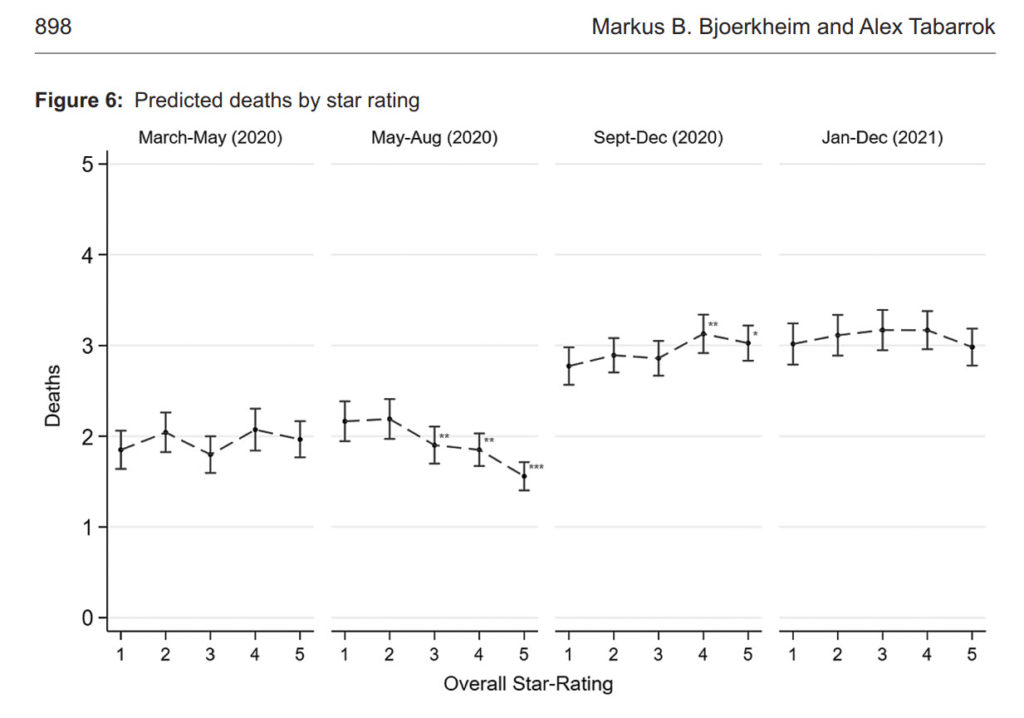
The following figure shows predicted deaths by 5-star rating. There is no systematic relationship between nursing homes rating and COVID deaths. (In the figure, we control for factors outside of a nursing homes control, such as case prevalence in the local community. But even if you don’t control for other factors there is little to no relationship. See the paper for more.) Case prevalence in the community not nursing home quality determined death rates.
More generally, we do some exploratory data analysis to see whether there were any “islands of protection” in the sea of COVID and the answer is basically no. Some facilities did more rapid tests and that was good but surprisingly (to us) the numbers of rapid tests needed to scale nationally and make a substantial difference in nursing home deaths was far out of sample and below realistic levels.
Finally, keep in mind that the United States did focused protection. Visits to nursing homes were stopped and residents and staff were tested to a high degree. What the US did was focused protection and lockdowns and masking and we still we had a tremendous death toll in the nursing homes. Focused protection without community controls would have led to more deaths, both in the nursing homes and in the larger community. Whether that would have been a reasonable tradeoff is another question but there is no evidence that we could have lifted community controls and also better protected the nursing homes. Indeed, as I pointed out at the time, lifting community controls would have made it much more difficult to protect the nursing homes.
My Conversation with John Adams
Here is the audio and transcript, here is part of the episode summary:
He joined Tyler to discuss why architects have it easier than opera composers, what drew him to the story of Antony and Cleopatra, why he prefers great popular music to the classical tradition, the “memory spaces” he uses to compose, the role of Christianity in his work, the anxiety of influence, the unusual life of Charles Ives, the relationship between the availability and appreciation of music, how contemporary music got a bad rap, his favorite Bob Dylan album, why he doesn’t think San Francisco was crucial to his success, why he doesn’t believe classical music is dead or even dying, his fascination with Oppenheimer, the problem with film composing, his letter to Leonard Bernstein, what he’s doing next, and more.
And here is an excerpt:
COWEN: How do you avoid what Harold Bloom called the anxiety of influence?
ADAMS: Harold Bloom was a very great literary critic, sometimes a little bit of a windbag, but his writings on Coleridge and Shelley, and especially on Shakespeare, were very important to me. He had a phrase that he coined, the anxiety of influence, which is interesting because he himself was not a creator. He was a critic, but he intuited that we creators, whether we’re painters or novelists or filmmakers or composers — that we live, so to speak, under the shadow of the greats that preceded us.
If you’re a poet, you’ve got all this great literature behind you, whether it’s Shakespeare or Walt Whitman or Emily Dickinson. And likewise for me, I’ve got really heavyweight predecessors in Beethoven, in Bach, in Mahler, in Stravinsky. Maybe that’s what he meant, just the anxiety of, is what I do even comparable with this great art? Another thing is, if I have an idea, has somebody already thought of it before? Those are the neurotic aspects of my life, but I’m no different than anybody else. We just have to deal with those concerns.
COWEN: Are you more afraid of Mozart or of Charles Ives?
ADAMS: [laughs] I’m not afraid of either of them. I love them. I obviously love Mozart more than Charles Ives. Charles Ives is a very, very unusual figure. He was almost completely unknown in most of the 20th century until Leonard Bernstein, who was very glamorous and very well known — Bernstein brought him to the public notice, and he coined this idea that Charles Ives was the Abraham Lincoln of music. Of course, Americans love something they can grasp onto like, “Oh, yes, I can relate to that. He’s the Abraham Lincoln of music.”
Charles Ives was a hermit. He worked during the day in an insurance firm, at which he was very successful, but spent his weekends and his summer vacations composing. His work is very sentimental, also very avant-garde for its time. I’ve conducted quite a few of his pieces. They are not, I have to admit, 100 percent satisfying, and I think a lot of that has to do with the fact that Ives never heard these pieces, or hardly ever heard them.
When you’re composing, you have to hear something and then realize, “Oh, that works and that doesn’t.” I think the fact that Ives — maybe he was just born before his time. He was born in Connecticut in the 1870s, and America at that time just was still a very raw country and not ready for a classical experimental composer.
COWEN: You seem to understand everything in music, from Indian ragas to popular songs, classical music, jazz. Do you ever worry that you have too many influences?
Recommended.
*Crack-Up Capitalism*
That is the new book by Quinn Slobodian. Slobodian is very smart, and knows a lot, but…I don’t know. I fear he is continuing to move in the Nancy McLean direction with this work.
This is a tale of how libertarian and libertarian-adjacent movements have embraced various anti-democratic and non-democratic positions. So you can read about seasteading, Hans-Hermann Hoppe, Hong Kong as a charter city, and “decentralization” plans for Ciskei, South Africa.
You won’t hear about the highly successful SEZ reforms for the Dominican Republic, or how the European Union was partly rooted in Hayek’s postwar piece on interstate federalism. In that essay, Hayek was explicit about how much would be done by treaty, rather than direct vote, and that is (mostly) how the European Union has turned out. With reasonable success, I might add. Do only the nuttier episodes of “less democracy” count?
Question one: Is the word “plutocratic” ever illuminating?
Question two: Is this a useful descriptive sentence for Milton Friedman? “He [Patri] had a famous grandfather, perhaps the century’s most notorious economist, both lionized and reviled for his role in offering intellectual scaffolding for ever more radical forms of capitalism and his sideline in advising dictators: Milton Friedman. The two shared a basic lack of commitment to democracy.”
Here is a YouTube clip of Friedman on democracy. Or I asked davinci-003 and received:
Yes, Milton Friedman did believe in democracy. He was an advocate of democracy and free markets, believing that economic freedom would advance both economic and political freedom. He argued that government should be limited in size and scope and that the free market should be allowed to operate with minimal interference.
Or how about engaging with the academic literature on Friedman’s visit to Chile? And more here. Was Friedman, who was elected president of the American Economic Association and won an early Nobel Prize, really “notorious”?
There is valuable content in this book, but it needs to cut way back on the mood affiliation.
The Story of VaccinateCA
The excellent Patrick McKenzie tells the story of VaccineCA, the ragtag group of volunteers that quickly became Google’s and then the US Government’s best source on where to find vaccines during the pandemic.
Wait. The US Government was giving out the vaccines. How could they not know where the vaccines were? It’s complicated. Operation Warp Speed delivered the vaccines to the pharmacy programs and to the states but after that they dissappeared into a morass of incompatible systems.
[L]et’s oversimplify: Vials were allocated by the federal government to states, which allocated them to counties, which allocated them to healthcare providers and community groups. The allocators of vials within each supply chain had sharply limited ability to see true systemic supply levels. The recipients of the vials in many cases had limited organizational ability to communicate to potential patients that they actually had them available.
Patients then asked the federal government, states, counties, healthcare providers and community groups, ‘Do you have the vaccine?’ And in most cases the only answer available to the person who picked up the phone was ‘I don’t have it. I don’t know if we have it. Plausibly someone has it. Maybe you should call someone else.’ Technologists will see the analogy to a distributed denial of service incident, and as if the overwhelming demand was not enough of a problem, the rerouting of calls between institutions amplified the burden on the healthcare system. Vaccine seekers were routinely making dozens of calls.
This caused a standing wave of inquiries to hit all levels of US healthcare infrastructure in the early months of the vaccination effort. Very few of those inquiries went well for any party. It is widely believed, and was widely believed at the time, that this was primarily because supply was lacking, but it was often the case that supply was frequently not being used as quickly as it was produced because demand could not find it.
It turned out that the best way to get visibility into this mess was not to trace the vaccines but to call the endpoints on the phone and then create a database that people could access which is what VaccinateCA did but in addition to finding the doses they had to deal with the issue of who was allowed access.
A key consideration for us, from the first day of the effort, was recording not just which pharmacist had vials but who they thought they could provide care to. This was dependent on prevailing regulations in their state and county, interpretations of those regulations by the pharmacy chain, and (frequently!) ad hoc decision-making by individual medical providers. Individual providers routinely made decisions that the relevant policy makers did not agree comported with their understanding of the rules.
VaccinateCA saw the policy sausage made in real time in California while keeping an eye on it nationwide. It continues to give me nightmares.
California, not to mince words, prioritized the appearance of equity over saving lives, over and over and over again, as part of an explicitly documented strategy, at all levels of the government. You can read the sanitized version of the rationale, by putative medical ethics experts, in numerous official documents. The less sanitized version came out frequently in meetings.
This was the official strategy.
The unofficial strategy, the result the system actually obtained, was that early access to the vaccine was preferentially awarded based on proximity to power and to the professional-managerial class.
… The essential workers list heavily informed the vaccination prioritization schedule. Lobbyists used it as procedural leverage to prioritize their clients for vaccines. The veterinary lobby was unusually candid, in writing, about how it achieved maximum priority (1A) for veterinarians due to them being ‘healthcare workers’.
Teachers’ unions worked tirelessly and landed teachers a 1B. They were ahead of 1C, which included (among others) non-elderly people for whom preexisting severe disability meant that ‘a covid-19 infection is likely to result in severe life-threatening illness or death’. The public rationale was that teachers were at elevated risk of exposure through their occupation. Schools were, of course, mostly closed at the time, and teachers were Zooming along with the rest of the professional-managerial class, but teachers’ unions have power and so 1B it was. Young, healthy teachers quarantining at home were offered the vaccine before people who doctors thought would probably die if they caught Covid.
Now repeat this exercise up and down the social structure and economy of the United States.
…Healthcare providers were fired for administering doses that were destined to expire uselessly. The public health sector devoted substantial attention to the problem of vaccinating too many people during a pandemic. Administration of the formal spoils system became farcically complicated and frequently outcompeted administration of the vaccine as a goal.
The process of registering for the vaccine inherited the complexity of the negotiation over the prioritization, and so vulnerable people were asked to parse rules that routinely befuddled healthy professional software engineers and healthcare administrators – the state of New York subjected senior citizens to a ‘51 step online questionnaire that include[d] uploading multiple attachments’!
That isn’t hyperbole! New York meant to do that! On purpose!
Lives were sacrificed by the thousands and tens of thousands for political reasons. Many more were lost because institutions failed to execute with the competence and vigor the United States is abundantly capable of.
…The State of California instituted a policy of redlining in the provision of medical care in a pandemic to thunderous applause from its activist class and medical ethics experts….Residency restrictions were pervasively enforced at the county level and frequently finer-grained than that. A pop-up clinic, for example, might have been restricted to residents of a single zip code or small group of zip codes.
All people are equal in the eyes of the law in California, but some people are . . . let’s politely say ‘administratively disfavored’.
The theory was, and you could write down this part of it, disfavored potential patients might use social advantages like better access to information and transportation to present themselves for treatment at locations that had doses allocated for favored potential patients. This part of the theory was extremely well-founded. Many people were willing to drive the length and breadth of California for their dose and did so.
What many wanted to do, and this is the part that they couldn’t write down, is deny healthcare to disfavored patients. Since healthcare providers are public accommodations in the state of California, they are legally forbidden from discriminating on the basis of characteristics that some people wanted to discriminate on. So that was laundered through residency restrictions.
Many more items of interest. I didn’t know this incredibly fact about the Biden adminsitratins Vaccines.gov for example:
Pharmacies through the FRPP had roughly half of the doses; states and counties had roughly the other half (sometimes administered at pharmacies, because clearly this isn’t complicated enough yet). You would hope that state and county doses were findable on Vaccines.gov. It was going to be the centerpiece of the Biden administration’s effort to fix the vaccine finding problem and take credit for doing so.
…Since the optics would be terrible if America appeared to serve some states much better than others on the official website that everyone would assume must show all the doses, no state doses, not even from states that would opt in, would be shown on it, at least not at the moment of maximum publicity. Got that?
A good point about America.
We also benefited from another major strength of America: You cannot get arrested, jailed, or shot for publishing true facts, even if those facts happen to embarrass people in positions of power. Many funders wanted us to expand the model to a particular nation. In early talks with contacts there in civil society, it was explained repeatedly and at length that a local team that embarrassed the government’s vaccination rollout would be arrested and beaten by people carrying guns. This made it ethically challenging to take charitable donations and try to recruit that team.
Many more points of interest about the process of running a medical startup during a pandemic. Read the whole thing.
National divorce for Russia?
Here is an interesting thread by Kamil Galeev:
National Divorce
Within the next year Russia will spiral into a deep political crisis. There is a nonzero chance that it may scale up existing separatist tendencies leading to the breakup of the empire. In this thread I will outline a model of how this process could look like🧵 pic.twitter.com/gV7uXDxaBx
— Kamil Galeev (@kamilkazani) December 7, 2022
Chinese Industrial Policy is Failing
In Picking Winners? Government Subsidies and Firm Productivity in China, Branstetter, Li and Ren look at the effect of direct cash subsidies to Chinese firms.
Our results provide little evidence to support the view that government subsidies have been given to more productive firms or that they have enhanced the productivity of the Chinese listed firms. First, at the aggregate level, subsidies seem to be allocated to less productive firms, and the relative productivity of firms’ receiving these subsidies appears to decline further after disbursement. Second, using the categorized subsidy data, we find that neither subsidies promoting R&D and innovation promotion nor subsidies promoting industrial and equipment upgrading are positively associated with firms’ subsequent productivity growth. On the other hand, we find there is a positive association between subsidy and employment, both for aggregate and employment-related subsidies.
I appreciated this discussion of the earlier debate over Japanese industrial policy:
Drawing upon qualitative methods and largely anecdotal evidence, a group of noneconomists, business experts, and policymakers argued that Japan’s rapid recovery and robust growth after WWII could be explained by skillful industrial policy (Johnson, 1982; Prestowitz, 1988; Vogel, 1979) .10 Japan’s “government-led” economic model came to be viewed as a threat to U.S. prosperity by some participants in these debates. By the end of the 1980s, some policy makers and influential experts were calling for a policy of “containing Japan,” lest its unbalanced growth undermine the economy of the United States (Fallows, 1989).
Economists and more empirically minded social scientists in other disciplines viewed the claims of industrial policy efficacy with skepticism and suggested that Japan’s intervention in its economy tended to favor declining industries rather than growing ones (Calder, 1988; Saxonhouse, 1983).11 Eventually, the skeptics were able to bolster their claims with hard data demonstrating that the Japanese government had offered some degree of economic support to nearly all sectors, but that the preponderance of support had not gone to the sectors or firms with the fastest productivity growth. An important turning point in this debate came in the form of a careful econometric deconstruction of the notion that industrial policy drove Japan’s economic miracle published by Richard Beason and David Weinstein in the mid-1990s. This empirical analysis at the industry level found no relationship between productivity growth and the alleged instruments of industrial policy (Beason and Weinstein, 1996). As it turned out, the policy efforts to promote rising sectors championed by some elements of Japan’s bureaucracy were undermined by countervailing efforts to buttress the employment levels and solvency of politically connected but economically weak firms and industries.
Japan’s long period of economic outperformance came to an abrupt end in the early 1990s; after two decades of slow growth, few scholars now argue that Japanese industrial policy is a model worthy of emulation (Ito & Hoshi, 2020).
As I emphasized in my post, What Operation Warp Speed Did, Didn’t and Can’t Do, you need a lot more than “market failure” to have a successful government subsidy program of firms–you need massive externalities and precise, well understood targets. The garden-variety market failure that can be shown on a blackboard isn’t enough, in part because such arguments often underestimate the market and in part because they overestimate government.
Hat tip: Caleb Watney who offers some useful comments.
Walter Grinder has passed away, RIP
Meeting Walter at age 13 was a formative moment in my life, as he hooked me on the world of ideas. Fortunately, Walter lived in Bogota, New Jersey at the time, and I was not so far away. He was the first person to show me it was possible to have a life devoted to intellectual inquiry. I looked forward to each meeting with Walter more than anything else, and I would never stop peppering him with questions about which books to read and which NYC bookstores to visit. It also seemed impossibly cool to me that he had hung out with Camus and in addition visited Yugoslavia. I saw him and thought, ‘I want to be some version of this.’
I remember Walter giving me an autographed copy of his edition of Albert Jay Nock. Walter being purged by the Rothbardians. Walter going off to study with David O’Mahony at the University of Cork and complaining about the telephone service. Walter being CEO of the Institute for Humane Studies. And Walter moving back to Menlo Park. Walter also had a great family.
Not everything in Walter’s career went the way he wanted it to. Still, Walter had a huge impact on many people, many of them successful and influential themselves. We are a kind of secret club, we know who each other are, and this is a day we are all mourning.
*The Disappearance of Josef Mengele*
A novel, one of the best books of the year, also short and readable. The author is from Strasbourg. “I’ve read enough about the Holocaust” is not a good reason to avoid iihs book. Here is a short review, and you can buy it here. How does in fact a sophisticated doctor become a Nazi and then frame that decision to himself? Definitely recommended.
The return of the horse?
Faced with climate breakdown, the energy crisis, and modern stress levels, there is a growing movement in French towns to bring back the horse and cart as an alternative to fossil fuels and a way to slow down urban life.
Florence, an estate agent in Hennebont, always stepped out of her office to watch the horse-drawn bin cart pass. “When I hear the sound of the hooves it’s just total happiness to me,” she said. “It brings a kind of gentle calm in these frantic times. It brings a bit of poetry into daily life, a reminder that things can be more simple. If I could live in a world without cars, I would.”
Since the first trials to reintroduce draft horses for municipal tasks in the mid-1990s, the number of French towns and urban areas using them has multiplied by almost 20 and continues to rise. Up to 200 urban areas have used draft horses in recent years. The most frequent tasks are rubbish collection and horse-drawn carriages taking children to school.
In the southern town of Vendargues, where the horse-drawn school carts are so popular that waiting lists have been 100 families-long, a study found they had improved the children’s relationship to learning. Some children who could walk or cycle to school preferred travelling by horse-drawn cart, despite it taking longer, because they found it “calming”.
Here is the full story, via Steven Kaufman.
Peter Thiel…telephone!