Category: Music
The symphony orchestra and the Industrial Revolution
I heard Mozart’s 39th symphony in concert last night, and it occurred to me (once again) that I also was witnessing one of mankind’s greatest technological achievements. Think about what went into the activity: each instrument, developed eventually to perfection and coordinated with the other instruments. The system of tuning and the underlying principles of the music. The acoustics of the music hall. The sheet music on paper and the musical notation. All of those features extremely well coordinated with the kind of compositional talent being produced in Central and Western Europe from say 1710 to 1920. And by the mid-18th century most of the key features of this system were in place and by the early 19th century they were more or less perfected.
Sometimes I think of the Industrial Revolution as fundamentally a Cultural Revolution. The first instantiation of this Cultural Revolution maybe was the rise of early Renaissance Art in Italy and in the Low Countries. That too was based on a series of technological developments, including improved quality tempera paint, the development of oil painting, the resumption of bronze and marble techniques for sculpture, and the reintroduction of paper into Europe, which enabled artists’ sketches and drawings.
As with classical music, this unfolding of quality production was all based on extreme experimentation, a kind of scientific method, urbanization, and competing city-states. There was also the rediscovery of knowledge from antiquity, and the importation or reimportation of science from China and the Arabic world, including the afore-mentioned knowledge of paper-making.
The creation of a book culture, and a culture of experimental science, could be cited as well.
Perhaps the only [sic] difference with the Industrial Revolution proper is that it came to sectors — energy, transport, and textiles — that boosted living standards immensely. But arguably it was just another of a series of Cultural Revolutions that had their roots in late medieval times, with even classical music deriving ultimately from Franco-Flemish polyphony. One of these Cultural Revolutions just happened to be Industrial.
Of course the earliest parts of Revolutions are often the best, as we’ve surpassed the steam engines of the 19th century but Mozart and Leonardo are still with us.
Who’s complacent?
What or how much are we willing to sacrifice to continue to promote some of mankind’s greatest creative achievements, namely classical music?:
Musicians could be required to wear earplugs “at all times” following a landmark ruling on hearing loss.
In the first case of its kind, viola player Christopher Goldscheider claimed he suffered hearing loss while playing at the Royal Opera House in 2012.
A High Court judge ruled on Wednesday that the company had been in breach of regulations regarding noise at work.
The verdict has “profound implications” for the future of live music, said the umbrella body for British orchestras.
“It effectively says an orchestral workspace is no different from a factory,” said Mark Pemberton, director of the Association of British Orchestras.
“What it says is that musicians will need to be wearing their hearing protection at all times.
Here is the full BBC story.
The day job
ONCE UPON A time, artists had jobs. And not “advising the Library of Congress on its newest Verdi acquisition” jobs, but job jobs, the kind you hear about in stump speeches. Think of T.S. Eliot, conjuring “The Waste Land” (1922) by night and overseeing foreign accounts at Lloyds Bank during the day, or Wallace Stevens, scribbling lines of poetry on his two-mile walk to work, then handing them over to his secretary to transcribe at the insurance agency where he supervised real estate claims. The avant-garde composer Philip Glass shocked at least one music lover when he materialized, smock-clad and brandishing plumber’s tools, in a home with a malfunctioning appliance. “While working,” Glass recounted to The Guardian in 2001, “I suddenly heard a noise and looked up to find Robert Hughes, the art critic of Time magazine, staring at me in disbelief. ‘But you’re Philip Glass! What are you doing here?’ It was obvious that I was installing his dishwasher and I told him that I would soon be finished. ‘But you are an artist,’ he protested. I explained that I was an artist but that I was sometimes a plumber as well and that he should go away and let me finish.”
That is from Katy Waldman in the NYT. You will find similar themes discussed in my earlier book In Praise of Commercial Culture. In her article I also enjoyed this part:
Edi Rama, the Prime Minister of Albania, sometimes feels his hand doodling as he contemplates a political decision. The art pours out to center and steady him. In 1998, Rama left a promising career as an artist in Paris to become Albania’s minister of culture. Now the country’s leader, he shows his loose, improvisatory drawings and sculptures in galleries around the world. “I found myself drawing almost all my working time whilst interacting with people in my office or on the phone,” he said in a 2016 interview. “I began to understand that my subconscious was being helped … by my hand to stay calm while my conscious had to focus on demanding topics.”
Recommended.
Solve for the music legal equilibrium
Pop superstar Miley Cyrus now being sued for copyright infringement — with damages potentially hitting $300 million. That is, for one lyric in her hit single, “We Can’t Stop”. The song is from her fourth studio album, Bangerz, released in 2013.
The lawsuit is coming from Michael May, better known as Flourgon, a Jamaican dancehall artist. Flourgon had several Jamaican hit singles in the late 1980s and 1990s, and remains an active performer today.
May alleges that Cyrus ripped off his catch-phase, ‘We Run Things,’ which is actually the name of a song written by May. In “We Can’t Stop,” Cyrus repeats the lyric ‘we run things’ in the chorus.
“We run things/Things don’t run we” are the lyrics of Miley’s single.
In May’s track, the lyrics are: “We run things/Things no run we.”
Here is the full article, via Ted Gioia.
My favorite things Poland
No, I am not there now, but Adam D. emails me and requests this, so here goes:
1. Novel: Stanislaw Lem, Solaris, all about identity and erotic guilt. Next in line would be any number of Isaac Singer novels, I don’t have a favorite offhand. Soon I will try The Family Moskat. Gombrowicz is probably wonderful, but I don’t find that it works for me in translation. Quo Vadis left me cold.
2. Chopin works: The Preludes, there are many fine versions, and then the Ballades. The Etudes excite me the most, the Mazurkas and piano sonatas #2 and #3 are most likely to surprise me at current margins of listening. I find it remarkable how I never tire of Chopin, in spite of his relatively slight output.
3. Painter: This one isn’t as easy as it ought to be.
4. Architect: Daniel Libeskind was born in Poland. But more generally one can cite Krakow, and I suspect the older versions of Gdansk.
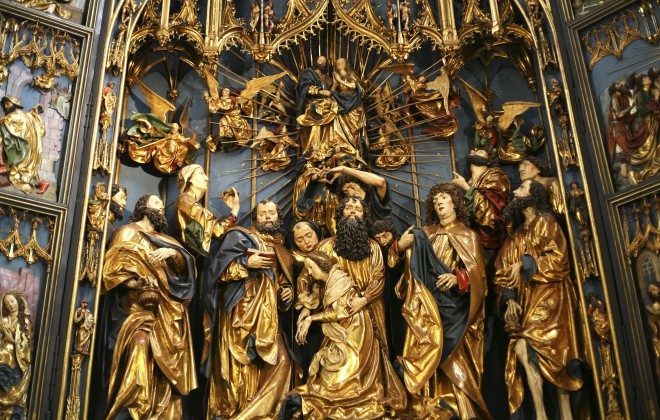
The wooden churches and folk art of southern Poland also deserve mention.
5. Political thinker: Czesław Miłosz, The Captive Mind, about the capitulations of artists to communism, though subtler than just an anti-state polemic. He once stated: ” I have never been a political writer and I worked hard to destroy this image of myself.” I do not feel I can judge his poetry, though last year’s biography of him was a good book.
6. Astronomer and originator of the quantity theory of money: Copernicus.
7. Television show: The Decalogue, perhaps #4 is my favorite. Here is good NPR coverage.
8. Movie: Any of the Andrzej Wajda classics would do, maybe start with Kanal or Ashes and Diamonds. More recently I would opt for Ida. I like Kieślowski’s TV more than his films, and prefer Hollywood Polanski to Polish Polanski.
9. Classical pianist: There are many, but I will cite Kristian Zimerman over Artur Rubinstein. The former plays the piano better. Josef Hofmann deserves mention, but there are dozens of picks here.
10. Jazz musician: Trumpeter Tomasz Stańko.
11. Economists: There is Kalecki, Hurwicz, the now-underrated Oskar Lange (doesn’t Singaporean health care work fine?), and Victor Zarnowitz. I had thought Mises was born in Poland, but upon checking it turned out to be Ukraine.
Overall the big puzzle is why there isn’t more prominence in painting, given Poland’s centrality in European history.
Robin Hanson bleg
Soon I will be having a conversation with Robin Hanson — the Robin Hanson. What should I ask him? The jumping-off point will be his new book with Kevin Simler, but of course we won’t stop there.
Samuelson-Stolper arbitrage against musical nationalism
A notable event in the
@SanDiegoSymph‘s It’s About Time festival, now under way: a performance of John Luther Adams’s Inuksuit next Saturday will involve percussionists on both sides of the Mexico-U.S. border.
That is a tweet from Alex Ross, here is the accompanying event link.
My Conversation with Ross Douthat
I think Ross, along with Steven Pinker, received the hardest (though never hostile) questions from me, but of course that is a measure of respect. Plus serious questions about God are difficult by their nature. Here is how the summarizers described the ground covered:
…Douthat’s views on religion and theology, but then moves on to more earth-bound concerns, such as his stance on cats, The Wire vs The Sopranos, why Watership Down is the best modern novel for understanding politics, eating tofu before it was cool, journalism as a trade, why he’s open to weird ideas, the importance of Sam’s Club Republicans, the specter of a Buterlian Jihad, and more.
Not to mention Reformicons, CRISPR, Thiel/Girard, Godwin’s Law, euthanasia, what Ross learned his mother, and the dangers of too much smart phone use. Ross responded in fine form, here is the audio and transcript. Here is one excerpt:
DOUTHAT: I suppose that I’m drawn to the idea that the truth about human existence lies in what can seem like paradoxical formulations, and this is of course very Catholic in certain ways. Certainly a G. K. Chestertonian idea, so I’m just stealing it from other people. But the idea that various heresies of Christianity, Calvinism included — with apologies to my Calvinist friends — tend to take one particular element of you that’s supposed to be in synthesis and possibly in tension, and run with it. And therefore the truth about things lies in a place that may seem slightly contradictory.
And I think this is borne out in many ways in everyday experience. This both-and experience of human existence. The idea that you can’t split up grace and works in any kind of meaningful way. It’s connected to larger facts about the nature of human existence. The tension between determinism and free will that persists in any philosophical system. You can get rid of God and stop having these Jansenist Jesuit arguments about predestination and so on, but you’re still stuck with the free will–determinism debate. That debate doesn’t go away.
So, yeah, there’s a point at the intersection of different ideas that is as close to the truth as our limited minds can get and in Christian thought, we call that point orthodoxy. Now, how that is connected to my political views is a really good question.
And:
COWEN: We all know the Marcionite heresy: the view, from early Christianity, that the Old Testament should be abandoned. At times, even Paul seems to subscribe to what later was called the Marcionite heresy. Why is it a heresy? Why is it wrong?
DOUTHAT: It’s wrong because it takes the form . . . It’s wrong for any number of reasons, but in the context of the conversation we’re having, it’s wrong because it tries to basically take one of the things that Christianity is trying to hold in synthesis and run with it to the exclusion of everything else, and essentially to solve problems by cutting things away.
The Marcionite thesis is, basically, if you read the New Testament, Jesus offers you a portrait of God that seems different from the portrait of God offered in Deuteronomy; therefore, these things are in contradiction. Therefore, if you believe that Jesus’s portrait of God is correct, then the Deuteronomic portrait of God must be false; therefore, the God of the Old Testament must be a wicked demiurge, etc., etc. And the next thing you know, you’re ascribing to, again, a kind of . . . What is the Aryan Christianity of the Nazis, if not the Marcionite heresy given form in the 1930s and 1940s?
And so the orthodox Christian says, “No, any seeming tension between the Old Testament and the New, any seeming contradiction, is actually suggesting that we need to look for a kind of synthesis between them, and for a sense in which there is not contradiction, but fulfillment in some way, which —
COWEN: Bringing us back to Hegelian Douthat.
DOUTHAT: Yes, yes.
And:
I think it’s probably fair to say that Chesterton’s Father Brown stories had as much influence on my worldview as his more sort of polemical and argumentative writings. And, again, I think therein lies some important insight that I haven’t thought through, but I think you’re correctly gesturing at, about a particular way of thinking about God and theology that isn’t unique to Christianity, but that is strongly suggested by just the structure of the revelation that we have. Marilynne Robinson has a line, I think in Gilead, about — one of the characters is imagining that this life is like the epic of heaven. That we’re living in the Iliad or the Odyssey of heaven. This is the story that will be told in the streets.
And:
COWEN: When you see how much behavior Islam or some forms of Islam motivate, do you envy it? Do you think, “Well, gee, what is it that they have that we don’t? What do we need to learn from them?” What’s your gut emotional reaction?
On another topic:
I’ve been always disappointed that there hasn’t been a kind of sustained Watership Down revival because it’s such a great book and it’s a book about — essentially, it’s about a founding.
It’s connected, in a sense, to the kind of things that the Straussians are always arguing about and so on. What does the founding mean, and so on? But you have a group of rabbits who go forth and encounter different models of political order, different ways of relating to humankind, that shadow over rabbit-kind at any point.
You have a warren that has essentially surrendered itself to humanity and exists as a kind of breeding farm, and you have a warren that’s run as a fascist dictatorship essentially. And then you have this attempt to form a political community that is somewhere in between the two, getting back to the Hegelian synthesis and so on. And you have sort of this primal narrative where the problem is of course that they don’t have any females, and so there’s this competition, this competition for reproductive power that’s carried out between these different warrens where the rabbits from the good warren have to literally — not kidnap, because the does come willingly — but steal women from the fascist dictatorship, which maintains a ruthless control over reproduction.
So there’s just a lot of fascinating stuff there, and then it’s all interspersed with storytelling. There’s the sort of rabbit folktales that Richard —
COWEN: So, narrative again.
DOUTHAT: Narrative again.
Strongly recommended, and I do thank Ross for putting up with me. Do read or listen to the whole thing.
And I very much enjoyed reading Ross’s forthcoming book To Change the Church: Pope Francis and the Future of Catholicism, which I found totally engrossing.
*The Elephant in the Brain: Hidden Motives in Everyday Life*
The authors are Kevin Simler and Robin Hanson, and now it is out!
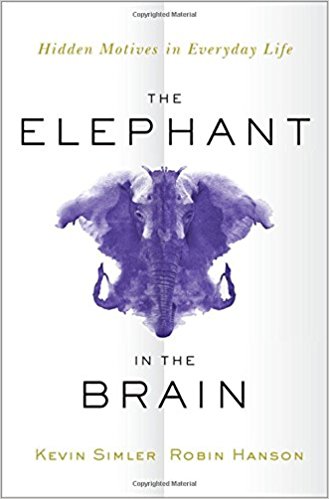
Robin reports:
On press coverage, back in July Publishers Weekly had a paragraph on it, the Boston Globe did an interview of me back then that they just released, Vice interviewed me recently so I expect that out soon, and I’m told that a Wall Street Journal review is forthcoming. Amazon now has 5 reviews, Goodreads has 7, and 2 reviews have appeared on blogs.
I am pleased to be doing a Conversation with Robin about the book, and other matters too. But don’t forget — conversations aren’t about talking!
Favorite jazz from 2017
Charles Lloyd New Quartet, Passin’ Thru. If their last few albums were released during the golden age of jazz, they would be revered to this day.
Cecile McLorin Salvant, Dreams and Daggers. The new Ella Fitzgerald.
Alexandre Tharaud, Hommage a’ Barbara, classical pianist goes the route of French song, wonderful acoustics to these arrangements.
Django Bates, Saluting Sgt. Pepper. A German (!) big band redoes the whole album, with a semi-comic music hall feel, intricate horn arrangements, works surprisingly well.
Mulatu of Ethiopia, the title says it all.
Runners-up might be Steve Coleman, Nicole Mitchell, Matt Mitchell, Tyshawn Sorey, Craig Taborn, Rez Abbasi, and Vijay Iyer, but I’m not sure I’ll go back to those in the longer run.
Favorite world music 2017
Danyèl Waro, Monmon. From the Reunion Islands, sample.
Residente, album is called Residente, Puerto Rican rap/reggaeton roots, but spreading out through diverse styles.
The Secret Ensemble, Call of the Birds, Turkish with classical roots, teaser here. Passionate stuff.
Minore Manes: Rebetika Songs, from Smyrna.
Sahra Halgan Trio, Faransiskiyo, Somaliland. Try this.
Duo Sabil, Zabad, oud and percussion. Here is one cut.
Try this music video by Afro-Haitian Experimental Orchestra.
If you insist on something Brazilian, we can go back a year and pull out Sociedade Recreativa.
Favorite popular music from 2017
It’s wrong to call this “popular music,” because most of it isn’t that popular, but we certainly can’t call it rock and roll any more, can we?
First, here are the ones that everyone else recommends too:
Run the Jewels 3, not a let down.
Kendrick Lamar, Damn, a common pick for best of the year.
Tyler the Creator, the album has an obscene name, which I won’t reproduce, but I can list the name of the Creator.
King Krule, Ooz, “The world is a filthy, utterly debased place, his music suggests, but there are rewards of sorts for those determined to survive it. In this spirit, The OOZ drops at our feet like a piece of poisoned fruit, a masterpiece of jaundiced vision from one of the most compelling artists alive.”
Migos, Culture, rap from Atlanta.
Vince Staples, Big Fish Theory, but not theory as they do it as Northwestern.
SZA- Cntrl, from New Jersey, “Her forebears are more Keyshia Cole and Mary J. Blige, who have hurt and have been fearless enough to sing about that hurt…”
Lorde, Melodrama, “the New Zealand century” is gaining on “the Norwegian century.”
Taylor Swift, Reputation. This one is kind of popular.
Perfume Genius, No Shape, “The body has become sturdier, less despotic.”
My summary remark is that I didn’t intend to listen to so much rap/hip-hop, but it remains the most vital genre.
Here are some more original selections:
Jlin, Black Origami, “…a gorgeous and overwhelming piece of musical architecture, an epic treatise on where rhythm comes from and where it can go.”
Juana Molina, Halo. Argentina, avant-garde songstress, vivid vocal and instrumental textures, she has almost abolished lyrics.
The Secret Sisters, You Don’t Own Me Any More, folk for 2017, “They went from opening shows for Bob Dylan and Paul Simon to cleaning houses to make ends meet.”
Django Bates, Saluting Sgt. Pepper. A jazzy, big band, music hall take on the album, works surprisingly well, one of the freshest takes on the Beatles since Laibach.
Paul McCartney, Flowers in the Dirt, remastered, an underrated album to begin with, this release also includes the previously unavailable acoustic demo tapes with Elvis Costello.
Death Grips, Bottomless Pit. Has the information density and partial unpleasantness of the old Skinny Puppy recordings, “seesawing from grit to gloss to back again.”
Beach Boys, Wild Honey, titled 1967 — Sunshine Tomorrow. This remix brings out what was supposed to be just a “blues/soul/Brian cooling his heels” album as an acoustic masterpiece and proper successor to Pet Sounds and Smile.
Philip Glass, Piano Works, by Víkingur Ólafsson. One of the two or three best Glass recordings I know, here is an interview with the pianist.
Overall, if I had to push any of these on you it would be the last two. Soon I’ll cover jazz and world music.
What should I ask Ross Douthat?
I will be having a Conversation with him December 4th, by the way, you can register here. His forthcoming book is spectacular, but we will talk about everything under (and above) the sun, what should I ask him?
My Conversation with Sujatha Gidla
Here is the transcript and podcast, I enjoyed this chat very much. Here is part of the opening summary:
Sujatha Gidla was an untouchable in India, but moved to the United States at the age of 26 and is now the first Indian woman to be employed as a conductor on the New York City Subway. In her memoir Ants Among Elephants, she explores the antiquities of her mother, her uncles, and other members of her family against modern India’s landscape.
Our conversation considered the nature and persistence of caste, gender issues in India, her time as a revolutionary, New York City lifestyle and neighborhoods and dining, religion, living in America versus living in India, Bob Dylan and Dalit music, American identity politics, the nature of Marxism, Halldor Laxness, and why she left her job at the Bank of New York to become a New York City subway conductor, among other topics.
Here is one sequence:
GIDLA: Actually, the only relation I have with my family members is political views.
[laughter]
GIDLA: If we have to connect on familial links, we will always be fighting and killing each other. All that we talk about with my mother is politics and untouchability and caste and Modi and things like that.
It’s the same thing with my sister also. This is where we connect. Otherwise, we are like enemies. My brother, we’re completely alienated from each other, firstly because he goes to church now. We never used to go to church before. He’s into this Iacocca. Is there a name . . . ?
COWEN: Iacocca?
GIDLA: Yeah.
COWEN: Lee Iacocca?
GIDLA: Yeah.
COWEN: The former Chrysler chairman?
GIDLA: Yeah. He reads that kind of books.
COWEN: Management books.
GIDLA: He’s into that kind of stuff.
COWEN: You don’t?
GIDLA: No.
GIDLA: He read Freakonomics and he liked it. I don’t relate to that stuff.
And this toward the end:
COWEN: Your most touching memory of your mother?
GIDLA: I don’t know. When I was arrested, she was very worried. She said, “I wish I could take you back into my womb.”
Strongly recommended. I was pleased to see that Publisher’s Weekly named Sujatha Gidla’s book as one of the ten best of 2017, you can order it here.
The Economics of Attention
David Evans on the economics of attention:
In 2016, 437 billion hours, worth $7.1 trillion dollars, were exchanged in the
attention market in the US based on conservative estimates reported above. Attention
platforms paid for that time with content and then sold advertisers access to portions of that
time. As a result, advertisers were able to deliver messages to consumers that those
consumers would probably not have accepted in the absence of the barter of content for
their time. Consumers often don’t like getting these messages. But by agreeing to receive
them they make markets more competitive.
The economics of attention markets focuses on three features. First it focuses on
time as the key dimension of competition since it is what is being bought and sold. Second,
it focuses on content since it plays a central role in acquiring time, embedding advertising
messages, and operating efficient attention platforms. And third it focuses on the scarcity of
time and the implications of that for competition among attention platforms.
The $7.1 trillion estimate for the value of content seems too high. The high value comes from Evans assuming that the marginal wage is higher than the average so the average wage which he uses to calculate the value of time is, if anything, an underestimate while for most people I think the marginal wage is lower than the average (many people don’t even have jobs) so the average is an over-estimate. Brynjolfsson and Oh, however, using somewhat different methods estimate the consumer surplus from television as 10% of GDP and from the internet of 6% GDP or combined about $3 trillion at current levels. Either way the attention economy is very large and understudied relative to its importance.