Category: Science
My Conversation with the excellent Ami Vitale
Here is the audio, visual, and transcript. Here is the episode summary:
Ami Vitale is a renowned National Geographic photographer and documentarian with a deep commitment to wildlife conservation and environmental education. Her work, spanning over a hundred countries, includes spending a decade as a conflict photographer in places like Kosovo, Gaza, and Kashmir.
She joined Tyler to discuss why we should stay scary to pandas, whether we should bring back extinct species, the success of Kenyan wildlife management, the mental cost of a decade photographing war, what she thinks of the transition from film to digital, the ethical issues raised by Afghan Girl, the future of National Geographic, the heuristic guiding of where she’ll travel next, what she looks for in a young photographer, her next project, and more.
Here is one excerpt:
COWEN: As you probably know, there’s a long-standing and recurring set of debates between animal welfare advocates and environmentalists. The animal welfare advocates typically have less sympathy for the predators because they, in turn, kill other animals. The environmentalists are more likely to think we should, in some way, leave nature alone as much as possible. Where do you stand on that debate?
VITALE: It depends. It’s hard to make a general sweeping statement on this because in some cases, I think that we do have to get involved. Also, the fact is, it’s humans in most cases who have really impacted the environment, and we do need to get engaged and work to restore that balance. I really fall on both sides of this. I will say, I do think that is, in some cases, what differentiates us because, as human beings, we have to kill to survive. Maybe that is where this — I feel like every story I work on has a different answer. Really, I don’t know. It depends what the situation is. Should we bring animals back to landscapes where they have not existed for millions of years? I fall in the line of no. Maybe I’m taking this in a totally different direction, but it’s really complicated, and there’s not one easy answer.
And:
COWEN: As you know, there are now social networks everywhere, for quite a while. Images everywhere, even before Midjourney. There are so many images that people are looking at. How does that change how you compose or think about photos?
VITALE: Well, it doesn’t at all. My job is to tell stories with images, and not just with images. My job as a storyteller — that has not changed. Nothing has changed in the sense of, we need more great storytellers, visual storytellers. With all of those social media, I think people are bored with just beautiful images. Or sometimes it feels like advertising, and it doesn’t captivate me.
I look for a story and image, and I am just going to continue doing what I do because I think people are hungry for it. They want to know who is really going deep on stories and who they can trust. I think that that has never gone away, and it will never go away.
I am very happy to have guests who do things that not everyone else’s guests do.
Vaccine Induced Social Amnesia
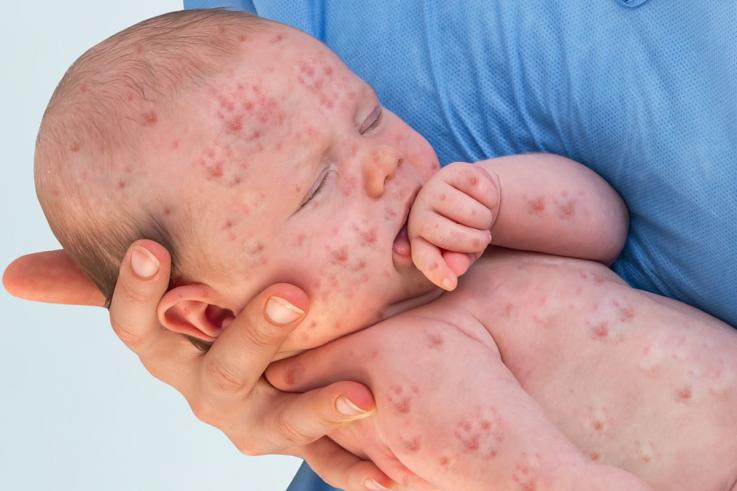
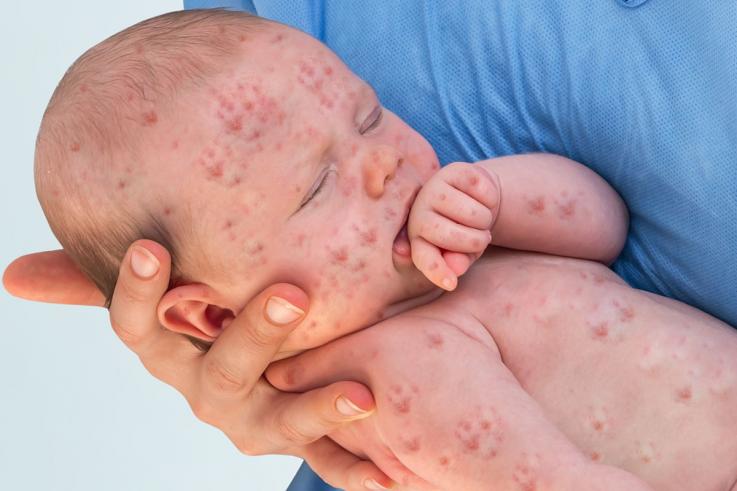
NYT: In 2022, there were 941 reported cases of measles in the World Health Organization’s European region. Over just the first 10 months of last year, according to an alarming bulletin the W.H.O. issued in mid-December, there were more than 30,000.
This is the kind of spike — a 3,000 percent increase — that looks implausible in headlines….But as the year drew to a close, the European measles outbreak kept growing. Through December, case numbers in the region eventually reached over 42,000, and although the largest outbreaks were in countries most Americans regard as pretty remote (Kazakhstan, Kyrgyzstan and Russia), there is also a vicious surge in Britain, which may look plausibly to us as the canary in a coal mine. There, in just one of England’s nine regions, the West Midlands, 260 cases have been confirmed and dozens more suspected, in a country which, as a whole, recorded just two cases as recently as 2021.
As David Wallace-Wells explains, vaccination rates are still 90%+ and down only slightly but measles is so infectious that even amid an otherwise well-vaccinated population, it can sometimes find pockets of low vaccination populations and spread like wildfire.
Measles is an especially nasty infection because it can induce “immunological amnesia“, thereby making individuals more susceptible to pathogens that they previously were able to resist.
Ironically, just as measles can induce immunological amnesia, vaccines can induce social amnesia about the severity of diseases, thereby making society more susceptible to pathogens that they previously were able to resist.
My new podcast with Dwarkesh Patel
We discussed how the insights of Hayek, Keynes, Smith, and other great economists help us make sense of AI, growth, risk, human nature, anarchy, central planning, and much more.
Dwarkesh is one of the very best interviewers around, here are the links. If Twitter is blocked to you, here is the transcript, here is Spotify, among others. Here is the most salacious part of the exchange, highly atypical of course:
Dwarkesh Patel 00:17:16
If Keynes were alive today, what are the odds that he’s in a polycule in Berkeley, writing the best written LessWrong post you’ve ever seen?
Tyler Cowen 00:17:24
I’m not sure what the counterfactual means. Keynes is so British. Maybe he’s an effective altruist at Cambridge. Given how he seemed to have run his sex life, I don’t think he needed a polycule. A polycule is almost a Williamsonian device to economize on transaction costs. But Keynes, according to his own notes, seems to have done things on a very casual basis.
And on another topic:
Dwarkesh Patel 00:36:44
We’re talking, I guess, about like GPT five level models. When you think in your mind about like, okay, this is GPT five. What happens with GPT six, GPT seven. Do you see it? Do you still think in the frame of having a bunch of RAs, or does it seem like a different sort of thing at some point?
Tyler Cowen 00:36:59
I’m not sure what those numbers going up mean, what a GPT seven would look like, or how much smarter it could get. I think people make too many assumptions there. It could be the real advantages are integrating it into workflows by things that are not better GPTs at all. And once you get to GPT, say, 5.5, I’m not sure you can just turn up the dial on smarts and have it, like, integrate general relativity and quantum mechanics.
Dwarkesh Patel 00:37:26
Why not?
Tyler Cowen 00:37:27
I don’t think that’s how intelligence works. And this is a Hayekian point. And some of these problems, there just may be no answer. Like, maybe the universe isn’t that legible, and if it’s not that legible, the GPT eleven doesn’t really make sense as a creature or whatever.
Dwarkesh Patel 00:37:44
Isn’t there a Hayekian argument to be made that, listen, you can have billions of copies of these things? Imagine the sort of decentralized order that could result, the amount of decentralized tacit knowledge that billions of copies talking to each other could have. That in and of itself, is an argument to be made about the whole thing as an emergent order will be much more powerful than we were anticipating.
Tyler Cowen 00:38:04
Well, I think it will be highly productive. What “tacit knowledge” means with AIs, I don’t think we understand yet. Is it by definition all non-tacit? Or does the fact that how GPT-4 works is not legible to us or even its creators so much? Does that mean it’s possessing of tacit knowledge, or is it not knowledge? None of those categories are well thought out, in my opinion. So we need to restructure our whole discourse about tacit knowledge in some new, different way. But I agree, these networks of AIs, even before, like, GPT-11, they’re going to be super productive, but they’re still going to face bottlenecks, right? And I don’t know how good they’ll be at, say, overcoming the behavioral bottlenecks of actual human beings, the bottlenecks of the law and regulation. And we’re going to have more regulation as we have more AIs.
You will note I corrected the AI transcriber on some minor matters. In any case, self-recommending, and here is the YouTube embed:
An important new paper on the costs of climate change
Forthcoming in ReStud, I haven’t had the chance to read it yet:
To analyze climate change mitigation strategies, economists rely on simplified climate models — so-called climate emulators — that provide a realistic quantitative link between CO2 emissions and global warming at low computational costs. In this paper, we propose a generic and transparent calibration and evaluation strategy for these climate emulators that is based on freely and easily accessible state-of-the-art benchmark data from climate sciences. We demonstrate that the appropriate choice of the free model parameters can be of key relevance for the predicted social cost of carbon. The key idea we put forward is to calibrate the simplified climate models to benchmark data from comprehensive global climate models that took part in the Coupled Model Intercomparison Project, Phase 5 (CMIP5). In particular, we propose to use four different test cases that are considered pivotal in the climate science literature: two highly idealized tests to separately calibrate and evaluate the carbon cycle and temperature response, an idealized test to quantify the transient climate response, and a final test to evaluate the performance for scenarios close to those arising from economic models, and that include exogenous forcing. As a concrete example, we re-calibrate the climate part of the widely used DICE-2016, fathoming the CMIP5 uncertainty range of model responses: the multi-model mean as well as extreme, but still permissible climate sensitivities and carbon cycle responses. We demonstrate that the functional form of the climate emulator of the DICE-2016 model is fit for purpose, despite its simplicity, but its carbon cycle and temperature equations are miscalibrated, leading to the conclusion that one may want to be skeptical about predictions derived from DICE-2016. We examine the importance of the calibration for the social cost of carbon in the context of a partial equilibrium setting where interest rates are exogenous, as well as the simple general equilibrium setting from DICE-2016. We find that the model uncertainty from different consistent calibrations of the climate system can change the social cost of carbon by a factor of four if one assumes a quadratic damage function. When calibrated to the multi-model mean, our model predicts similar values for the social cost of carbon as the original DICE-2016, but with a strongly reduced sensitivity to the discount rate and about one degree less long-term warming.
The social cost of carbon in DICE-2016 is oversensitive to the discount rate, leading to extreme comparative statics responses to changes in preferences.
That is the abstract from Doris Folini, Aleksandra Friedl, Felix Kübler, and Simon Scheidegger,
What happened in 17th century England (a lot)
East India Company founded — 1600
Shakespeare – Hamlet published 1603
England starting to settle America – 1607 in Virginia, assorted, you could add Harvard here as well
King James Bible – 1611
The beginnings of steady economic growth – 1620 (Greg Clark, JPE)
Rule of law ideas, common law ideas, Sir Edward Coke – 1628-1648, Institutes of the Laws of England, four volumes
Beginnings of libertarian thought – Levellers 1640s
Printing becomes much cheaper, and the rise of pamphlet culture
John Milton, Aeropagitica, defense of free speech, 1644
King Charles I executed – 1649 (leads to a period of “Britain without a King,” ending 1660)
Birth of economic reasoning – second half of 17th century
Royal African Company and a larger slave trade – 1660
General growth of the joint stock corporation
Final subjugation of Ireland, beginnings of British colonialism and empire (throughout, mostly second half of the century)
Discovery of the calculus, Isaac Newton 1665-1666
Great Plague of London, 1665-1666, killed ¼ of city?
Great Fire of London, 1666
John Milton, Paradise Lost, 1667
Social contract theories – John Locke 1689
Bill of Rights (rights of Parliament) — 1689
Birth of modern physics – Newton’s Principia 1687
Bank of England — 1694
Scientific Revolution – throughout the 17th century, places empiricism and measurement at the core of science
The establishment of Protestantism as the religion of Britain, both formal and otherwise, throughout the century, culminating in the Glorious Revolution of 1688.
London – becomes the largest city in Europe by 1700 at around 585,000 people.
England moves from being a weak nation to perhaps the strongest in Europe and with the strongest navy.
Addendum: Adam Ozimek adds:
…first bank to print banknotes in Europe, 1661
Discovery of the telescope 1608
First patent for a modern steam engine 1602
Economic ornithology
But a hundred years ago, birds were seen as the best remedy for the weeds and insect pests that threatened the country’s food supply and cost farmers hundreds of millions of dollars every year. And in order to identify the precise impact that birds had on agriculture, a field called economic ornithology was born. According to one of its leading practitioners, economic ornithology was “the study of birds from the standpoint of dollars and cents … in short, it is the practical application of the knowledge of birds to the affairs of everyday life.”1 And from the 1880s to the 1930s, birds were widely seen as economic agents, working alongside farmers in the fight against the insect hordes.
By the 1940s, economic ornithology had become discredited and obsolete. Effective and affordable pesticides had entirely replaced the birds’ bug-killing role, while economic ornithologists could never prove that their methods actually increased the number of helpful birds. But before their role in agriculture was dismissed, there was a time when we believed that we depended on birds for our food, and for our very survival.
And here was the method of economic ornithology:
In 1916, Gilbert Trafton summarized the primary approach used by economic ornithologists: “The practical value of birds to man, whether helpful or harmful, depends chiefly on their food habits,” and by examining what they eat, “the exact economic status of a bird is determined.” Sometimes this was done by observing the behaviors of birds in the field, but it usually meant dissecting birds and seeing what they had in their stomachs.
Here is the full Substack, by Robert Francis. Via Philip Wallach.
Department of Uh-Oh, economic research edition
We assess statistical power and excess statistical significance among 31 leading economics general interest and field journals using 22,281 parameter estimates from 368 distinct areas of economics research. Median statistical power in leading economics journals is very low (only 7%), and excess statistical significance is quite high (19%). Power this low and excess significance this high raise serious doubts about the credibility of economics research. We find that 26% of all reported results have undergone some process of selection for statistical significance and 56% of statistically significant results were selected to be statistically significant. Selection bias is greater at the top five journals, where 66% of statistically significant results were selected to be statistically significant. A large majority of empirical evidence reported in leading economics journals is potentially misleading. Results reported to be statistically significant are about as likely to be misleading as not (falsely positive) and statistically nonsignificant results are much more likely to be misleading (falsely negative). We also compare observational to experimental research and find that the quality of experimental economic evidence is notably higher.
That is from a new paper by Zohid Askarov, Anthony Doucouliagos, Hristos Doucouliagos, and T. D. Stanley.
Via my colleague Jonathan Schulz.
How women are perceiving the economics profession
Fewer women reported being satisfied with the climate in the economics profession in 2023 compared to five years ago, despite efforts during that time to improve conditions for women in the field, according to a new survey.
About 17% of women in economics said they strongly agreed or agreed with a statement about being satisfied in the profession, down from 20% in 2018, according to the topline results of a survey conducted in the fall. The preliminary findings were presented by University of Chicago Booth School of Business economist Marianne Bertrand Friday at the American Economic Association’s annual meeting in San Antonio.
The gap between women and men’s experience in economics widened slightly over the past five years, with 39% of men saying they were satisfied with the profession’s climate, compared to 40% in 2018.
Women made up just 17.8% of full economics professors in 2022. While representation is higher among students and associate professors, the share of new economics doctoral degree recipients that were women fell in 2023, Bertrand said Friday.
*Forgotten Creators*
The subtitle is How German-Speaking Scientists and Engineers Invented the Modern World, And What We Can Learn from Them . This is a 5501 (!) pp. work, published on-line. I haven’t read it yet. By Todd H. Rider. It’s probably good.
The economics of dinosaur brand names
But unlike a full-grown T. rex, which would be about the size of a city bus, this dinosaur was more like the size of a pickup truck.
The specimen, which is now listed for sale for $20 million at an art gallery in London, raises a question that has come to obsess paleontologists: Is it simply a young T. rex who died before reaching maturity, or does it represent a different but related species of dinosaur known as a Nanotyrannus?
The dispute has produced reams of scientific research and decades of debate, polarizing paleontologists along the way. Now, with dinosaur fossils increasingly fetching eye-popping prices at auction, the once-esoteric dispute has begun to ripple through auction houses and galleries, where some see the T. rex name as a valuable brand that can more easily command high prices.
Here is more from the NYT.
Why Do Poor People Commit More Crime?
It’s well known that people with lower incomes commit more crime. Call this the cross-sectional result. But why? One set of explanations suggests that it’s precisely the lack of financial resources that causes crime. Crudely put, maybe poorer people commit crime to get money. Or, poorer people face greater strains–anger, frustration, resentment–which leads them to lash out or poorer people live in communities that are less integrated and well-policed or poorer people have access to worse medical care or education and so forth and that leads to more crime. These theories all imply that giving people money will reduce their crime rate.
A different set of theories suggests that the negative correlation between income and crime (more income, less crime) is not causal but is caused by a third variable correlated with both income and crime. For example, higher IQ or greater conscientiousness could increase income while also reducing crime. These theories imply that giving people money will not reduce their crime rate.
The two theories can be distinguished by an experiment that randomly allocates money. In a remarkable paper, Cesarini, Lindqvist, Ostling and Schroder report on the results of just such an experiment in Sweden.
Cesarini et al. look at Swedes who win the lottery and they compare their subsequent crime rates to similar non-winners. The basic result is that, if anything, there is a slight increase in crime from winning the lottery but more importantly the authors can statistically reject that the bulk of the cross-sectional result is causal. In other words, since randomly increasing a person’s income does not reduce their crime rate, the first set of theories are falsified.
A couple of notes. First, you might object that lottery players are not a random sample. A substantial part of Cesarini et al.’s lottery data, however, comes from prize linked savings accounts, savings accounts that pay big prizes in return for lower interest payments. Prize linked savings accounts are common in Sweden and about 50% of Swedes have a PLS account. Thus, lottery players in Sweden look quite representative of the population. Second, Cesarini et al. have data on some 280 thousand lottery winners and they have the universe of criminal convictions; that is any conviction of an individual aged 15 or higher from 1975-2017. Wow! Third, a few people might object that the correlation we observe is between convictions and income and perhaps convictions don’t reflect actual crime. I don’t think that is plausible for a variety of reasons but the authors also find no statistically significant evidence that wealth reduces the probability one is suspect in a crime investigation (god bless the Swedes for extreme data collection). Fourth, the analysis was preregistered and corrections are made for multiple hypothesis testing. I do worry somewhat that the lottery winnings, most of which are on the order of 20k or less are not large enough and I wish the authors had said more about their size relative to cross sectional differences. Overall, however, this looks to be a very credible paper.
In their most important result, shown below, Cesarini et al. convert lottery wins to equivalent permanent income shocks (using a 2% interest rate over 20 years) to causally estimate the effect of permanent income shocks on crime (solid squares below) and they compare with the cross-sectional results for lottery players in their sample (circle) or similar people in Sweden (triangle). The cross-sectional results are all negative and different from zero. The causal lottery results are mostly positive, but none reject zero. In other words, randomly increasing people’s income does not reduce their crime rate. Thus, the negative correlation between income and crime must be due to a third variable. As the authors summarize rather modestly:
Although our results should not be casually extrapolated to other countries or segments of the population, Sweden is not distinguished by particularly low crime rates relative to comparable countries, and the crime rate in our sample of lottery players is only slightly lower than in the Swedish population at large. Additionally, there is a strong, negative cross-sectional relationship between crime and income, both in our sample of Swedish lottery players and in our representative sample. Our results therefore challenge the view that the relationship between crime and economic status reflects a causal effect of financial resources on adult offending.

Moving to Opportunity?
But inside the lab, Chetty and his colleagues have not always practiced what their research preaches, several former employees say. When hiring for their prestigious “pre-doctoral fellowship” program, for instance, the lab uses a rubric that explicitly favors students from the very colleges that its own research has called out for reinforcing elitist systems. Opportunity Insights didn’t have its first Black pre-doc until 2021. Seven former employees who spoke to The Chronicle about their experiences were bothered by what they saw as contradictions between the lab’s practices and its stated values.
After landing the fellowship, some employees said they were also disturbed to find a culture of overwork that left them fried but feeling forced to impress in order to secure a letter of recommendation to a top Ph.D. program. For some employees, it took a toll on their health. Harvard even reviewed the lab following claims of unsustainable working hours.
That is excerpted from the (gated) Chronicle of Higher Education.
Of course I am with Chetty here, noting I have no idea how good their personnel selections are (though a priori I would be surprised if they were not very good). In any case, once again you can see the tension between the meritocratic elements of the top schools and the rhetoric they claim to live by. This is reaching an absurd point. “Culture of overwork”? C’mon people, no one has to join up. You don’t think Chetty “overworks” very very hard? Isn’t that exactly the opportunity on tap, admittedly not for everyone?
How about “feeling forced to impress in order to secure a letter of recommendation to a top Ph.D. program”? I am in fact opposed to this whole pre-doc thing, but I don’t blame Chetty and co. “Forced to impress”? On what basis are good letters supposed to be handed out? Are we not also “forced to impress” the people we want to date and marry? Do start-ups with?
Someone needs to “go the full Ayn Rand” on this whole thing. Part of the real shame is that Chetty and co. are in no real position to do that.
John Stuart Mill on empirical economics and causal inference
Written by me, here is a passage from GOAT: Who is the Greatest Economist of All Time, and Why Should We Care?
A System of Logic covers many different topics, but for our purposes the most important discussion is Mill’s treatment “Of the Four Methods of Experimental Inquiry,” sometimes called “Mill’s Methods” and indeed receiving their own Wikipedia page. Mill outlines different manners in which causes and effects might be correlated, or not, and what we can infer from such patterns, and how difficult it can be to sort out actual cause and effect from the data. He refers to the “direct method of agreement,” the “method of difference,” “joint method of agreement difference,” the “method of residue,” and the “method of concomitant variations,” all as ways of trying to make correct or at least better inferences from the data.
I’ll spare you the details on the full argument, but in essence Mill was trying to figure out how to do causal inference econometrics, but with words only. That enterprise was doomed to fail, but it gives us insight into what Mill thought was by far the most important question in social science, namely causal inference when faced with complex underlying chains of cause and effect. For Mill, everything is what we would now call “an identification problem,” and this understanding is clearest in Mill’s chapters “Fallacies of Generalization” and “Fallacies of Ratiocination.” Mill also serves up a remarkably on-target discussion of how the different nature of social science problems, and their possibly greater complexity, can lead to identification problems that are not necessarily present in the natural sciences – see his chapter “Of the Chemical, or Experimental, Method in the Social Science.” That entire approach is remarkably 2020s in orientation, and you won’t find earlier history of thought books giving Mill much if any credit for this.
In a funny way, Mill was ahead of Milton Friedman in his understanding here. Friedman knew much more statistics, but in his economics he often presented causal inference as fairly straightforward. In his Monetary History of the United States, co-authored with Anna Schwartz, the reader does get the impression that the historical correlations, and ordinary least squares techniques, do in fact show that the money supply is a central driver of nominal income, given the relative stability of money demand. Later, the real business cycle theorists were to challenge that inference, and suggest that often it was income that was causing the money supply. That is a kind of complex challenge Mill seemed quite comfortable with in A System of Logic, whereas Friedman and Schwartz assigned higher power to common sense approaches to cause and effect.
Mill remains in my eyes one of the most underrated thinkers.
Asimov Press
Asimov Press, a new publishing venture that will produce books + magazines about progress in biotechnology, launched today. We’ll publish new articles regularly and hope you’ll follow! Modelled on Stripe Press, and we’re advised by a Works in Progress co-founder.
No Child Left Behind: Accelerate Malaria Vaccine Distribution!
My post What is an Emergency? The Case for Rapid Malaria Vaccination, galvanized the great team at 1DaySooner. Here is Zacharia Kafuko writing at Foreign Policy:
Right now, enough material to make 20 million doses of a lifesaving malaria vaccine is sitting on a shelf in India, expected to go unused until mid-2024. Extrapolating from estimates by researchers at Imperial College London, these doses—enough for 5 million children—could save more than 31,000 lives, at a cost of a little more than $3,000 per life. But current plans by the World Health Organization to distribute the vaccine are unclear and have been criticized as lacking urgency.
…Vaccine deployment and licensure is an incredibly complex scientific, legal, and logistical process involving numerous parties across international borders. Roughly speaking, after the WHO recommends vaccines (such as R21), it must also undertake a prequalification process and receive recommendations from its Strategic Advisory Group of Experts before UNICEF is allowed to purchase vaccines. Then Gavi—a public-private global health alliance—can facilitate delivery by national governments, which must propose their anticipated demand to Gavi and make plans to distribute the vaccines.
Prequalification can take as long as 270 days after approval. However, the COVID-19 vaccines were rolled out within weeks of WHO’s approval, using the separate EUL process rather than the more standard prequalification process that R21 is now undergoing.
For COVID-19 vaccines, EUL was available because the pandemic was undeniably an emergency. Given the staggering scale of deaths of children in sub-Saharan Africa every year, shouldn’t we also be treating malaria vaccine deployment as an emergency?
The R21 malaria vaccine does not legally qualify for EUL because malaria already has a preventive and curative toolkit available. My concern is that this normalizes the deaths of hundreds of thousands of children each year in Africa.
We can move more quickly and save more lives, if we have the will.