*Bad Pharma*, by Ben Goldacre
Here is a simple sentence from Frank Lichtenberg, an economist who studies pharmaceuticals and a highly reputable researcher in the area:
This implies that the incremental cost-effectiveness ratio (cost per life-year gained) of pharmaceutical innovation was about $12,900.
Read the whole paper, and if you wish to go further, you can peruse his entire body of work.
I am thus a little nervous when Ben Goldacre entitles his recent book Bad Pharma: How Drug Companies Mislead Doctors and Harm Patients. (I have a UK copy, and it is due out in the U.S. this February.) I do in fact agree with Goldacre’s portrait of a sector wracked with massive corruption and shoddy scientific standards. And I see many aspects of this book as deserving an “A” or “A+” rating, which I would not hand out lightly. But I won’t continue down that track, because I suspect the book will receive many very positive reviews, as indeed it did in the UK.
Could he not have called the book Not Nearly as Good as it Could be Pharma: How Corruption is Diminishing One of Our Great Benefactors? Admittedly that does not roll off the tongue as nicely.
Or how about Slow Pharma: How to Get the New Drug Pipeline Up and Running Again?
Goldacre’s policy recommendations would in general raise the costs of research and development, although they would likely improve the accuracy of research results and reduce over-prescription and overuse of drugs. It is quite possible they would lower the rate of return to pharmaceutical innovation, likely I would say. These trade-offs are neglected, and, much as I admire many features of this book, I cannot help but, alas with trepidation, call some of its central features “Bad Science.” Bad Economic Science. The morality of the narrative and the Platonism of his vision distracts him from presenting the policy trade-offs clearly.
Lichtenberg’s name does not appear in Goldacre’s index. Nor does the word “innovation.”
Recommended, with or without prescription, but use with extreme caution. And you should “compound” this with other books.
Addendum: I bought this book myself, which included Amazon shipping charges from the UK, and was not sent a free sample or visited by an attractive sales representative.
Second Addendum: There is some back and forth between Goldacre and me in the comments section.
Adding two more movies to my year’s list
Lincoln is one, and Life of Pi is the other. I didn’t think I would like either one, but both were excellent and in unexpected ways. The original list of 2012 favorites is here.
The Autism Advantage
That is a new and excellent feature story by Gareth Cook. Much of the article concerns Specialisterne, a Danish company which specializes in hiring autistic individuals to perform technical tasks. Here is the part concerning my work:
Tyler Cowen, an economist at George Mason University (and a regular contributor to The Times), published a much-discussed paper last year that addressed the ways that autistic workers are being drawn into the modern economy. The autistic worker, Cowen wrote, has an unusually wide variation in his or her skills, with higher highs and lower lows. Yet today, he argued, it is increasingly a worker’s greatest skill, not his average skill level, that matters. As capitalism has grown more adept at disaggregating tasks, workers can focus on what they do best, and managers are challenged to make room for brilliant, if difficult, outliers. This march toward greater specialization, combined with the pressing need for expertise in science, technology, engineering and mathematics, so-called STEM workers, suggests that the prospects for autistic workers will be on the rise in the coming decades. If the market can forgive people’s weaknesses, then they will rise to the level of their natural gifts.
The link to my paper is here.
The Washington Wizards are the deflationary sector
“It’s very driven by who the visiting team is,” he said. “For example, tonight, you can get into the [Wizards/Blazers] game for $1.69, but to get into the Heat game on Dec. 4 is $26, so it’s definitely matchup driven. When you have teams that are poor — and I am certain that the Wizards qualify — you see the bottom drop out.”
Yet, while the Wizards’ thrifty prices may not be uncommon, how fast they became so thrifty is.
“What’s rarer about this instance that it’s happening 12 games into the season,” Lehrman said. “Normally, you see this level of apathy take place in the middle of the season when you’re 40 games in and there’s not gonna be a playoff chase. You don’t normally see the fans quit on their team so quickly.
The story is here, and the Wizards were 0-12 to start the year. Here is further information about their quality.
They won their first game last night, which perhaps will bring the expectation of higher prices and thus stimulate demand.
Assorted links
1. Eagleton reviews the new Derrida biography.
2. The economics of France in the 1920s.
3. Photos of Chinese architecture (recommended), and a new study of overinvestment in China, and Fuchsia Dunlop on Chinese food.
4. Peter Leeson on the economics of human sacrifice, a rational choice approach.
Sentences about wine and petrol
…the enjoyment of petrol notes is becoming more mainstream. But since it’s still off-putting to novice drinkers, many winemakers have moved to downplay the word petrol. You rarely see it on labels, for instance. The German Wine Institute has omitted mention of petrol in its German-language version of the official Wine Aroma Wheel.
Some winemakers, in some cases, have even declared petrol a defect. Famed winemakers like Olivier Humbrecht, of Zind-Humbrect in Alsace, and Michel Chapoutier (the famed Rhone producer who now makes wine in Alsace) have declared within the past couple years that young rieslings should never smell of petrol.
Here is more, and the article discusses other tastes too, courtesy of The Browser. What again is that famous quotation from Apocalypse Now? Which wines did the guy drink?
New York City fact of the day
New York City passed a day without a single report of a person being shot, stabbed or subject to other sorts of violent crime for the first time in recent memory, police said today.
The rare day occurred on Monday, near the end of a year when the city’s murder rate is on target to hit its lowest point since 1960, according to New York Police Department chief spokesman Paul Browne.
Mr Browne said it was “first time in memory” the city’s police force had experienced such a peaceful day.
While crime is up 3 per cent overall, including a 9 per cent surge in grand larceny police attribute to a rash of smart phone thefts, murder is down 23 percent over last year, the NYPD said.
The story is here.
What the Swiss will do with garage-like boxes
Zurich council has approved a plan to build the boxes, which will, it hopes, provide a discreet location for prostitutes and their clients to conduct business when they open in August next year.
Located in an industrial area of the city, the row of garage-like boxes will have roofs and walls for privacy, and easy access for cars. The council estimates that around 30 prostitutes will meet clients at the site of the boxes, and use the drive-in slots on a first-come-first-served basis.
“The big difference is that until now prostitution has been in the public space,” Michael Herzig, from Zurich’s social welfare department, told Swiss Radio. “Now we are going to change this, move it from the street to a private space in an old industrial area, which belongs to the city. This gives us the possibility to define the rules of prostitution in this area.”
The opening of the sex boxes will coincide with a major reform of prostitution laws in the Swiss city. Prostitution will be outlawed in certain areas of Zurich where it has taken grip, and led to local complaints about women being harassed on the streets and the activities of pimps.
The prostitutes who use the sex boxes will also have to take out medical insurance and buy a £26 licence in order to ply their trade. On top of that they will also have to feed five Swiss francs, about £3.30, into a roadside ticket machine each night when they clock on.
The story is here, and I thank a loyal MR reader for the pointer.
The North Korean productivity miracle
…brewing remains just about the only useful activity at which North Korea beats the South. The North’s Taedonggang Beer, made with equipment imported from Britain, tastes surprisingly good.
That is from The Economist, I cannot confirm this judgment. Furthermore there is no North Korean great stagnation:
Talking to CNN, a South Korea government official showed the apparently innocent objects that the killer was planning to use to kill Park Sang-hak on the streets of Seoul. Two of them were pens, which apparently are standard issue among North Korean secret agents. The first kills on contact, injecting quickly a poison that paralyzes the victim and kills it within seconds. The second one fires one single bullet, a tiny projectile which is also filled with a killing venom.
But those two were well known by the South Korean’s intelligence agency. The third weapon, however, is completely new to them: a flashlight that has three holes. Each hole is actually gun barrel, which gets activated with the push of a button. One click and boom, you are dead.
The article, with photos, is here. And North Korea may soon be launching long-range missiles.
For the pointer on the first item I thank Nick Slepko.
Assorted links
1. The net price myth will not save the sustainability of higher education.
2. Purely defensive technological innovation, for cows.
3. Chris Blattman’s African development exam.
4. Will the “buy a home, get a visa” idea spread?
5. Mistakes people make in buying Christmas gifts, by Cass Sunstein. And good summary of what the Greek deal consists of.
6. Fun but somewhat off story on Krugman and Germany, too many overgeneralizations about German psychology, caveat emptor.
“The Myth of American Meritocracy: How corrupt are Ivy League admissions?”
There is a new and stimulating piece by Ron Unz, in The American Conservative. The article covers plenty of ground, but I took away two main points. The first is that there is massive and quite unjustified bias against Asian and Asian-American students in the U.S. admissions process. Yes, I already thought that but it turns out it is much worse than I had thought. Yet many people support this aspect of our current admissions systems, either directly or indirectly.
The second point is the claim that Jewish academic achievement in America is collapsing at the top end, in relative terms at least.
For reasons which are possibly irrational on my end, but perhaps not totally irrational, I am not entirely comfortable with the religious and ethnic and racial “counting” methods applied in this piece (blame me for mood affiliation if you wish). Still, it is an interesting read and after some internal debate I thought I would pass it along, albeit with caveats.
In any case, the link to the article is here.
Ethical software up for grabs
Does your car swerve off the bridge or plough through the nearby crowd? In case of an impending accident, which ethical standards will govern your driverless car? (Which govern you?) “And over here, at a price discount, is the Peter Singer Utilitarian Model. The Roark costs $800 more.”
Or perhaps it will be put up to a vote, or handed over to OIRA. California can run a referendum. Alex earlier called this the Google Trolley problem, after the famous philosophical conundrum.
Joshua adds in the comments: “Can’t we just give the robot cars like three general guidelines and let them figure out the details on their own?”
For the pointer I thank Gordon H.
Seasonally adjusted U.S. household median income
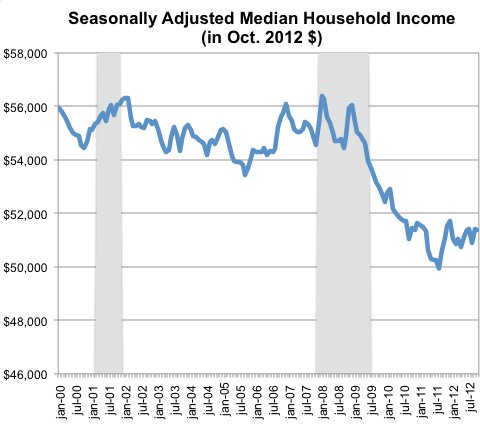
The source is here.
Why do older players commit more technical fouls in basketball? (model this)
Surprisingly, the average player gets whistled for more technicals each season they are in the league, according to Stats LLC. For instance, rookies average less than one technical. That number grows to an average of two technical fouls by the third year of a player’s career, and to more than three technicals by the fifth. Players average closer to four technicals per season upon reaching their 12th year.
Why the additional whistles? A primary reason: Players get ruder as they get older.
“Guys will call you ‘Mister’ early in their career, then they develop a comfort level to where it becomes a first-name basis,” said retired official Steve Javie, now an ESPN analyst. “They’re more comfortable talking to you, and sometimes that leads them to express their emotions a bit too much at times.”
The technical-foul disparity is most pronounced for players who enter the league as high draft picks.
Here is more. What are the other implied predictions of this model? And this is interesting too:
While players get more technicals the longer they stay in the league, coaches do the opposite. The average NBA coach picks up six technicals a season his first six years on the job before mellowing out. Those who coach 13 years or more average fewer than four techincals per season.
Are Prediction Markets Against the Public Interest?
Here is more on the CFTC’s attack on Intrade:
Why doesn’t Intrade just obey the complicated law and become a licensed exchange? They tried, but the CFTC won’t give them a license. When an established, licensed U.S. commodity exchange applied for permission to do what Intrade does, the CFTC turned them down, too.
Most importantly, in rejecting Nadex’s application to trade “political event derivatives contracts” the CFTC said this:
As a result of reviewing the complete record, the CFTC determined that the contracts involve gaming and are contrary to the public interest…
Thus the CFTC’s attack on Intrade is not about following or not following a particular regulation; it goes much deeper, the CFTC is arguing that all such markets are against the public interest.
Addendum: Kenneth J. Arrow, Robert Forsythe, Michael Gorham, Robert Hahn, Robin Hanson,
John O. Ledyard, Saul Levmore, Robert Litan, Paul Milgrom, Forrest D. Nelson,
George R. Neumann, Marco Ottaviani, Thomas C. Schelling, Robert J. Shiller,
Vernon L. Smith, Erik Snowberg, Cass R. Sunstein, Paul C. Tetlock, Philip E. Tetlock,
Hal R. Varian, Justin Wolfers, and Eric Zitzewitz disagree with the CFTC (among others).