Pay For Performance Increases Performance (Water Runs Downhill)
In my 2011 book, Launching the Innovation Renaissance, I wrote:
At times, teacher pay in the United States seems more like something from Soviet-era Russia than 21st-century America. Wages for teachers are low, egalitarian and not based on performance. We pay physical education teachers about the same as math teachers despite the fact that math teachers have greater opportunities elsewhere in the economy. As a result, we have lots of excellent physical education teachers but not nearly enough excellent math teachers. The teachers unions oppose even the most modest proposals to add measures of teacher quality to selection and pay decisions.
As I wrote, however, Wisconsin passed Act 10, a bill that discontinued collective bargaining over teachers’ salary schedules. Act 10 took power away from the labor unions and gave districts full autonomy to negotiate salaries with individual teachers. In a paper that just won the Best Paper published in AEJ: Policy in the last three years, Barbara Biasi studies the effect of Act 10 on salaries, effort and student achievement.
Compensation of most US public school teachers is rigid and solely based on seniority. This paper studies the effects of a reform that gave school districts in Wisconsin full autonomy to redesign teacher pay schemes. Following the reform some districts switched to flexible compensation. Using the expiration of preexisting collective bargaining agreements as a source of exogenous variation in the timing of changes in pay, I show that the introduction of flexible pay raised salaries of high-quality teachers, increased teacher quality (due to the arrival of high-quality teachers from other districts and increased effort), and improved student achievement.
We still have a long way to go but COVID, homeschooling and universal voucher programs have put a huge dent in the power of the teacher’s unions. There is now a chance to bring teacher pay into the American model. Moreover, such a model is pro-teacher! Not every district in Wisconsin grasped the opportunity to reform teacher pay but those districts that did raised pay considerably. Appleton district, for example, instituted pay for performance, Oshkosh did not. Prior to the Act salaries were about the same in the two districts:
After the expiration of the CBAs, the same teacher could earn up to $68,000 in Appleton, and only between $39,000 and $43,000 in Oshkosh.
Thus, pay for performance is a win-win policy. Paying the best teachers more is good for teachers and great for students who see increases in achievement which pay off many years later in higher wages.
Hat tip: Josh Goodman on twitter who will surely agree about the negative effect of egalitarian pay on the relative quality of math teachers.
*Civil War*
This movie was more cinematically serious than I was expecting, and with some odd (but mostly good) 1970s vibes. It is also an interesting case study in anhedonia.
Video and grenades seem scarcer than they ought to be, even given the constraints. Good characters.
The movie works very hard not to reveal its politics to a mainstream audience, but of course they are there, you just have to squint and think a bit. No, I’m not going to spoil that one for you.
“Thirty Canadian?”
Excellent soundtrack as well. The same director also made Annihilation and Ex Machina.
History of economic thought paper ideas
These topics seem underexplored to me:
Montesquieu
Economics in the Talmud
Rise of econometrics in the 19th century
The Irish economists, including Cairnes and Longfield
The last 50 years of economics are in general very poorly covered
Works in any foreign language you might read
Chinese economic thought
Economic thought in India
The funding of economics, and economists, through the ages (very underdone)
The institutionalization of economics
History of women in economics, especially recently
History of prizes and awards in economics
Economic ideas and fascism, in various eras
Economic thoughts on the arts, starting with Hume
History of finance and financial economics, considerably understudied
Economics and demographic thought, throughout the ages, for instance the 1920s
The very early history of law and economics
Economic thought in various religions
Economics and 19th century psychology
History of experimental economics
History of RCTs
History of economics and education, as a topic
History of what has been taught in economics classes, over the generations
History of textbooks
History of economists in government
History of economists in multi-lateral institutions
History of economists working in central banks
History of how various economic databases have been built
History of economists doing journalism (both Menger and Walras were first journalists)
Early history of “environmental economics”
Early history of economics/water supply issues
Earlier writings on the economics of slavery
History of economists holding public office, J.S. Mill, Einaudi, many others, or as central bankers
The Henry Geoge movement over the generations
Economic “dissidents” of various kinds
History of economists working with the military and national security
Thursday assorted links
1. Some progress on the Moderna cancer vaccine.
2. The culture that is New Zealand (excruciating, not recommended).
3. My podcast with Sean Speer and The Hub on GOAT.
4. Edward S.F. suggests:
K. Omodo reviews G O A T:
“It was amazing. I took it in all at once!”
Here is the short video.
Scrabble markets in everything, okie-dokie edition
For the first time in 75 years, Mattel is making a major change to the iconic board game Scrabble — and touting a “No More Scoring” gameplay option.
The new launch is a double-sided version of the famous board game — one side with the original game for those who want to stick to the long-time traditional version, and one side with a “less competitive” version to appeal to Gen Z gamers.
The flip side of the classic game, called Scrabble Together, will include helper cards, use a simpler scoring system, be quicker to play and allow people to play in teams.
“The makers of Scrabble found that younger people, Gen Z people, don’t quite like the competitive nature of Scrabble,” Gyles Brandreth, who co-hosts the language podcast Something Rhymes With Purple, told BBC Radio 4 Today. “They want a game where you can simply enjoy language, words, being together and having fun creating words.”
And:
So what’s new exactly? In addition to a dual-sided board, there are helper cards, which provide assistance, prompts and clues and can be selected to match the player’s challenge level of their choice.
In the new version, scoring is a thing of the past — now all one has to do is finish a goal and collect the goal card.
Goal cards include challenges such as: “Play a horizontal word,” “play a three-letter word” or “play a word that touches the edge of the board.”
Here is the full story. I have read that 33 out of the world’s top 100 Scrabble players are Nigerian — I wonder what they think of this?
UNOS Kills
I’ve long been an advocate of increasing the use of incentives in organ procurement for transplant; either with financial incentives or with rules such as no-give, no-take which prioritize former potential organ donors on the organ recipient list. What I and many reformers failed to realize, however, is that the current monopolized system is so corrupt, poorly run and wasteful that thousands of lives could be saved even without incentive reform. (To be clear, these issues are related since an incentivized system would never have become so monopolized and corrupt in the first place but that is a meta-issue for another day.) Here, for example, is one incredible fact:
An astounding one out of every four kidneys that’s recovered from a generous American organ donor is thrown in the trash.
Here’s another:
Organs are literally lost and damaged in transit every single week. The OPTN contractor is 15 times more likely to lose or damage an organ in transit than an airline is a suitcase.
Organs are not GPS-tracked!
In an era when consumers can precisely monitor a FedEx package or a DoorDash dinner delivery, there are no requirements to track shipments of organs in real time — or to assess how many may be damaged or lost in transit.
“If Amazon can figure out when your paper towels and your dog food is going to arrive within 20 to 30 minutes, it certainly should be reasonable that we ought to track lifesaving organs, which are in chronic shortage,” Axelrod said.
Here’s one more astounding statistics:
Seventeen percent of kidneys are offered to at least one deceased person before they are transplanted….
Did you get that? The tracking system for patients is so dysfunctional that 17% of kidneys are offered to patients who are already dead–thus creating delays and missed opportunities.
All of this was especially brought to light by Organize, a non-profit patient advocacy group who under an innovative program embedded with the HHS and working with HHS staff produced hard data.
Many more details are provided in this excellent interview with Greg Segal and Jennifer Erickson, two of the involved principals, in the IFPs vital Substack Statecraft.
TimeGPT-1
In this paper, we introduce TimeGPT, the first foundation model for time series, capable of generating accurate predictions for diverse datasets not seen during training. We evaluate our pre-trained model against established statistical, machine learning, and deep learning methods, demonstrating that TimeGPT zero-shot inference excels in performance, efficiency, and simplicity. Our study provides compelling evidence that insights from other domains of artificial intelligence can be effectively applied to time series analysis. We conclude that large-scale time series models offer an exciting opportunity to democratize access to precise predictions and reduce uncertainty by leveraging the capabilities of contemporary advancements in deep learning.
That is from a new paper by Azul Garza and Max Mergenthaler-Canseco. A few of you may be needing a new job soon!
Udio
Introducing Udio, an app for music creation and sharing that allows you to generate amazing music in your favorite styles with intuitive and powerful text-prompting.
1/11 pic.twitter.com/al5uYAsU5k
— udio (@udiomusic) April 10, 2024
Robert Whaples reviews *GOAT*
An excellent piece, here is one excerpt I enjoyed in particular:
Cowen reads the John Maynard Keynes of The General Theory “as writing about an economy where uncertainty was much higher than usual, investment was highly unstable, fiscal policy was unable to fill in the gap, there was a risk or even reality of a downward spiral of prices and wages, monetary and exchange rate policies were out of whack, multipliers operate, the quest for savings could lower incomes overall, and the influence of liquidity factors on money demand and interest rates was especially high. All at once” (p. 72, emphasis in the original). In other words, Cowen drives home the point that this “general theory” isn’t actually general, it’s about very special, very unusual circumstances.
He considers Lord Keynes the GOAT contender whom he would most “want to hang around with” (p. 54). I had exactly the opposite reaction. The Keynes he portrays is virtually an egotistical monster. One who, for example, “kept an extended spreadsheet of his lovers and sexual encounters … each one rated by number” (p. 58). Anyone who treats other human beings this way—let alone writing it down—isn’t the kind of person I want to hang around with.
Recommended.
Wednesday assorted links
1. Terminator metal.
2. An RCT on the economic benefits of vision correction.
3. “Claude 3 Opus is roughly as persuasive as humans.“
4. Jon Haidt responds to the Nature review. And Greg Lukianoff with his First Amendment concerns.
5. Interview with Nicholas Tabarrok, who works in the movies.
6. Samo Burja skeptical on nuclear.
The $20 bill gets picked up, body parts markets in everything
At the 1815 Battle of Waterloo, Napoleon Bonaparte’s final battle, more than 10,000 men and as many horses were killed in a single day. Yet today, archaeologists often struggle to find physical evidence of the dead from that bloody time period. Plowing and construction are usually the culprits behind missing historical remains, but they can’t explain the loss here. How did so many bones up and vanish?
In a new book, an international team of historians and archaeologists argues the bones were depleted by industrial-scale grave robbing. The introduction of phosphates for fertilizer and bone char as an ingredient in beet sugar processing at the beginning of the 19th century transformed bones into a hot commodity. Skyrocketing prices prompted raids on mass graves across Europe—and beyond.
Here is the full article, via William Meller. And, as Alex has stressed in the past, never underestimate the elasticity of supply!
Why is there a movement to ban lab-grown beef?
That is the topic of my latest Bloomberg column, here is one bit:
…let me offer another theory: The anti-lab-grown-meat movement is about conservative cultural insecurity — the fear that, without the force of law, some conservative cultural norms will fade away…
Imagine that lab-grown meat proves feasible at a reasonable cost. It might end up as cheaper than beef from a cow, and it might also be better for the climate. In such a world, there might be growing pressures to abandon real meat for the lab-grown kind. There could even be a political movement to tax or ban real meat, similar to carbon taxes or plans to phase out fossil fuels.
Currently there is no momentum in that direction. For all the talk of vegetarianism and veganism, the percentage of Americans who practice those beliefs seems to be roughly flat. Many Americans like eating meat, for better or worse. But if real meat had a true substitute, perhaps the political calculus would differ.
This is the real fear — not of lab-grown meat itself, but of the changing culture its popularity would represent. Whether conservatives find the meat substitute to be adequate is beside the point. Society would have decided that some of their most cherished beliefs can be disposed of. Both humankind’s dominion over nature, which runs strong in the Christian strand of conservative thought, and the masculinized meat-eating culture — more specifically, the meat-grilling culture — would be under threat.
If artificial meat is banned, of course, none of that can happen.
In one sense, critics of conservatism should be heartened by the campaign against lab-grown meat. If I were a mainstream animal-rights advocate, I would revise upwards my estimate of my own power and influence.
I then consider how we might use science to arrive at a better resolution of these disputes.
Modi and investment
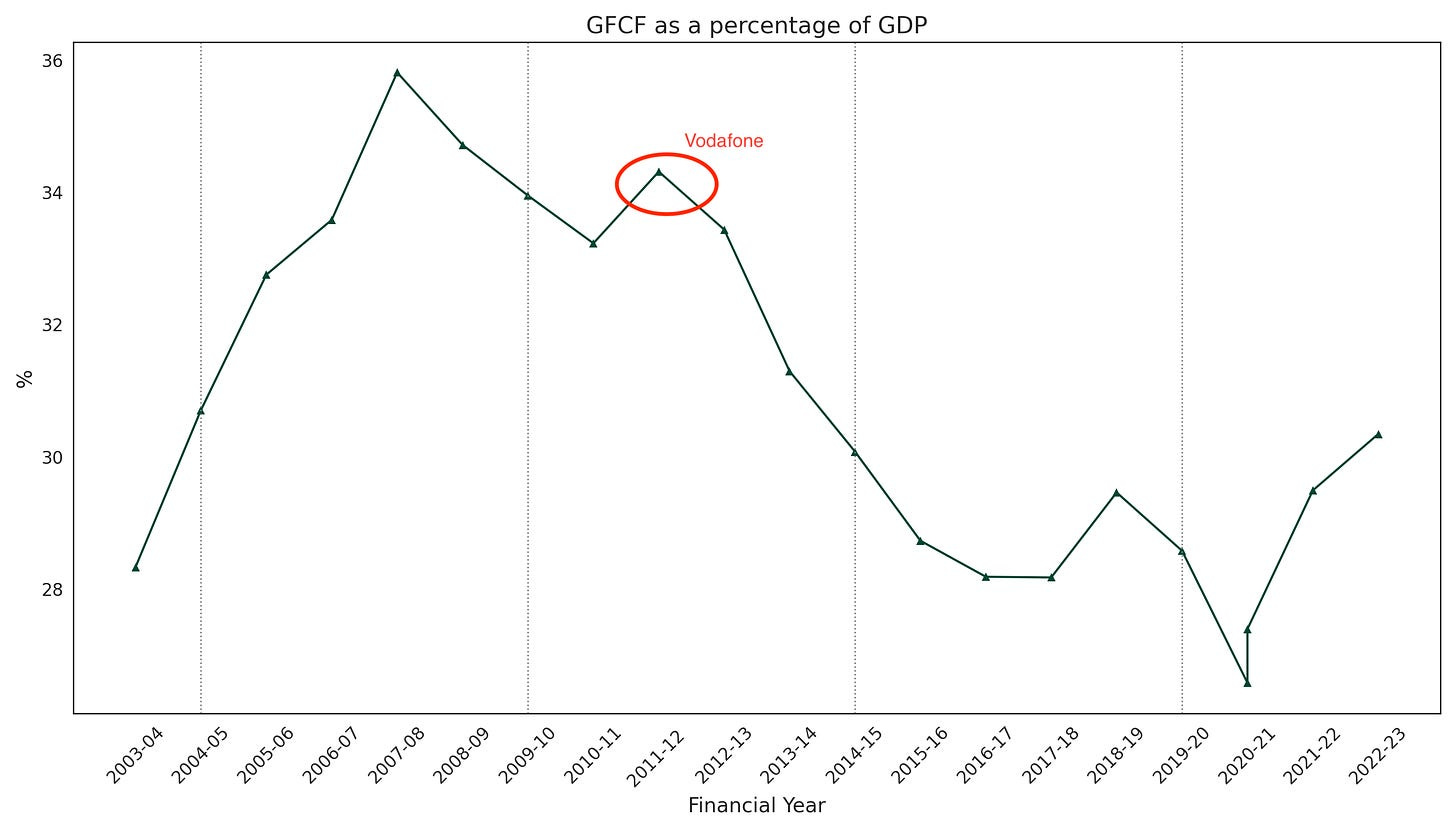
Yes, India is doing well but the picture could be much better:
During Modi’s tenure, GFCF [gross fixed capital formation] as a percentage of GDP declined and has remained low until the post-pandemic recovery. In fact the highest level of GFCF as a percentage of GDP during the first nine years of Modi’s leadership is lower than the lowest level in PM Singh’s tenure.
Here is more from Shruti.
Tuesday assorted links
1. Skepticism about the beauty premium?
2. “On a cellular level, younger generations seem to be aging faster than their forebears.” (speculative)
4. William Stanley Jevons and eclipses (NYT). And an Amtrak train ride across the country is less carbon-efficient than flying (NYT).
5. The ascent of high school wrestlers.
6. A short video on how the Great Pyramids may have been built.
7. Was more spent on eclipse tourism than on the Taylor Swift tour?
Philipp Strack wins the J.B. Clark award
Congratulations! Here is the AEA announcement and summary of his work.