Mortality Change Among Less Educated Americans
The bottom of the educational distribution is doing very very poorly:
Changing mortality rates among less educated Americans are difficult to interpret because the least educated groups (e.g. dropouts) become smaller and more negatively selected over time. New partial identification methods let us calculate mortality changes at constant education percentiles from 1992–2015. We find that middle-age mortality increases among non-Hispanic whites are driven almost entirely by changes in the bottom 10% of the education distribution. Drivers of mortality change differ substantially across groups. Deaths of despair explain a large share of mortality change among young non-Hispanic whites, but a small share among older whites and almost none among non-Hispanic blacks.
That is from Paul Novosad and Charlie Rafkin.
How I choose fiction
An MR reader emails me:
Reading: what is your decision model for choosing fiction?
Here is a description, these are not necessarily recommendations for you:
1. If a woman as smart (or smarter) as I am tells me to read a particular work of fiction, it is likely I do so. If a smarter man tells me to read a particular work of fiction, odds are I will ignore it.
2. I am least likely to read American fiction. The 1850s, Faulkner, and Pynchon aside, American fiction seems more superficial to me than say European or Latin American fiction. American fiction is also very popular in…America, which leads to an excessively loose selection mechanism for those residing in this country and reading its media. Whereas if a novel from El Salvador (Castellanos Moya) makes its way in front of your eyes, it may be quite good.
3. In genre fiction, I am most likely to read American fiction. Superficiality is less of a problem, and vitality is more likely to be relevant.
4. I track fiction reviews in the NYT, Times Literary Supplement, London Review of Books, Financial Times, the WSJ and WaPo, BookForum, The New Yorker, New York Review of Books, and on-line, and I buy what seems interesting to me. I read the blog Literary Saloon which covers fiction in translation. I will randomly sample other sources as well, sometimes the Guardian too or the London Times. I will click on “best of” lists relating to fiction.
5. If I am in a German- or Spanish-speaking country, I’ll buy a few titles from the front tables and also ask an intelligent-seeming clerk what I ought to be reading. I don’t always get around to actually reading those, noting that the final equilibrium has not yet arrived.
6. I used to scan the “New Arrivals” section of the local public libraries for fiction titles, but in recent years I have cut back on my fiction consumption and this practice has fallen by the wayside. It was not leading to a high hit rate in any case (too many second- or third-tier books by writers I already like but who are past their peak years).
7. I will periodically reread old classics, on a more or less random basis, mostly correlated with how long ago I last read them.
The new Quentin Tarantino movie
Richard Brody’s New Yorker review is titled: “Quentin Tarantino’s Obscenely Regressive Vision of the Sixties in “Once Upon a Time . . . in Hollywood”“.
I didn’t love the film, and with each work of his I see, the more I like the others (and him?) less. My main takeaway was to be reminded of an enormous and unprecedented historical shift. In the 1960s, in part because of the birth control pill, the sexual opportunities of high status heterosexual men, or even medium status men, increased enormously, in terms of both quantity and quality. And indeed the men in this movie take advantage of that, to various extremes (wife murder, the Manson cult) and it is not entirely clear how much Tarantino disapproves.
Whatever your normative view of this change, keep it in mind the next time you encounter the “Puritan excesses” of today’s PC movement. Very rapid historical shifts in norms do in fact bring various forms of reaction and sometimes overreaction, and pushing back against the overreaction is not always the wisest thing to do.
If you want to see southern California on the big screen, you might enjoy Echo in the Canyon more, while its bookend cinematic partner David Crosby: Remember My Name will fill in the Joni Mitchell blank and also show you how deeply unpopular and unlikeable people talk and think about themselves.
Saturday assorted links
1. The public sector lobotomy.
2. No food desert in this gas station.
3. Maybe Canada does not want drug importation from the United States.
4. Marxism and Progress Studies. A thread.
5. Forthcoming: “Towards an Economics of Natural Equals: A Documentary History of the Early Virginia School,” by David M. Levy and Sandra Peart.
6. Zeke Emanuel: Democrats should focus on health care affordability (NYT).
7. Regulatory reform in Ohio (WSJ).
A Toolkit of Policies to Promote Innovation
That is the new Journal of Economic Perspectives article by Nicholas Bloom, John Van Reenen, and Heidi Williams. Most of all, such articles should be more frequent and receive greater attention and higher status, as Progress Studies would suggest. Here is one excerpt:
…moonshots may be justified on the basis of political economy considerations. To generate significant extra resources for research, a politically sustainable vision needs to be created. For example, Gruber and Johnson (2019) argue that increasing federal funding of research as a share of GDP by half a percent—from 0.7 percent today to 1.2 percent, still lower than the almost 2 percent share observed in 1964 in Figure 1—would create a $100 billion fund that could jump-start new technology hubs in some of the more educated but less prosperous American cities (such as Rochester, New York, and Pittsburgh, Pennsylvania). They argue that such a fund could generate local spillovers and, by alleviating spatial inequality, be more politically sustainable than having research funds primarily flow to areas with highly concentrated research, such as Palo Alto, California, and Cambridge, Massachusetts.
In general I agree with their points, but would have liked to have seen more on freedom to build, and of course on culture, culture, culture. At the very least, policy is endogenous to culture, and culture shapes many economic outcomes more directly as well. I’m fine with tax credits for R&D, but I just don’t see them as in the driver’s seat.
America, in two charts, social average is over
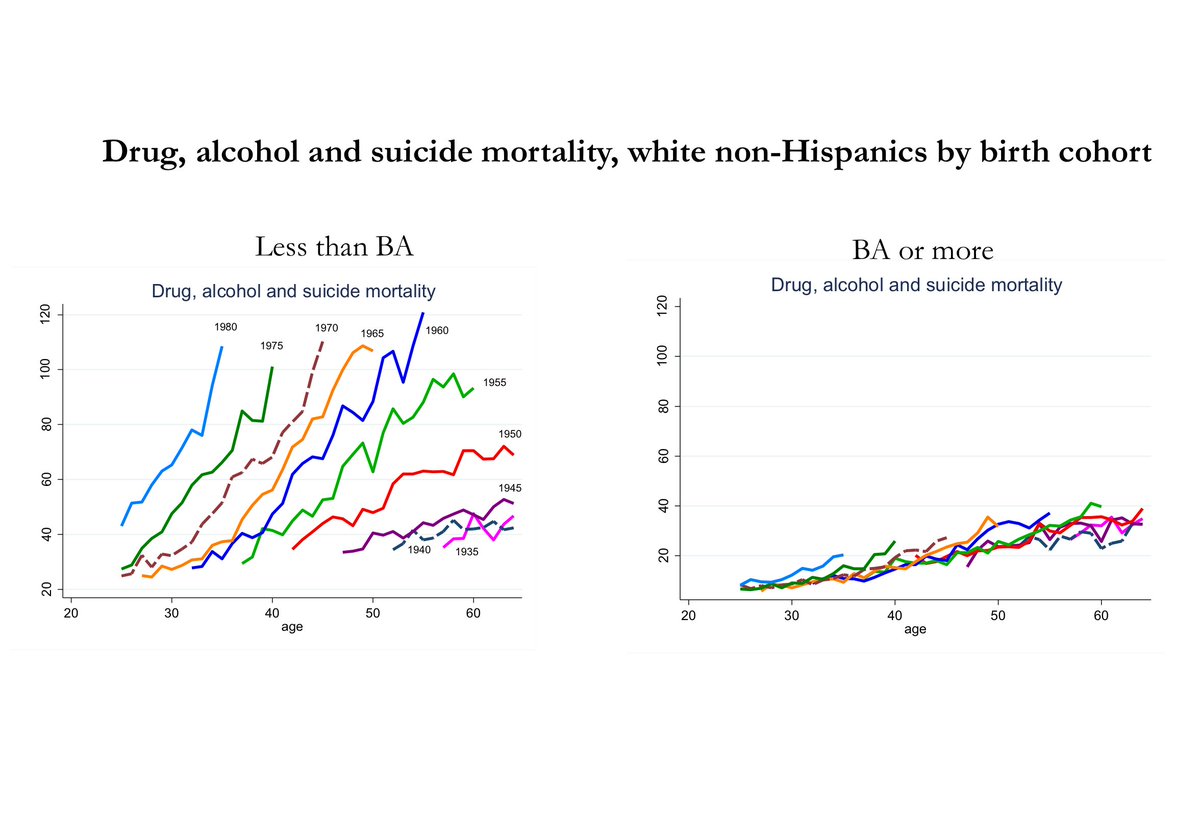
Forgive the formatting, and yes the axes are not square up (in fact it should look worse), here is the link. And here is the source with explanation, p.48.
The parrot culture that is British the First Amendment is underrated
British newspapers can legitimately mock parrots and compare them to psychopaths, the press regulator has ruled, after an unsuccessful complaint that the Daily Star misrepresented the emotions of a pet bird.
The Independent Press Standards Organisation (Ipso) rejected the complaint after the tabloid mocked a “pain-loving parrot” which it Photoshopped with a flat cap to look like a violent character from the TV show Peaky Blinders.
Here is enough more, via Michelle Dawson.
Friday assorted links
What should I ask Alain Bertaud?
He is an urbanist scholar at NYU, and also a lifetime practitioner, here is my review of his recent excellent book Order without Design: How Markets Shape Cities. Here is his home page.
This will be a live event in New York City, September 9, register here.
So what should I ask him?
Paul Krugman’s Most Evil Idea
Erik Torenberg, co-founder of the VC firm Village Global, interviews me in a wide-ranging podcast. Here is one bit from a series of questions on what do you disagree about with ____. In this case, Paul Krugman.
AT: …Krugman and I are almost in perfect agreement. Only marginally different. Paul says ‘Republicans are corrupt, incompetent, unprincipled and dangerous to a civil society’. I agree with that entirely. I would only change one word. I would change the word Republicans to the word politicians. If Paul could only be convinced of doing that, coming over to the libertarian side, we would be in complete agreement. But he is much more partisan than I am and even though I worry about Republicans more than Democrats at this particular point in time I think the larger incentive is that we all need to be worried about politicians rather than any one particular party.
Although I agree with Paul a lot of the time, sometimes he does just drive me absolutely batty. He just says things which I think are so wrong. In his latest column which to be fair was written as a column fifty years in the future so maybe it was a bit tongue in cheek. The column was pretending that Elon Musk and Peter Thiel were a hundred years of age and fit and fiddle and still major players in society. And Krugman wrote:
Life extension for a privileged few is by its nature a socially destructive technology and the time has come to ban it.
Now to me this is just evil. This is like something out of Ayn Rand’s Anthem, that it is evil to live longer than your brothers and all must be sentenced to death so that none live more than their allotted time. I think it is evil if we accept even the premise of his argument that these technologies are very expensive. Even on that ground it’s evil to kill people just so that they don’t live longer than average. But perhaps even a bigger point is that I think these technologies of life extension are some of the most important things that people are working on today. And the billionaires are doing an incredible service to humanity by investing in these radical ideas and pushing the frontier and that is going to have spillover effects on everyone. If we are to reach the singularity it will because the billionaires are getting us there earlier and faster and they are the ones pushing us to the singularity and everyone will benefit from these life extension technologies.
So I agree with Paul quite a bit, more than you might expect, but sometimes he just says things which are absolutely evil.
We cover open borders, whether capitalism and democracy are compatible, the Baumol effect and more. Listen to the whole thing.
Highly decentralized solar geoengineering
Nonstate actors appear to have increasing power, in part due to new technologies that alter actors’ capacities and incentives. Although solar geoengineering is typically conceived of as centralized and state-deployed, we explore highly decentralized solar geoengineering. Done perhaps through numerous small high-altitude balloons, it could be provided by nonstate actors such as environmentally motivated nongovernmental organizations or individuals. Conceivably tolerated or even covertly sponsored by states, highly decentralized solar geoengineering could move presumed action from the state arena to that of direct intervention by nonstate actors, which could in turn, disrupt international politics and pose novel challenges for technology and environmental policy. We conclude that this method appears technically possible, economically feasible, and potentially politically disruptive. Decentralization could, in principle, make control by states difficult, perhaps even rendering such control prohibitively costly and complex.
That is from Jesse L. Reynolds & Gernot Wagner, and injecting fine aerosols into the air, as if to mimic some features of volcanic eruptions, seems to be one of the major possible approaches. I am not able to judge the scientific merits of their claims, but it has long seemed to me evident that some version of this idea would prove possible.
Solve for the equilibrium! What is it? Too much enthusiasm for correction and thus disastrous climate cooling? Preemptive government regulation? It requires government subsidy? It becomes controlled by concerned philanthropists? It starts a climate war between America/Vietnam and Russia/Greenland? Goldilocks? I wonder if we will get to find out.
Via the excellent Kevin Lewis.
What I’ve been reading
1. Jonathan Paine’s Selling the Story: Transaction and Narrative Value in Balzac, Dostoevsky, and Zola combines several interests of mine in an effective fashion. This book is most useful for seeing economic themes in some of the classic authors, above and beyond their citations of monetary values and payments.
2. The Bretton Woods Agreements, Together with Scholarly Commentaries and Essential Historical Documents, edited by Naomi Lamoreaux and Ian Shapiro. Virtually all edited collections are sleep-inducing, but this one is consistently interesting, at least if you are the kind of person who might possibly be drawn in by the title. Doug Irwin, Barry Eichengreen, Kurt Schuler, and Michael Bordo are among the contributors.
3. Ken Ochieng’ Opalo, Legislative Development in Africa: Politics and Postcolonial Legacies. The book also is more exciting than the title and subtitle indicate. It covers the determinants of cross-national African legislative successes, and argues that often the best and strongest legislatures emerge from a context of previously effective autocracy.
4. Roger Faligot, Chinese Spies: From Chairman Mao to Xi JinPing. A sobering account of how much spying — indeed spying on a mass level — has been central to Chinese history since the advent of communism. I found some parts of this book too detailed for me to read the entire thing, but arguably that ought to scare you all the more. Note that the narrative essentially ends around 2008.
5. Mario Bertolotti, The History of the Laser. Only about half of this book, at most, covers the laser. Those parts seemed fine enough, but what I really enjoyed was the coverage of the development of electromagnetic theory leading up to the laser. The book is also good for showing that the “transistor revolution” starting in 1948 was not really so distinct from the earlier industrial and electromagnetic revolution of the late 19th century.
Pew data on American opinions on this, that, and the other
There has been a 12 percentage point decline in the share of Democrats who view the impact of churches positively (from 50% to 38%); Democrats are now evenly divided in these attitudes (38% positive, 40% negative). In five previous Pew Research Center surveys over the past decade, significantly more Democrats viewed the impact of religious organizations positively than negatively. Republicans continue to view religious organizations much more positively than do Democrats (68% positive in the new survey).
Republicans and Democrats also have moved further apart in opinions about how banks and large corporations affect the country. Half of Republicans say banks and other financial institutions have a positive effect on the U.S., compared with just 27% of Democrats. Two years ago, the partisan gap was less pronounced (46% of Republicans, 33% of Democrats).
Today, Republicans are more than twice as likely than Democrats to say large corporations have a positive effect on the way things are going in the U.S. (45% vs. 17%). In 2016, 34% of Republicans and 26% of Democrats said they had a positive effect.
There are further topics considered at the link. At least labor unions are more popular.
That was then, this is now
Poughkeepsie Journal: “Woodstock 50 festival has been canceled. Set for Aug. 16-18, Woodstock 50 was to memorialize the iconic event many consider to be the top achievement of the 60s counterculture. But there was a failure to secure permits or a venue.”
That is from John Fund on Twitter.
Average is Over: Newspaper Edition
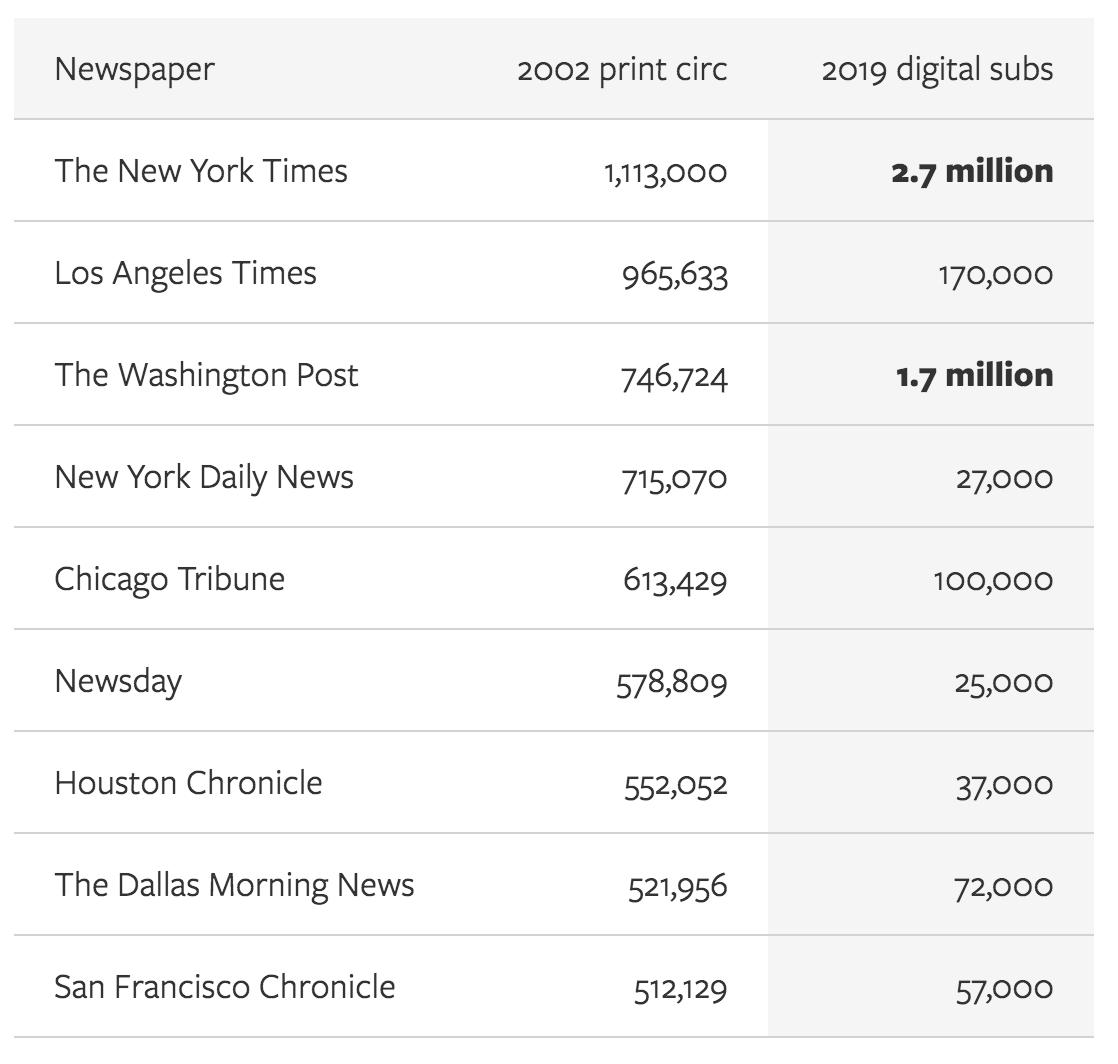
Joshua Benton at the LA Times illustrates average is over for newspapers. On the left the print circulation of major newspapers in 2002. The NYTimes is the leader but other newspapers follow closely behind in a slowly decaying curve likely related to city size. On the right, 2019 digital subscriptions. The NYTimes dominates. Only the Washington Post is even in the same league (The Wall Street Journal, however, should also have made Benton’s list at 1.5 million digital subscribers.) Without classified ads and other local information, for which there are now multiple online substitutes, there isn’t a big demand for local newspapers. News is now national and only a handful of newspapers can survive at national scale. Moreover, the few who can survive at national scale are now so much better than their competitors precisely because they can afford to be better.