Tuesday assorted links
1. Solve for the equilibrium price of real estate.
2. Kanye + Star Wars vs. NIMBY.
3. Reputation markets in everything: “The Wall Street Journal’s Erich Schwartzel recently wrote a story revealing that none of these tough-guy actors likes it very much when the characters they play get pummeled on screen. One of them even negotiated limits on how much his character can get beat up. Another has his sister, a producer, count how many times his character gets punched, to make sure he gives as good as he gets.
Today, Erich joins us to talk about the lengths these actors have gone to preserve their ever-so-fragile reputations for macho toughness. And the incentives they have for doing so.”
4. A Straussian take on Kenyan rebellion (song, The Rivingtons, 1962). This was the recording that prompted Dave Marsh to describe Bob Dylan’s “The Times They Are a Changin'” as a “dull diatribe.”
Open Borders in Svalbard!
 Well north of Iceland there is a island archipelago that is governed by Norway but because of a peculiar treaty it has entirely open borders:
When you land in Longyearbyen, the largest settlement in the Norwegian archipelago of Svalbard, you can step off the plane and just walk away. There’s no passport control, no armed guard retracing your steps, no biometric machine scanning your fingers. Svalbard is as close as you can get to a place with open borders: As long as you can support yourself, you can live there visa-free.
In an excellent piece in The Nation, Atossa Araxia Abrahamian describes the history and what it is like to visit:
Formally, Svalbard—known as Spitsbergen until the 20th century—belongs to Norway, which writes the laws, enforces order, builds infrastructure, and regulates hunting, fishing, and housing. Last year, when a Russian man was caught trying to rob a bank in town, a Norwegian judge sentenced him under Norwegian law to a Norwegian jail. But Norway’s control over Svalbard comes with obligations outlined by an unusual 1920 treaty signed as part of the Versailles negotiations ending World War I.
Written in the aftermath of the war, the Svalbard Treaty is both of and ahead of its time. Its architects stipulated that the territory cannot be used for “warlike” purposes. They included one of the world’s first international conservation agreements, making Norway responsible for the preservation of the surrounding natural environment. The treaty also insists that the state must not tax its citizens more than the minimum needed to keep Svalbard running, which today typically amounts to an 8 percent income tax, well below mainland Norway’s roughly 40 percent.
Most radically, the treaty’s architects held Norway to what’s known as the nondiscrimination principle, which prevents the state from treating non-Norwegians differently from Norwegians. This applies not just to immigration but also to opening businesses, hunting, fishing, and other commercial activities. Other countries could not lay formal claims on Svalbard, but their people and companies would be at no disadvantage.
Some 37 percent of Svalbard’s population is foreign born and there is an abandoned Soviet town with statues of Vladmir Lenin. Tyler will also be pleased to know that there are puffins.
I can’t say that I am tempted to move, but given global climate change it’s good to know that I could.
Hat tip: The Browser.
The Pigouvian culture and polity that is Sweden
A Swedish town has become the first in the country to introduce an official begging permit, requiring anyone who asks for money in the street to pay SEK 250 (£21) upfront for a licence.
Valid for three months, the permit can be obtained by filling in a form online or at a police station and requires a valid ID. Anyone found begging for money in Eskilstuna, west of Stockholm, without one faces a fine of up to SEK 4,000 (£342).
Here is much more, via Shaffin. Note that some beggars are trying to circumvent the ban by “selling blueberries.”
The rise of niche consumption
Here is a new and neat paper which, to the extent it is true, would appear to address several significant puzzles at once. From Brent Neiman and Joseph S. Vavra:
We show that over the last 15 years, the typical household has increasingly concentrated its spending on a few preferred products. However, this is not driven by “superstar” products capturing larger market shares. Instead, households increasingly focus spending on different products from each other. As a result, aggregate spending concentration has in fact decreased over this same period. We use a novel heterogeneous agent model to conclude that increasing product variety is a key driver of these divergent trends. When more products are available, households can select a subset better matched to their particular tastes, and this generates welfare gains not reflected in government statistics. Our model features heterogeneous markups because producers of popular products care more about maximizing profits from existing customers, while producers of less popular niche products care more about expanding their customer base. Surprisingly, however,our model can match the observed trends in household and aggregate concentration without any resulting change in aggregate market power.
This is related to what I called “matching” in The Complacent Class.
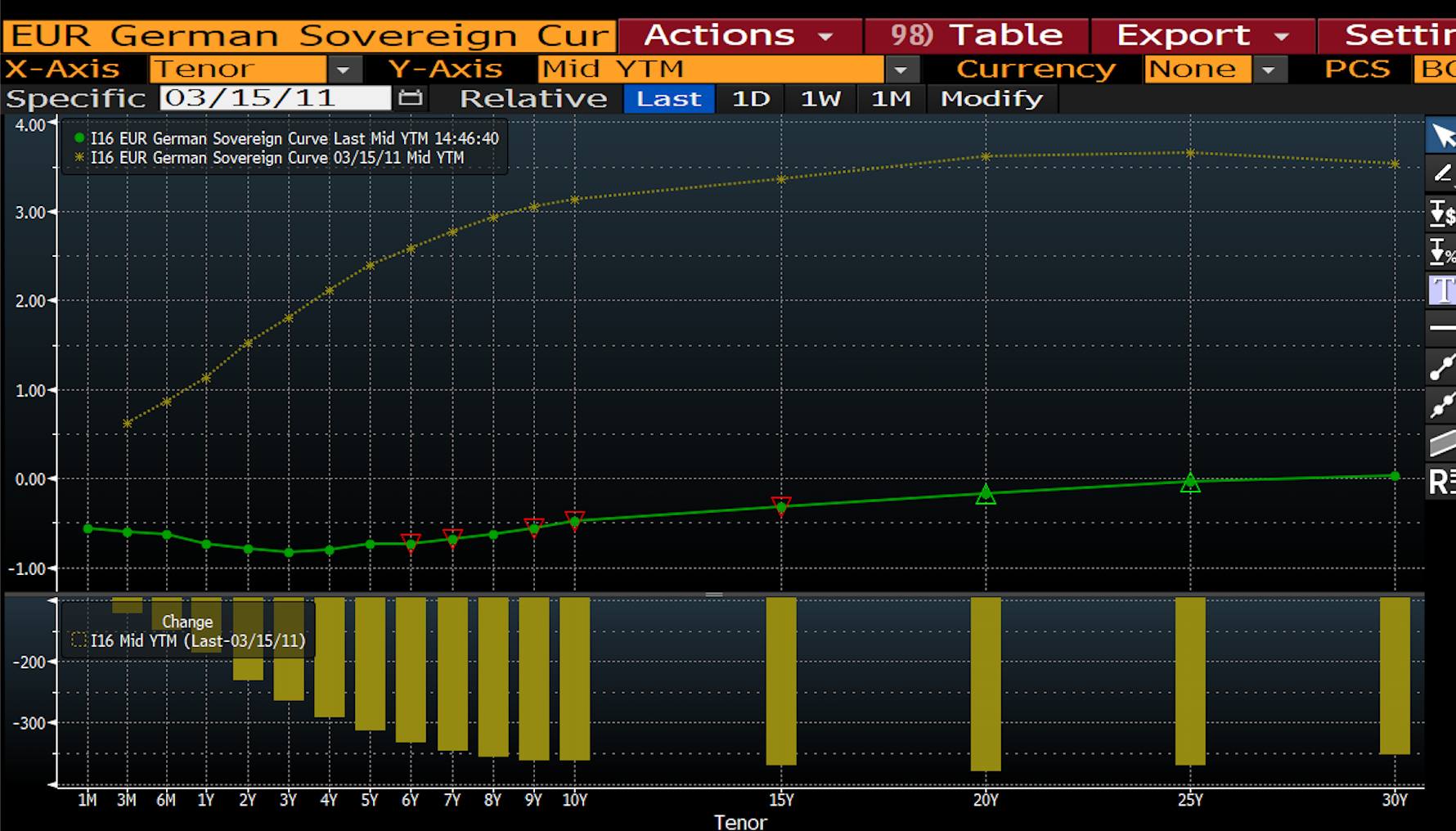
The Entire German Yield Curve is Trading Below Zero
The German government could today borrow billions of Euro and in a decade they could give back to investors less than they borrowed and the investors would be happy. Does the German government have no net positive investments to make?
The global savings glut which drives asset prices higher and makes them more volatile is very much still with us. Around the world there is now over 15 trillion in negative interest debt.
The labor share is not in general falling
We study the joint impact of three measurement issues in the empirical literature on the labor share: (i) start and end periods for the empirical analysis; (ii) accounting for self-employment; and (iii) accounting for residential real estate income. When we correct for these three potential biases, we do not find a general decline in the labor share in our sample of advanced economies. In that respect the behavior of the US labor share after 2000 presents a puzzle.
That is from a new NBER Working Paper by Gilbert Cette, Lorraine Koehl, and Thoimas Philippon.
Monday assorted links
1. Do you like any of these “bad” home designs? (How about the two toilets?)
3. List of readings on progress. By Daniel May.
4. On Bloom’s two-sigma problem.
6. The evolution of language, Hong Kong style.
Very good links today.
Identity Politics Versus Independent Thinking
Anthony Kronman, former Dean of the Yale Law school, writes in the WSJ:
The politically motivated and group-based form of diversity that dominates campus life today discourages students from breaking away, in thought or action, from the groups to which they belong. It invites them to think of themselves as representatives first and free agents second. And it makes heroes of those who put their individual interests aside for the sake of a larger cause. That is admirable in politics. It is antithetical to one of the signal goods of higher education.
…Grievance is the stuff of political life…Academic disagreements are different. Important ones are often inflamed by passion too. But the goal of those involved is to persuade their adversaries with better facts and arguments—not to bludgeon them into submission with complaints of abuse, injustice and disrespect to increase their share of power. Today, the spirit of grievance has been imported into the academy, where it undermines the common search for truth by permeating it with a sense of hurt and wrong on the part of minority students, and guilt on the part of those who are blamed for their suffering.
…For college students, the search for truth is important not because reaching it is guaranteed—there are no such guarantees—but as a discipline of character. It instills habits of self-criticism, modesty and objectivity. It strengthens their ability to subject their own opinions and feelings to higher and more durable measures of worth. It increases their self-reliance and their respect for the values and ideas of those far removed in time and circumstance. In all these ways, the search for truth promotes the habit of independent-mindedness that is a vital antidote to what Tocqueville called the “tyranny of majority opinion.”
…Tocqueville was an enthusiastic admirer of America’s democracy. He thought it the most just system of government the world had ever known. But he was also sensitive to its pathologies. Among these he identified the instinct to believe what others do in order to avoid the labor and risk of thinking for oneself. He worried that such conformism would itself become a breeding ground for despots.
As a partial antidote, Tocqueville stressed the importance of preserving, within the larger democratic order, islands of culture devoted to the undemocratic values of excellence and truth. These could be, he thought, enclaves for protecting the independence of mind that a democracy like ours especially needs.
Today our colleges and universities are doing a poor job of meeting this need, and the idea of diversity is at least partly to blame. It has become the basis of an illiberal and antirational academic cult—one that undermines the spirit of self-reliance and the commitment to truth on which not only higher education, but the whole of our democracy, depends.
How carbon-unfriendly is the act of flying?
That is the topic of my latest Bloomberg column, with a focus on Greta Thunberg, whom I admire but I wish she would endorse nuclear power and other practical possible solutions to climate change problems. At this point, I don’t think the returns to “simple moralizing” are that high, and they may be a substitute for concrete actions. Excerpt:
Or think more broadly about how to choose one’s symbolic commitments to combat climate change. Buying a carbon offset, verifiable by an independent third party, seems like a good practical step. Thunberg also could take a stand in favor of nuclear power — a feasible source of green energy — except that she opposes it. Nuclear power has worked quite well for France for about 70 years, even if it is not suitable for earthquake zones.
Another way to show one’s dedication to limiting global temperatures would be to educate the public on carbon sequestration, which recently has made a good deal of real progress. How about a strike or demonstration to call people’s attention to the possibilities of this new technology, and to ask for additional funding?
There is much more at the link.
Genetic Endowments and Wealth Inequality
That new paper by Daniel Barth, Nicholas W. Papageorge and Kevin Thom is attracting a great deal of attention and also some controversy. Here is the first sentence of the abstract:
We show that genetic endowments linked to educational attainment strongly and robustly predict wealth at retirement.
But it’s not mainly about IQ. I found this to be the most interesting part of the paper, noting that EA is a polygenic score:
Our use of the EA score as a measure of biological traits linked to human capital is related to previous attempts in the literature to measure ability through the use of tests scores such as IQ or the AFQT…We note two important differences between the EA score and a measure like IQ that make it valuable to study polygenic scores. First, a polygenic score like the EA score can overcome some interpretational challenges related to IQ and other cognitive test scores. Environmental factors have been found to influence intelligence test results and to moderate genetic influences on IQ (Tucker-Drob and Bates, 2015). It is true that differences in the EA score may reflect differences in environments or investments because parents with high EA scores may also be more likely to invest in their children. However, the EA score is fixed at conception, which means that post-birth investments cannot causally change the value of the score. A measure like IQ suffers from both of these interpretational challenges. High IQ parents might have high IQ children because of the genes that they pass on, but also because of the positive investments that they make…Compared to a cognitive test score like IQ, the EA score may also measure a wider variety of relevant endowments. This is especially important given research, including relatively recent papers in economics, emphasizing the importance of both cognitive and non-cognitive skills in shaping life-cycle outcomes (Heckman and Rubinstein, 2001). Existing evidence suggests a correlation of approximately 0.20 between a cognitive test score available for HRS respondents and the EA score (Papageorge and Thom, 2016). This relatively modest correlation could arise if both variables measure the same underlying cognitive traits with error, or if they measure different traits. However, Papageorge and Thom (2016) find that the relationship between the EA score and income differs substantially from the relationship between later-life cognition scores and income, suggesting that the EA score contains unique information…
…we interpret the EA score as measuring a basket of genetic factors that influence traits relevant for human capital accumulation.
If I understand the paper correctly, the polygenic score is what predicts well from the genetic data set, it is not a “thing with a known nature.” And I believe the results are drawn from the same 1.1 million person data set as is used in this Nature paper.
Gun policy suggestions from Jennifer Doleac
Several programs are at least worthy of consideration. Summer jobs programs for teens reduce mortality by 18 to 20 percent among participants. This effect is driven by a reduction in young men killed by homicide or suicide. Cognitive behavioral therapy for at-risk young men lowers violent crime arrests by 45 to 50 percent for participants. Access to Medicaid in early childhood decreases suicide by 10 to 15 percent later in life. Mandating that health insurance cover mental health benefits at parity reduces the suicide rate by 5 percent. Access to antidepressants also reduces suicide rates: An increase in antidepressant sales equivalent to one pill per capita reduced suicide by 5 percent.
In addition, repealing duty-to-warn laws for mental health providers—which require that they report a patient’s violent threats, perhaps causing patients to be less honest—could reduce teen suicides by 8 percent and decrease homicides by 5 percent. Repealing juvenile curfews could lower urban gunfire by two-thirds. And if the goal is to reduce mortality in general—not just gun deaths—then there are many more options policymakers should consider.
Here is more. I don’t read her as endorsing all of those uncategorically, simply as noting that many available options are on the table.
Sunday assorted links
1. “The style of play is a key factor in the home advantage. Teams that make more two point and free-throw shots see larger advantages at home. Given the rise in three-point shooting in recent years, this finding partially explains the gradual decline in home advantage observed across the league over time.” Link here.
3. Tiebout Twitter.
4. “A giant tortoise has been reunited with his owner after the “world’s slowest police chase”.” Left- or right-wing link?
5. Javier Marías remains “old school.” (NYT)
Mortality Change Among Less Educated Americans
The bottom of the educational distribution is doing very very poorly:
Changing mortality rates among less educated Americans are difficult to interpret because the least educated groups (e.g. dropouts) become smaller and more negatively selected over time. New partial identification methods let us calculate mortality changes at constant education percentiles from 1992–2015. We find that middle-age mortality increases among non-Hispanic whites are driven almost entirely by changes in the bottom 10% of the education distribution. Drivers of mortality change differ substantially across groups. Deaths of despair explain a large share of mortality change among young non-Hispanic whites, but a small share among older whites and almost none among non-Hispanic blacks.
That is from Paul Novosad and Charlie Rafkin.
How I choose fiction
An MR reader emails me:
Reading: what is your decision model for choosing fiction?
Here is a description, these are not necessarily recommendations for you:
1. If a woman as smart (or smarter) as I am tells me to read a particular work of fiction, it is likely I do so. If a smarter man tells me to read a particular work of fiction, odds are I will ignore it.
2. I am least likely to read American fiction. The 1850s, Faulkner, and Pynchon aside, American fiction seems more superficial to me than say European or Latin American fiction. American fiction is also very popular in…America, which leads to an excessively loose selection mechanism for those residing in this country and reading its media. Whereas if a novel from El Salvador (Castellanos Moya) makes its way in front of your eyes, it may be quite good.
3. In genre fiction, I am most likely to read American fiction. Superficiality is less of a problem, and vitality is more likely to be relevant.
4. I track fiction reviews in the NYT, Times Literary Supplement, London Review of Books, Financial Times, the WSJ and WaPo, BookForum, The New Yorker, New York Review of Books, and on-line, and I buy what seems interesting to me. I read the blog Literary Saloon which covers fiction in translation. I will randomly sample other sources as well, sometimes the Guardian too or the London Times. I will click on “best of” lists relating to fiction.
5. If I am in a German- or Spanish-speaking country, I’ll buy a few titles from the front tables and also ask an intelligent-seeming clerk what I ought to be reading. I don’t always get around to actually reading those, noting that the final equilibrium has not yet arrived.
6. I used to scan the “New Arrivals” section of the local public libraries for fiction titles, but in recent years I have cut back on my fiction consumption and this practice has fallen by the wayside. It was not leading to a high hit rate in any case (too many second- or third-tier books by writers I already like but who are past their peak years).
7. I will periodically reread old classics, on a more or less random basis, mostly correlated with how long ago I last read them.
The new Quentin Tarantino movie
Richard Brody’s New Yorker review is titled: “Quentin Tarantino’s Obscenely Regressive Vision of the Sixties in “Once Upon a Time . . . in Hollywood”“.
I didn’t love the film, and with each work of his I see, the more I like the others (and him?) less. My main takeaway was to be reminded of an enormous and unprecedented historical shift. In the 1960s, in part because of the birth control pill, the sexual opportunities of high status heterosexual men, or even medium status men, increased enormously, in terms of both quantity and quality. And indeed the men in this movie take advantage of that, to various extremes (wife murder, the Manson cult) and it is not entirely clear how much Tarantino disapproves.
Whatever your normative view of this change, keep it in mind the next time you encounter the “Puritan excesses” of today’s PC movement. Very rapid historical shifts in norms do in fact bring various forms of reaction and sometimes overreaction, and pushing back against the overreaction is not always the wisest thing to do.
If you want to see southern California on the big screen, you might enjoy Echo in the Canyon more, while its bookend cinematic partner David Crosby: Remember My Name will fill in the Joni Mitchell blank and also show you how deeply unpopular and unlikeable people talk and think about themselves.