Results for “age of em” 17233 found
What can LLMs never do?
By Rohit Krishnan, he and I are both interested in the question of what LLMs cannot do, and why. Here is one excerpt:
It might be best to say that LLMs demonstrate incredible intuition but limited intelligence. It can answer almost any question that can be answered in one intuitive pass. And given sufficient training data and enough iterations, it can work up to a facsimile of reasoned intelligence.
The fact that adding an RNN type linkage seems to make a little difference though by no means enough to overcome the problem, at least in the toy models, is an indication in this direction. But it’s not enough to solve the problem.
In other words, there’s a “goal drift” where as more steps are added the overall system starts doing the wrong things. As contexts increase, even given previous history of conversations, LLMs have difficulty figuring out where to focus and what the goal actually is. Attention isn’t precise enough for many problems.
A closer answer here is that neural networks can learn all sorts of irregular patterns once you add an external memory.
And:
In LLMs as in humans, context is that which is scarce.
Interesting throughout.
What is the proper policy toward tourists?
That is the topic of my latest Bloomberg column, basically you should charge them fees rather than discourage them through other means> Here is one excerpt:
By this reasoning, the Japanese decision to raise bullet train prices for tourists is exactly the right approach. In the meantime, the Japanese government, which faces high pension costs, has more money at its disposal. There is no need to resent or otherwise restrict the tourists at all, and indeed I have found the Japanese people to be extremely gracious and helpful to foreigners. Higher prices for tourist train tickets will make it easier for them to stay this way.
If there is any problem with Venice’s five-euros-a-day charge, it is that it is not nearly high enough, given crowding and accumulated wear and tear on the city. How about 50 euros? But with a smile!
The same goes for the bus in Barcelona: Why not raise the fare? Just for tourists. It is easy enough to (partially) enforce this differential treatment with spot checks on the bus line. An alternative or possible complement to this plan is to run more buses to the park, to alleviate congestion. Higher fees for tourists can help pay for them.
Here is an interesting problem:
Amsterdam has a more difficult challenge. Barcelona and Venice have some unique attractions and sites that can be priced at higher levels, with exclusion applied to non-payers. In contrast, for many Amsterdam tourists the attractions are booze, pot and sex, all of which have prices set in basically competitive markets. I’m all for more expensive tickets to the Rijksmuseum, but that might not make much of a difference to Amsterdam’s “party tourism” problem.
Worth a ponder.
More Tuesday links
1. AI Camera turns your images into poetry.
2. Highly capable model locally on your phone.
3. Clara Piano reviews GOAT. “Perhaps, in his emphasis on the importance of ideas, Cowen reveals that he is ultimately a Simonian. After all, the human mind is the ultimate resource.”
4. Market liberalism, Chinese style.
5. Red flags for improper judicial conduct.
6. Data on the economics of bookselling, designed to dissuade would-be authors.
Four Thousand Years of Egyptian Women Pictured
 In an excellent, deep-dive Alice Evans looks at patriarchy in Egypt using pictures drawn from four thousand years of history. Here are three examples.
A wealthy woman, shown at right circa 116 CE. Unveiled, immodest, looking out at the world. A person to be reckoned with.
After the Arab conquests, pictures of people in general disappear, and there are no books written by women. With the dawn of photography in the 19th century we see (at left) what was probably typical, veiled women, and very few women on the street.

In the 1950s and 1970s we see a remarkable revitalization and liberalization noted most evidently in advertisements (advertisers being careful not to offend). Note the bare legs and the fact that many advertisements are directed at women (below)

This period culminates in a remarkable video unearthed by Evans of Nasser in 1958 openly laughing at the idea that women should or could be required to veil in public. Worth watching.
In the 1980s, however, it all ends.
Egyptians who came of age in the 1950s and ‘60s experienced national independence, social mobility and new economic opportunities. By the 1980s, economic progress was grinding down. Egypt’s purchasing power was plummeting. Middle class families could no longer afford basic goods, nor could the state provide.
As observed by Galal Amin,
“When the economy started to slacken in the early 1980s, accompanied by the fall in oil prices and the resulting decline in work opportunities in the Gulf, many of the aspirations built up in the 1970s were suddenly seen to be unrealistic and intense feelings of frustration followed”.
‘Western modernisation’ became discredited by economic stagnation and defeat by Israel. In Egypt, clerics equated modernity with a rejection of Islam and declared the economic and military failures of the state to be punishments for aping the West. Islamic preachers called on men to restore order and piety (i.e., female seclusion). Frustrated graduates, struggling to find white collar work, found solace in religion, whilst many ordinary people turned to the Muslim Brotherhood for social services and righteous purpose.
That’s just a brief look at a much longer and fascinating post.
Hiring discrimination sentences to ponder
Several common measures — like employing a chief diversity officer, offering diversity training or having a diverse board — were not correlated with decreased discrimination in entry-level hiring, the researchers found.
But one thing strongly predicted less discrimination: a centralized H.R. operation.
The researchers recorded the voice mail messages that the fake applicants received. When a company’s calls came from fewer individual phone numbers, suggesting that they were originating from a central office, there tended to be less bias. When they came from individual hiring managers at local stores or warehouses, there was more. These messages often sounded frantic and informal, asking if an applicant could start the next day, for example.
“That’s when implicit biases kick in,” Professor Kline said. A more formalized hiring process helps overcome this, he said: “Just thinking about things, which steps to take, having to run something by someone for approval, can be quite important in mitigating bias.”
Seasonality and the Invention of Agriculture
Forthcoming from the QJE, here is a new paper by Andrea Matanga:
The Neolithic revolution saw the independent development of agriculture among at least seven unconnected hunter-gatherer populations. I propose that the rapid spread of agricultural techniques resulted from increased climatic seasonality causing hunter-gatherers to adopt a sedentary lifestyle and store food for the season of scarcity. Their newfound sedentary lifestyle and storage habits facilitated the invention of agriculture. I present a model and support it with global climate data and Neolithic adoption dates, showing that higher seasonality increased the likelihood of agriculture’s invention and its speed of adoption by neighbors. This study suggests that seasonality patterns played a dominant role in determining our species’ transition to farming.
Here are various less gated copies. Via Nicanor Angle.
Tying the Knot
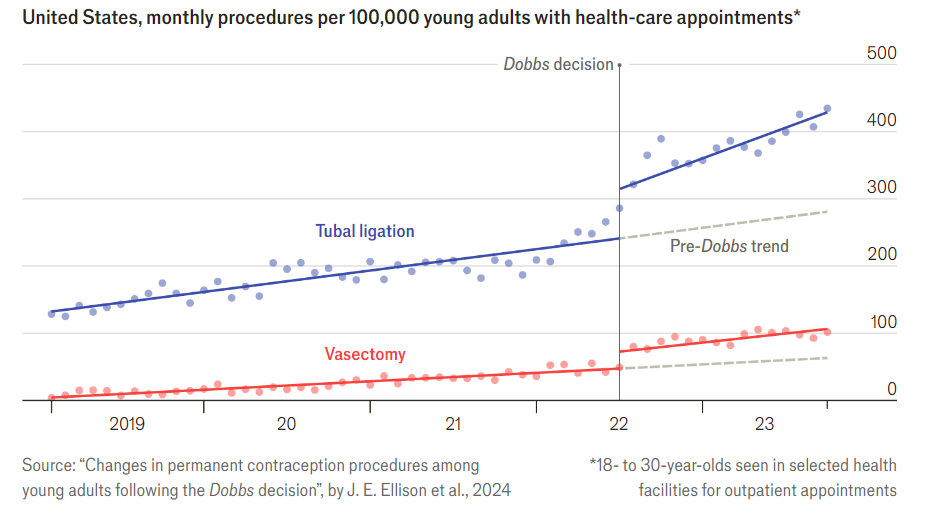
Dobbs, of course, was the Supreme Court decision saying that the constitution does not provide a right to abortion, thus leading to restrictions on abortion in many states. The pictures is from The Economist, the original paper is here.
“The Simple Macroeconomics of AI”
That is the new Daron Acemoglu paper, and he is skeptical about its overall economic effects. Here is part of the abstract:
Using existing estimates on exposure to AI and productivity improvements at the task level, these macroeconomic effects appear nontrivial but modest—no more than a 0.71% increase in total factor productivity over 10 years. The paper then argues that even these estimates could be exaggerated, because early evidence is from easy-to-learn tasks, whereas some of the future effects will come from hard-to-learn tasks, where there are many context-dependent factors affecting decision-making and no objective outcome measures from which to learn successful performance. Consequently, predicted TFP gains over the next 10 years are even more modest and are predicted to be less than 0.55%.
Note he is not suggesting TFP (total factor productivity, a measure of innovation) will go up by 0.71 percentage points (a plausible estimate, in my view), he is saying it will go up 0.71% over a ten year period, or by 0.07 annually. Here is the explanation of method:
I show that when AI’s microeconomic effects are driven by cost savings (equivalently, productivity improvements) at the task level—due to either automation or task complementarities—its macroeconomic consequences will be given by a version of Hulten’s theorem: GDP and aggregate productivity gains can be estimated by what fraction of tasks are impacted and average task-level cost savings. This equation disciplines any GDP and productivity effects from AI. Despite its simplicity, applying this equation is far from trivial, because there is huge uncertainty about which tasks will be automated or complemented, and what the cost savings will be.
Mostly I think this piece is wrong, and I think it is wrong for reasons of economics. It is not that I think the estimate is off, I think the method is misleading altogether.
As with international trade, a lot of the benefits of AI will come from getting rid of the least productive firms from within the distribution. This factor is never considered.
And as with international trade, a lot of the benefits of AI will come from “new goods,” Since the prices of those new goods previously were infinity (do note the degree of substability matters), those gains can be much higher than what we get from incremental productivity improvements. The very popular Character.ai is already one such new good, not to mention I and many others enjoy playing around with LLMs just about every day.
By the way, the core model of this paper — see pp.6-7 — postulates only a single good for the economy. Mention of the contrary case does surface on p.11, and starting with p.19, where most of the attention is devoted to bad new goods, such as more effective manipulation of consumers. Note the paper doesn’t have any empirical argument as to why most new AI goods might be bad for social welfare.
pp.34-35 focus on the possibility of a public goods problem for AI use, similar to what has been suggested for social media. That discussion seems very far from both current practices with AI and most of the speculation from AI experts. Do I have to use Midjourney because all of my friends do, and I wish the whole thing didn’t exist? Or rather do I simply find it to be great fun, as do many people when they create their own songs with AI? It is dubious to play up the prisoner’s dilemma effects so much, but Acemoglu returns to this point with much force in the conclusion.
Toward the end he writes:
Productivity improvements from new tasks are not incorporated into my estimates. This is for three reasons. First and most parochially, this is much harder to measure and is not included in the types of exposure considered in Eloundou et al. (2023) and Svanberg et al. (2024). Second, and more importantly, I believe it is right not to include these in the likely macroeconomic effects, because these are not the areas receiving attention from the industry at the moment, as also argued in Acemoglu (2021), Acemoglu and Restrepo (2020b) and Acemoglu and Johnson (2023). Rather, areas of priority for the tech industry appear to be around automation and online monetization, such as through search or social media digital ads. Third, and relatedly, more beneficial outcomes may require new institutions, policies and regulations, as also suggested in Acemoglu and Johnson (2023) and Acemoglu et al. (2023).
While many of the points in that paragraph seem outright wrong to me (such as the industry attention point), what he can’t bring himself to say is that the gains from such new tasks will in fact be small. Because they won’t be. But whether or not you agree, what is going on in the paper is that the gains from AI measure as small because it is assumed AI will not be doing new things. I just don’t see why it is worth doing such an exercise.
A more general question is whether this model can predict that TFP moves around as much as it does. I am pretty sure the answer there is “no,” not anywhere close to that.
On the general approach, I found this sentence (p.4) very odd: “…my framework also clarifies that what is relevant for consumer welfare is TFP, rather than GDP, since the additional investment comes out of consumption.” I would say what is relevant for consumer welfare is the sum of consumer and producer surpluses, of which TFP is not a sufficient statistic. This unusual “redefinition of all welfare economics in a single sentence” perhaps follows from how many other gains from trade he has abolished from the system? And footnote six is odd and also wrong: “For example, if AI models continue to increase their energy requirements, this would contribute to measured GDP, but would not be a beneficial change for welfare.” Even for dirty energy that might be wrong, not to mention for green energy. If an innovation induces the market to invest more in a service, the costs of that added investment simply do not scuttle the gains altogether. And if Acemoglu wants to argue that weird welfare economics is true in his model, that is a good argument against his model, not a good argument that such gains would not count in the real world, which is what this paper is supposed to be about.
Acemoglu explicitly rules out gains from doing better science, as they may not come within the ten-year time frame. On that one, he is the prisoner of his own assumptions. If many gains come in say years 10-15, I would just say the paper is misleading, even if his words are defensible in the purely literal sense.
That said, just how much does the “no new science” clause rule out? In terms of an economic model, how does “new science” differ from “TFP”? I am not sure, not are we given clear guidance. Is better software engineering “new science”? Maybe so? Won’t we get a lot of that within ten years? Don’t we have some of it already?
In sum, I don’t think this paper at all establishes the “small gains point” it is trying to promote in the abstract.
It is perfectly fair to point out that the optimists have not shown large gains, but in this paper the deck is entirely — and unfairly — stacked in the opposite direction.
For the pointer I thank Gabriel.
South Africa fact of the day
Two economists from the Harvard Growth Lab (Shah and Sturzenegger) estimate that the average transport costs for those who are employed in South Africa is equal to 57% of net wages when time to commute is accounted for.
Here is the whole John McDermott tweet storm, in part that is the spatial legacy from the earlier system of apartheid, and in part from poor public transport systems. Here is a related blog post.
The politics of *Civil War* (full of spoilers, do not read)
I saw the film as having very definite politics, and yes I am aware of the pronouncements of the director — ignore them! I am writing about the movie, what was on the screen.
The seceding states — California, Texas, and Florida — all have substantial Latino population segments. The core political message is that a nation cannot hold together under those conditions. The “Democrat vs. Republican” issues become irrelevant in those scenarios, and that too is part of the political message. Ethnic considerations become primary in the final analysis. And note that the separate Florida, not part of the Western Alliance, is the one state with lots of Latinos and not so many Mexicans. It is California and Texas that share the same ethno ambitions.
The key moment is the scene when they encounter the evil blond-haired guy with the big gun, and he asks “What kind of American are you?” The naive viewer expects the Socratic dialogue to shift in the direction of red vs. blue states, but no the baddie starts talking about “Central Americans” and “South Americans.” The real question has become what kinds of Americans are we indeed.
The Hong Kong/Chinese guy is shot immediately, once he announces his nationality, again a stand-in for the broader ethnostate divisions the movie is portraying.
When the two individuals shift cars, and jump from one moving vehicle to the other, that is the true portend of pending disaster, as Hollis Robbins has pointed out. Stay in your car (country)!
Of course Hollywood cannot put such a message on the screen explicitly, nor are most critics capable of seeing it. Mostly they are left wondering what has happened to the Trump vs. anti-Trump divisions they heard about on NPR.
If you doubt whether this movie is historically detailed and aware, consider how it portrays West Virginia on this civil war “next time around.” They are less interested than are the Virginians.
You won’t see much Christianity in the film at all.
Except for the black veteran, the media class are shown as selfish, elevating the scoop above all while disclaiming moral responsibility, enjoying the witnessing of violence, and verging on the psychotic. It is not an entirely favorable portrait (and yes I do know the director’s words on this).
The U.S. citizenry gets rather caught up in fighting the war, and the most positive visions are of the two fathers who retreat to their farms, again a reactionary message.
Blacks are shown as the servant class of each side in the civil war, a portrait that, if people were more aware, would be considered offensive.
So those are the politics of the movie, but with the distractions of the violence on the screen and of current culture wars, we just don’t notice how much they are pushed into our faces. I give the director credit for his guts, noting that George Lucas ripped off Leni Riefenstahl and I still like that movie too.
To be clear, those are not my politics at all, as loyal MR readers can attest. But that is not how I judge movies and this one — while definitely flawed — was still pretty good.
What I am nostalgic about
With a group of friends I was having a chat about the merits of the current vs. past America. Battle of the Ancients and Moderns! I generally favor current times, but not unconditionally. So I promised them a list of what I missed from the past. To be clear, these are personal judgments, not claims about net social value. I’ll also offer comments on features from the past that many miss, but I do not. Here goes:
1. Visiting Borders in its heyday. Nowadays I have to go to London to have comparable experiences.
2. That you could just show up at various venues, pay modest prices, and see incredible performers. For instance I saw Horowitz and also McCartney at his peak. Leo Kottke at his peak. Pierre Boulez. Many more. Such experiences are hardly gone, but in terms of cultural resonance the earlier times were much better. How did I fail to go see Miles Davis!?
Similarly, you could just go see Milton Friedman, Kenneth Arrow, Derek Parfit, and many other famous figures. No current economist or philosopher is comparable in this regard.
2b. Note that in some areas, such as NBA basketball, there are more “must see” players today than in any earlier era. Or say tech titans. So I am not favoring the nostalgic perspective per se, but for music, economics, and philosophy the nostalgic perspective on live performance is correct.
3. There were more and better museum art exhibits to see before 9/11. Much of that has to do with insurance rates and the ease of international agreements.
4. Good seafood was cheap and readily available.
5. Reading the Far Eastern Economic Review in its heyday.
6. Awaiting the arrival of a new issue of the Journal of Political Economy, knowing it would have exciting new ideas.
7. Many, many locations were better to travel to and visit. Amsterdam is one obvious example. But by no means is this true for all places, India for instance is better to visit today than before.
8. Hollywood movies used to be better, though global cinema overall is doing fine.
9. Very recently there are too many parts of the world you really just can’t visit, Iran and Russia most notably.
10. Mainstream media was much better, noting I nonetheless would rather have the internet. Still, I miss the quality of cultural reviews, local news, and several other features of normal newspapers.
11. San Francisco of the 1980s and Miami Beach of the 1990s.
12. So many intellectuals could afford to live in New York City, and indeed Manhattan. The city was overall more interesting, though worse to live in or to have to deal with.
13. Parking was much easier, even in Manhattan. I used to just get parking spots, even in the Village or Midtown. Now I would never bother to look.
14. The emphasis on personal freedom in American popular culture of the 1970s and 1980s.
15. Paperback editions of the classics were so often far superior in earlier times. Nowadays most of them look and feel like crap.
A few things I have no nostalgia for:
1. I feel America today is overall a higher-trust society, admittedly with the picture being somewhat complex. American cities certainly are much safer, and most of them look much better.
2. I prefer current airport procedures to those before 9/11.
3. Young people are overall smarter, and arguably more moral.
4. Just seeing white (and sometimes black) people everywhere, except a few cities on the coasts.
5. The seafood issue aside, food in America is obviously much much better.
6. I can’t think of anything in the category of “how people interacted with each other” that I preferred in earlier times.
7. I don’t miss having more snow, quite the contrary.
8. Medical and dental care are far superior, obviously.
What else should be on these lists?
Response from Devin Pope, on religious attendance
All of this is from Devin Pope, in response to Lyman Stone (and myself). Here was my original post on the paper, concerning the degree of religious attendance. I won’t double indent, but here is Devin and Devin alone:
“I’m super grateful for Lyman’s willingness to engage with my recent research on measuring religious worship attendance using cellphone data. Lyman and I have been able to go back and forth a bit on Twitter/X, but I thought it might be useful to send a review of this to you Tyler.
For starters, I appreciate that Lyman and I agree on a lot of stuff about the paper. He has been very kind by sharing that he agrees that many parts of my paper are interesting and “very cool work”. Where we disagree is about whether the cellphone data can provide a useful estimate for population-wide estimates of worship attendance. Specifically, Lyman’s concerns are that due to people leaving their cellphones at home when they go to church and due to questionable cellphone coverage that might exist within church buildings, the results could be super biased. He sums up his critiques well with the following: “Exactly how big these effects are is anyone’s guess. But I really think you should consider just saying, `This isn’t a valid way of estimating aggregate religious behavior. But it’s a great way to look at some unique patterns of behavior among the religious!’ Don’t make a bold claim with a bunch of caveats, just make the claim you actually have really great data for!” This a very reasonable critique and I’m grateful for him making it.
My first response to Lyman’s concerns is: we agree! I try to be super careful in how the paper is written to discuss these exact concerns that Lyman raises. Even the last line of the abstract indicates, “While cellphone data has limitations, this paper provides a unique way of understanding worship attendance and its correlates.”
Here is where we differ though… To my knowledge, there have been just 2 approaches used to estimate the number of Americans who go to worship services weekly (say, 75% of the time): Surveys that ask people “do you go to religious services weekly?” and my paper using cell phone data. It is a very hard question to answer. Time-use surveys, counting cars in parking lots, and other methods don’t allow for estimating the number of people who are frequent religious attenders because of their repeated cross-sectional designs.
There are definitely limitations with the cellphone data (I’ve had about 100 people tell me that I’m not doing a good job tracking Orthodox Jews!). I know that these issues exist. But survey data has its own issues. Social desirability bias and other issues could lead to widely incorrect estimates of the number of people who frequently attend services (and surveys are going to have a hard time sampling Orthodox Jews too!). Given the difficulty of measuring some of these questions, I think that a new method – even with limitations – is useful.
At the end of the day, one has to think hard about the degree of bias of various methods and think about how much weight to put on each. The degree of bias is also where Lyman and I disagree. In my paper, I document that the cell phone data do not do a great job of predicting the number of people who go to NBA basketball games and the number of people who go to AMC theaters. I both undercount overall attendance and don’t predict differences across NBA stadiums well at all.
The reason why Lyman is able to complain about those results so vociferously is because I’m trying to be super honest and include those results in the paper! And I don’t try to hide them. On page 2 of the paper I note: “Not all data checks are perfect. For example, I undercount the number of people who go to an AMC theater or attend NBA basketball games and provide a discussion of these mispredictions.”
There are many other data checks that look really quite good. For example, here is a Table from the paper that compares cellphone visits as predicted by the cellphone data with actual visits using data from various companies:

The cellphone predictions in the above table tend to do a decent job predicting many population-wide estimates of attendance to a variety of locations. The one large miss is AMC theaters where we undercount attendance by 30%. Now about half of that undercount is because the data are missing a chunk of AMC theaters (this is not due to a cellphone pinging issue, but due to a data construction issue). But even if one were to make that correction, we undercount theater attendance by 15%.
Lyman argues that one should be especially worried about undercounting worship attendance due to people leaving their phones at home. I agree that this is a huge concern that is specific to religious worship and doesn’t apply in the same way for trips to Walmart. I run and report results from a Prolific Survey (N=5k) that finds that 87% of people who attend worship regularly indicate that they “always” or “almost always” take their phone to services with them. So definitely some people are leaving their phones at home, but this survey can help guide our thinking about how large that bias might be. Are Prolific participants representative of the US as a whole? Certainly not. There is additional bias that one should think about in that regard.
Overall, my view is that estimating population-wide estimates for how many people attend religious services weekly is super hard and cellphone data has limitations. My view is that other methods (surveys) also have substantial limitations. I do not think the cellphone data limitations are as large as Lyman thinks they are and stand by the last line of the abstract that once again states, “While cellphone data has limitations, this paper provides a unique way of understanding worship attendance and its correlates.”
All of that was Devin Pope!
My excellent Conversation with Peter Thiel
Here is the audio, video, and transcript, along with almost thirty minutes of audience questions, filmed in Miami. Here is the episode summary:
Tyler and Peter Thiel dive deep into the complexities of political theology, including why it’s a concept we still need today, why Peter’s against Calvinism (and rationalism), whether the Old Testament should lead us to be woke, why Carl Schmitt is enjoying a resurgence, whether we’re entering a new age of millenarian thought, the one existential risk Peter thinks we’re overlooking, why everyone just muddling through leads to disaster, the role of the katechon, the political vision in Shakespeare, how AI will affect the influence of wordcels, Straussian messages in the Bible, what worries Peter about Miami, and more.
Here is an excerpt:
COWEN: Let’s say you’re trying to track the probability that the Western world and its allies somehow muddle through, and just keep on muddling through. What variable or variables do you look at to try to track or estimate that? What do you watch?
THIEL: Well, I don’t think it’s a really empirical question. If you could convince me that it was empirical, and you’d say, “These are the variables we should pay attention to” — if I agreed with that frame, you’ve already won half the argument. It’d be like variables . . . Well, the sun has risen and set every day, so it’ll probably keep doing that, so we shouldn’t worry. Or the planet has always muddled through, so Greta’s wrong, and we shouldn’t really pay attention to her. I’m sympathetic to not paying attention to her, but I don’t think this is a great argument.
Of course, if we think about the globalization project of the post–Cold War period where, in some sense, globalization just happens, there’s going to be more movement of goods and people and ideas and money, and we’re going to become this more peaceful, better-integrated world. You don’t need to sweat the details. We’re just going to muddle through.
Then, in my telling, there were a lot of things around that story that went very haywire. One simple version is, the US-China thing hasn’t quite worked the way Fukuyama and all these people envisioned it back in 1989. I think one could have figured this out much earlier if we had not been told, “You’re just going to muddle through.” The alarm bells would’ve gone off much sooner.
Maybe globalization is leading towards a neoliberal paradise. Maybe it’s leading to the totalitarian state of the Antichrist. Let’s say it’s not a very empirical argument, but if someone like you didn’t ask questions about muddling through, I’d be so much — like an optimistic boomer libertarian like you stop asking questions about muddling through, I’d be so much more assured, so much more hopeful.
COWEN: Are you saying it’s ultimately a metaphysical question rather than an empirical question?
THIEL: I don’t think it’s metaphysical, but it’s somewhat analytic.
COWEN: And moral, even. You’re laying down some duty by talking about muddling through.
THIEL: Well, it does tie into all these bigger questions. I don’t think that if we had a one-world state, this would automatically be for the best. I’m not sure that if we do a classical liberal or libertarian intuition on this, it would be maybe the absolute power that a one-world state would corrupt absolutely. I don’t think the libertarians were critical enough of it the last 20 or 30 years, so there was some way they didn’t believe their own theories. They didn’t connect things enough. I don’t know if I’d say that’s a moral failure, but there was some failure of the imagination.
COWEN: This multi-pronged skepticism about muddling through — would you say that’s your actual real political theology if we got into the bottom of this now?
THIEL: Whenever people think you can just muddle through, you’re probably set up for some kind of disaster. That’s fair. It’s not as positive as an agenda, but I always think . . .
One of my chapters in the Zero to One book was, “You are not a lottery ticket.” The basic advice is, if you’re an investor and you can just think, “Okay, I’m just muddling through as an investor here. I have no idea what to invest in. There are all these people. I can’t pay attention to any of them. I’m just going to write checks to everyone, make them go away. I’m just going to set up a desk somewhere here on South Beach, and I’m going to give a check to everyone who comes up to the desk, or not everybody. It’s just some writing lottery tickets.”
That’s just a formula for losing all your money. The place where I react so violently to the muddling through — again, we’re just not thinking. It can be Calvinist. It can be rationalist. It’s anti-intellectual. It’s not thinking about things.
Interesting throughout, definitely recommended. You may recall that the very first CWT episode (2015!) was with Peter, that is here.
Why is the Biden Administration Against Fee Transparency in Education?
President Biden has made a big deal of simplifying fees:
The FTC is proposing a rule that…would ban businesses from charging hidden and misleading fees and require them to show the full price up front. The rule would also require companies disclose up front whether fees are refundable. This would mean no more surprise resort fees at check out or unexpected service fees to buy a live event ticket.
Like everyone, I dislike these kinds of fees, although I don’t think they are a good subject for legislation. But I would certainly not prevent firms from offering a simple, up-front fee. And yet that is exactly what the Biden administration is doing in higher education.
So called Inclusive Access programs let colleges package textbooks with tuition and other fees. Students get one bill and access to textbooks on the first day of college. It’s convenient, no more hunting for textbooks or sticker shock. In addition, inclusive access programs give colleges bargaining power when negotiating prices.
Strangely, the Biden administration’s Department of Education wants to ban colleges from offering inclusive access programs. Thus, the Dept. of Education is arguing that simplified pricing is bad for consumers at the same time as the FTC is arguing that simplified pricing is good for consumers. What makes this contradiction even more baffling is that Inclusive Access was a program promoted in 2015 by the Obama-Biden Administration!
Proponents of the ban argue that letting students negotiate their own purchases lets them better tailor the outcome. Maybe, but that’s the same argument for letting airlines unbundle seat choice and baggage allowances. Hard to have it both ways. Pricing is complex.
Tyler and I are textbook authors so you might wonder where our interests lie. I actually have no idea. It’s complicated. I suspect inclusive access leads to a more winner-take-all market on textbooks. Modern Principles is a winner, thus on those grounds I would favor. More generally, however, I would get the FTC and the Dept. of Education out of pricing decisions and let colleges and firms negotiate. Pricing decisions are more complicated and contextual than simplified bans or regulations.
Does the NYT not recognize child abuse?
“I have one partner now with three kids. He is transmasc, and he’s radical about the way he raises them. They’re radically home-schooled. They’re 17 and nonbinary, 6 and 5. They know everything in age-appropriate ways. They’ve seen their mommy undergo the transmasc experience, seen their mom become who they really are.”
5 and 6! Here is their latest polyamory story, the tone of the story, including the treatment of the children, seems to be entirely normal or possibly positive? (I have nothing against polyamory per se.) Is no one at the NYT made uncomfortable by this? Is it permissible to speak up internally on such issues? Or not? The stronger left-wing take would be that this is one of the better arguments for public education, namely that parent-dominated cults can truly harm children, most of all when they control their education.