Results for “age of em” 17243 found
Why are many curry house owners favoring Brexit?
The support for Brexit from chefs and curry house owners, predominantly from Bangladesh, has come as a surprise voice in the debate, as the Leave campaign is widely perceived as anti-immigration.
Their argument centers around “freedom of movement,” one of the pillars of the European Union — meaning that citizens from across the community can essentially turn up in the country of their choice and try their luck at finding a job.
“It’s not that we think Europeans shouldn’t have a chance in Britain, it’s just that we feel the country should choose who it needs, what kind of skills they need, so that industries like ours are not short handed,” Khan told CNN.
Freedom of movement has put pressure on Britain’s migrant intake from outside the EU, prompting the government to almost double the minimum salary required for non-EU immigrants, from £18,700 ($26,610) to £35,000 ($50,000).
“This just doesn’t suit the industry. The average salary for a chef in the country is £25,000, so why should we have to pay a junior chef £35,000 to make curry? It’s just not affordable,” Khan said.
Call it the cheap channa argument, though note if this chain of reasoning were better known, it might help the prospects for Remain. The story is here, and here are my previous posts on Brexit (which I nonetheless oppose, cheap channa or not).
For the pointer I thank Brennan McDavid.
Nascent insurance markets in everything
…at least one insurer seems to sense an opportunity where others fear to tread. In what appears to be an unprecedented move, a British insurance company has begun offering a special policy designed for autonomous and partly automated vehicles. In theory, you could use this on your Google driverless car or your Tesla that’s equipped with autopilot.
Unfortunately, it’s only available in Britain. But the policy protects against all of the usual things you would find in your typical car insurance — damage, fire, theft. And it also goes further, covering accidents caused by malfunctions in the car’s driverless systems even if the passenger has failed to use a manual override. It covers any havoc that hackers may wreak on a car’s operating system. It applies to cars even if they haven’t been updated to the latest software. And it even covers mishaps that may occur if your car loses satellite or other crucial connectivity.
From Brian Fund here is the full story.
The evolution of the period.
Increasingly, says Professor Crystal, whose books include “Making a Point: The Persnickety Story of English Punctuation,” the period is being deployed as a weapon to show irony, syntactic snark, insincerity, even aggression
If the love of your life just canceled the candlelit, six-course, home-cooked dinner you have prepared, you are best advised to include a period when you respond “Fine.” to show annoyance
“Fine” or “Fine!,” in contrast, could denote acquiescence or blithe acceptance
“The period now has an emotional charge and has become an emoticon of sorts,” Professor Crystal said
And this:
Researchers at Binghamton University in New York and Rutgers University in New Jersey have also recently noted the period’s new semantic force
They asked 126 undergraduate students to review 16 exchanges, some in text messages, some in handwritten notes, that had one-word affirmative responses (Okay, Sure, Yeah, Yup) Some had periods, while others did not
Those text message with periods were rated as less sincere, the study found, whereas it made no difference in the notes penned by hand
Here is the full Dan Bilefsky story (NYT).
Thursday assorted links
1. Who needs the Free State movement the Mormon culture that will be Vermont.
2. Thaler’s AEA presidential address on behavioral economics.
3. New fossils strengthen case for “Hobbit” species (NYT).
4. Bill Simmons breaks his silence.
5. The new site Book Marks will aggregate book reviews.
Advice on Choosing a Career
One branch of the effective altruism movement emphasizes the rigorous evaluation of charities. A second branch is focused on a different but related aspect, career choice. Choosing a career to benefit others actually strikes me as a bit of a downer–get out the sackcloth and ashes, repent, renounce your sins and all that.
The 80,000 hours research charity, co-founded by William MacAskill, can be a bit preachy but they have assembled and reviewed a large amount of research on careers–not just on what makes a career useful but also what makes it enjoyable. Young people spend surprisingly little time thinking about a career. There’s a lot more advice about choosing and getting into a college than there is serious advice about choosing a major let alone figuring out a practical plan towards a career.
The 80,000 hours career guide, offers quite a bit of practical, scientifically-based advice and it’s not the usual join the Peace Corp kind of thing.
Here’s two lovely hard-headed graphs that skewer common wisdom and give a taste of their approach:

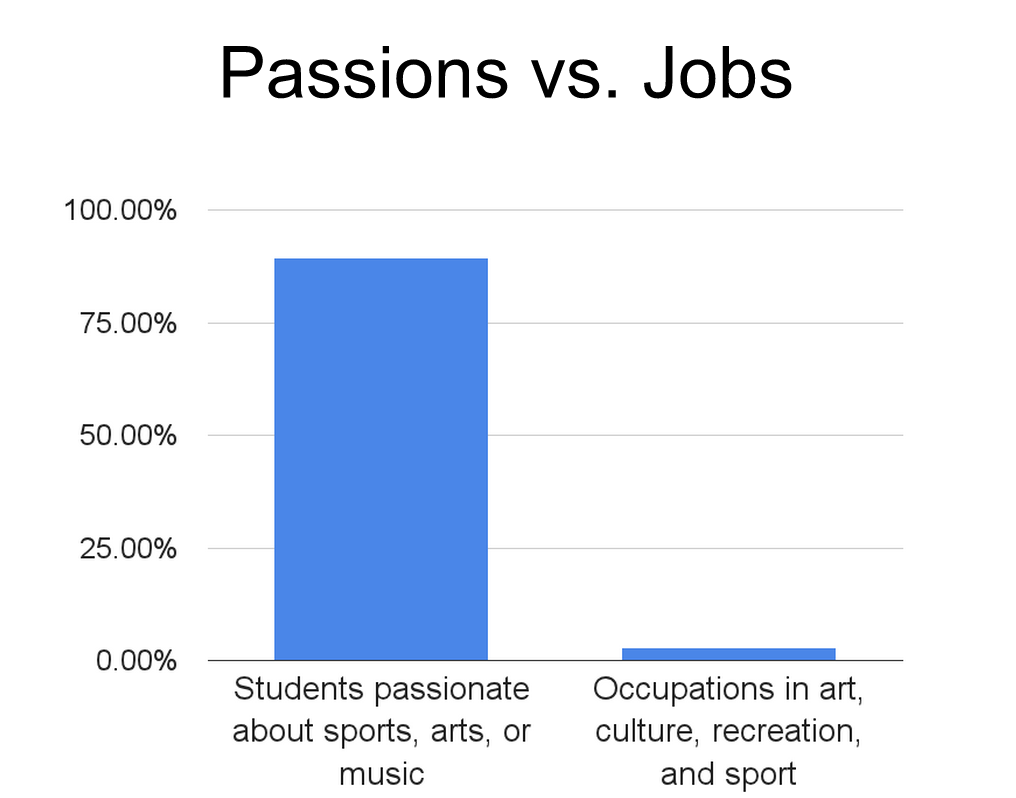
If you know a young person nearing college, the career guide is well worth a few hours of their time.
Not all complaints can be true at the same time
How sticky are real wages anyway? The mainstream view is that real wages are almost completely acyclical. But a new paper by Basu and House challenges this, here is part of their conclusion:
…there are indications that the allocative wage — the wage that governs hours worked and that firms internalize when making production and pricing decisions — may not equal the contemporaneous remitted wage. In particular, firms and workers may well have an implicit understanding that the remitted wage will be a smoothed version of the expected allocative wage. By estimating the expected present value of wage payments, one can construct a “user cost of labor,” which should measure the underlying allocative wage.
You can think of the employer as adjusting the “career ladder” of the worker while the contemporaneous wage remains more or less constant. So in good times that “true” real wage goes up, and in bad times it goes down.
I would say the verdict on this idea remains out, but I found this a stimulating piece to read and it also offers an excellent survey of the literature.
Here’s the catch: on the internet I’ve read dozens — no, hundreds of times — that real wages haven’t gone up more because the Fed chokes off real wage hikes every time the economy nears recovery. You will notice that this claim is simply flat out wrong if the mainstream view of real wage acyclicality is correct. Somehow that never seems to come up. (Yet it seems this ability of the Fed to stifle real wage hikes feels like it is true.)
Now, the Basu and House paper, if it is correct, actually creates an avenue through which you could start (partially) viewing the Fed as a real wage villain. Maybe. If some other auxiliary hypotheses were to kick in, which is not guaranteed.
But then here is the thing: you could no longer believe in traditional doctrines of wage stickiness. And you would have to change many of your views on macroeconomics, and indeed on the efficacy of labor markets more generally.
People, repeat after me: Not all complaints can be true at the same time. I know it is hard to live with that reality, but maybe it is worth a try. And if you don’t like it, you can complain about that too.
Intimate partner violence against women and the Nordic paradox
That is the title of a new and interesting paper by Enrique Garcia and Juan Merlo, here is the (to me) rather surprising summary:
The Nordic countries are the most gender equal nations in the world, but at the same time, they also have a disproportionately high rate of intimate partner violence against women. This is perplexing because logically violence against women would be expected to drop as women gained equal status in a society. A new study explores this contradictory situation, which has been labeled the ‘Nordic paradox.’
Denmark clocks in at about 32%, Finland at 30%, and Sweden at 28%; Denmark and Finland by the way should disabuse you from blaming this phenomenon on immigrants.
My first response was to think this must be a data reporting issue. Perhaps Nordic women are more willing to step forward, or somehow those systems are more efficient in recording such complaints. But the paper does not support that interpretation:
…the same FRA survey provides data suggesting lower levels of disclosure of IPV [intimate partner violence] to the police by women in Nordic countries as compared to other EU countries. For example the average percentage for the EU of women indicating that the most serious incident of IPV came to the attention of the police is 20%, whereas for Denmark and Finland is 10% and 17% for Sweden. In any case, the ‘higher disclosure’ explanation, however, would not solve the Nordic paradox, as these more ‘reliable’ levels of disclosure would rather reinforce the paradox posited by very high levels of IPV prevalence (prevalence rates around 30% is by all means disproportionate) in countries with high levels of gender equality.
So this remains a puzzle. Here is an earlier post on a very different form of the Nordic gender equality paradox. And here is a recent post on (non-Nordic) brutishness.
For the pointer I thank Eric Barker.
FAA Grounds Uber of the Sky
Uber is not only fast and convenient it spreads the capital cost of an automobile over a large group of people, thereby increasing efficiency. A typical general aviation aircraft costs ten times or more the price of an automobile so the case for an Uber of the sky is strong. Indeed, shortly after the Wright Brothers flew, informal ride-sharing bulletin  boards and word of mouth connected pilots with passengers who wanted to hitch a ride and were willing to share the cost.
Flytenow created an app to more easily connect pilots to “passengers” who would pay a share of the “cost” (the reason for the quotes will become clear) but was shut down by the FAA. Flytenow argued that they were simply modernizing the bulletin board system but the FAA worried that they were doing an end run around regulation. The Federal Aviation Act of 1958 requires pilots who are being compensated for their services to have a commercial license. Flytenow was shut down.
Jared Meyer interviewed the founders:
Jared Meyer: …from what I understand, it is still completely legal to find people to share flights (and their costs) by using old-fashioned tools such as bulletin boards or telephone calls. Why does the FAA not allow people to use peer-to-peer online interaction to make the process much more efficient and inclusive?
Alan Guichard: You’re exactly right. Pilots have always been allowed to share flights as long as the pilot and the passenger share a common purpose, which they clearly have on an online bulletin board such as Flytenow. The FAA’s concern is that online interaction will lead to sharing beyond what they refer to as “friends and acquaintances.”
For example, the FAA explained that advertising a shared flight on Facebook would be permissible if a person only had a few friends, but that the same flight would transform the pilot into Delta or American Airlines if he or she had “thousands” of friends.
An Uber of the sky would increase the number of private flights and put pressure on the airlines. It would also create some safety issues. Right now only the rich regularly risk their life in a small airplane. Do we want more people to have access? It’s debatable but there is certainly some level of safety where we would want more passenger-carrying small-aircraft. But which is chicken and which is egg? Safety doesn’t just happen–safety is in part an endogenous consequence of investment and demand. How will we get flying cars if we restrict investment?
The economics of *Hamilton*, and money left on the table
The average resale of “Hamilton” tickets on StubHub is roughly $872, according to a New York Times analysis, a markup of $700 above the current average original ticket sale price.
For any given performance, roughly 13 to 22 percent of the seats at the Richard Rodgers — somewhere between 180 and 300 tickets — are available on the secondary market, according to The Times’s research and interviews with ticket sellers. So for each performance of “Hamilton,” ticket sellers and brokers are reaping roughly $150,000. With the Broadway cast putting on more than 400 shows per year, that means these sellers could reap about $60 million per year, just in New York — money the producers, investors and Mr. Miranda will never see.
I still find this equilibrium puzzling. By the way, here are some numbers on book tie-ins:
“Hamilton” can even sell books. “Hamilton: The Revolution,” a behind-the-scenes book about the creation of the musical by Jeremy McCarter and Mr. Miranda, went on sale in April with a list price of $40. In less than two months, it sold more than 101,000 copies, according to Nielsen, and hit the No. 1 spot on the New York Times hardcover nonfiction best-seller list. (Other authors have benefited from “Hamilton” fever, too: Ron Chernow’s 2004 biography, which inspired Mr. Miranda to write the musical, has spent 33 weeks on the paperback best-seller list. This fall, Three Rivers Press will publish Jeff Wilser’s self-help book “Alexander Hamilton’s Guide to Life.”)
Here is the Michael Paulson and David Gelles NYT piece, it has much more of interest on the economics of the show.
The resurrection of the Lucas supply function at the hands of Keynesians
Wolfgang Munchau has perhaps the clearest statement of the view that an extra dose of current inflation will boost output:
A helicopter drop means that the ECB would print and distribute money to citizens directly. If it were to distribute, say, €3,000bn or about €10,000 per citizen over five years, that would take care of the inflation problem nicely. It would provide an immediate demand boost, and drive up investment as suppliers expanded their capacity to meet this extra demand.
I don’t mean to pick on Munchnau, who is one of the two or three best columnists in the world (thus the clarity), but I view this as incorrect as stated. And it is symptomatic of a mistake which I see more and more frequently, including from reputable economists. Given the genesis of the Great Recession, commentators have become obsessed with stimulating demand, but “mere inflation” does not on its own put people back to work, at least not by much.
To be clear, if aggregate demand is on the verge of falling, and expansionary monetary policy maintains aggregate demand, that will indeed prevent a big increase in unemployment. And typically that is very much worth doing, and most of all what is useful is an ex ante AD maintenance rule from the get-go. But that does not mean inflation in any particular state of affairs will boost employment significantly.
Let’s go back in time to the 1970s and 1980s. Bob Lucas developed a monetary misperceptions version of business cycle theory, in which boosts of inflation encouraged people to work more, at least temporarily, and set off a cyclical pattern of boom and bust. Fortunately the Keynesians stepped in and criticized Lucas in a rather devastating manner. The measured responsiveness of labor supply, or for that matter investment, to inflation, or for that matter relative price changes, simply wasn’t that large. That also was a big problem with the core labor market mechanisms of real business cycle theory; for instance read the prescient critique by Larry Summers (pdf). Those same arguments imply that today more inflation will boost employment by only small amounts.
And consistent with that claim, the Phillips Curve is not exactly stable as of late.
There are also plenty of papers on inflation and investment. They are hard to summarize, but overall it is easier to argue that more inflation harms investment rather than helping it (pdf). And at the most general level, it is real cash flow that predicts investment well, not nominal cash flow. So I am not so optimistic about more inflation today boosting investment by very much, even though I agree that a higher price inflation or ngdp target in the steady state would be very useful for preventing aggregate demand collapses.
Now you might think we are in special circumstances with rates of price inflation at especially low levels. What harm is there in risking more inflation and having prices rise at 2 percent, 2.5 percent, or even three percent a year? I agree with this argument. (I’d be happy to see higher rates of price inflation if only to erode the value of academic tenure.) Still, if we ask ourselves what is the best point estimate for how much more an extra dose of inflation today will boost investment (and not just the stock market), any strongly positive answer is based more on faith than on clear evidence. The mere fact that you know “demand hasn’t been high enough” — which is true — doesn’t have to mean current doses of price inflation are going to get us very far. Yet that is the mistake I see people making again and again.
People, economists have known this for a long time, it’s just that they now are starting to forget it.
One more point: demand could go up through yet another mechanism. Imagine the economy becomes more productive, wages rise, and stronger consumer demands percolate throughout the broader economy. That too is an increase in demand, and for that matter supply, and a decline in the risk premium. It is quite possible the effect of that kind of demand increase on output is stronger than the effects of higher price inflation. We should not conflate these two scenarios, and I get nervous when I see the word “demand” without further qualifiers or description.
Here are related remarks from Matthew C. Klein.
Can War Foster Cooperation?
There is a new NBER working paper on this question by Michal Bauer, Christopher Blattman, Julie Chytilová, Joseph Henrich, Edward Miguel, Tamar Mitts:
In the past decade, nearly 20 studies have found a strong, persistent pattern in surveys and behavioral experiments from over 40 countries: individual exposure to war violence tends to increase social cooperation at the local level, including community participation and prosocial behavior. Thus while war has many negative legacies for individuals and societies, it appears to leave a positive legacy in terms of local cooperation and civic engagement. We discuss, synthesize and reanalyze the emerging body of evidence, and weigh alternative explanations. There is some indication that war violence especially enhances in-group or “parochial” norms and preferences, a finding that, if true, suggests that the rising social cohesion we document need not promote broader peace.
That is an all-star line-up of authors, and no this doesn’t mean any of those individuals are in favor of war. That would be the fallacy of mood affiliation, and we all know that MR readers never commit the fallacy of mood affiliation…
On nicknames and their political uses
That is a William Hazlitt essay from the Edinburgh Magazine of 1828, reprinted in Table-Talk (scroll to p.165), focusing on why the political uses of nicknames are so problematic. It retains some relevance today:
The only meaning of these vulgar nicknames and party distinctions, where they are urged most violently and confidently, is, that others differ from you in some particular or other (whether it be opinion, dress, clime, or complexion), which you highly disapprove of, forgetting that, by the same rule, they have the very same right to be offended at you because you differ from them. Those who have reason on their side do not make the most obstinate and grievous appeals to prejudice and abusive language.
…a nickname…is a disposable force, that is almost always perverted to mischief. It clothes itself with all the terrors of uncertain abstraction, and there is no end of the abuse to which it is liable but the cunning of those who employ, or the credulity of those who are gulled by it. It is a reserve of the ignorance, bigotry, and intolerance of weak and vulgar minds, brought up where reason fails, and always ready, at a moment’s warning, to be applied to any, the most absurd purposes…a nickname baffles reply.
…the passions are the most ungovernable when they are blindfolded. That malignity is always the most implacable which is accompanied with a sense of weakness, because it is never satisfied with its own success or safety. A nickname carries the weight of the pride, the indolence, the cowardice, the ignorance, and the ill-nature of mankind on its side. It acts by mechanical sympathy on the nerves of society.
…”A nickname is the heaviest stone that the devil can throw at a man.”
There is more excellent analysis at the link, most of all on how the uses of nicknames avoids and runs away from the careful making and unpacking of specific charges. Hazlitt notes the nickname can on the surface sound quite innocent yet nonetheless be a form of powerful invective. For a while the Whigs were called “the Talents,” yet in a manner reeking of implicit scorn.
From Hazlitt, here is another scary part:
I have heard an eminent character boast that he had done more to produce the late war by nicknaming Buonaparte “the Corsican,” than all the state papers and the documents put together.
Here is a brief summary of the essay. Hazlitt remains under-read and underappreciated.
For the pointer to this essay I thank Hollis Robbins.
Monday assorted links
1. Against the translations of Richard Pevear and Larissa Volokhonsky.
3.”Or perhaps we should read it, as some have read More’s Utopia, as a satire on current society.” And here Robin Hanson reviews his reviews.
4. Unearned wealth doesn’t change lives that much. And first female Vietnamese billionaire runs a bikini airline.
What is neo-reaction?
Or perhaps I should rephrase that question: what would neo-reaction be if it were presented in a more coherent analytic framework? (You’ll find other takes here; I like it better with the hyphen.) Here is a list of propositions, noting that these are an intellectualized summary of a somewhat imagined collective doctrine, and certainly not a statement of my own views:
1. “Culturism” is in general correct, namely that some cultures are better than others. You want to make sure you are ruled by one of the better cultures. In any case, one is operating with a matrix of rule.
2. The historical ruling cultures for America and Western Europe — two very successful regions — have largely consisted of white men and have reflected the perspectives of white men. This rule and influence continues to work, however, because it is not based on either whiteness or maleness per se. There is a nominal openness to the current version of the system, which fosters competitive balance, yet at the end of the day it is still mostly about the perspectives of white men and one hopes this will continue. By the way, groups which “become white” in their outlooks can be allowed into the ruling circle.
3. Today there is a growing coalition against the power and influence of (some) white men, designed in part to lower their status and also to redistribute their wealth. This movement may not be directed against whiteness or maleness per se (in fact some of it can be interpreted as an internal coup d’etat within the world of white men), but still it is based on a kind of puking on what made the West successful. And part and parcel of this process is an ongoing increase in immigration to further build up and cement in the new coalition. Furthermore a cult of political correctness makes it very difficult to defend the nature of the old coalition without fear of being called racist; in today’s world the actual underlying principles of that coalition cannot be articulated too explicitly. Most of all, if this war against the previous ruling coalition is not stopped, it will do us in.
4. It is necessary to deconstruct and break down the current dialogue on these issues, and to defeat the cult of political correctness, so that a) traditional rule can be restored, and/or b) a new and more successful form of that rule can be introduced and extended. Along the way, we must realize that calls for egalitarianism, or for that matter democracy, are typically a power play of one potential ruling coalition against another.
5. Neo-reaction is not in love with Christianity in the abstract, and in fact it fears its radical, redistributive, and egalitarian elements. Neo-reaction is often Darwinian at heart. Nonetheless Christianity-as-we-find-it-in-the-world often has been an important part of traditional ruling coalitions, and thus the thinkers of neo-reaction are often suspicious of the move toward a more secular America, which they view as a kind of phony tolerance.
6. If you are analyzing political discourse, ask the simple question: is this person puking on the West, the history of the West, and those groups — productive white males — who did so much to make the West successful? The answer to that question is very often more important than anything else which might be said about the contributions under consideration.
Already I can see (at least) four problems with this point of view. First, white men in percentage terms have become a weaker influence in America over time, yet America still is becoming a better nation overall. Second, some of America’s worst traits, such as the obsession with guns, the excess militarism, or the tendency toward drunkenness, not to mention rape and the history of slavery, seem to come largely from white men. Third, it seems highly unlikely that “white men” is in fact the best way of disambiguating the dominant interest groups that have helped make the West so successful. Fourth, America is global policeman and also the center of world innovation, so it cannot afford the luxury of a declining population, and thus we must find a way to make immigration work.
By the way, here is Ross Douthat on neo-reaction:
But while reactionary thought is prone to real wickedness, it also contains real insights. (As, for the record, does Slavoj Zizek — I think.) Reactionary assumptions about human nature — the intractability of tribe and culture, the fragility of order, the evils that come in with capital-P Progress, the inevitable return of hierarchy, the ease of intellectual and aesthetic decline, the poverty of modern substitutes for family and patria and religion — are not always vindicated. But sometimes? Yes, sometimes. Often? Maybe even often.

Anyway, let’s continue.
Who are the important neo-reaction thinkers?
Those who come immediately to mind are Aristotle, Hobbes, Montesquieu, Jonathan Swift, Benjamin Franklin, John Calhoun, James Fitzjames Stephens, Nietzsche, Carl Schmitt, Martin Heidegger, and Lee Kuan Yew. For all of the fulminations against neo-reaction, the intellectual movement is not a flash in the pan. Of course these thinkers were not operating in the cultural matrix laid out above, nonetheless they embody varying elements of elitism, non-egalitarianism, historical pessimism, and culturalism. The most significant neo-reaction thinker today probably is Steve Sailer, who often comments on this blog in addition to writing his own. By the way, both F.A. Hayek and Murray Rothbard were drawn to neo-reaction in their later years, and perhaps a separate post could be written on the complex connections between libertarianism and neo-reaction.
The miracle to my mind is that neo-reaction as an intellectual movement was relatively dormant for so long, not that it is coming back or will persist.
And maybe some of you are upset that I am even covering this topic, but neo-reaction, in varying forms, is a (the?) significant ideology in China, India, Russia, and Japan, and it is growing in popularity in Western Europe and of course America, where it has captured the presidential nomination of one of the two major parties. It seems odd not to discuss it at all.
Is neo-reaction a racist movement?
I don’t “hang out” with neo-reaction, whatever that might mean, so I cannot speak from first-hand experience. Still, I see overwhelming circumstantial evidence, including from the MR comments section, that the answer is yes, neo-reaction is very often racist. (And by “racist” I mean not only a particular set of beliefs, but how they are held with a kind of obnoxious, self-pleased glee.) If you read through the above propositions, it is easy enough to see why racists might find neo-reaction a congenial home. And that is an important critique of neo-reaction, namely that the doctrine, when stated explicitly or understood clearly enough, encourages a very harmful racism and a variety of other forms of bad behavior. Even if not every neo-reaction thinker is a racist himself or herself.
The early stages of the Trump campaign show clearly enough how publicly propagated neo-reaction disturbs the fabric and rhetoric of society. And there is a cruelness to the humor one finds in neo-reaction which is all too revealing; more generally neo-reaction just does not seem so conducive to a deep generosity of spirit.
That all said, I think it is a category mistake to dismiss neo-reaction on the grounds of racism or prejudice. There exists a coherent form of the doctrine perfectly consistent with the view that different races are intrinsically equal in both capabilities and moral worth, even if such a variant tends to get pushed out by the less salubrious elements. Furthermore calling neo-reaction racist, as a primary response, seems to personalize the debate in a Trump-like way, ultimately playing into the strengths of neo-reaction and distracting the liberals, in the broad sense of that term, from building up the most appealing vision of their philosophy and doctrine.
Liberalism isn’t actually an automatic emotional default for most people on this planet, so being a scold is in the longer run a losing strategy. I believe many current “democratic mainstream” thinkers genuinely do not understand how boring and unconvincing they are, as they live in bubbles filled with others of a similar bent. And while neo-reaction does not get exactly right the nature of “the golden goose” in modern America, that is a question which modern progressivism rather aggressively avoids in its attempt to view the wealthy as an essentially inexhaustible ATM.
What about me?
As an undergraduate, I was deeply struck by my readings of the Spanish and Salamancan friars who protested against the New World enslavement of the Indians, as they were then called. You can start with Bartolomé de las Casas. Here was a doctrine that was anti-slavery, anti-oppression, pro-reason, pro-liberty, pro-individual rights, and analytically egalitarian, and on top of that based on actual real world experience with the subject matter. On top of that, the overwhelming empirical fact is that people are far too willing to go tribal when it comes to politics. We don’t need to encourage that any further, nor am I excited by the notion of setting tribe against tribe.
The world could be facing some fairly dicey times in the decades to come, mostly for geopolitical reasons. I view the Spanish friars and their successors and offshoots — Montaigne, David Hume, Adam Smith, William Wilberforce, John Stuart Mill, Edmund Silberner, Martin Luther King Jr., Gene Sharpe, Thomas Schelling, and some of the EU founders, among many others — as providing better and more useful guides to our world than neo-reaction. Looking earlier, toss in Buddha and Jesus Christ and some of the Stoics as well.
Still, it would be a big mistake to simply dismiss neo-reaction, even though there are some rather easy and facile ways to do so. It’s a wake-up call for the fragility of liberalism, a doctrine which sinks all too readily into its own dogmatic slumbers.
Are work hours allocated justly and efficiently?
That is the topic of my latest NYT column for The Upshot. Here are some excerpts:
In short, most older people already enjoy a much better deal than Keynes had predicted for the entire work force. The 1930 Keynes essay “Economic Possibilities for Our Grandchildren” didn’t even mention retirement, perhaps because he was accustomed to a world in which so many people worked until they died or were seriously disabled.
Teenagers are also ahead of Keynes’s workplace predictions. Several decades ago, about 55 percent of teenagers had jobs, but lately only about 35 percent do. In addition, service sector jobs have been replacing jobs involving manual labor. While enormous disparities exist among teenagers of different races and income groups, over all, life has gotten easier for them.
And:
If people in all of these groups are working less, then someone must be working more. The answer, overwhelmingly, is women, who have taken on an Atlaslike role in supporting American economic growth.
There are reasons to believe that at least some of the growth in female work hours has been an unfair burden. It is well known, for instance, that men do not come anywhere close to fully sharing in the household chores or child rearing when their partners are working, and that often means more stress for women. Furthermore, the best available evidence, from Betsey Stevenson and Justin Wolfers, both professors of public policy at the University of Michigan (Mr. Wolfers is also a regular contributor to this column), suggest that overall female happiness in America has been declining, while age-adjusted death rates for middle-aged white women — though not for white men — have been increasing. Those troubling trends are perhaps another sign that the distribution of stress has been uneven.
Many men are working too little, and perhaps many women too much. But why isn’t there more smoothing of leisure over time?
On the other hand, many women do receive significant recompense in leisure time eventually — once they become older. Because women on average live longer than men, they are likely to have more years in retirement. Yet it is a strange society that disproportionately bunches much work and stress for so many women in the middle of their lives, and rewards them only much later with leisure. It is a kind of feast or famine for work, leisure and earnings.
Most economic models don’t account for these patterns, and instead assume that people engage in what is called smoothing behavior, in which leisure and work is evenly distributed across the years. Yet Americans as a whole are not experiencing that kind of moderation.
That is the real labor supply puzzle, and I don’t know of any consistent model which explains that along with other basic labor supply facts.