Results for “age of em” 17234 found
From the comments — the economics of Mormon tithing
Jay McCarthy writes:
I am Mormon. I am from Massachusetts, but lived in Utah for a long time, and have lived in prosperous and not-prosperous Mormon areas.
I don’t think tithing is an effective way to get social status.
Let me explain some mechanics. When I get a paycheck, I got to a Web site the church runs and tell them to transfer 10% from my checking account to their accounts. The new online system lets me do it whenever I want, whereas previously (the online system is about eight months old) I wrote a check and handed it to a local church leader. Even in the old days of physical checks, there was extreme paranoia about keeping this an anonymous process. You would occasionally see people handing their checks, but the only people who could know what the amount was was the local leader (called a bishop) and their one or two clerks. (Aside: this local leader and their clerks are lay people that volunteer on a rotating basis for terms of about three to five years.) In the new system, only the local leader sees your tithing amount and maybe a clerk as they print out reports.
The next step is that each year, around the end of the year (December), you have a meeting with the local leader called “tithing settlement”. Before the meeting, you get a sealed letter from a clerk with a statement of all the money you’ve given. You go to the meeting as an entire family (in my case, my wife and three kids younger than 8). It normally lasts about 30 minutes and you spend the time chatting about how things are going in your life and if you have any needs and what is going on. At the end the bishop remembers, “Oh, it’s tithing settlement.” And says, “Is this amount tithed listed on your report accurate?” then asks “Are you a full tithe payer, a partial tithe payer, or not a tithe payer?”. Whatever you answer, he will have no comment about and then you leave.
The other way that tithing is noticed is that every two years you renewed what is called your “temple recommend”. This is an barcoded ID card that is tied to your membership records in the church database. When you want to go to the temple, you bring this card and they scan it to verify that you are allowed in the temple. (Aside, the temple is not where you go each Sunday. There are about 150 in the world. It is for special occasions and most people that are working try to go monthly, but most retired people try to go daily.) During this renewal process, you have an interview with two local leaders—one that you go to church with and one from the administrative unit above that (called a stake). During this interview, you are asked lots of “Yes” and “No” questions (they are encouraged to not require more than “Yes” or “No” answers, because historically some of these leaders changed the requirements to reflect their own interpretations of the rules.) One of the questions is, “Are you a full tithe payer?”. There is no checking of this answer with the answer you give at tithing settlement.
So, in summary, tithing is such a secretive process that I don’t believe it is a good way to get status.
In the preceding discussion, I always wrote “tithing”, but actually we would say “tithes and offerings” because when you pay you can always give additional money. The additional money can be flagged for certain programs. (The tithing CANNOT be flagged.) For instance, one program is called a “fast offering” and it is used for the poor and needy who are local to you. Others are to sponsor a missionary or help build a temple.
I have never heard a local leader with knowledge of offering matters ever say anything about how much a family gave or if they were giving a lot or being generous or anything like that. I have not been a local leader, but I have been on the executive committee of local congregations and attended all the meetings that the local leader did. If they said anything, it would be considered an incredible violation of protocol.
In my opinion, Mormons gain social status within the group by two major ways. First, by externality conformity to norms, such as dressing modestly, having lots of kids, never cursing, discussing the gospel with each other, and so on. Second, by in kind donation of time. Everything that happens at church is done by volunteers and there are many things that need to happen. Each Sunday, meetings are three hours long and there are many classes and lectures that need to be given. The first hour has about three lectures. The second and third hour each have about fifteen concurrent lessons (for different age groups). So, this means that about 33 people need to volunteer to teach for an hour weekly. On the Wednesdays, all youth from 8 to 18 have their own classes and activities at the church that need to be taught by someone. There’s another program for high school students called Seminary (a dumb name) where they are taught about the scriptures EVERY DAY before school. Outside of Utah, this is a volunteer position typically done by one person and is an immense time commitment. (That’s what I do.)
I think these things are much more expensive than tithing and an academic analysis of Mormonism would get more out of studying their impact than studying tithes and offerings.
— A few small comments.
The tithing settlement form says “The Church provided no goods or services in consideration, in whole or in part, for the contributions detailed below but only intangible religious benefits.” I chuckle every time I see that.
I assume that the details of your tithing are considered if you are considered for prestigious volunteer jobs, like bishop.
In executive meetings, we do hear about what percentage of the local membership paid tithing. In my experience, in Utah, social conformity is high but tithing payment is relatively low, but outside of Utah it is the opposite: there are more diverse Mormons and everyone is paying tithing.
Mormon home production is not caused by tithing. It’s explicit motivation is worry about the millennium (a similar impetus to “preppers”) and getting attacked by the government (as happened in Missouri, Illinois, and Utah in the 1800s.) It’s implicit motivation is to gain social status by conformity to norms.
Here is the original post.
Thursday assorted links
The Absurdity of Mandatory Voting
NBER: We study a unique quasi-experiment in Austria, where compulsory voting laws are changed across Austria’s nine states at different times. Analyzing state and national elections from 1949-2010, we show that compulsory voting laws with weakly enforced fines increase turnout by roughly 10 percentage points. However, we find no evidence that this change in turnout affected government spending patterns (in levels or composition) or electoral outcomes. Individual-level data on turnout and political preferences suggest these results occur because individuals swayed to vote due to compulsory voting are more likely to be non-partisan, have low interest in politics, and be uninformed.
In other words, all mandatory voting did was add noise to the system and as such probably made everyone worse off including the new voters.
The Soviet internet
There is a new and intriguing book out by Benjamin Peters called How Not to Network a Nation: The Uneasy History of the Soviet Internet, which outlines exactly what it claims to. Here is one introductory excerpt:
In late September 1970, a year after the ARPANET went online, the Soviet cyberneticist Viktor Glushkov boarded a train from Kiev to Moscow to attend what proved to be a fateful meeting for the future of what we might call the Soviet Internet. On the windy morning of October 1, 1970, he met with members of the Politburo, the governing body of the Soviet state, around the long rectangular table on a red carpet in Stalin’s former office in the Kremlin. The Politburo convened that day to hear Glushkov’s proposal and decide whether to build a massive nationwide computer network for citizen use — or what Glushkov called the All-State Automated System (OGAS, obshche-gosudarstvennyi avtomatizirovannaya system), the most ambitious computer network of its kind in the world at the time. OGAS was to connect tens of thousands of computer centers and to manage and optimize in real time the communications between hundreds of thousands of workers, factory managers, and regional and national administrators. The purpose of the OGAS Project was simple to state and grandiose to imagine: Glushkov sought to network and automatically manage the nation’s struggling command economy.
They failed! The author blames this not on backward technology, but rather “entrenched bureaucratic corruption and conflicts of interest at the heart of the system…”
Anyone interested in the history of the internet, comparative systems, or the history of the Soviet Union should read this book.
*The Nordic Gender Equality Paradox*
That is the new and quite interesting book by Nima Sanandaji. The main point is that there are plenty of Nordic women in politics, or on company boards, but few CEOs or senior managers. In fact the OECD country with the highest share of women as senior managers is the United States, coming in at 43 percent compared to 31 percent in the Nordics. More generally, countries with more equal gender norms do not have a higher share of women in senior management positions. Within Europe, Bulgaria does best and other than Cyprus, Denmark and Sweden do the worst in this regard.
One reason for the poor Nordic performance at higher corporate levels is high taxes, which limits the amount of household services supplied through markets. If it is harder to hire someone to do the chores, that makes it harder for women to invest the time to climb the career ladder. Generous maternity leave policies may encourage women to take off “too much” time, or at least this is suggested by the author. A history of communism is also strongly correlated with women rising to the top in business and management; this may stem from a mix of relatively egalitarian customs and a more general mixing up of status relations in recent times and a turnover of elites.
I don’t find this book to be the final word, and I would have liked a more formal econometric treatment. It is nonetheless a consistently interesting take which revises a lot of the stereotypes many people have about the Nordic countries as being so absolutely wonderful for gender egalitarianism in every regard.
Here is the book’s website, from Timbro (a very good group), I don’t yet see it on Amazon.
What I’ve been reading
1. Jason Brennan, Against Democracy. He is a epistocrat. P.S. voters are ignorant and irrational. Furthermore “Politics is not a Poem.” I agree with most of the debunking arguments in this book, but I am not convinced epistocracy ends up being better; Brennan’s examples of epistocracy include restricted franchise, plural voting, voting by lottery, epistocratic veto (the Senate, but more so), and weighted voting. I see big advantages to a strict normative ideal of legal egalitarianism of civic rights, and I suspect that ends up meaning some form of democracy, albeit constrained by the overlay of a constitutional republic.
2. Ji Xianlin, The Cowshed: Memoirs of the Chinese Cultural Revolution. The classic account of its kind, in this edition brilliantly translated and presented.
And I am happy to praise Frank Dikötter’s The Cultural Revolution: A People’s History 1962-1976, but I did not find it as revelatory as his earlier books on China. Here is a Judith Shapiro NYT review.
3. Aileen M. Kelly, The Discovery of Chance: The Life and Thought of Alexander Herzen. Beautifully written, and full of interesting history, but it never quite convinces the reader that Herzen is an interesting and worthwhile intellect for 2016. Maybe he isn’t — does that make this book better or worse?
David L. Ulin’s Sidewalking: Coming to Terms with Los Angeles is a meditation on to what extent Los Angeles succeeds as a walkable city, or someday might get there.
There is Don Watkins and Yaron Brook, Equal is Unfair: America’s Misguided Fight Against Income Inequality, by no means do I go all the way with them, but still this a useful corrective to some current obsessions.
Don and Alex Tapscott, Blockchain Revolution: How the Technology Behind Bitcoin is Changing Money, Business, and the World lists more possible uses for blockchains than you would have thought possible.
James T. Bennett, Subsidizing Culture: Taxpayer Enrichment of the Creative Class, the subtitle says it all.
Tuesday assorted links
1. Maybe America isn’t an oligarchy after all. A very good post on this topic.
2. School districts, test scores, and socioeconomic status. Ditto.
3. Do the Chinese welcome Trump? And Peter Thiel is likely to be a delegate for Donald Trump.
4. “We find that the effect of GED certification on either employment or earnings is not statistically significant.” (pdf, I believe a version of this is forthcoming in the JPE).
Life Expectancy is Increasing and Health Inequality is Down
We have heard a great deal about increases in mortality among white, non-hispanic, middle-aged Americans (especially women) but to state the case is also to note that this is one group among many. In an excellent new paper, Currie and Schwandt discuss the good news overall–life expectancy is up and health inequality is down, in some cases dramatically. Here, for example, is life expectancy at birth by gender and year.
 Even more impressive is that life expectancy has increased significantly across all poverty groups (as measured by county poverty levels). In the graph below, for example, the blue triangles indicate life expectancy in 1990 (men on the left, women on the right). Note that as the poverty level of the county increases along the horizontal axis life expectancy falls. The green dots are life expectancy in 2010. Once again, as poverty increases, life expectancy falls. What’s remarkable, however, is how much life expectancy increased between 1990 and 2010 in counties of all poverty levels.
The news is good and may get better. Between 1990 and 2010 mortality rates for children ages 0-4 fell especially dramatically and especially so in poor counties. Moreover, since mortality at older ages is often baked in 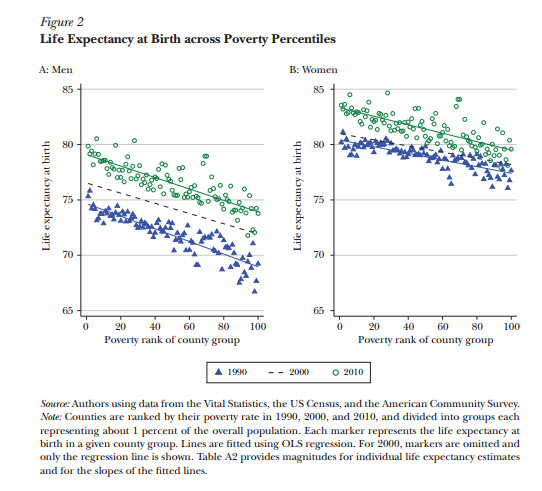 by poor health at younger ages there is significant opportunity for these gains to persist over time.
The New York Times also reported yesterday on inequality in life expectancy across race. It’s down.
Infant mortality is down by more than a fifth among blacks since the late 1990s, double the decline for whites. Births to teenage mothers, which tend to have higher infant mortality rates, have dropped by 64 percent among blacks since 1995, faster than for whites.
Blacks are still at a major health disadvantage compared with whites. But evidence of black gains has been building and has helped push up the ultimate measure — life expectancy. The gap between blacks and whites was seven years in 1990. By 2014, the most recent year on record, it had shrunk to 3.4 years, the smallest in history, with life expectancy at 75.6 years for blacks and 79 years for whites.
Part of the reason has been bad news for whites, namely the opioid crisis. The crisis, which has dominated headlines — some say unfairly, given racial disparities — has hit harder in white communities, bringing down white life expectancy and narrowing the gap.
But there also has been real progress for blacks. The rate of deaths by homicide for blacks decreased by 40 percent from 1995 to 2013, according to Andrew Fenelon, a researcher with the National Center for Health Statistics, compared with a 28 percent drop for whites. The death rate from cancer fell by 29 percent for blacks over that period, compared with 20 percent for whites.
The Currie and Schwandt paper is also very good on describing how these estimates are produced and some of the data issues with making these estimates. It’s a must read for those interested in these issues.
Does Facebook suppress conservative news and views?
That’s the hullaballoo of the day (NYT here):
Facebook workers routinely suppressed news stories of interest to conservative readers from the social network’s influential “trending” news section, according to a former journalist who worked on the project. This individual says that workers prevented stories about the right-wing CPAC gathering, Mitt Romney, Rand Paul, and other conservative topics from appearing in the highly-influential section, even though they were organically trending among the site’s users.
That’s not exactly what I would have suppressed, but I can’t say I am broken up about this. Most media bias in journalism is demand-driven, and I suspect this feature of the article selection and elevation “algorithm” is perceived by Facebook as demand-driven as well. Overall I think of Twitter as radicalizing, and Facebook as calming and connecting. The “censored” right wing sources don’t fit the chummy, nostalgic socializing mood so well, and therefore Facebook wanted to keep them away. A clear minority is sufficiently interested in those stories to get them trending initially, but that’s not the overall image Facebook wants to present to either its marginal or median user.
Maybe such algorithms mean that social ideas are too slow to change, because user demand depends in part on what Facebook pushes. Right now I’m more worried about American ideas getting worse than American ideas getting better, so a status quo, don’t offend anybody bias I can live with. And frankly, a lot of right-wing news sources just aren’t very good — I suppress them myself, without any aid from Facebook.
There is also this:
“People stopped caring about Syria,” one former curator said. “[And] if it wasn’t trending on Facebook, it would make Facebook look bad.” That same curator said the Black Lives Matter movement was also injected into Facebook’s trending news module. “Facebook got a lot of pressure about not having a trending topic for Black Lives Matter,” the individual said. “They realized it was a problem, and they boosted it in the ordering. They gave it preference over other topics. When we injected it, everyone started saying, ‘Yeah, now I’m seeing it as number one’.” This particular injection is especially noteworthy because the #BlackLivesMatter movement originated on Facebook, and the ensuing media coverage of the movement often noted its powerful social media presence.
In those two cases I see the change in coverage as bringing net content gain rather than loss. The cynical underlying reality is that Facebook does not wish to appear heartless, but does not (yet) have the more subtle manipulative institutions that newspapers and TV stations have developed over decades or even centuries. They clumsily act in a politically correct manner, without proper institutional camouflage, and now they are being called on it. They will refine their bias, and make it subtler and harder to criticize, thereby becoming more like most other media outlets. Ultimately this is more of a social conformity story than a monopoly power dilemma. I am more worried about pervasive ennui and complacency than the political bias per se.
The Solow Model Animated!
 Modern Principles of Economics was the first principles textbook to make the Solow model of economic growth easily accessible to undergraduates. By focusing on simple mathematics that the students already know, like the square root function, we made the Solow model easy to understand without losing the power of the model to explain the world.
Modern Principles is the only textbook with the Super Simple Solow model! And now we’ve brought the model to life with a series of fun videos in our Principles of Macroeconomics class at MRUniversity. You’ve never seen the Solow model taught like this!
Introduction to the Solow Model introduces the questions and the “characters” that drive the story. Physical capital and diminishing returns explains the idea of a production function and diminishing returns. We then introduce capital depreciation and focus in on the most important idea for understanding the Solow model, the steady state:
I’ll cover some more videos in the Solow series later this week.
Your TA Will Be Jill Watson
WSJ: One day in January, Eric Wilson dashed off a message to the teaching assistants for an online course at the Georgia Institute of Technology.
“I really feel like I missed the mark in giving the correct amount of feedback,” he wrote, pleading to revise an assignment.
Thirteen minutes later, the TA responded. “Unfortunately, there is not a way to edit submitted feedback,” wrote Jill Watson, one of nine assistants for the 300-plus students.
Last week, Mr. Wilson found out he had been seeking guidance from a computer.
…Last year, a team of Georgia Tech researchers began creating Ms. Watson by poring through nearly 40,000 postings on a discussion forum known as “Piazza” and training her to answer related questions based on prior responses. By late March, she began posting responses live.
Don’t confuse Ms. Watson with the customer-service chatbots used online by airlines and other industries. Mr. Goel boasts that she answers only if she has a confidence rate of at least 97%.
“Most chatbots operate at the level of a novice,” Mr. Goel said. “Jill operates at the level of an expert.”
In our paper on online education Tyler and I wrote about AI Tutors:
Feedback from interactive systems will be more immediate and more informative (Skinner 1958). Adaptive tutoring systems are already nearly as effective as human tutors in many circumstances and much cheaper to scale (VanLehn 2011).
Singapore (India) fact of the day
…it [Singapore] draws more travelers than countries such as India, Indonesia and Philippines.

Here is the story.
I sometimes say that large, populous places mostly will get better, so visit them later. Small countries, islands, and regions will become worse to visit, losing their ethos to massive crowds, so see them now before it is too late.
The small Singapore, with its weird mix of hyper-modernity and charming retro, is an exception to this rule. It may well be more interesting to visit ten years from now, by extending its modernity, even if it loses more of its retro. But you cannot say the same about Bali, Tahiti, or Split, Croatia. Amsterdam already has been ruined, more or less, by the crowds, Venice too during many times of the year.
Twenty years from now, Java, India, and Nigeria will be splendid to visit. They will be easier to deal with, but won’t have lost much of their style and flair. Sheer numbers locks that in. So some of you should just wait. That said, if you follow my advice and visit the small units now, you only make this problem worse.
Trump voters are fairly well off
Trump voters’ median income exceeded the overall statewide median in all 23 states, sometimes narrowly (as in New Hampshire or Missouri) but sometimes substantially. In Florida, for instance, the median household income for Trump voters was about $70,000, compared with $48,000 for the state as a whole. The differences are usually larger in states with substantial non-white populations, as black and Hispanic voters are overwhelmingly Democratic and tend to have lower incomes. In South Carolina, for example, the median Trump supporter had a household income of $72,000, while the median for Clinton supporters was $39,000.
Furthermore:
However, while Republican turnout has considerably increased overall from four years ago, there’s no sign of a particularly heavy turnout among “working-class” or lower-income Republicans. On average in states where exit polls were conducted both this year and in the Republican campaign four years ago, 29 percent of GOP voters have had household incomes below $50,000 this year, compared with 31 percent in 2012.
About 44 percent of Trump supporters have a college degree, compared to 29 percent for the nation as a whole.
That is from Nate Silver, by the way here is my conversation with Nate, transcript, audio, and video at the link.
To what extent are business cycles just random?
Let’s ask Guido Menzio, who perhaps knows something about random. Here is one of his papers, with Mikhail Golosov (pdf):
We propose a new business cycle theory. Firms need to randomize over firing or keeping workers who have performed poorly in the past, in order to give them an ex-ante incentive to exert effort. Firms have an incentive to coordinate the outcome of their randomizations, as coordination allows them to load the firing probability on states of the world in which it is costlier for workers to become unemployed and, hence, allows them to reduce overall agency costs. In the unique equilibrium, firms use a sunspot to coordinate the randomization outcomes and the economy experiences endogenous and stochastic aggregate fluctuations.
In other words, by coordinating with each other, if only implicitly, employers make the firing threat more fearful. You don’t have to interpret this paper literally as an entire explanation for cyclical unemployment, only that it may have something to do with the story.
And here is his about to appear JPE piece with Greg Kaplan (pdf):
We propose a novel theory of self-fulfilling unemployment fluctuations. When a firm increases its workforce, it increases the demand facing other firms—as employed workers spend more than unemployed workers—and decreases the extent of competition facing other firms—as employed workers have less time to search for low prices than unemployed workers. In turn, the increase in demand and the decline in competition induces other firms to hire more labor in order to scale-up their presence in the product market. The feedback between employment and product market conditions generates multiple equilibria—and the possibility of self-fulfilling fluctuations—if the differences in the shopping behavior of employed and unemployed workers are large enough. Empirical evidence on spending, shopping and prices paid suggests that this is the case.
In general, not enough popular macro discourse asks the question of how much of the cycle results from self-fulfilling prophecies. Furthermore what does that imply for policy? yes, “confidence” can be important, but confidence in what exactly?
Saturday assorted links
1. Alligator wrestling markets in everything. And MIE: KFC-flavored nail polish.
2. James Palmer on minority survival in China. And China to test first hybrid power train.
3. I agree with Scott Sumner on Brexit.
4. David Samuels on Ben Rhodes and Obama’s foreign policy, in case you haven’t already read it (NYT). Interesting along numerous dimensions.
5. “It turns out that we’re very bad at judging who our friends are…” Paper here.