Results for “age of em” 17233 found
Military Egalitarianism: a short speculative fiction
In the Empire of Amerigo there is heated debate about the priorities of the polity.
The Egalitarians push for much higher military spending, on the grounds that many poor people around the world require Empire protection from aggressors or at the very least from severe external pressure. The Egalitarians have a subcult, called The Samanthas, who favor direct military intervention in very destructive civil wars. They are willing to cut domestic spending on social services to achieve this end, even though their founder did not draw this exact same conclusion.
The opposing party The Three-Percenters favors much higher social spending to the nation’s less fortunate citizens, who are for the most part within the global top three percent. The Three-Percenters are an openly elitist party, and they emphasize how place of birth determines an individual’s moral worth, Amerigo coming first of course with no prize for second place.
The Egalitarians have been pushing hard for affirmative action. It turns out that no one on the country’s Supreme Council has a military background, and they believe this should be rectified by an explicit system of quota. Furthermore only a few members of the legislature ever have killed another human being in service of their country. So the military point of view, as would be required to implement true egalitarian social justice, is badly underrepresented in the upper tiers of government and society.
After the great wage equalization of 2104, it became the common view that willingness to die and more importantly the willingness to kill for one’s country — or not — was the most fundamental remaining difference among citizens of Amerigo. The self-proclaimed Proud Killer Faction earns some of the lowest wages in the country, yet they continue to push for greater recognition at the federal level, realizing it is not enough to control several state governments.
So far the Three-Percenters have the more popular view, because after all humans are naturally elitist and clubbish, and so their coalition rule has remained unchallenged for several terms of government. Yet virtually all philosophers and academics back The Egalitarians, with some radicals even endorsing the Proud Killer Faction.
Addendum: There is another, now-vanquished faction of The Egalitarians, called The Medicoors. They argue the strange and indeed untenable view that those on the verge of death have almost infinitely less than anyone else, even the very poor, and so a true egalitarianism means everything should be redistributed their way to prolong their lives, even if only for a short period of time. They ruled the government for almost a century. At first they were mocked for the doctrine of being “Forward Lookers,” and then finally they were defeated by the success of their own efforts. Medical technology raised life expectancy to three hundred years of age, thereby inducing voters to think of themselves as nearly eternal, at least for the time being. Some seers have predicted that eventually the Medicoors will make a major political comeback…
It is easier to forget your bad behavior — “unethical amnesia”
A study published (paywall) today (May 16) in the Proceedings of the National Academy of Sciences indicates that when we act unethically, we’re more likely to remember these actions less clearly. Researchers from Northwestern University and Harvard University coined the term “unethical amnesia” to describe this phenomenon, which they believe stems from the fact that memories of ourselves acting in ways we shouldn’t are uncomfortable.
“Unethical amnesia is driven by the desire to lower one’s distress that comes from acting unethically and to maintain a positive self-image as a moral individual,” the authors write in the paper.
To investigate, Maryam Kouchaki, a behavioral research specialist at the Kellogg School of Management at Northwestern University and her colleague Francesca Gino at Harvard Business School conducted nine separate studies with over 2,100 participants. Over the course of their work, they found that people remember the times they acted ethically, like playing a game fairly, more clearly than the times they probably cheated.
“We speculated…that people are limiting the retrieval of memories that threaten their moral self-concept and that is the reason we see pervasive ordinary unethical behaviors,” Kouchaki wrote in an email.
Here is the full story.
*A Life Beyond Boundaries*,by Benedict Anderson
That is the title of his posthumous memoir, highly recommended. It is one of the best books on the charm of studying Southeast Asia, and also a very good look at how American academia rose from mediocre to excellent in the postwar era. It is short and can be consumed in a single gulp.
Here is Andrew Batson on the book. Here is Anderson on Wikipedia; he was best known as a theorist of nationalism but he also did important work on Indonesia and Thailand.
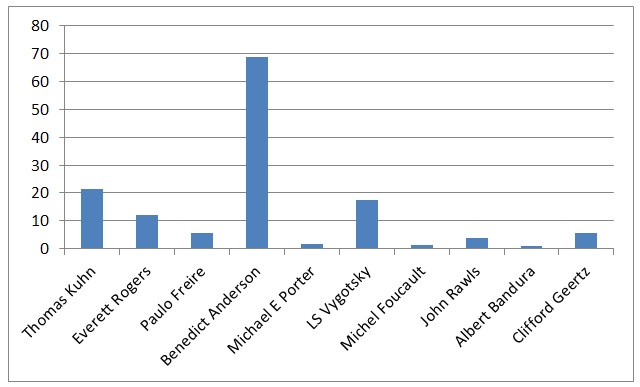
Ratio of most-cited publication to second-most-cited publication for authors among the top-10 most cited books in the social sciences:
Friday assorted links
1. What we learn from collecting lots of data on San Francisco rents. And here, both are excellent and useful pieces, basically SF is ****ed.
2. How do trees sleep? Paper here: “Quantification of Overnight Movement of Birch (Betula pendula) Branches and Foliage with Short Interval Terrestrial Laser Scanning.”
3. Review of Singapore’s driverless taxis to come. And Uber knows you are willing to pay more when your battery life is low.
4. Deirdre on public bathrooms.
5. The horror markets in everything the horror.
6. Cato vindicated, apology and also broader rethink of method is due.
*Polarized: Making Sense of a Divided America*
James E. Campbell has written an excellent book on this contested and…polarizing…topic. Here is just one of many good bits:
As they [some commentators] see it, party polarization has been asymmetrical. The Republican Party allegedly has been captured by right-wing zealots while the Democratic Party has remained a reasonable center-left party. The claim of asymmetrical party polarization is half-true and completely understandable. First, there should be no mystery to asymmetry. If the parties are very competitive, as they are, and the public is skewed to the conservative end of the ideological scale, the parties should be similarly skewed. In a center-right nation, the right-wing party should be further to the right than the left-wing party is to the left. If the two parties were equally ideological, the Democrats would be in a permanent minority. That said, the increased polarization of the parties cannot be entirely attributed to the Republican Party becoming more conservative. Before the Republicans began moving to the right, Democrats had moved further to the left. Party polarization followed the staggered nature of the realignment. In the 1970s, congressional Democrats moved significantly to the left, while there was little change in congressional Republicans. The Republican shift to the right came later and was augmented by the growth of conservatism in the public. The polarization of the parties was a two-step dance — maybe three big steps: One big step to the left and two smaller steps to the right.
There is also this:
A five- or ten-percentage-point shift in ideological preferences may seem like “small potatoes,” but a nation that is 40% moderate and 60% ideological (liberal or conservative) operates quite different politically from one that is a 50-50 split.
By the way, it is sometimes noted, or noticed, that left-leaning thinkers have become crazier lately. I think overall that is true. It may be a sign that America is switching from a center-right to a center-left nation, given Campbell’s analysis above.
Recommended, due out in June from Princeton University Press. And here is Timothy Taylor on polarization.
How does China use the QWERTY keyboard?
Chinese “input” uses the QWERTY keyboard in an entirely different manner. In China, the QWERTY keyboard is “smart,” in the sense that it makes full use of modern-day computer power to augment and accelerate the input process. First of all, the letters of the Latin alphabet are not used in the same limited way that we use them in the alphabetic world. In China, “Q” (the button) doesn’t necessarily equal “Q” (the letter). Instead, to press the buttons marked Q, W, E, R, T, Y (or otherwise) is, strictly speaking, a way to give instructions to a piece of software known as an “Input Method Editor” (IME), which runs quietly in the background on your computer, intercepts all your keystrokes, and uses them as guidelines to try and figure out which Chinese characters the user wants. Using the most popular IME around today — Sougou Pinyin — the moment I strike the letter Q, the system is off and running, trying to figure out what I want. With the first clue, the IME immediately starts showing me options or “candidates” in a pop-up menu that follows me along on screen — in this case, Chinese characters, names, or phrases whose phonetic value begins with Q, such as Qingdao or Qigong.
The moment I hit the second button — let’s say U — the IME immediately changes up its recommendations, now giving me only characters that have pronunciations starting with “Qu.” There is no set, standard way to manage this process, moreover. There are many IMEs on the market, and each IME has many customizable settings. Some IMEs don’t use phonetics at all, in fact, but instead use Latin letters to indicate certain shapes or structural properties of the Chinese characters you want. And on top of all of this, there are countless abbreviations and shortcuts you can use to speed up the process (e.g., typing “Beijing” will get you the capital of China, but so will “bjing,” “beij,” or simply “bj”). And then, of course, there is “predictive text,” which as I have shown elsewhere, was developed and popularized in China decades before it was in the West.
In other words, for the computer age the Chinese system of characters has worked out quite well, and in some ways may be superior to the Roman alphabet. The piece is Jeffrey Wasserstrom interviewing Tom Mullaney, and is of interest more generally.
Wednesday assorted links
1. Employers cannot force workers to be happy.
2. Earpiece translates foreign languages.
4. After twelve years, Japan is making a new Godzilla movie. And markets not in everything if you’re Pakistani.
5. Will Wilkinson on social justice. A very good piece.
6. The economics of Elsevier. And more here. The upside is this: such services become obsolete over time, and if SSRN received lots of money from Elsevier, that is an incentive for someone else to do better, with an eye toward an eventual buy out. We will see how big the lock-in effect is, but I am not convinced it is enormous, if a better system were to come along. See Joshua Gans.
The Rent Seekers Never Sleep
In The Rise and Decline of Nations Mancur Olson argued that collusive arrangements accumulate slowly, reducing efficiency and economic growth. It’s difficult to defeat collusions, however, because the organized-winners fight harder than the unorganized-losers. But there is a way. Ironically, collusions get weaker in groups.
The base-closing principle tells us that the way to defeat collusions is to bundle them and force their existence on a single up or down vote. That’s one reason why general agreements on tariffs and trade, GATT agreements, are important. Trade agreements increase efficiency not simply because of comparative advantage, increasing returns to scale, and increased diversity but because general agreements are necessary to defeat the rent seekers.
Unfortunately, as Gary Hufbauer and Euijin Jung point out, we haven’t had a successful GATT since 1986 and the time between GATT rounds has been getting longer and longer. Moreover, just as Olson would have expected, collusions–what Hufbauer and Jung call “micro-protections”–have grown.
In the wake of the Great Recession of 2008–09, micro-protectionism has run rampant, often skirting the letter of WTO rules. This phenomenon is driven by political promises to create more jobs and to protect domestic firms and industries, notably evident in Buy America statutes and copy-cat local content legislation across the globe. As an illustration, table 2 reports that the imposition of 117 local content requirement measures identified since 2008 is estimated to affect $928 billion of global trade in goods and services in 2010, perhaps reducing global exports by $93 billion.
Local content requirements are just one form of trade restrictive measures introduced since the Great Recession…Macroeconomists are wrong to dismiss the quantitative importance of these poison pills, perhaps individually small but collectively deadly. The fact that highly visible tariff barriers have not been erected on a large scale does nothing to diminish the cumulative impact of thousands of opaque measures designed to keep out imports.
Micro-protections are especially important where trade most needs to increase, in services. There is vast scope for the expansion of world trade but we need a general agreement on trade, especially one focused on breaking down local markets for services.
The rent-seekers never sleep so simple measures of trade protectionism understate the prevalence of micro-protections but simple measures of the gains from trade understate the benefits of defeating strangling collusions.
Used book perfume markets in everything
“Book smell” is now a thing in the perfume world, like vanilla or sandalwood. In the last few years, dozens of products have appeared on the market to give your home or person the earthy scent of a rare book collection.
Sweet Tea Apothecaries sells Dead Writers Perfume, which promises to evoke the aroma of books old enough for their authors to have passed to the great writers’ retreat in the sky. Perfumer Christopher Brosius’s “In the Library” product line makes your home and body smell just like that. The high-end fragrance Paper Passion claims to capture the “unique olfactory pleasures of the freshly printed book,” though for roughly $200 per bottle it’s a lot cheaper to just buy a freshly printed book.
The appeal of old books’ smell has been studied in depth. Wood-based paper contains lignin, a chemical closely related to vanillin, the compound that gives vanilla its fragrance. As the pages age and the compounds break down, they release that signature scent. An experienced rare book handler can date a volume by scent alone, according to the International League of Antiquarian Booksellers.
Here is the full story by Corinne Purtill.
Cherokee Gothic channels Tyrone on Brexit
Discombobulated by my anti-Brexit post, apparently Kevin has been receiving secret messages for some time now, he writes:
People, I just received the following Linkedin message from Tyrone which I reproduce here verbatim (apparently Tyler’s been really cracking down on poor Tyrone):
It’s a good thing Tyler wasn’t an influential blogger back in the 1770s. We’d all still be British subjects.
In 2016 he’s blogging Brexit and unsurprisingly, he’s again come out against change.
The end result he concedes would be good but the path rocky and “the path is everything”.
This from a man who believes the social rate of discount should be zero!
(and, just to hammer on this, if the discount rate is zero, the path is the opposite of everything)
Tyler’s against Scottish Independence, Catalan Independence, Brexit. I somehow feel like he’s even against Grexit (the path! the path!).
Apparently, change is bad.
People, I’m here to tell you Brexit is a no-brainer. The EU is a utility killing machine exponentially ratcheting up dumb regulations while ignoring or actively worsening the real problems that the group suffers. When I solve for the equilibrium I see a place where everything is either mandatory or banned.
Consider refugees as an example of idiotic EU policy. Now that Kenya and Niger have seen that the EU is paying for poor countries to house refugees, they have quite rationally closed their existing camps and put out a call for bids. Niger has opened by asking for a cool billion or so to keep refugees off Europe’s beaches.
The UK’s per capita income is currently about 2/3 that of the US. They and most EU countries have been falling further and further behind the wealth frontier in the last decades. The EU hasn’t exactly been a huge success story for them. In the long run, they will do much better on their own (better policies, closer relation to their former settler colonies, less regulatory crushing) and since the social discount rate really should be zero, the path, while perhaps rocky, is temporary while the new equilibrium is rosy and permanent.
Tyrone out.
This is Tyler again…Tyrone sent me his own message on LinkedIn, and he reminded me of this old Tyler post from 2006, “Would I have supported the American Revolution?“:
These modal questions are tricky. Which “Tyler” is doing the choosing? (If I were an elephant, would pink be my favorite color? Living in 1773, have I at least still read Jonathan Swift? Would a modern teenage Thomas Jefferson have a crush on Veronica Mars?)
But think about it, wasn’t it more than a wee bit whacky? “Let’s cut free of the British Empire, the most successful society the world had seen to date, and go it alone against the French, the Spanish, and the Indians.” [TC: they all seemed more formidable at the time than subsequently]
Taxes weren’t that high, especially by modern standards. The British got rid of slavery before we did. Might I have concluded the revolution was a bunch of rent-seekers trying to capture the governmental surplus for themselves?
Tyrone, of course, wishes we had sold off the entire North American British empire to the Spanish crown…
Very good sentences
In my view, the focus of left-wing attention on trade restrictions is due not to the importance of international trade flows in altering income distribution, but rather springs from different motives: from attempts to hook up some of the energy that for two centuries now has been abundantly focused on nation and cross-connect it to class. As Ernst Gellner wrote, leftists have been faced with what they regard as a historical anomaly in the rise of nationalism, and have reacted by embracing:
[Gellner]: The Wrong Address Theory…. Just as extreme Shi’ite Muslims hold that Archangel Gabriel made a mistake, delivering the Message to Mohamed when it was intended for Ali, so Marxists basically like to think that the spirit of history of human consciousness made terrible boob. The awakening message was intended for classes, but by some terrible postal error was delivered to nations. It is now necessary for revolutionary activists to persuade the wrongful recipient to hand over the message, and the zeal it engenders, to the rightful and intended recipient. The unwillingness of both the rightful and the usurping recipient to fall in with this requirement causes the activist great irritation…
That is from Brad DeLong.
Recent product innovations favor the wealthy
Xavier Jaravel now has a paper on this important topic:
Using detailed product-level data in the retail sector in the United States from 2004 to 2013, this paper shows that product innovations disproportionately benefited high-income households due to increasing inequality and the endogenous response of supply to market size. Annualized quality-adjusted inflation was 0.65 percentage points lower for high-income households, relative to low-income households. Using national and local changes in market size driven by demographic trends plausibly exogenous to supply factors, the paper provides causal evidence that a shock to the relative demand for goods (1) affects the direction of product innovations, and (2) leads to a decrease in the relative price of the good for which demand became relatively larger (i.e. the long-term supply curve is downward sloping). A calibration shows that this channel can explain most of the observed difference in quality-adjusted inflation rates across the income distribution.
Also see my old paper with Alex, “Who Benefits from Progress?”
A classical liberal case for the European Union
Dalibor Rohac had a new and important book just out — Towards an Imperfect Union: A Conservative Case for the European Union, obviously of great relevance to the Brexit debates. Here is the book’s home page, here is the publisher’s home page for the book.
My own view is this: if the United Kingdom could simply press a button and obtain the current status of Canada, via-a-vis the EU, probably they should do so. But they cannot, and in some issues, as with Catalonian independence, the path is everything. I’ve read through much of the Treasury report, and I believe it underestimates the economic cost of Brexit. Were Brexit to happen, probably the UK would see a major recession, and possibly a financial crisis, and there is even a chance significant parts of the EU could unravel in response. And for what gain? The country would not be able to boost living standards through EU immigration cuts. Building new trade agreements would take a long time and in few of the most important cases would the UK hold most of the bargaining power. Security issues probably would worsen.
Even if the Brexit vote fails, it remaining on the table as a live option, as would result from a close vote, would dampen investment in the UK. The best way forward is for the UK to swallow its pride and admit the whole referendum idea was a mistake by voting unanimously to stay. No one would take the unanimity vote as a sincere reflection of preference, but best not to know the true state of public opinion on this one!
I sometimes call Brexit “the Donald Trump of England” — don’t be fooled!
Do Italians cheat on their taxes more than Swedes?
This study examines cultural differences in ordinary dishonesty between Italy and Sweden, two countries with different reputations for trustworthiness and probity. Exploiting a set of cross-cultural tax compliance experiments, we find that the average level of tax evasion (as a measure of ordinary dishonesty) does not differ significantly between Swedes and Italians. However, we also uncover differences in national “styles” of dishonesty. Specifically, while Swedes are more likely to be either completely honest or completely dishonest in their fiscal declarations, Italians are more prone to fudging (i.e., cheating by a small amount). We discuss the implications of these findings for the evolution and enforcement of honesty norms.
Here is the research, by Andrighetto, et.al., via the excellent Kevin Lewis.
From the comments — the economics of Mormon tithing
Jay McCarthy writes:
I am Mormon. I am from Massachusetts, but lived in Utah for a long time, and have lived in prosperous and not-prosperous Mormon areas.
I don’t think tithing is an effective way to get social status.
Let me explain some mechanics. When I get a paycheck, I got to a Web site the church runs and tell them to transfer 10% from my checking account to their accounts. The new online system lets me do it whenever I want, whereas previously (the online system is about eight months old) I wrote a check and handed it to a local church leader. Even in the old days of physical checks, there was extreme paranoia about keeping this an anonymous process. You would occasionally see people handing their checks, but the only people who could know what the amount was was the local leader (called a bishop) and their one or two clerks. (Aside: this local leader and their clerks are lay people that volunteer on a rotating basis for terms of about three to five years.) In the new system, only the local leader sees your tithing amount and maybe a clerk as they print out reports.
The next step is that each year, around the end of the year (December), you have a meeting with the local leader called “tithing settlement”. Before the meeting, you get a sealed letter from a clerk with a statement of all the money you’ve given. You go to the meeting as an entire family (in my case, my wife and three kids younger than 8). It normally lasts about 30 minutes and you spend the time chatting about how things are going in your life and if you have any needs and what is going on. At the end the bishop remembers, “Oh, it’s tithing settlement.” And says, “Is this amount tithed listed on your report accurate?” then asks “Are you a full tithe payer, a partial tithe payer, or not a tithe payer?”. Whatever you answer, he will have no comment about and then you leave.
The other way that tithing is noticed is that every two years you renewed what is called your “temple recommend”. This is an barcoded ID card that is tied to your membership records in the church database. When you want to go to the temple, you bring this card and they scan it to verify that you are allowed in the temple. (Aside, the temple is not where you go each Sunday. There are about 150 in the world. It is for special occasions and most people that are working try to go monthly, but most retired people try to go daily.) During this renewal process, you have an interview with two local leaders—one that you go to church with and one from the administrative unit above that (called a stake). During this interview, you are asked lots of “Yes” and “No” questions (they are encouraged to not require more than “Yes” or “No” answers, because historically some of these leaders changed the requirements to reflect their own interpretations of the rules.) One of the questions is, “Are you a full tithe payer?”. There is no checking of this answer with the answer you give at tithing settlement.
So, in summary, tithing is such a secretive process that I don’t believe it is a good way to get status.
In the preceding discussion, I always wrote “tithing”, but actually we would say “tithes and offerings” because when you pay you can always give additional money. The additional money can be flagged for certain programs. (The tithing CANNOT be flagged.) For instance, one program is called a “fast offering” and it is used for the poor and needy who are local to you. Others are to sponsor a missionary or help build a temple.
I have never heard a local leader with knowledge of offering matters ever say anything about how much a family gave or if they were giving a lot or being generous or anything like that. I have not been a local leader, but I have been on the executive committee of local congregations and attended all the meetings that the local leader did. If they said anything, it would be considered an incredible violation of protocol.
In my opinion, Mormons gain social status within the group by two major ways. First, by externality conformity to norms, such as dressing modestly, having lots of kids, never cursing, discussing the gospel with each other, and so on. Second, by in kind donation of time. Everything that happens at church is done by volunteers and there are many things that need to happen. Each Sunday, meetings are three hours long and there are many classes and lectures that need to be given. The first hour has about three lectures. The second and third hour each have about fifteen concurrent lessons (for different age groups). So, this means that about 33 people need to volunteer to teach for an hour weekly. On the Wednesdays, all youth from 8 to 18 have their own classes and activities at the church that need to be taught by someone. There’s another program for high school students called Seminary (a dumb name) where they are taught about the scriptures EVERY DAY before school. Outside of Utah, this is a volunteer position typically done by one person and is an immense time commitment. (That’s what I do.)
I think these things are much more expensive than tithing and an academic analysis of Mormonism would get more out of studying their impact than studying tithes and offerings.
— A few small comments.
The tithing settlement form says “The Church provided no goods or services in consideration, in whole or in part, for the contributions detailed below but only intangible religious benefits.” I chuckle every time I see that.
I assume that the details of your tithing are considered if you are considered for prestigious volunteer jobs, like bishop.
In executive meetings, we do hear about what percentage of the local membership paid tithing. In my experience, in Utah, social conformity is high but tithing payment is relatively low, but outside of Utah it is the opposite: there are more diverse Mormons and everyone is paying tithing.
Mormon home production is not caused by tithing. It’s explicit motivation is worry about the millennium (a similar impetus to “preppers”) and getting attacked by the government (as happened in Missouri, Illinois, and Utah in the 1800s.) It’s implicit motivation is to gain social status by conformity to norms.
Here is the original post.