Results for “age of em” 17234 found
Could a neuroscientist understand a microprocessor?
The Visual6502 team reverse-engineered one of the chips used in the early Atari video game system:
…we exposed the silicon die, photographed its surface at high resolution and also photographed its substrate. Using these two highly detailed aligned photographs, we created vector polygon models of each of the chip’s physical components – about 20,000 of them in total for the 6502. These components form circuits in a few simple ways according to how they contact each other, so by intersecting our polygons, we were able to create a complete digital model and transistor-level simulation of the chip.
This model is very accurate and can run classic 6502 programs, including Atari games.
By the way, this is the same idea that Robin Hanson argues will be used to create Ems of human brains.
Eric Jonas and Konrad Kording then applied the same types of techniques which neuroscientists use to try to understand the human brain to the simulation–including lesion studies, analysis of spike trains, and correlation studies. Could the tools of neuroscience be used to understand the much simpler Atari brain? The answer is mostly no. The authors, for example, looked at three “behaviors”, Donkey Kong, Space Invaders and Pitfall (!) and they are able to find transistors which uniquely crash one of the games but not the others.
We might thus conclude they are uniquely responsible for the game – perhaps there is a Donkey Kong transistor or a Space Invaders transistor.
Of course, this conclusion would be very misleading but what are we then to make of similar brain lesion studies? The authors conclude:
…we take a simulated classical microprocessor as a model organism, and use our ability to perform arbitrary experiments on it to see if popular data analysis methods from neuroscience can elucidate the way it processes information. We show that the approaches reveal interesting structure in the data but do not meaningfully describe the hierarchy of information processing in the processor. This suggests that current approaches in neuroscience may fall short of producing meaningful models of the brain.
I was surprised to read this:
Granger causality [37] has emerged as a method of assessing putative causal relationships between brain regions based on LFP data.
Scott Alexander on Robin Hanson
There are some people who are destined to become adjectives. Pick up a David Hume book you’ve never read before and it’s easy to recognize the ideas and style as Humean. Everything Tolkien wrote is Tolkienesque in a non-tautological sense. This isn’t meant to denounce either writer as boring. Quite the opposite. They produced a range of brilliant and diverse ideas. But there was a hard-to-define and very consistent ethos at the foundation of both. Both authors were very much like themselves.
Robin Hanson is more like himself than anybody else I know. He’s obviously brilliant – a PhD in economics, a masters in physics, work for DARPA, Lockheed, NASA, George Mason, and the Future of Humanity Institute. But his greatest aptitude is in being really, really Hansonian.
Immigration and the savings glut
If there truly is a savings glut, more immigration from lesser-skilled countries ought to do wonders. Those laborers would soak up more of this capital investment as if they are a free lunch. No domestic worker would have to end up with less capital invested, precisely because of the glut. And by drawing down the “glutted” stock of savings through conversion into productive investment, the immigrants start to pull the economy out of a liquidity trap. It seems also that the conversion of capital into immigrant wages should boost consumption, which at times has become the new (and wrong?) stand-in for aggregate demand.
I should stress that I do not find the “savings glut” terminology to be useful. But if. Do the advocates of the savings glut argument in fact draw this conclusion? Isn’t this actually a good form of (indirect) fiscal policy?
Addendum: You’ll notice that if the savings glut is global, you do need lesser-skilled immigrants because they have to come from countries where less capital is invested per worker. But if the savings glut is better understood as a regional or national phenomenon, immigrant labor from Sweden would do the trick too.
The dominance of the New York City subway
Perhaps the most incredible thing about the New York City Subway has been its utter dominance of the well-publicized national transit ridership increases of the last decade. According to annual data published by the American Public Transportation Association (APTA), ridership on the New York City Subway accounts for all of the transit increase since 2005. Between 2005 and 2015, ridership on the New York City Subway increased nearly 1 billion trips. By contrast, all of the transit services in the United States, including the New York City Subway, increased only 800 million over the same period. On services outside the New York City subway, three was a loss of nearly 200 million riders between 2005 and 2015…
That is from Wendell Cox. And note that use of the NYC system peaked in the late 1940s!
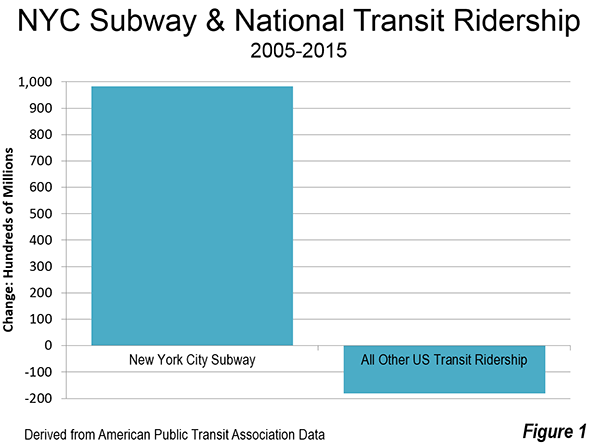
For the pointer I thank the estimable Chug.
Some Good News on Organ Donation
Representative Matt Cartwright (D-PA 17th District) has introduced the Organ Donor Clarification Act. The act would:
- Clarify that certain reimbursements are not valuable consideration but are reimbursements for expenses a donor incurs
- Allow government-run pilot programs to test the effect of providing non cash incentives to promote organ donation. These pilot programs would have to pass ethical board scrutiny, be approved by HHS, distribute organs through the current merit based system, and last no longer than five years.
Importantly the legislation has been endorsed by the American Medical Association and a number of other groups including Fair Allocations in Research Foundation, Transplant Recipients International Organization and WaitList Zero.
See my piece on the organ shortage in Entrepreneurial Economics and previous MR posts for more.
Friday assorted links
1. Museum of the Flat Earth opens in Newfoundland.
2. Interview with Matt Gentzkow.
3. Can a Chinese “straddling bus” carry one thousand people? And China’s scientific ambitions — scale, scale, scale! The latter is an important piece, deserving its own post though it is too hard to excerpt and thus it ends up as a link.
4. Can you catch terrorists by using machine learning to analyze faces?
5. “The first rule of Friends of Abe,” members are told at their induction meeting, “is don’t talk about Friends of Abe.” Link here.
6. Henry on vindictive billionaires (and me). I worry more about vindictive non-billionaires. More directly to Henry’s point, I think there is a pretty clear libertarian mode of discourse about excess legal damages. And while libertarians may not have a good “public choice” solution to that problem, it is hardly the case that the bad outcomes there have been driven by billionaires, quite the contrary. The net effect of billionaires is to keep down the size of legal awards, for obvious reasons, and that tendency is likely to continue.
7. Profile of Dani Rodrik (pdf).
Neerav Kingsland on the new Robin Hanson book
Here is an excerpt from a longer post, which also includes a summary:
Here are some of the most interesting ideas in the book:
1. Mind speeds: I had not previously spent much time thinking about how our brain’s hardware affects the speed at which we think. As it happens, our minds are spectacularly slow compared to what’s feasible with other materials! Better hardware, as well inequalities of hardware across individuals, will likely drive many parts of em society.
2. Death in the time of copies: An individual’s relationship to death is much different when you can make and store copies of yourself. Given how much of our current lives and societies are wrapped in who dies / how they die / when we die – a world where death is less central has major implications for identity, values, and relationships.
3. Security concerns are paramount: Theft (making copies of you without your permission) thus becomes almost more of an issue than death. As such, laws and cultural taboos will shift with security becoming more central to em value systems.
4. Less democratic: In a short period of a time, a well run non-democratic regime can outperform your average democracy. However, in the modern human world, these regimes often implode on themselves before they can dominate the rest of the world. But in the em world, things will move so fast (economic doubling rates are incredibly fast, every month or two!), that the rewards to short bursts of effective non-democratic regimes may be very high.
5. Religion: I tend not to think of robots as religious, but Robin makes the case that the utility of religion (nicer hard-working people) and the values of the em world (more farmer like) should lead to increased religiosity.
6. Increased utility: The sheer number of ems, coupled with their high mind speeds – as well as the likelihood that there lives will be ok in terms of meaning and happiness – suggests that the transition to an em world will be a positive utility move.
You can order the book here. Here is my earlier review.
Notes from Changsha, Hunan province
Changsha is the ugliest and most ungainly Chinese city I have seen, which is saying something. Nonetheless for a food pilgrimage it is a serious rival for #1 spot in the world, perhaps surpassing Chengdu for the quality and novelty of its dishes. Very little effort is required to do well, and some of my best courses I had at the Hunan restaurant in the Sheraton, also the only time I saw an English-language menu.

Even at major hotels, hardly anyone speaks passable English, much less good English. But you can find many hanging portraits of Chairman Mao, who converted to communism in this city.
Carry an iPad, so you can look up and communicate the Chinese characters for “eggplant with orange chilies on top.”

There were plans to erect the world’s tallest building, and ground was broken, but the foundations were not extended and they have since been repurposed as a fish farm, hail Friedrich Hayek.

When they set their minds to it, they can build towers at the rate of three stories a day.

The marginal value of entering a park here is high, as I stumbled upon card games, group exercise sessions, dance clubs, and performances of traditional music, all at higher rates than in most other Chinese cities I have visited. At the entrance to one I read on the sign: “Don’t sneeze into the face of others,” and also I was ordered to reject “feudal superstitious practices.”
The people seem…different. I feel the cab drivers often are on the verge of cackling, except when they are cackling. Then the verge disappears. The word “rollicking” frequently comes to mind, which of course is a sign you would not want to be governed by this province.

Thursday assorted links
3. What/who will the future remember from rock music? By Chuck Klosterman.
4. How cyclical is the current extension of octopi biomass?
5. Myths about Chinese debt. And Chinese debates over the yuan, the article has real information.
6. Mood affiliation with Bernie Sanders (NYT).
Jason Willick on Gawker, Hulk Hogan, and Peter Thiel
Hogan’s lawsuit was not “frivolous”—at least, not in the mind of the judge, who allowed the suit to proceed over Gawker’s many appeals, nor in the minds of members of the jury, who were so disgusted by Gawker’s conduct that they ordered the mischievous media mavens to pay Hogan tens of millions of dollars more than he asked for. And it is not at all clear that Thiel and Hogan did anything to menace to press freedom: As the legal scholar Erwin Chemerinsky told the New York Times when the verdict came out: “I think this case establishes a very limited proposition: It is an invasion of privacy to make publicly available a tape of a person having sex without that person’s consent.”
It’s also not clear what policy response Gawker’s outraged defenders would recommend. Put caps on the amount of money people can contribute to legal efforts they sympathize with? That would put the ACLU and any number of advocacy groups out of business. It would also represent a far greater threat to free expression than a court-imposed legal liability for the non-consensual publication of what is essentially revenge porn. If Marshall and others are worried about the superrich harassing critics with genuinely frivolous lawsuits—as, yes, authoritarian characters like Donald Trump have attempted to do—they would have more success backing tort reform measures to limit litigiousness overall than attacking Thiel for contributing to a legitimate cause he has good reason to support.
Here is more. Here are Thiel’s own words (NYT), here is one bit:
“It’s less about revenge and more about specific deterrence,” he said in his first interview since his identity was revealed. “I saw Gawker pioneer a unique and incredibly damaging way of getting attention by bullying people even when there was no connection with the public interest.”
Mr. Thiel said that Gawker published articles that were “very painful and paralyzing for people who were targeted.” He said, “I thought it was worth fighting back.”
Mr. Thiel added: “I can defend myself. Most of the people they attack are not people in my category. They usually attack less prominent, far less wealthy people that simply can’t defend themselves. He said that “even someone like Terry Bollea who is a millionaire and famous and a successful person didn’t quite have the resources to do this alone.”
Jinan and Qufu notes
Jinan is the second largest city in Shandong province, and a good place to see “normal China”; it is much more in the “concrete and motorbikes” mode than is Qingdao.
Qufu is the birthplace of Confucius, and a longstanding home of the Chinese nobility and Chinese scholars, with monument-building visits by various emperors. Reputedly the town is full of fine-featured individuals with very exact patterns of speech. In any case downtown is pleasant to walk and shop in, and has relatively few environmental problems.

The tomb of Confucius was my favorite site. There is a continuity of civilization (if not regime) for over 2500 years, and visiting the tomb drives this point home. Even the Cultural Revolution did not much damage this area of homage, in part because of loyalty to Confucius, itself a form of Confucian behavior.
Many of the flowers on the tomb were left by the national television station, perhaps as advertising and also signaling loyalty to Confucian ideals.
But that is not China’s oldest heritage, far from it:
This research reveals a 5,000-y-old beer recipe in which broomcorn millet, barley, Job’s tears, and tubers were fermented together. To our knowledge, our data provide the earliest direct evidence of in situ beer production in China, showing that an advanced beer-brewing technique was established around 5,000 y ago.
One local functionary said to me: “We think Trump will win. You always surprise us — he is the next surprise.”
What the hell is going on?
Donald Trump may get the nuclear suitcase, a cranky “park bench” socialist took Hillary Clinton to the wire, many countries are becoming less free, and the neo-Nazi party came very close to assuming power in Austria. I could list more such events.
Haven’t you, like I, wondered what is up? What the hell is going on?
I don’t know, but let me tell you my (highly uncertain) default hypothesis. I don’t see decisive evidence for it, but it is a kind of “first blast” attempt to fit the basic facts while remaining within the realm of reason.
The contemporary world is not very well built for a large chunk of males. The nature of current service jobs, coddled class time and homework-intensive schooling, a feminized culture allergic to most forms of violence, post-feminist gender relations, and egalitarian semi-cosmopolitanism just don’t sit well with many…what shall I call them? Brutes?
Quite simply, there are many people who don’t like it when the world becomes nicer. They do less well with nice. And they respond by in turn behaving less nicely, if only in their voting behavior and perhaps their internet harassment as well.
Female median wages have been rising pretty consistently, but the male median wage, at least as measured, was higher back in 1969 than it is today (admittedly the deflator probably is off, but even that such a measure is possible speaks volumes). A lot of men did better psychologically and maybe also economically in a world where America had a greater number of tough manufacturing jobs. They thrived under brutish conditions, including a military draft to crack some of their heads into line.
To borrow a phrasing from Peter Thiel, perhaps men did better in the age of “technological progress without globalization” rather than “globalization without technological progress,” as has been the case as of late.
Here’s a line from Martin Wolf:
Princeton professors Anne Case and Angus Deaton note, in addition, a sharp relative deterioration in mortality and morbidity among middle-aged white American men, due to suicide, and drug and alcohol abuse.
(Addendum: note this correction.)
For American men ages 18-34, more of them live with their parents than with romantic partners.
Trump’s support is overwhelming male, his modes are extremely male, no one talks about the “Bernie sisters,” and male voters also supported the Austrian neo-Nazi party by a clear majority. Aren’t (some) men the basic problem here? And if you think, as I do, that the incidence of rape is fairly high, perhaps this shouldn’t surprise you.
The sad news is that making the world nicer yet won’t necessarily solve this problem. It might even make it worse.
Again, we don’t know this is true. But it does help explain that men seem to be leading this “populist” charge, and that these bizarre reactions are occurring across a number of countries, not just one or two. It also avoids the weaknesses of purely economic explanations, because right now the labor market in America just isn’t that terrible. Nor did the bad economic times of the late 1970s occasion a similar counter-reaction.
One response would be to double down on feminizing the men, as arguably some of the Nordic countries have done. But America may be too big and diverse for that really to stick. Another option would be to bring back some of the older, more masculine world in a relatively harmless manner, the proverbial sop to Cerberus. But how to do that? That world went away for some good reasons.
If this is indeed the problem, our culture is remarkably ill-suited to talking about it. It is hard for us to admit that “all good things” can be bad for anyone, including brutes. It is hard to talk about what we might have to do to accommodate brutes, and that more niceness isn’t always a cure. And it is hard to admit that history might not be so progressive after all.
What percentage of men are brutes anyway? Let’s hope we don’t find out.
Does Causality Matter More Now?
The subtitle of that new paper is “Increase in the Proportion of Causal Language in English Texts,” here is the abstract:
The vast majority of the work on culture and cognition has focused on cross-cultural comparisons, largely ignoring the dynamic aspects of culture. In this article, we provide a diachronic analysis of causal cognition over time. We hypothesized that the increased role of education, science, and technology in Western societies should be accompanied by greater attention to causal connections. To test this hypothesis, we compared word frequencies in English texts from different time periods and found an increase in the use of causal language of about 40% over the past two centuries. The observed increase was not attributable to general language effects or to changing semantics of causal words. We also found that there was a consistent difference between the 19th and the 20th centuries, and that the increase happened mainly in the 20th century.
For all of its problems, there is much to be said for the twentieth century. The authors — the people who caused that paper to happen (with apologies to David Hume)– are Iliev and Axelrod.
Maybe studying economics doesn’t morally corrupt you after all
So say Hummel, Pfaff, and Rost, in a recent paper:
In view of the numerous accounting and corporate scandals associated with various forms of moral misconduct and the recent financial crisis, economics and business programs are often accused of actively contributing to the amoral decision making of their graduates. It is argued that theories and ideas taught at universities engender moral misbehavior among some managers, as these theories mainly focus on the primacy of profit-maximization and typically neglect the ethical and moral dimensions of decision making. To investigate this criticism, two overlapping effects must be disentangled: the self-selection effect and the treatment effect. Drawing on the concept of moral judgment competence, we empirically examine this question with a sample of 1773 bachelor’s and 501 master’s students. Our results reveal that there is neither a self-selection nor a treatment effect for economics and business studies. Moreover, our results indicate that—regardless of the course of studies—university education in general does not seem to foster students’ moral development.
For the pointer, I thank a lost, forgotten soldier in my Twitter feed.
Monday assorted links
1. Is Finnish youth culture turning sour?
2. Do philosophers actually think better?
3. Cross-linguistic onomatopoeias.
4. “The algae is trapped,” Knudsen explained. “It has a lot of tubes going into it. It’s controlled by chemical signals … The first time I saw it under the microscope, I wanted to join the Algae Liberation Front. I mean, it looked bad.” Link here.
5. Drinking doesn’t make you happier for long, a result from British people.
6. Attending the 2016 Esperanto conference.
7. By Jim Tankersley: recovery average is over.