Results for “age of em” 17233 found
Education as loss leader?
And then there is the Walt Disney Company. It is building a chain of language schools in China big enough to enroll more than 150,000 children annually. The schools, which weave Disney characters into the curriculum, are not going to move the profit needle at a company with $41 billion in annual revenue. But they could play a vital role in creating a consumer base as Disney builds a $4.4 billion theme park and resort in Shanghai.
Here is more, mostly on whether media companies enjoy any synergies in education markets, interesting throughout.
Assorted links
1. Who dies from Russian roulette?
2. Interview with the new GMU President, Ángel Cabrera.
3. Lawrence Summers on government growth (very good piece), or try this link, and a Reihan follow-up.
4. Sokurov’s Faust will be out on DVD soon, it has received rave reviews.
5. Updated results on right to carry laws, and Medicaid seems to improve black child mortality but perhaps not white child mortality.
Evan Soltas is now writing for Bloomberg
Here is his excellent column on decentralized provincial health care provision in Canada. Excerpt:
By fixing the maximum federal contribution, block grants offer Canada’s provincial and territorial governments far better incentives to reduce the cost and improve the quality of the medical services they purchase. When costs rise, the provinces that run the programs are forced to pay 100 percent of the added costs at the margin, unlike in the U.S., where state governments pay an average of 43 cents at the margin for every dollar of added Medicaid expense.
Decentralized administration gives provinces the flexibility and the accountability to design their programs according to their needs and particular local challenges, rather than federal “one-size-fits-none” imposition. It also creates opportunities for innovation. By sharing notes, provinces and territories learn from one another and improve their Medicare programs.
Canada has been using block grants for 35 years. After several years of ruinously high growth in Medicare expenses during the 1970s, their federal government abandoned a 50-50 cost-sharing plan in 1977. Through the Canada Health Transfer program, which gives states some money directly and some through tax-shifting agreements, Canadian provinces and territories receive equal per capita aid, regardless of actual health care expenditure.
Hat tip goes to Miles Kimball.
Recent figures on capacity utilization
Industrial production picked up in July after two months of slight growth, the Federal Reserve said Wednesday in the latest reading that shows the economy in the third quarter got off to a decent start. Industrial production picked up 0.6% in July after slender 0.1% monthly gains in May and June, the Fed said. The Fed had previously reported a 0.4% gain in June and a 0.2% drop in May. The 0.6% gain was as expected in a MarketWatch-compiled poll of economists. Capacity utilization rose to 79.3% in July from 78.9% in May – the highest level since April 2008. Even so, it’s still 1% below its average from 1972 to 2011.
The link is here. It suggests there is excess capacity, but not in wild amounts. Elsewhere, in China:
Capacity utilisation has dropped from about 80% before the crisis to a mere 60% in 2011. That compares with about 78.9% for the US currently for total industry (which is not very high by US’s historical average), and 66.8% at the financial crisis trough according to the Federal Reserve. In other words, current capacity utilisation in China appears to be even lower than that of the US during the 2008/09 financial crisis.
Beware all Chinese numbers, but still that cannot be taken as a good sign. Note that the real estate bubble probably is not fundamental to the Chinese economic crisis (though it is a problem), but excess capacity is.
To the point (Austro-Chinese business cycle theory)
“There is persuasive evidence to conclude that the Chinese economy is actually growing at just 4 or 5 per cent right now based on a composite of other indicators,” says Patrick Chovanec, a business professor at Tsinghua University in Beijing.
“Of China’s 9.2 per cent GDP growth in 2011, 5 percentage points came from investment which means that if China builds just as many roads, bridges, condos and villas as it built last year and no more it will knock five points of this year’s GDP growth. Growth is dependent on ever-rising levels of investment in an environment where that investment is not creating adequate returns.”
That is from the FT. Does this paragraph reassure you?:
Officials and state media reports have suggested local governments will be able to compensate for slumping exports and real estate construction by embarking on a new infrastructure building binge.
Racism by Political Party
It is undeniably the case that racist Americans are almost entirely in one political coalition and not the other.
Chris Hayes, Up w/ Chris Hayes, August 18, 2012.
Here is data asking whites the question Do you Favor Laws Against Interracial Marriage (this is from 2002, the latest year available for this question).
| Favor Laws Against Interracial Marriage | |||||
| Democrat | Ind | Repub | Other | TOTAL | |
| YES | 11.9 | 9.6 | 11.5 | 5 | 10.8 |
| NO | 88.1 | 90.4 | 88.5 | 95 | 89.2 |
Here is data asking whites whether they agree with the sentiment that Blacks Shouldn’t be Pushy.
| Blacks Shouldn’t Be Pushy | |||
| Democrat | Ind | Republican | |
| AGREE STRONGLY | 14.9 | 14.2 | 15.8 |
| AGREE SLIGHTLY | 20.4 | 20.6 | 26.6 |
| DISAGREE SLIGHTLY | 30.2 | 28 | 25.9 |
| DISAGREE STRONGLY | 34.5 | 37.2 | 31.7 |
Finally from 2008 here is data asking whites whether they would vote for a black for President. (Row: racpres, column partyid, filter: race(1) year(2008)).
| Would Vote for Black President | |||||
| STRONG DEMOCRAT | NOT STR DEMOCRAT | NOT STR REPUBLICAN | STRONG REPUBLICAN | ||
| YES | 92.4 | 94 | 93.9 | 94.7 | |
| No | 7.6 | 6 | 6.1 | 5.3 | |
It is true that there are more differences across party lines on policy questions such as on affirmative action, again with a mix in both parties but with more Republicans than Democrats opposing. I don’t consider these types of policy preferences to be grounds for calling someone a racist, however.
It is undeniable that some Americans are racist but racists split about evenly across the parties. No party has a monopoly on racists.
Addendum: John Sides, Reihan Salam and Razib Khan offer further comment.
Solve for the equilibrium
…the Romney campaign went up with an ad just days after the Ryan pick, hitting Obama on the $716 billion figure.
“You paid into Medicare for years: every paycheck. Now, when you need it, Obama has cut $716 billion dollars from Medicare. Why? To pay for Obamacare,” the ad says. “The Romney-Ryan plan protects Medicare benefits for today’s seniors and strengthens the plan for the next generation.”
How the GOP ticket talks about Medicare is vitally important in Florida in particular, a competitive swing state with a high retirement-age population. Ryan is visiting the state for the first time today since he was named to the ticket, and will go to The Villages — billed as the largest retirement community in the world — with his mom.
But instead of wading into the policy details with which Ryan is most comfortable, Republican strategists said it would be far smarter for the Wisconsin lawmaker to focus on the Obama move to remove money from the Medicare trust fund and portray Republicans as the program’s savior.
Assorted links
Too Central to Fail
A lot of attention has been put on “too big to fail,” the idea that big is risky. What really matters in a complex network system, however, is not bigness per se but connection centrality. In a network the liabilities of institution A become the assets of institution B whose own liabilities become the assets of institution C. An institution with high connection centrality can spread distress throughout a large portion of the network.
Inspired by Google’s PageRank, the authors of a new paper create DebtRank, a measure of connection centrality. The vertical axis in the following diagram shows DebtRank (centrality) the horizontal axis asset shows size relative to the total network and the color indicates fragility/leverage. Institutions such as Wachovia, RBS and Barclays were relatively small but because of their centrality and fragility they imposed big risks on the system.
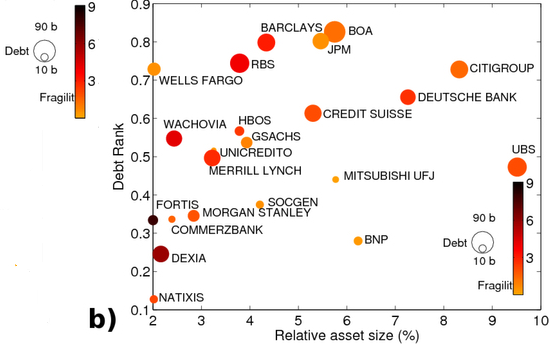
You can find the paper here but do check out the web page of the author group which includes much more material including these animations. Mark Buchanan over at Bloomberg also offers useful comment.
One point to note is that the authors calculated centrality using ex-post data from the Fed. Using this measure, DebtRank clearly signaled danger prior to the crisis and did so earlier than other metrics. In order to do this in real time, however, much more transparent and timely data would be necessary. The fact that centrality doesn’t correlate all that well with bigness, however, indicates that without this data the problem of monitoring risk is even more difficult than it appears.
Who gained the most from the euro?
Looking at the growth of real incomes over the first few years of the Euro’s existence, it is hard to argue against the idea that the peripheral countries should be taking more pain now. Core countries have had to accept a decline in real living standards, and it seems unrealistic to expect them to finance an increase in living standards for others.
Here is much more. I don’t agree with all of their methods of assessment, but the piece makes some important (and valid) points.
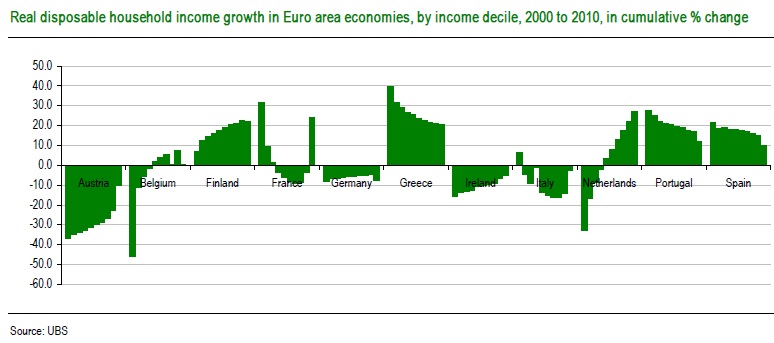
For all the talk about how much German has benefited from the euro, we learn:
What Donovan and co found is that the lowest-income sections of the more “core” countries saw negative real disposable income growth, while those at the other end of the income scale saw incomes rise still further. In other words, in the core countries, the rich got richer, the poor got poorer.
In other contexts, this pattern is not usually considered a benefit at all. Brad Plumer adds comment, as does Angus.
Posner on Skidelsky and Keynes and leisure time
This review is a fun rant about whether we would be better off with lower incomes and more leisure time. Here is one excerpt:
…I well remember as recently as the 1980s how shabby England was, how terrible the plumbing, how shoddy the housing materials, how treacherously uneven the floors and sidewalks, how inadequate the heating and poor the food — and how tolerant the English were of discomfort. I recall breakfast at Hertford College, Oxford, in an imposing hall with a large broken window — apparently broken for some time — and the dons huddled sheeplike in overcoats; and in a freezing, squalid bar in the basement of the college a don in an overcoat expressing relief at being home after a year teaching in Virginia, which he had found terrifying because of America’s high crime rate, though he had not been touched by it. I remember being a guest of Brasenose College — Oxford’s wealthiest — and being envied because I had been invited to stay in the master’s guest quarters, only to find that stepping into the guest quarters was like stepping into a Surrealist painting, because the floor sloped in one direction and the two narrow beds in two other directions. I recall the English (now American) economist Ronald Coase telling me that until he visited the United States he did not know it was possible to be warm.
Assorted links
*Queen of Versailles*
I enjoyed this movie, although I didn’t think it lived up to its most enthusiastic reviews. It is striking how much economics the film contains. The implicit macro model of the crash emphasizes the credit channel, rather than the monetary channel. Repeated cuts to nominal wages fail to work because credit/liquidity is a complementary factor of production. There is another implicit model of lender asymmetry, namely that your old lenders may try to drive you under, to get the collateral, and competition from new, less informed lenders cannot step in to fill the gap. The fixed costs of bankruptcy are high. The male protagonist in the movie is a Caplanian pro-natalist, and a satire of such at the same time. Habits are formed, and then unformed, and possibly will be formed again. The wealthy are not so different from the rest of us. Someone didn’t read Aristotle, or for that matter Markowitz and Tobin.
Old Lady Opposition to Driverless Cars
I think driverless cars will change the design of cities, revolutionize retailing, and greatly change our driving culture, soon for example you will need a license to drive…well, you know what I mean. The scale effects on this technology are tremendous, once it works for one car it works for all. The technology won’t be expensive and it will get better every year. The technology will also get better the more driverless cars their are. Once these cars become common, for example, I expect speed limits for driverless vehicles to be substantially increased.
I do worry about lawsuits in the early years. I am not worried, however, about the following attack on driverless cars which appears to be real although it seems like something from the Onion:
One of the reasons I don’t think this will work is that the technology will be offered first as an option, like cruise control, which will appeal most to the safety conscious. The elderly in danger of losing their license, for example, may appreciate a driverless car. Personally, I would like the driverless option for night driving and I would be much happier lending my teenager the car if I could say “but only if you use the Google option!” At first when there is an accident people will ask, “did he have the driverless option on?” But soon they will start to say “if only he had the driverless option on.”
I do think, however, that technologists should change the name to the electronically chauffeured vehicle. Electronically chauffeured vehicles will appeal to the affluent, the influential and the productive.
The ubiquitous Daniel Lippman gets the hat tip.
Company to offer its own degrees
A leading business publisher is to become the first FTSE 100 company to award its own degrees.
Pearson, which owns the Edexcel exam board as well as Penguin and the Financial Times, will recruit up to 100 undergraduates from September 2013 for a business and enterprise degree course.
David Willetts, the Universities minister, is trying to encourage private providers to set up their own degree courses.
Pearson will charge £6,500 a year for a basic three-year university course. Students are expected to be eligible for government loans to cover the fees and Pearson will also be offering “performance scholarships” to help its brightest recruits pay their fees.
That is probably not a big deal, just fyi, and here is a bit more.
For the pointer I thank Daniel Lippman.