Improving GDP
Under EU rules Britain will add illegal drug sales and prostitution to its calculations of GDP:
HPost: Britain makes £10 billion a year thanks to drug dealers and prostitutes, the government’s statistics watchdog is set to confirm.
The Office for National Statistics is expected to comply with new EU rules by revealing its first estimates for the size of the illegal industries and how it has reached these calculations as soon as March or April.
Prostitution in Britain is set to be valued at around £3 billion a year while the drug dealing sector is set to be valued at £7 billion, with both of them factored into the UK’s £1.6 trillion gross domestic product, according to the Times.
The Economics of Online Education
The Economist covers the economics of online education:
Alex Tabarrok…reckons the most salient feature of the online course is its rock-bottom marginal cost: teaching additional students is virtually free.
..as prices converge towards marginal cost, there will be little scope for undercutting the competition. Instead MOOCs are likely to compete on quality…Higher production costs are a small price to pay to attract much greater numbers of students. Such markets often evolve into winner-take-all, “superstar” competitions. The best courses attract the most customers and profit handsomely as a result. In this respect online education may more closely resemble information industries such as film-making than service industries such as hair-cutting.
The market for textbooks already fits this description. New textbooks are costly to write and design but can be reproduced fairly cheaply. Not surprisingly, only four introductory economic texts account for half of the American market, according to Mr Tabarrok. Indeed, says Tyler Cowen, a co-founder of Marginal Revolution University, it is possible that textbook publishers are better equipped than universities to develop MOOCs profitably.
I agree also with a point made by Caroline Hoxby:
Less selective institutions are close substitutes for MOOCs. Course content is often standardised and interaction with professors is limited in order to keep costs down.
…Elite institutions face very different circumstances, Ms Hoxby reckons. They operate like venture-capital firms, offering subsidised, labour-intensive education to highly qualified students. They aim to cultivate a sense of belonging and gratitude in students in order to recoup their investment decades later in the form of donations from successful alumni…. For top schools, the best bet may simply be to preserve their exclusivity.
Altruistic Kidney Donors Favoring Financial Compensation
Dmitri Linde joins Alexander Berger and Virginia Postrel as altruistic kidney donors who advocate for lifting the ban on financial incentives. Here is Linde:
Two policies would address the shortfall of kidneys in the U.S.: instituting a priority-scoring system for donors and their kin and paying donors.
Israel pioneered the former in 2012. Prioritizing organ allocation by donor status—a system that economist Alex Tabarrok termed “no give, no take”—incentivized people to register as organ donors. It also removed a hurdle to living donation: The incentive to abstain because of a hypothetical (What if my son needs a kidney?) went away since the policy guarantees that a donor’s kin will be prioritized in the event that they need a transplant. The results? Both living and deceased donations have gone up, and the number of people who have died on the waitlist fell by 30% between 2010 and 2013.
To obviate the kidney shortage, we should heed the recommendation of Nobel Prize-winning economist Gary Becker and others by making it legal to compensate donors.
Linde donated a kidney with the aid of the excellent National Kidney Registry. The registry matched him to a recipient whose own willing but incompatible donor donated to another patient in need. Bravo Dmitri.
Here are previous MR posts on organ donation.
Private Schooling In India: Results from a Randomized Trial
Karthik Muralidharan runs very large, randomized controlled trials on education in India. His previous work showed that performance pay for teachers in India has large and significant improvements on student learning. In his latest paper (with Venkatesh Sundararaman) he reports on the results of The Andhra Pradesh School Choice Project, a long-term randomized controlled trial covering over 6,000 students in 180 villages for four years (2008-2012). The study offered students a lottery for a private school scholarships and lottery winners were compared with non-winners. The results show modest improvements in learning for private school students and big increases in school productivity.
We find that private school teachers have lower levels of formal education and training than public-school teachers, and
are paid much lower salaries. On the other hand, private schools have a longer school day, a longer
school year, smaller class sizes, lower teacher absence, higher teaching activity, and better school
hygiene. After two and four years of the program, we find no difference between the test scores of
lottery winners and losers on math and Telugu (native language). However, private schools spend
significantly less instructional time on these subjects, and use the extra time to teach more English,
Science, Social Studies, and Hindi. Averaged across all subjects, lottery winners score 0.13 σhigher,
and students who attend private schools score 0.23 σhigher. We find no evidence of spillovers on
public-school students who do not apply for the voucher, or on students who start out in private schools
to begin with, suggesting that the program had no adverse effects on these groups. Finally, the mean
cost per student in the private schools in our sample is less than a third of the cost in public schools.
Our results suggest that private schools in this setting deliver (slightly) better test score gains than
their public counterparts, and do so at substantially lower costs per student.
As Karthik notes in a Ideas for India short article that summarizes:
Since private schools achieved equal or better outcomes at one-third the cost, the fundamental question that needs to be asked is “How much better could private management do if they had three times their current level of per-child spending?”
Is any economist doing more important work with greater potential for real improvement in the lives of millions than Karthik Muralidharan?
Charter High Schools Increase Earnings and Educational Achievement
Private and charter schools appear to have significant but modest effects on test scores but much larger effects on educational attainment and even on long-run earnings. A new working paper from Booker, Sass, Gill and Zimmer and associated brief from Mathematica Policy Research finds that charter schools raise high school graduation, college enrollment and college persistence rates by ~7 to 13%. Moreover, the income of former charter school students when measured at 23-25 years old is 12.7% higher than similar students. Similar in this context is measured by students who were in charter schools in grade 8 but who then switched to a traditional high school–in many ways this is a conservative comparison group since any non-random switchers would presumably switch to a better school (other controls are also included).
The effect of charters on graduation rates is consistent with a larger literature finding that Catholic schools increase graduation rates (e.g. here and here). I am also not surprised that charters increase earnings but the earnings gain is surprisingly large; especially so when we consider that the gain appears just as large among charter and non-charter students both of whom attended college (i.e. the gain is not just through the college attendance effect).
I wouldn’t bet on the size of the earnings effect just yet but what we are learning from this and related research, such as Chetty et al. on teachers, is that better schools and better teachers appear to have a significant and beneficial long-run impact that is not fully captured by higher test scores.
As I said in Launching, one of the factors that makes me optimistic about education in the United States is that it remains relatively decentralized and open to experimentation and evolution.

Counter Intuitive Nudges
Incentives don’t always work in the way we expect and neither do nudges. The British found that different slogans to encourage organ donation had markedly different effects.
…the least successful message was: “Every day thousands of people who see this page decide to register [as an organ donor],” which ran alongside a picture of a group of smiling people.
….The most successful slogan was one which read: “If you needed an organ transplant, would you have one? If so, please help others.”
Ex-post it’s easy to come up with explanations for these differences but ex-ante these are difficult to predict. The unsuccessful slogan, for example, lets people know about a social norm; an approach that has been said to be very successful at reducing binge drinking and electricity consumption, so why didn’t it work for organ donation?
Here’s another peculiar nudge in NYC:
A counterintuitive “pilot program” aimed at reducing garbage in subway stations by removing trash cans appears, against all logic, to be working.
The idea of removing the trash cans came to the MTA in 2011 as a possible method of combating rats…But when the cans were removed from 10 stations, the agency found that not only did rat populations decrease, the amount of litter decreased, too.
My suspicion is that if this is true (and not random noise) then it’s a non-generalizable partial-equilibrium effect. If the trash cans have been removed only in some stations then people may be holding on to their trash knowing that they can dump it at the next station or in a trash can on the street. If you were to remove all or most of the cans this won’t happen.
Do you have other examples of counter-intuitive nudges? And what other explanations can you offer for the trash can effect?
Hat tip: Holman Jenkins.
Why the Worst Get on Top – India Edition
Consider this extraordinary figure: 30 percent of members of parliament have criminal cases pending against them…the answer to why political parties in India nominate candidates with criminal backgrounds is painfully obvious: because they win (see figure 1). In the 2004 or the 2009 parliamentary elections, a candidate with no criminal cases pending had—on average—a 7 percent chance of winning. Compare this with a candidate facing a criminal charge: he or she had a 22 percent chance of winning. Granted, this simple comparison does not take into account numerous other factors such as education, party, or type of electoral constituency. Nevertheless, the contrast is marked.
Writing at the Carnegie Endowment for International Peace blog, Milan Vaishnav goes on to note that those with criminal backgrounds appear to have ready access to cash and in addition their toughness appeals to voters:
In contexts where the rule of law is weak and social divisions are highly salient, politicians often use their criminal reputation as a badge of honor—a signal of their credibility to protect the interests of their parochial community and its allies, from physical safety to access to government benefits and social insurance.
…The appeal of candidates who are willing to do what it takes—by hook or crook—to protect the interests of their community provides some intuition for why the odds of a parliamentary candidate winning an election actually increase with the severity of the charges, with slightly diminishing returns in the most severe instances…
Harford (and Tabarrok) on Macroeconomics
Tim Harford gave an excellent talk at Cato on his new book The Undercover Economist Strikes Back.
You may have heard recently that the richest 85 people in the world have more wealth than the bottom 3.5 billion. Tim began by pointing out that his 2 year old also has more wealth than the bottom 2 billion since his 2-year old has no debt. Later in the talk Tim gave a brilliant explanation for how and why economists began to treat data like an unfaithful spouse. Watch for that!
Tim’s talk begins around the 7:20 mark. I come in around the 34:00 mark and after saying some more nice things about Tim’s book I have some critiques focusing on how long can wages and prices really be sticky and also giving a brief introduction and defense to “Real Business Cycle” theory especially the recent sectoral approaches of Gabaix and also Acemoglu et al.
At the link you can also find links for iTunes and downloadable formats. CSpan also covered the event.
Money Laundering
From a new paper that caught my eye in the journal Industrial and Engineering Chemistry Research:
With nearly 150 billion new banknotes being manufactured and printed every year around the world, the replacing of unfit currency is approaching $10 billion annually. In addition, central banks must also deal with the environmental challenge of annually disposing of nearly 150,000 tons worth of notes unfit for recirculation. Seminal work by the De Nederlandsche Bank (DNB) has identified that soiling is primarily a yellowing of the notes due to the accumulation of oxidized sebum. We show that supercritical CO2 (SCCO2) can be effectively utilized to remove sebum and other oils and contaminants, including common bacterial colonies, from both paper and polymer banknotes without destroying the costly and sophisticated security features employed by central banks to prevent counterfeiting. SCCO2 cleaning at 60°C and 5000 psi was shown to be effective in cleaning conventional straps of 100 banknotes, extracting nearly 4% of the initial strap weight. Measurements of note soiling distributions on a banknote sorting machine running at 10 banknotes per second showed a significant shift in soiling levels after cleaning, supporting the claim that processing of SCCO2-cleaned notes would result in significantly fewer notes being classified as unfit due to soiling and shredded.
Hat tip: Fast Company.
How Many Homicides were there in 2010?
How many homicides were there in 2010 in the United States? Well, that’s easy. Let’s just do some Googling:
Between the smallest and largest figures there is a difference of 3,292 deaths or 25%!
The differences are striking but not entirely arbitrary or without explanation. I assume the second figure adds late additions to the 2010 data and so should be considered more authoritative but that is a relatively small difference.
The difference between 2 and 3 is puzzling and seems to be that the number in 2 is drawn from the Supplementary Homicide Report (SHR) statistics on victims while the larger figure is drawn from homicide reports in the UCR. Not all agencies collect the more detailed statistics in the SHR while the UCR is nearly complete. Thus the victim figure is smaller than the report figure (this doesn’t appear to conform exactly to where the data is supposed to be sourced but it’s what the FBI tells me). It’s unclear why the FBI would report both figures when they know one is misleading.
The difference between 3 and 4 comes from different definitions of homicide. The FBI collects data on crimes. If a killing is ruled justified, i.e. not a crime, it doesn’t go into the FBI homicide statistics. The CDC collects data from death certificates which list as homicide any death caused by “injuries inflicted by another person with intent to injure or kill, by any means.” Thus, the CDC data includes justifiable homicide. In 2010 according to the FBI there were 387 justifiable homicides by law enforcement and 278 by private citizen for a total of 665 justifiable homicides, so that accounts for some but not all of the difference.
(By the way, the 278 justifiable homicides in 2010 by private citizens compared to 387 by law enforcement and 14,720 unjustifiable homicides would seem to be an important context for many claims about stand your ground laws. N.b. this doesn’t mean that the laws couldn’t be associated with more unjustifiable homicides).
The FBI (3) and NVSS (4) figures track each other closely over time but its important to be aware of the differences and to be consistent in one’s calculations.
Traffic Forecasts
Official DOT forecasts of road traffic with actual road traffic.
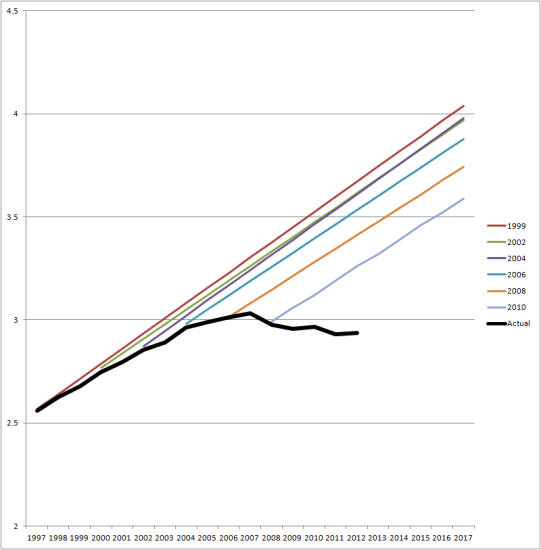
Hat tip to Andrew Gelman, who compares it with some other famous forecasts.
Harford Strikes Back
Tim Harford is speaking about his new book, The Undercover Economist Strikes Back, at Cato at noon on Thursday Jan. 23. I will be commenting. More info and to register here.
If you can’t make it to the Cato Institute, you can watch this event live online at www.cato.org/live.
Here is Cato’s announcement.
In his new book, Tim Harford attempts to demystify macroeconomics in the same way his earlier bestseller, The Undercover Economist, demystified microeconomics. Using his characteristic conversational style, Harford will discuss abstract macroeconomic ideas, explaining the most common models of recessions and the difficulty of discriminating between them on empirical grounds. For example, was the crisis of 2008 driven by supply- or demand-side factors? And why do failures of the financial sector seem to have such severe economic consequences? He will not shy away from other topics, including income inequality, or the growing interest in alternative measures of economic well-being, such as self-reported happiness. Please join us for a discussion of what macroeconomists believe about the economy and of why those beliefs often seem to lead to bad public policy.
The Chemicals in Our Food

More here.
Airport Congestion and Value Pricing
Major airports are often congested which leads to an inefficient allocation of resources. For example, some planes carry low-value packages that are not time-sensitive. Other planes carry high-value, time-sensitive packages. You don’t want to delay the plane carrying the heart for transplant so that a plane carrying 3-day mail can land a bit early. Vernon Smith and co-authors created and tested a combinatorial auction market to allocate airport slots and improve efficiency. In an auction market when there is congestion the high-value packages can outbid the low-value packages so not every package pays the same freight. Prices in an auction market are also valuable signals telling us where congestion is most severe and expansion most warranted. Revenues from pricing can be used to fund expansion.
Some people, however, are against prioritizing package delivery because they argue that treating every package equally will increase innovation.
Addendum: Don’t take these points as the only or determining considerations but I would like to see more attention given to analysis and less to slogans.
Inequality and the Masters of Money
This post isn’t about inequality and money it’s about inequality and the masters of monetary policy. Consider Janet Yellen, her recent confirmation to chair the Fed has made her the most powerful woman in the world, the most powerful woman in world history, the world’s second most powerful person, or the world’s most  powerful person depending on who you believe. In anycase, Yellen is powerful. Moreover, Yellen is married to Nobel prize winner George Akerlof. The fact that two such outstanding individuals should be married to one another is an illustration of assortative mating. Yellen-Akerlof are the 1% of the 1% and all that political and cultural achievement concentrated in one family is an example of the growth of inequality. Tellingly, one of the drivers of this inequality was greater equality of opportunity for women.
Now consider, President Obama’s nomination for Fed vice-chairman, Stanley Fischer. Fischer was born in Zambia, holds dual Israeli-American citizenship and was most recently the governor of the Bank of Israel. In all of US history there is almost no precedent for a former major official of a foreign country to become a major official of the United States. Given all the economists in the United States one might have thought that a suitable candidate could be found without this peculiar history and yet it’s not hard to understand why President Obama has nominated Fischer–to wit, I wouldn’t be surprised if everyone President Obama asked for advice on this question to told him that Fischer would be one of the best people in the entire world for the job.

Indeed, many of the people Obama spoke to, including Ben Bernanke, would have been Fischer’s students, themselves a large subset of the tiny elite of the world’s top monetary economists. Perhaps the world of monetary economics is an inbred clique, a supplier-controlled cartel. Maybe so, but I see this as part of a larger story. Stanley Fischer, rather than thousands of other nearly equally-qualified people, is being nominated to the U.S. Federal Reserve for the same reasons that large firms, compete madly for a handful of CEO’s (in the process bidding up their wages to stratospheric levels).
Consider that even in the rarefied world of monetary policy Fischer’s appointment isn’t unique. In 2012, the British appointed Mark Carney, a Canadian, to be the Governor of the Bank of England, the first non-Briton to ever hold the role. When even Great Britain and the United States find that their home-grown talent isn’t good enough that tells you that the demand for talent is immense. My favorite example of this from the business world is Sergio Marchionne. Marchionne is the CEO of Italy’s Fiat and the Chairman and CEO of Chrysler, among several other positions. He commutes between Italy and the United States, lives in Switzerland, and has dual Italian and Canadian (!) citizenship. Appointments and potential appointments like those of Carney and Fischer illustrate that the demand for talent and the winner-take-all phenomena of a globalized world are not limited to the business world.
Small differences in quality at the top have a greater impact the larger the firm, the market, or the economy. How many truly great decisions did Bill Gates make at Microsoft (compared to another plausible CEO)? I would guess that fewer than 10 decisions made billions of dollars of difference. And if Yellen-Fischer make just a few better calls than their next best counterparts, well that could easily be worth hundreds of billions.
It’s also notable that the Federal Reserve is trying to create the highest-quality team. O-ring production tells us that you maximize the value of production by matching high-quality workers with other high quality workers. In the private sector, O-ring production magnifies inequalities of talent into even larger inequalities of income. In the public-sector, O-ring production magnifies inequality of talent into even larger inequalities of power.
The bottom line is this, a common set of factors is driving inequality: equality of opportunity, assortative mating, O-ring production, increases in the demand for talent driven by the leveraging of talent through technology. The forces are similar and so are the results, the money elite, the monetary elite, the power elite.