They should make a movie
The son of Indian immigrants, Mathew Martoma has led a pretty interesting life.
Part Two: An arrest can dog you for life but if you can avoid an arrest record, you can get away with a lot.
In 1999, Mr. Martoma was expelled from Harvard for creating a false transcript when he applied for a clerkship with a federal judge, court papers unsealed on Thursday showed. Mr. Martoma used a computer program to change several grades from B’s to A’s, including one in criminal law, and then sent the forged transcript to 23 judges as part of the application process.
Then, during a Harvard disciplinary hearing to determine whether he should be expelled, Mr. Martoma tried to cover his tracks by creating a fake paper trail that included fabricated emails and a counterfeit report from a computer forensics firm that Mr. Martoma had created to help conceal his activities.
After Harvard expelled him, Mr. Martoma, who at the time was known as Ajay Mathew Thomas, legally changed his name to Mathew Martoma.
Nearly a decade after he was kicked out of Harvard, federal prosecutors contend, Mr. Martoma carried out one of the largest insider trading schemes while working at Steven A. Cohen’s hedge fund.
From the NYTimes. But if you think that is the end of the story you would be wrong because the Times doesn’t even mention that Mortoma had an earlier career as, wait for it….a medical ethicist at the NIH! He even wrote a paper on medical ethics (bonus points if you can find it).
Part One, from USA Today, Academics praise insider trading suspect’s past:
Bruce Payne, a former Duke professor, stressed Martoma’s strong ethical code when he wrote a recommendation letter for his ex-pupil’s application to Stanford University Graduate School of Business. Martoma was in Payne’s ethics and policymaking class in 1994, before later becoming his chief teaching assistant for the class.
Payne…wrote that Martoma was “extraordinarily intelligent,” ”remarkably analytic” and “wonderfully fair-minded.”
and here is the piece de resistance:
“No one has contributed more to our class discussions of Sissela Bok’s Lying, nor was anyone in our class as acute on the issues of moral capacity raised by Camus’ The Plague,” Payne told Stanford.
Addendum: A reader points me to the paper. It’s on genetic testing and insurance. Unfortunately, they missed the key reference in this field.
DSGE has Failed the Market Test
Noahpinion makes a good point:
As far as I’m aware, private-sector firms don’t hire anyone to make DSGE models, implement DSGE models, or even scan the DSGE literature. There are a lot of firms that make macro bets in the finance industry – investment banks, macro hedge funds, bond funds. To my knowledge, none of these firms spends one thin dime on DSGE. I’ve called and emailed everyone I could think of who knows what financial-industry macroeconomists do, and they’re all unanimous – they’ve never heard of anyone in finance using a DSGE model.
If you know someone who does, please reply in the comments. I’m sure there’s someone out there. But even if there is, they haven’t soared to fame and fortune on the back of their DSGE model.
…In other words, DSGE models (not just “Freshwater” models, I mean the whole kit & caboodle) have failed a key test of usefulness. Their main selling point – satisfying the Lucas critique – should make them very valuable to industry. But industry shuns them.
Is the Sugar Quota JUSTIFIED?
 Justified, one of the best written and most entertaining shows on television, premiered last night. I liked this exchange between two drawling criminals:
Where’s the rest of the money?
That’s all we got from the candy company.
Yeah, what candy company is that Dillie?
The one that bought the sugar.
The joke is that we think the criminals are talking in street code about another white powder but, as we learn later, they actually are part of a sugar smuggling operation. The US sugar quota has increased the US price of sugar well above world levels and this has in fact pushed a number of candy companies to the wall. I suspect that few of them have turned to the black market for their sugar although I wouldn’t put this past some unethical confectioners. Nevertheless, sugar smuggling is not unknown.

In the 1980s when the US price of sugar was pushed as much as four times higher than the world price there were many smuggling schemes if not actual sugar-runners. In our textbook, Modern Principles, Tyler and I discuss one scheme where Canadian entrepreneurs shipped super-sweet iced tea to the United States where the “tea” was then sifted and the sugar resold. And from 2000 here is a great moment for US democracy, namely US Senator Byron Dorgan rising in support of legislation:
…to prevent molasses stuffed with sugar from being allowed into this country.
As others have stated, the molasses in question is stuffed with South American sugar in Canada [those Canadians again, AT], and then transported into the United States. The sugar is then spun out of this concoction and sold in this country while the molasses is sent right back across the border to be stuffed with more sugar–and the smuggling cycle starts over again.
The Austerity Flip-Flop
On April 28, 2013 Paul Krugman clearly said that 2013 was a test of market monetarism:
But as Mike Konczal points out, we are in effect getting a test of the market monetarist view right now, with the Fed having adopted more expansionary policies even as fiscal policy tightens.
Yesterday (Jan 4, 2014) however, Paul Krugman, said:
…I don’t take seriously the claims of market monetarists that the failure of growth to collapse in 2013 somehow showed that fiscal policy doesn’t matter.
There are two obfuscations here. First, it wasn’t the market monetarists who established the test it was Konczal and Krugman who laid down the glove so Krugman is saying he doesn’t take his own (April) claims seriously. Second, in April Krugman did appear to take his claims seriously, perhaps because:
…the results aren’t looking good for the monetarists: despite the Fed’s fairly dramatic changes in both policy and policy announcements, austerity seems to be taking its toll.
Now that the results are in, however, Paul claims that compared to southern Europe American austerity wasn’t so bad or it was really bad but small enough to be offset by “other stuff”:
US austerity, although a really bad thing, wasn’t nearly as intense as what happened in southern Europe; it was small enough that it could be, and I’d argue was, more or less offset by other stuff over the course of a single year.
But the ticker tape (April 27, 2013) suggests a much different emphasis (note also that here Paul names “other stuff’ and it is adding to the problem not subtracting):
There is some tendency among economic commentators to think that austerity policies in a deeply depressed economy are mainly a European thing… But the truth is that federal stimulus is years behind us, while state and local governments have cut back, so the overall story is one of fiscal contraction that’s smaller than in Europe, but not by that much….Bear in mind that in the years since the recession began we’ve seen a significant number of boomers reach retirement age, which would ordinarily have led to rising spending, not to mention the effects of rising health care costs. Bear in mind also that the private sector is still deleveraging, which means that government should be spending more to help sustain the economy. So this is actually a picture of very bad policy.
Even more amusingly, arch-Keynesian Paul Krugman now says we are approaching the long run! In a post titled What A Good Year Won’t Prove he says:
If 2014 is a year of relatively good growth, you know that many people will take that as somehow refuting Keynesianism — hey, didn’t you guys predict that the economy would never recover without fiscal stimulus?
No, we didn’t [the linked post, is from 2009, AT]
In the long run, we will have a spontaneous economic recovery, even if all current policy initiatives fail….
Now, to be fair, I happen to agree with Krugman that one test is not decisive. The economy is very complex and we don’t have controlled macro-experiments so lots of things are going on at the same time. But as one wise commentator put it:
…using hedged language doesn’t insulate you from consequences if things don’t turn out the way you were clearly suggesting they would, nor does the true point that sometimes the right model makes a wrong prediction. If your model led you to believe that
inflationausterity was a “great danger” in20092013 the fact that this danger never came to pass should substantially reduce your belief in that model – and should substantially reduce your credibility if you refuse to revise your beliefs.
Addendum: Scott Sumner has a similar reaction at Econlog.
Prison Admission Rates are Falling
In an earlier post, I pointed out that after increasing for more than thirty years, prison populations have been begun to decline. Keith Humphreys further notes that the trend is even more dramatic when we look at the flow of people into prisons (rather than the stock).
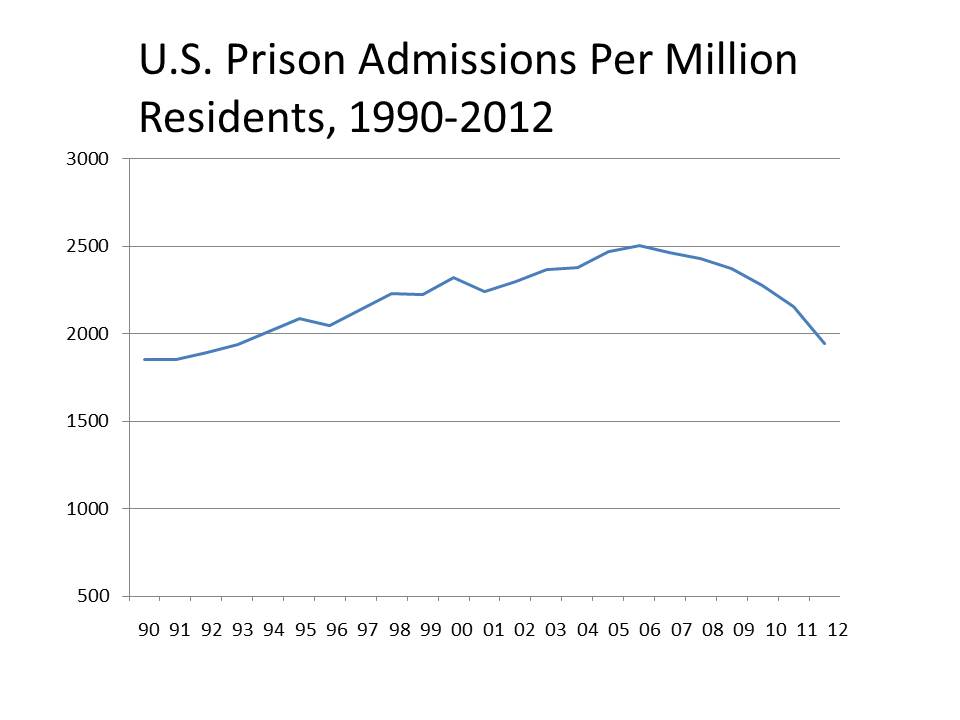
In absolute numbers, the number of admissions in 2012 (609,800) was the lowest since 1999.
Drug-related imprisonments are especially down. In 1991, for example, 23% of the prisoner’s sentenced for more than one year were sentenced for drug related reasons (including 8.2% for drug possession). In 2011 only 16.6% of imprisonments for more than one year were for drug-related reasons (including 4.1% for drug possession.) This trend is likely to continue with further drug legalization.
Uber-Economist
Uber is hiring economists. Looks like an interesting job:
Urban transportation has looked the same for a long time – a really long time – thanks in large part to regulatory regimes that don’t encourage innovation. We think it’s time for change. We’re a tech company sure, and we’re working in the transportation space, but at the end of the day we’re disrupting very old business models. Our Public Policy team prefers winning by being right over some of the darker lobbying arts, and so we’re looking for a Policy Economist to tease smart answers to hard questions out of big data. How do the old transportation business models impact driver income? What effect if any is Uber having on the housing market or drunk driving or public transit? To what extent are the different policy regimes in New York City and Taipei responsible for different transportation outcomes? Just a few of the questions we want you to dig on.
Most Popular MR Posts of 2013
Here is my annual round-up of the most popular MR posts of 2013 as measured, somewhat eclectically, using the number of links, tweets, shares, comments and so forth. Sadly, the post that was most linked to this year was by neither Tyler nor myself but by… Tyrone.
- Tyrone on why the government shutdown and the debt ceiling crisis were brilliant Republican strategy
Look people, I have explained this before. Tyrone is a bad man. Do Not Encourage Tyrone. Fortunately for us Tyrone doesn’t like it when people like him.
Second most highly linked was my post No One Is Innocent. I was also pleased that a related post, Did Obama Spy on Mitt Romney?, was also highly linked although I think that the question raised in this post about the potential for NSA tools to be abused for political purposes hasn’t been truly addressed in the main stream media. Conor Friedersdorf at The Atlantic in The Surveillance State Puts U.S. Elections at Risk of Manipulation was one of the few people to pick up on this important question.
Also highly linked were my post The Great Canadian Sperm Shortage and a few less substantive items drawn mostly from elsewhere such as Equal Population US States and What is the Most Intellectual Joke You Know.
If you followed Tyler’s timely advice in another highly linked post, China, and the soaring price of Bitcoin, you would have saved yourself from a big loss (albeit you would have made an even bigger profit by ignoring Tyler’s earlier advice).
The most shared post was Tyler’s Stereotyping in Europe with over seven thousand shares, followed by Nobody dislikes inflation more than strippers. I was pleased that a bunch of my substantive posts were highly shared including:
- My letter to my son’s high school principal, High School Safety in Northern Virginia
- Sinister Statistics: Do Left Hand People Die Young, a neat piece of statistical reasoning and
- The Animals are also Getting Fat.
Another highly shared and commented upon post was Our DNA, Our Selves on the FDA and 23andMe. Mark my words, when this or similar case goes to court the FDA will eventually lose on free speech grounds.
Gun posts get lots of comments including The Culture of Guns, The Culture of Alcohol, Guns, Suicide and Natural Experiments, Firearms and Suicides and How Japan Does Gun Control.
Question posts such as Who is the Worst Philosopher? and Who is the most influential public intellectual of the last twenty-five years? get lots of comments as did Who is Juan Galt?
There is overlap between most linked, shared, and commented so some of the above would fit in several categories but it’s surprisingly weak. Posts with a lot of comments, for example, often do not draw lots of links.
What were your favorite posts of 2013? And what requests do you have for 2014?
Merry Christmas!

Merry Christmas from New Orleans and best wishes for the New Year to all our readers.
A Few Favorite Books from 2013
Tom Jackson asked me for a couple of best books for his year end column. I don’t read as many books as Tyler so consider these some favorite social science books that I read in 2013.
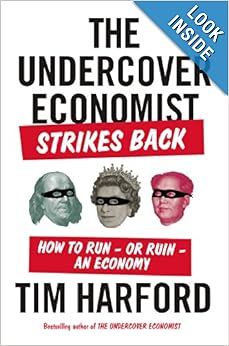 In The Undercover Economist Strikes Back, Tim Harford brings his genius for storytelling and the explanation of complex ideas to macroeconomics. Most of the popular economics books, like The Armchair Economist, Freakonomics, Predictably Irrational and Harford’s earlier book The Undercover Economist, focus on microeconomics; markets, incentives, consumer and firm choices and so forth. Strikes Back is that much rarer beast, a popular guide to understanding inflation, unemployment, growth and economic crises and it succeeds brilliantly. Mixing in wonderful stories of economists with exciting lives (yes, there have been a few!) with very clear explanations of theories and policies makes Strike Back both entertaining and enlightening.
Stuart Banner’s American Property is a book about property law, which sounds like an awfully dull topic. In the hands of Banner, however, it is a 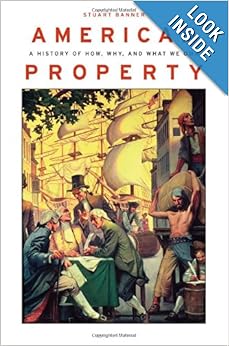 fascinating history of what we can own, how we can own it and why we can own it. Answers to these questions have changed as judges and lawmakers have grappled with new technologies and ways of life. Who owns fame? Was there a right to own one’s own image? Benjamin Franklin, whose face was used to hawk many products, would have scoffed at the idea but after the invention of photography and the onset of what would later be called the paparazzi thoughts began to change. In the early 1990s, Vanna White was awarded $403,000 because a robot pictured in a Samsung advertisement turning letters was reminiscent of her image on the Wheel of Fortune. American Property is a great read by a deep scholar who writes with flair and without jargon.
On June 3, 1980, shortly after the Soviet Union’s invasion of Afghanistan, the U.S. president’s national security adviser was woken at 2:30 am and told that Soviet submarines had launched 220 missiles at the United States. Shortly thereafter he was called again and told that 2,200 land missiles had also been  launched. Bomber crews ran to their planes and started their engines, missile crews opened their safes, the Pacific airborne command post took off to coordinate a counter-attack. Only when radar failed to reveal an imminent attack was it realized that this was a false alarm. Astoundingly, the message NORAD used to test their systems was a warning of a missile attack with only the numbers of missiles set to zero. A faulty computer chip had inserted 2’s instead of zeroes. We were nearly brought to Armageddon by a glitch. If that were the only revelation in Eric Schlosser’s frightening Command and Control it would be of vital importance but in fact that story of near disaster occupies just one page of this 632 page book. The truth is that there have been hundreds of near disasters and nuclear war glitches. Indeed, there have been so many covered-up accidents that it’s clear that the US government has come much closer to detonating a nuclear weapon and killing US civilians than the Russians ever did. Thankfully, we have reduced our stockpile of nuclear weapons in recent years but, as in so many other areas, we are also more subject to computers and their vulnerabilities as we make decisions at a faster, sometimes superhuman, pace. Command and control, Schlosser warns us, is an illusion. We are one black swan from a great disaster and if this is true about the US handling of nuclear weapons how much more fearful should we be of the nuclear weapons held by North Korea, Pakistan or India?
Shiller on Trills
In this short piece, Robert Shiller explains one of the basic ideas of his work on macro markets:
The governments of the world should issue shares in their GDPs, securities that pay to investors as dividends a specified fraction of GDP, in perpetuity (or until the government buys them back on the open market). Governments need to end their historic reliance on debt financing: governments issuing shares in GDP is analogous to corporations issuing equity. My Canadian colleague Mark Kamstra and I propose issuing trillionth shares in GDP, and so to call these “Trills.” Last year, a U.S. Trill would have paid $15.09 in dividends, a Canadian Trill C$1.72. The dividends will change every year as GDP is announced, and predicting these changes will certainly interest investors, just as in the stock market. Governments can auction off Trills when current government debt comes due and needs to be refinanced, as part of a debt reduction program.
In this piece, Shiller focuses on the benefits of Trills as opposed to debt:
Substituting Trills for conventional debt helps deleverage the government, something whose importance has become very clear with the debt crisis in Europe. The payments required of the government by the Trills is connected to the country’s ability to pay, measured by their GDP.
Trills could also be the foundation for many types of insurance products, for example, products that would pay off when GDP was down helping to alleviate business cycle issues. A market in Trills could also be used to make predictions and to judge policies (see Gurkaynak and Wolfers for an early test). Which policies will most increased the value of future trills? Similarly, by looking at how the market for trills changes as the Iowa Political Markets change we could identify which politicians are best for GDP (not just the equity and bond markets).
I featured Shiller’s work on macro markets in my book Entrepreneurial Economics: Bright Ideas from the Dismal Science. I think of this body of work as his most visionary and deserving of the Nobel.
Software Patents
Excellent column by Gordon Crovitz in the WSJ on patents and the prospects for reform:
Today’s patent mess can be traced to a miscalculation by Jimmy Carter, who thought granting more patents would help overcome economic stagnation. In 1979, his Domestic Policy Review on Industrial Innovation proposed a new Federal Circuit Court of Appeals, which Congress created in 1982. Its first judge explained: “The court was formed for one need, to recover the value of the patent system as an incentive to industry.”
The country got more patents—at what has turned out to be a huge cost. The number of patents has quadrupled, to more than 275,000 a year. But the Federal Circuit approved patents for software, which now account for most of the patents granted in the U.S.—and for most of the litigation. Patent trolls buy up vague software patents and demand legal settlements from technology companies. Instead of encouraging innovation, patent law has become a burden on entrepreneurs, especially startups without teams of patent lawyers.
…A system of property rights is flawed if no one can know what’s protected. That’s what happens when the government grants 20-year patents for vague software ideas in exchange for making the innovation public. In a recent academic paper (pdf), George Mason researchers Eli Dourado and Alex Tabarrok argued that the system of “broad and fuzzy” software patents “reduces the potency of search and defeats one of the key arguments for patents, the dissemination of information about innovation.”
…For now, the best prospect for real reform is in the Supreme Court, which earlier this month agreed to hear CLS Bank v. Alice Corp., a case about whether a bank’s computerized process for settling transactions via an escrow can be patented. A judge on the appeals court noted this idea was “literally ancient,” developed during the Roman Empire, and should not get a patent now just because a computer is involved.
I think it is too early to call CLS Bank v. Alice Corp. an obituary for software patents as The Economist does but real patent reform is stronger than I thought it would be even 6 months ago.
Addendum: Here is my 2 minute video on some of the problems with patents.
Guns, Suicides and Natural Experiments
Slate has a number of articles today on guns and violence including It’s Simple: Fewer Guns, Fewer Suicides by Justin Briggs and myself. The Slate article is based on our paper that I covered in an earlier post but here is some new material including one stunning fact that got cut from the Slate piece:
Suicide kills more people than all of the world’s armed conflicts combined.
and the results of two important natural experiments:
..our findings appear robust and are consistent with a series of “natural experiments” from around the world. For example, following the 1996 killing of 35 people in Port Arthur, Australia, a strong movement for gun control developed in Australia. States and territories made uniform and more stringent regulations for the possession of firearms, and instituted a buy-back of the newly illegal guns, most of which were rifles and shotguns. As Andrew Leigh and Christine Neill determined in a paper published in the American Law and Economics Review, these changes resulted in a reduction of the country’s firearm stock by 20 percent, or more than 650,000 firearms, and evidence suggests that it nearly halved the share of Australian households with one or more firearms. The effect of this reduction was an 80 percent fall in suicides by firearm, concentrated in regions with the biggest drop in firearms. Meanwhile there was little sign of any lasting rise in non-firearm suicides.
Suicide is a leading cause of death among adolescents and young adults, and limiting access to guns during those formative, sometimes unsteady years can have a real effect on suicides. In Israel most 18- to 21-year-olds are drafted into the Israeli Defense Forces and provided with military training—and weapons. Suicide among young IDF members is a serious problem. In an attempt to reduce suicides, the IDF tried a new policy in 2005, prohibiting most soldiers from bringing their weapons home over the weekends. Dr. Gad Lubin, the chief mental health officer for the IDF, and his co-authors estimate that this simple change reduced the total suicide rate among young IDF members by a stunning 40 percent. It’s worth noting that even though you might think that soldiers home for the weekend could easily delay suicide by a day or two, the authors did not find an increase in suicide rates during the weekdays. These results are consistent with interviews with near-fatal suicide survivors, who often say their decision was spontaneous and who typically go on to live long lives.
Our Slate article also includes a cost-benefit calculation that will probably upset many people.
Addendum: By popular demand Elsevier has given us a link to our research article, Firearms and Suicides in US states (pdf), that should work for everyone until late January.
The Media Doesn’t Talk About Suicide
Slate has been collecting media reports on gun deaths since Newton. What they found was a big discrepancy between the gun deaths reported in the media and the actual gun deaths as counted by the CDC. Chris Kirk explains:
The CDC counts about 32,000 people killed with guns each year, while Slate’s database only has one-third of that. Why the huge discrepancy?
Earlier this month Slate launched an effort to categorize the gun deaths in our system. That effort verified the source of the discrepancy: suicides. We’ve missed nearly all gun-related suicides, because our information is based on media reports, and the media typically avoid reporting on suicides.
The Media’s Picture of Gun Violence (suicides in red)

The CDC’s Picture of Gun Violence (suicides in red)

Justin Briggs and I also have an article in Slate on suicides and guns. I’ll cover that in another post.
Central Planning for Parking
Central planning is everywhere discredited except for central planning of parking places in American cities. Here from an excellent post is Matt Yglesias.
Are members of the Rockville, Maryland Town Council experts in real estate development? In parking management? Are they putting their own money on the line in the success or failure of projects in the center of their town? Of course not! Nonetheless:
Mayor Bridget Donnell Newton said she attended the Christmas tree lighting recently and was unable to find a parking space in Town Center. Councilman Tom Moore said he would like to get a briefing on Town Center parking from city staff before making a decision.
And:
Councilwoman Virginia Onley said the proposed parking reduction was her biggest concern with Duball’s plan. In Petworth, she said, some apartment residents have a Safeway downstairs. In Rockville, Town Center residents have to get in their cars to go to Safeway.
Suppose other kind of business decisions were made this way. Maybe someone wants to open a burger joint in Rockville, but he doesn’t want to serve milkshakes. One councilman says the last time he wanted to get a milkshake there was a very long line, so obviously the new burger place must serve milkshakes. Another councilman protests that he doesn’t even like burgers. Aren’t more people vegetarians these days?
Market forces aren’t good at everything. But striking a balance between the demand for some service (parking) and the cost (including opportunity costs) of providing it, is exactly what market forces are good at. And yet somehow when it comes to parking spaces no politician in America is radical enough to suggest that the solution is to build as much parking as people want to pay for.
Assorted Thoughts on the Market for New Econ PhDs
Here’s the good news. There were 1,243 new econ PhDs in 2012 and the AEA has 2,790 job listings. Compared to other fields where quantity supplied far outstrips quantity demanded, econ is doing very well.
Why are there fewer PhDs than jobs? One factor may be that women are underrepresented in economics. Women earn 34% of the PhDs in economics which is below the 46% of doctoral degrees earned by women overall. (On the other hand, economics is more gender-balanced than psychology where 72 percent of all degrees are earned by women). If women earned more degrees in economics would total degrees increase? Perhaps, although that hasn’t happened in medicine where the cartel has limited total physician supply.
What about the bad news? The number of new jobs for econ PhDs fell by 4.3%. The fall was especially pronounced in academia where the number of new jobs fell by 6.6%. New jobs tumbled in 2008 and since that time there has been some recovery but no catch-up. Are we seeing the transition to a new equilibrium?
On the university side, Clay Christensen’s prediction that half of all universities may go bankrupt in the next 15 years is not yet showing up in the data. Should I file that under good news or bad news?