Is America suffering a ‘social recession’?
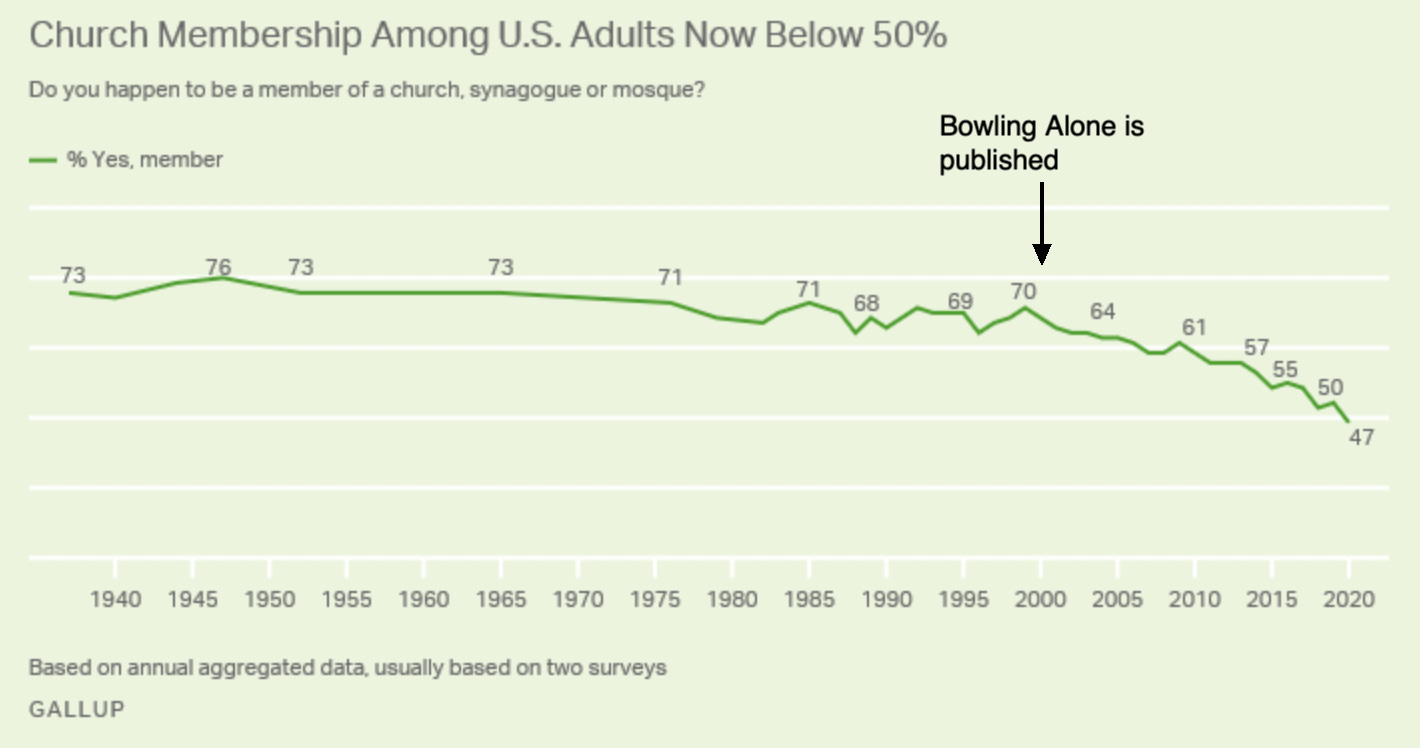
Anton Cebalo documents a decline in sex, friends and trust. Here’s a few points I found of interest. I had come to think about church membership in America as pretty much fixed around 70%. That was true for decades but not recently:
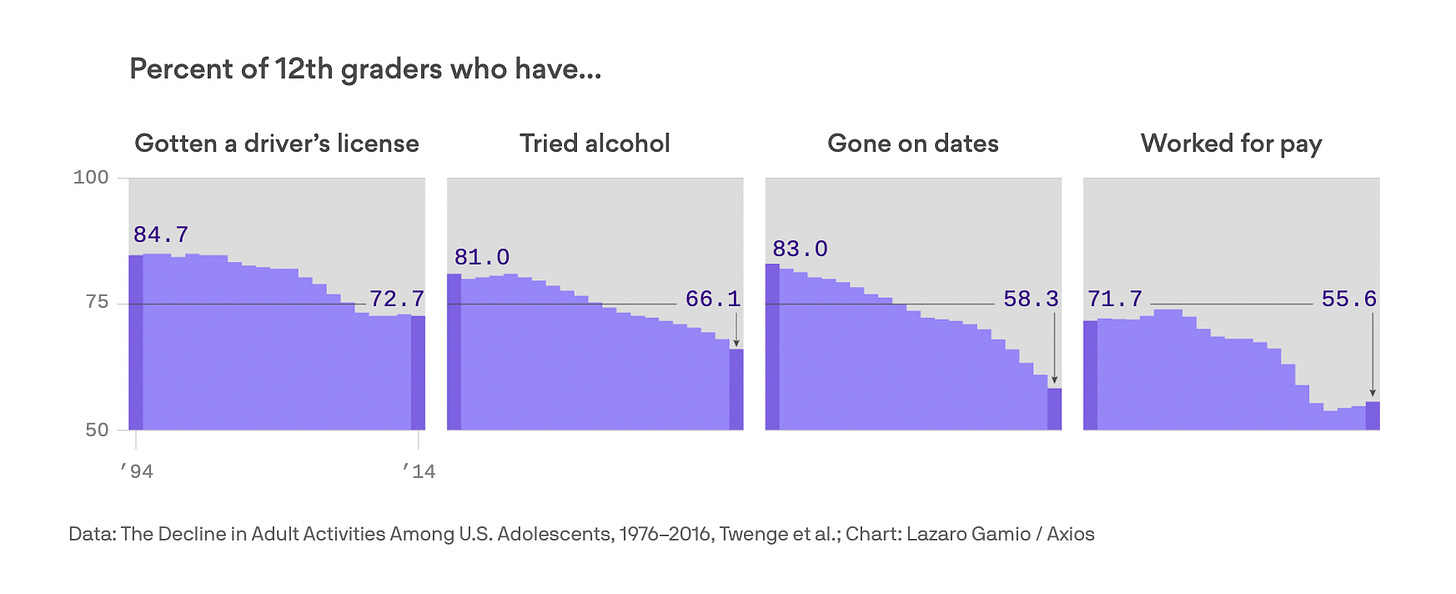
Here’s another trend, the extension of adoloscence. More and more we are treating young adults like children and in many respects they are more like children of earlier years.
There have been many psychological profiles of “late adulthood,” common among those born from the 1990s onward. Many of the milestones — getting a driver’s license, moving out, dating, starting work, and so on — have been delayed for many young adults.
The trend became obvious starting in the 2010s. In 2019, it was compiled in a comprehensive study titled The Decline in Adult Activities Among U.S. Adolescents, 1976-2016.
See Cebalo for more.
Privatization Improves Airports
Laurent Belsie summarizes a new NBER paper, All Clear for Takeoff: Evidence from Airports on the Effects of Infrastructure Privatization:
When private equity funds buy airports from governments, the number of airlines and routes served increases, operating income rises, and the customer experience improves.
…As of 2020, nearly 20 percent of the world’s airports had been privatized. Private equity (PE), usually through dedicated infrastructure funds, is playing an increasing role in privatization, purchasing 102 airports out of a total of 437 that have ever been privatized.
…A key metric of airport efficiency is passengers per flight. The more customers an airport can serve with existing runways and gates, the more services it can deliver and the more earnings it can generate. When PE funds buy government-owned airports, the number of passengers per flight rises an average 20 percent. There’s no such increase when non-PE private firms acquire an airport. Overall passenger traffic rises under both types of private ownership, but the rise at PE-owned airports, 84 percent, is four times greater than that at non-PE-owned private airports. Freight volumes and the number of flights, other measures of efficiency, show a similar pattern. Evidence from satellite image data indicates that PE owners increase terminal size and the number of gates. This capacity expansion helps enable the volume increases and points to the airport having been financially constrained under previous ownership.
…PE firms tend to attract new low-cost carriers to their airports, which in turn may lead to greater competition and offer consumers better service and lower prices. With regard to routes, PE acquirers increase the number of new routes, especially international routes, more than other buyers. International passengers are often the most profitable airport users, especially in developing countries.
A PE acquisition is also associated with a decline in flight cancellations and an increase in the likelihood of receiving a quality award. When an airport shifts from non-PE private to PE ownership, its odds of winning an award rise by 6 percentage points. The average chance of winning such an award is just 2 percent.
The fees that airports charge to airlines rise after airport privatizations. When the buyer is a PE firm, there is also a push to deregulate government limits on those fees. For example, after three Australian airports were privatized in the mid-1990s, the price caps governing airport revenues were replaced with a system of price monitoring that allows the government to step in if fees or revenues become excessive.
The net effect of a PE acquisition is a rough doubling of an airport’s operating income, due mostly to higher revenues from airlines and retailers in the terminal rather than cost-cutting. The driving forces behind these improvements appear to be new management strategies, which likely includes greater compensation for managers, alongside investments in new capacity as well as better passenger services and technology.
Does Angi Recommend Occupational Licensing?
Peter Blair and Mischa Fisher have a clever new paper on occupational licensing that uses data on millions of leads generated by Angi’s HomeAdivsor. Consumers on HomeAdvisor search for services, the platform knows whether the service requires a license in the consumer’s state and attempts to match the consumer with an appropriate local provider, the local provider can then choose whether to accept or reject the lead. If a lead is accepted, the consumer and provider then negotiate on the price and services–as the negotiation is mostly handled offline, the main measure of interest is the probability a lead is accepted.
Many occupations are licensed in one state but not in another (as I pointed out in my talk on occupational licensing to the Heritage Foundation this is odd if you think there are strong arguments for occupational licensing on safety or quality grounds). Thus the authors compare the accepted lead rate in states that require a license to complete a task to the rate in states where the same task is unlicensed. To better control for other factors, the authors only compare the accepted lead rate in counties that border different states, as shown below. The authors also control for state, month and task fixed effects.
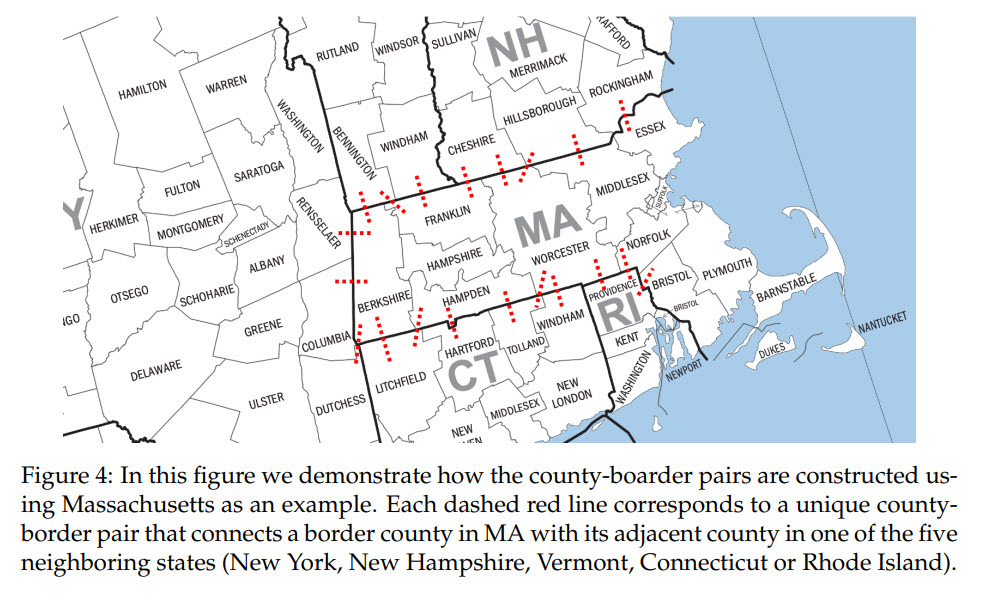
The bottom line is that the accepted lead rate is 12.3 percentage points or 21% lower in a county/state that license an occupation/task compared to a similar county/state where the task is unlicensed. In other words, if you live in a state that requires a license to complete a task it’s considerable more difficult to find a contractor than if you lived in nearby state that does not license the task.
Not surprisingly, the authors find that the accept rate declines not because there is a surge in demand for the licensed service but because supply declines when there are fewer licensed providers. In the long run, we also know that prices rise in licensed industries (e.g. my paper with Pizzola on licensing in the funeral services industry).
The authors combine their cross-sectional study with an event study that shows that after New Jersey required a license for pool contractors it become more difficult to find a pool contractor in New Jersey relative to other states.
The authors conclude:
The existing literature on licensing on digital platforms, which consists of three other papers, has carefully measured the impact of licensing on consumer satisfaction and safety by demonstrating that customer self-reports of service quality and objective platform measures of service provider safety do not increase in the presence of licensed service providers, despite the positive impact of licensing on prices (Hall et al., 2019; Farronato et al., 2020; Deyo, 2022).
…Taken together, our findings and those from the three others papers studying licensing in digital labor markets indicate that the traditional view of licensing espoused in Friedman (1962) about licensing in offline markets, i.e, licensing is a labor market restriction with limited benefits, also holds in digital labor markets (Hall et al., 2019; Farronato et al., 2020; Deyo, 2022). Our work provides a clear example where labor market regulations developed to govern the analogy economy work against the efficiency gains that technological innovation promises to bring in a digital economy (Goldfarb et al., 2015).
Phonics in High School!
It stuns me that the United States educational establishment tried to teach reading by thinking of words as pictures (whole word) or by literally using pictures to decode words (cueing). These are anti-conceptual methods and the result has been such a disaster that phonics is now being taught in high school in a (laudable) attempt to remediate.
NYTimes: In the early to mid-2010s, when high schoolers today were in elementary school, many schools practiced — and still practice — “balanced literacy,” which focuses on fostering a love of books and storytelling. Instruction may include some phonics, but also other strategies, like prompting children to use context clues — such as pictures — to guess words, a technique that has been heavily criticized for turning children away from the letters themselves.
…For some Oakhaven students, filling in gaps means going back to the beginning.
In an intensive class focused on phonics, ninth graders [AT] recently learned about adjacent consonants that make one sound, as in “rabbit,” and silent vowels. Students were mostly enthusiastic, competing to spell “repel” and giggling through an example about “dandruff.” After years of frustration, breakthroughs can feel exciting — and empowering.
One student said her grades had improved, and she was thinking about reading “The Vampire Diaries” novels, an undertaking, she said, that she previously would not have considered.
See my previous posts on Direct Instruction for more.
What to Watch: Holiday Edition 2022
 Glass Onion is a con job. It temporarily fools the viewer into thinking it original and clever and yet it is actually derivative and dumb. The ending left me bitter. It should be noted, however, that it is artfully constructed and the authors knew what they were doing. Benoit Blanc, the detective, stands in for the audience and comes to the same conclusion, “it’s all so obvious and also so stupid.” The name also gives a clue—it appears to be multi-layered but it’s glass so you can just look and see what is going on.
The Fabelmans—a paean to movie making and a close biography of Spielberg. He waited till his parents had died to make this movie. Yes, his mother actually brought home a monkey as a pet. The parents, the arty, flighty wife and the analytical, scientific husband couldn’t make it together but produced Spielberg who can and does—the opening scene with Spielberg watching his first movie between his parents says it all.
Avatar 2 I saw it in IMAX 3D. As spectacle it was great, especially the quieter water scenes. As movie it was good but broke no new ground. Indeed, Avatar 2 was exactly the same as Avatar only with more water. If you can’t see it in 3D or at least on a giant screen don’t bother.
The Recruit (Netflix): A fun CIA series which is ridiculous but rises a bit above the genre with some insight into the functions of a bureaucracy which kills people but attempts to do so legally.
 Acapulco (Apple TV). On the surface it’s a situation comedy about Maximo, a young Mexican man who sees opportunity in Los Colinas, the local resort run by a coterie of oddball characters, including the aging ex-starlet owner, Diane, who is fast approaching Norma Desmond territory. The situation is narrated by an older Maximo who has become rich and fabulously successful. At first the narration seems to be a mere device, but, over time, we begin to see that the writers are aiming at something bigger. How did Maximo become so rich? What lessons about life and business did he learn at Las Colinas? The second, hidden story line gives deeper meaning to the events of the first. Season one of Acapulco is almost entirely about Las Colinas. Only in season two do the two stories begin to converge. Can the writers pull off a denouement that brings everything together? I don’t know but the purposeful pacing and the fact that the writers aren’t showing all their cards makes me think we are seeing more than we first imagine. The opposite of Glass Onion in many ways.
Combination Rapid Tests
Once again, the US is behind on at-home rapid antigen tests–this time on combination tests that let you test for COVID, Influenza, and RSV all at once. These tests are widely available in Europe but have not been approved by the FDA. Rapid flu tests especially are potentially very useful in assigning appropriate treatment and reducing the overuse of antibiotics.

Top MR Posts of 2022
Here are the top MR posts by views from 2022. Biggest post was Tyler’s
1. Classical liberalism vs. The New Right
followed up by two posts by me on Biden’s student loan plan
2. The Student Loan Giveaway is Much Bigger Than You Think
3. Taxing Mechanical Engineers and Subsidizing Drama Majors
and further posts by me on FTX and the probability of a nuclear war.
5. What is the Probability of a Nuclear War, Redux
I said ProPublica was putting their reputation on the line with the lab-leak report but nevertheless I was too credulous. Much of the factual reporting remains correct, however. Lab leak is very much in play.
6. A “Safety Emergency” Happened at the Wuhan Institute of Virology in November of 2019
Tyler comes in next with a post on criticizing other people in private.
7. How much should you criticize other people?
and two posts on the Russian-Ukraine conflict.
9. How did the IR community get Russia/Ukraine so wrong?
Finally Tyler offers some advice:
Rounding out the top were Best Books of 2022, What Caused the 2020 Spike in Murders and How to Elect Republicans.
What were your favorite MR posts of 2022. What should we revisit?
Merry Christmas!
 From the Thomas Jefferson room at the Library of Congress.
Open Sesame!
The excellent Alec Stapp points us to an absolute classic in the law of unintended consequences:
APNews: A new federal law requiring that sesame be listed as an allergen on food labels is having unintended consequences — increasing the number of products with the ingredient.
Food industry experts said the requirements are so stringent that many manufacturers, especially bakers, find it simpler and less expensive to add sesame to a product — and to label it — than to try to keep it away from other foods or equipment with sesame.
As a result, several companies — including national restaurant chains like Olive Garden, Wendy’s and Chick-fil-A and bread makers that stock grocery shelves and serve schools — are adding sesame to products that didn’t have it before. While the practice is legal, consumers and advocates say it violates the spirit of the law aimed at making foods safer for people with allergies.
I Still Hate Flexible Spending Accounts
According to a new report in Money workers lost billions in so-called flexible savings accounts:
…44% of workers with FSAs in 2019 forfeited money. On average, the amount lost totals $339 per person.
…With reliable data on how often workers forfeit, how much they forfeit and how many FSAs workers hold, we can now reasonably estimate that workers forfeited approximately $3 billion in 2019 and $4.2 billion in 2020.
As I said in my post from 2017 (no indent), I hate “flexible” spending accounts, i.e. those accounts where you put say $1000 in tax-free but you then must submit a bunch of health or education receipts to claim the money–and the “benefits manager” tells you half of the receipts you submitted are no good so you have to trawl through your files to find more–or lose the money. The whole process is demeaning. My hatred of this process, however, pales in comparison to that of Scott Sumner who gives a correct analogy:
Imagine a government that took 10% of each person’s income, and put in in a wooden box. The box was placed at the end of a 10-mile gravel road. Each citizen was given a knife, and told they could crawl on their hands and knees down the road, and then use the knife to cut a hole in the box, and retrieve their money.
Scott’s point is twofold. First, there is a lot of waste in crawling down the road. Second, taken in isolation, it looks like the plan at least offers people an option and so, in isolation, flex accounts and their ilk appear to benefit taxpayers. In the big picture, however, the total amount taken in taxes is somewhat fixed by politics and economics so if we got rid of the spending accounts, taxes would probably fall in other ways that are difficult to predict but nonetheless real.
Some want to crawl down the gravel road, fearing that if they abolish the program the government will not reduce their tax rates, instead the money in the box will be diverted to welfare for the poor, or higher salaries for teachers. I can’t deny that this might occur, but if we don’t even TRY to build a good country, how can we possibly succeed? Isn’t it better to try and fail, rather than not even try?
I agree with Scott. If I am going to be forced to pay taxes I’d like to hand over my cash standing like a man and not be given the option of crawling to recoup some bills the tax collector magnanimously throws on the floor.
The FDA’s Lab-Test Power Grab
The FDA is trying to gain authority over laboratory developed tests (LDTs). It’s a bad idea. Writing in the WSJ, Brian Harrison, who served as chief of staff at the U.S. Department of Health and Human Services, 2019-2021 and Bob Charrow, who served as HHS general counsel, 2018-2021, write:
We both were involved in preparing the federal Covid-19 public-health emergency declaration. When it was signed on Jan. 31, 2020, the intent was to cut red tape and maximize regulatory flexibility to allow a nimble response to an emerging pandemic.
Unknown to us, the next day the FDA went in the opposite direction: It issued a new requirement that labs stop testing for Covid-19 and first apply for FDA authorization. At that time, LDTs were the only Covid tests the U.S. had, and many were available and ready to be used in labs around the country. But since the process for emergency-use authorization was extremely burdensome and slow—and because, as we and others in department leadership learned, it couldn’t process applications quickly—many labs stopped trying to win authorization, and some pleaded for regulatory relief so they could test.
Through this new requirement the FDA effectively outlawed all Covid-19 testing for the first month of the pandemic when detection was most critical. One test got through—the one developed by the Centers for Disease Control and Prevention—but it proved to be one of the highest-profile testing failures in history because the entire nation was relying on the test to work as designed, and it didn’t.
When we became aware of the FDA’s action, one of us (Mr. Harrison) demanded an immediate review of the agency’s legal authority to regulate these tests, and the other (Mr. Charrow) conducted the review. Based on the assessment, a determination was made by department leadership that the FDA shouldn’t be regulating LDTs.
Congress has never expressly given the FDA authority to regulate the tests. Further, in 1992 the secretary of health and human services issued a regulation stating that these tests fell under the jurisdiction of the Centers for Medicare and Medicaid Services, not the FDA. Bureaucrats at the FDA have tried to ignore this rule even though the Supreme Court in Berkovitz v. U.S. (1988) specifically admonished the agency for ignoring federal regulations.
Loyal readers will recall that I covered this issue earlier in Clement and Tribe Predicted the FDA Catastrophe. Clement, the former US Solicitor General under George W. Bush and Tribe, a leading liberal constitutional lawyer, rejected the FDA claims of regulatory authority over laboratory developed tests on historical, statutory, and legal grounds but they also argued that letting the FDA regulate laboratory tests was a dangerous idea. In a remarkably prescient passage, Clement and Tribe (2015, p. 18) warned:
The FDA approval process is protracted and not designed for the rapid clearance of tests. Many clinical laboratories track world trends regarding infectious diseases ranging from SARS to H1N1 and Avian Influenza. In these fast-moving, life-or-death situations, awaiting the development of manufactured test kits and the completion of FDA’s clearance procedures could entail potentially catastrophic delays, with disastrous consequences for patient care.
Clement and Tribe nailed it. Catastrophic delays, with disastrous consequences for patient care is exactly what happened. Thus, Harrison and Charrow are correct, giving the FDA power over laboratory derived tests has had and will have significant costs.
The Birx Plan for Early Vaccination of the Nursing Homes
In Covid in the nursing homes: the US experience, Markus Bjoerkheim and I show that the Great Barrington “focused protection” plan was unlikely to have worked. I covered this last week. But there was one strategy which could have saved tens of thousands of lives–early vaccination. If the vaccine trials had been completed just 5 weeks earlier, for example, we could have saved 14 thousand lives in the nursing homes alone. But put aside the possibility of completing the trials earlier. There was another realistic possibility under our noses. We had could have offered nursing home residents the vaccine on a compassionate use basis, i.e. even before all the clinical trials were completed. An early vaccination option was neither unprecedented nor a question of 20-20 hindsight, early vaccination was discussed at the time:
Deborah Birx, the coordinator of the White House Coronavirus Task Force, forcefully advocated that nursing home residents should be given the option of being vaccinated earlier under a compassionate use authorization (Borrell, 2022). Many other treatments, such as convalescent plasma, were authorized under compassionate use procedures and there was more than enough vaccine available to vaccinate all nursing home residents. As a first approximation we find the Birx plan would have prevented in the order of 200,000 nursing home cases and 40,000 nursing home deaths. To put that in perspective, it amounts to reducing overall nursing home Covid deaths by over 26 per cent (using all CMS reported resident nursing home deaths as of 5 December 2021, and estimates of underreported deaths from Shen et al. (2021)).
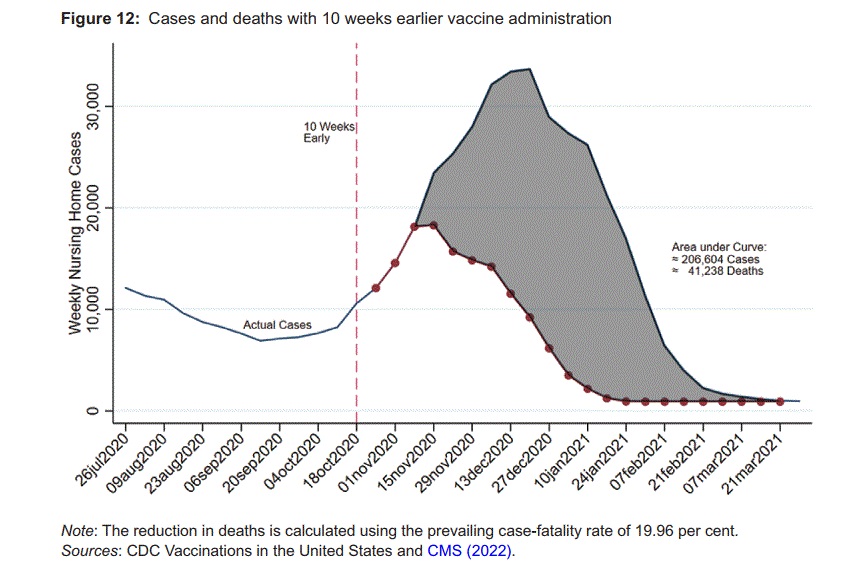
The lesson is not primarily about the past. It’s about the central importance of vaccines in any plan to protect the vulnerable and about how we should be bolder and braver the next time.
Addendum: See also Tyler’s tremendous post (further below) on focused protection.
Liberal Democracy Strong
Bravo to Richard Hanania for revisiting some beliefs:
In February, I argued that Russia’s imminent successful invasion of Ukraine was a sign heralding in a new era of multipolarity. By October, I declared every challenge to liberal democracy dead and Fukuyama the prophet of our time. It’s embarrassing to have two contradictory pieces written seven months apart. But it would’ve been more embarrassing to persist in believing false things. If there’s any time to change one’s mind, it’s in the aftermath of large, historical events that went in ways you didn’t expect. Russia’s failure in Ukraine and China’s Zero Covid insanity provided extremely clear and vivid demonstrations of what democratic triumphalists have been saying about the flaws of autocracy. Nothing that the US or Europe have done – from the Iraq War to our own overly hysterical response to the coronavirus – have been in the same ballpark as these Chinese and Russian mistakes. Perhaps the war on terror comes close in terms of total destruction and lives lost, but we could afford to be stupid and it didn’t end up hurting Americans all that much.
In the land of the blind, the one-eyed man is king but still it’s good to see liberal democracy put some points on the scoreboard.
The Great Barrington Plan: Would Focused Protection Have Worked?
A key part of The Great Barrington Declaration was the idea of focused protection, “allow those who are at minimal risk of death to live their lives normally to build up immunity to the virus through natural infection, while better protecting those who are at highest risk.” This was a reasonable idea and consistent with past practices as recommended by epidemiologists. In a new paper, COVID in the Nursing Homes: The US Experience, my co-author Markus Bjoerkheim and I ask whether focused protection could have worked.
Nursing homes were the epicenter of the pandemic. Even though only about 1.3 million people live in nursing homes at a point in time, the death toll in nursing homes accounted for almost 30 per cent of total Covid-19 deaths in the US during 2020. Thus we asked whether focusing protection on the nursing homes was possible. One way of evaluating focused protection is to see whether any type of nursing homes were better than others. In other words, what can we learn from best practices?
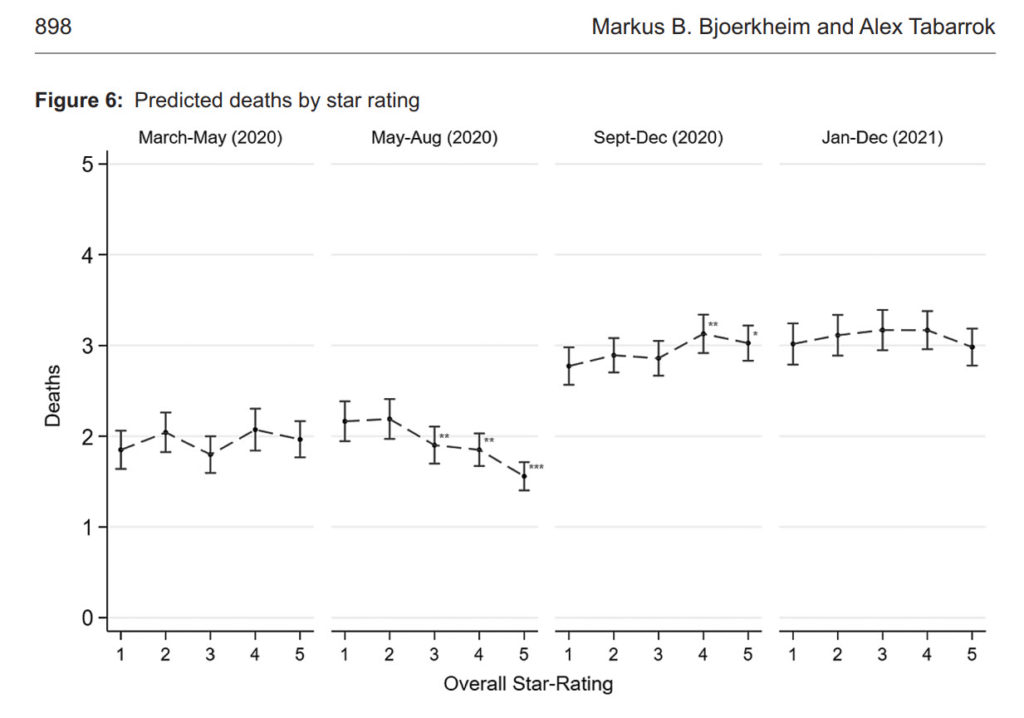
The Centers for Medicaire and Medicaid Services (CMS) has a Five-Star Rating system for nursing homes. The rating system is based on comprehensive data from annual health inspections, staff payrolls, and clinical quality measures from quarterly Minimum Data Set assessments. The rating system has been validated against other measures of quality, such as mortality and hospital readmissions. The ratings are pre-pandemic ratings. Thus, the question to ask is whether higher-quality homes had better Covid-19 outcomes? The answer? No.
The following figure shows predicted deaths by 5-star rating. There is no systematic relationship between nursing homes rating and COVID deaths. (In the figure, we control for factors outside of a nursing homes control, such as case prevalence in the local community. But even if you don’t control for other factors there is little to no relationship. See the paper for more.) Case prevalence in the community not nursing home quality determined death rates.
More generally, we do some exploratory data analysis to see whether there were any “islands of protection” in the sea of COVID and the answer is basically no. Some facilities did more rapid tests and that was good but surprisingly (to us) the numbers of rapid tests needed to scale nationally and make a substantial difference in nursing home deaths was far out of sample and below realistic levels.
Finally, keep in mind that the United States did focused protection. Visits to nursing homes were stopped and residents and staff were tested to a high degree. What the US did was focused protection and lockdowns and masking and we still we had a tremendous death toll in the nursing homes. Focused protection without community controls would have led to more deaths, both in the nursing homes and in the larger community. Whether that would have been a reasonable tradeoff is another question but there is no evidence that we could have lifted community controls and also better protected the nursing homes. Indeed, as I pointed out at the time, lifting community controls would have made it much more difficult to protect the nursing homes.
Why The United States Should Open New Consulates in India
A good piece by Michael Rubin in the National Interest:
India will likely become the most populous country on Earth this year, and, yet, outside of the U.S. Embassy in New Delhi, there are only four State Department consulates in the country of 1.4 billion. That is fewer consulates than the State Department operates in France and fewer offices than the U.S. Embassy services in Spain. The Canadian province of Quebec, whose population totals less than nine million, merits two consulates in the State Department’s view.
…The United States computer and tech industry rests disproportionately on the labor and intellectual contributions of America’s vast Indian-American community. If Silicon Valley is the center of America’s computer industry, then Bangalore is its equivalent in India. The interaction between the two is significant. And yet, while India maintains a consulate in San Francisco, the United States has no equivalent in Bangalore; the closest American post is more than 200 miles away in Chennai. It need not be an either/or decision, but at the very least the State Department should explain why maintaining an investment in Winnipeg, Canada is more important than nurturing the relationship between two of the largest tech hubs in the world.
… if U.S. diplomacy is to be effective, it needs to adjust to twenty-first-century realities rather than nineteenth-century ones.
With more consulates might we not also cut the ridiculous and embarrassing time it takes to get a US visitor or business visa? When I was last in Delhi I met with one of the economic officers at the American Embassy. His job was to drum up business between India and the US–how can anyone do that when business visas are so difficult to acquire? Talk about the land of red tape!
Hat tip: Ben.