Category: Music
What should I ask Camille Paglia?
I’ll be doing a Conversations with Tyler with her, Tuesday, April 12. What should I ask her?
The economics of animated movies
An executive producer who wants to cut costs has only two choice curbs: water and hair. Those are the most expensive things to replicate accurately via animation. It’s no mistake that the characters in Minions, the most profitable movie ever made by Universal, are virtually bald and don’t seem to spend much time in the pool.
Animation, as with all formulaic and saccharine film genres, tends to bring out Hollywood’s blockbuster gambling addiction. The perverse incentives of the format means that fortune favours the spendthrift — the bigger the budget, the bigger the windfall.
“In some ways, a $90 million movie is more risky than a $150 million one,” Creutz said.
This means that when animated films flop, they flop hard. In fourth quarter 2013, DreamWorks took an $87 million writedown on Rise of the Guardians. Without the charge, the studio would have posted a small profit in the period, rather than an $83 million loss. A few months later, it had to take a $57 million writedown on Mr. Peabody and Sherman, a film that cost $145 million to make and far more to market.
Interesting throughout, here is the article by Kyle Stock.
China facts of the day
Yet the world’s biggest economy (at least by some measures) is tiny in terms of the size of its music market, which is smaller than that of Austria or Switzerland. It’s a mere sliver of the size of the US music industry.
Piracy is a major factor, but note this too:
While the IFPI calls China a country of “enormous untapped potential,” it also notes that only 10% of the market goes to non-Chinese-language music right now.
For the future there is this:
…all foreign media companies will be blocked from publishing digital content in the country, any online text, audio, or video content produced abroad—starting March 10—will be in violation (link in Chinese) of national law.
Here is the Amy X. Wang piece, via Ted Gioia, who also points out that now China is the largest movie market in the world.
By the way, are you still thinking that China’s service sector is holding the economic line? Here is the latest:
Still, the services gauge slipped to 52.7 in February, from 53.5 in January. Measures of new orders, selling prices, employment, backlogs and inventories were below the 50 dividing line between improving and worsening conditions.
A separate manufacturing reading from Caixin Media and Markit Economics fell to 48 in February, from 48.4 in January.
That said, the 13th Five-Year Plan will be released soon…
My conversation with Nate Silver
The video, podcast, and transcript are here. Nate of course was excellent, here are just a few bits:
COWEN: What are the differences between forecasting and futurism, and do you have any predictions for the year 2050? They don’t have to be great. They just have to be better than the market. We’ll take a 52 percent prediction and go home and celebrate.
SILVER: I’m mildly pessimistic in some ways.
COWEN: What’s the biggest source of your pessimism?
SILVER: [laughs] There’s probably some survivorship bias in the United States, and thinking about how our way will persevere forever and ever and ever. We were talking backstage about how you go to Asia and I go to Asia — not as often as you. If you want to feel optimistic about civilization, then go there.
And:
COWEN: You’re a fan of baseball, and I’d like to ask you, of all the different baseball records, which is the one that is most impressive to you, or the most a statistical aberration, and try to stay a bit modern. We both know in 1889, Hoss Radbourn won 59 games.
Start with [Owen] Wilson’s — was it 36 triples in 1912? That, and up through the modern age. What’s the most statistically impressive baseball record, and why?
SILVER: I think the biggest outlier is the number of intentional walks that Barry Bonds drew. I forget what year it was, 2001, where he had like 161 intentional walks, and the next closest player is 50?
And:
COWEN: Singapore. Overrated or underrated?
SILVER: Underrated except by you.
There is of course much, much more, including remarks on the candidates and the elections, as well as My Bloody Valentine and more on sports too, prediction markets as well, the weather, and why so few professional athletes have come out as gay. Recommended.
Why Do We Kiss?
Smithsonian: [K]issing helps heterosexuals select a mate. Women in particular value kissing early on. Saliva is full of hormones
and other compounds that may provide a way of chemically assessing mate suitability—that’s the biological brain stepping in.
…While kissing, couples exchange 9 milliliters of water, 0.7 milligrams of protein, 0.18 mg of organic compounds, 0.71 mg of fats, and 0.45 mg of sodium chloride, along with 10 million to 1 billion bacteria, according to one accounting.
Women are also more likely to say that a first kiss could be the decider for selecting a mate. Can the biological drive overcome the perception that your chosen one is a bad kisser? Wlodarski says it’s hard to separate the two, but that “I would hazard a guess that if someone thinks someone is a bad kisser it’s because their smell wasn’t right,” he says. Women have to be more selective because they face greater consequences when they make a poor mating decision—like having to carry a baby for nine months, says Wlodarski.
…Not every culture is down with the full-on mouth kissing enlivened by a wandering tongue. That seems to be a modern, and Western, convention, perhaps from the last 2,000 years, says Wlodarski. A study published in 2015 found that less than half of the cultures surveyed engage in romantic, sexual kissing.
There’s evidence—at least from written history—that in the past, kissing was primarily mutual face or nose rubbing, or even sniffing in close proximity. In Hindu Vedic Sanskrit texts, kissing was described as inhaling each other’s soul.
My conversation with Kareem Abdul-Jabbar
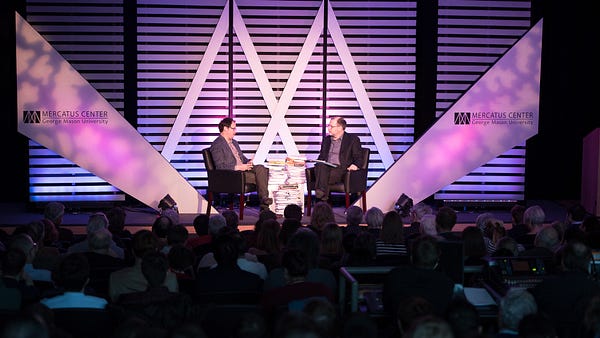
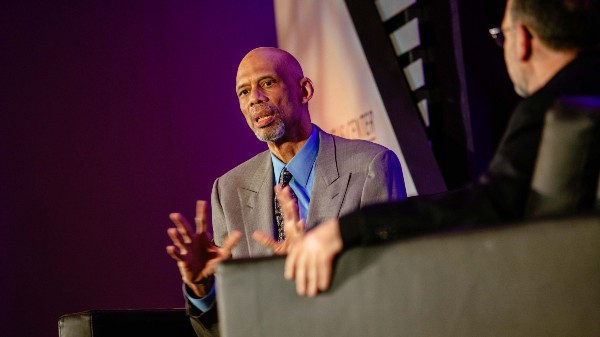
Here is the video, the podcast, and the transcript. Kareem really opened up. Here is the summary:
Kareem Abdul-Jabbar joins Tyler Cowen for a conversation on segregation, Islam, Harlem vs. LA, Earl Manigault, jazz, fighting Bruce Lee, Kareem’s conservatism, dancing with Thelonious Monk, and why no one today can shoot a skyhook.
Maybe you think of Kareem as a basketball player, but here is my introduction:
Kareem Abdul-Jabbar is one of America’s leading public intellectuals. I would describe him as an offshoot of the Harlem Renaissance, and what he and I share in common is a fascination with the character of Mycroft Holmes, the subject of Kareem’s latest book — and that of course, is Sherlock Holmes’s brother.
Here is Kareem:
I did know Amiri [Baraka]. I think the difference is I believe in what happened in Europe during what they call the Enlightenment. That needs to happen to black Americans, absolutely a type of enlightenment where they get a grasp of what is afflicting them and what the cures are.
I think that the American model is the best in the world but in order to get everybody involved in it we have to have it open to everyone. That hasn’t always been the case.
The most under-appreciated Miles Davis album?
For me [Kareem], the most under-appreciated one is Seven Steps to Heaven. And that shows, I think, Miles’ best group. There’s a big argument, what was Miles’ best group, the one that had Cannonball Adderley, Coltrane, Bill Evans, and Philly Joe Jones and Red Garland or Herbie Hancock, Ron Carter, Tony Williams, and Wayne Shorter?…number two is Porgy and Bess.
He cites Chester Himes as the underappreciated figure of the Harlem Renaissance. And Kareem thinks like an economist:
It [my instruction] was going well with Andrew Bynum, but Andrew finally got to sign his contract for $50 million, and then at that point Andrew thought that I didn’t know anything and that he didn’t have to listen to me, and we don’t know where Andrew is right now.
Read or hear also his very interesting remarks on Islam, and where its next Enlightenment is likely to come from, not to mention Kareem on the resource curse and of course his new book (and my Straussian read of it). And Kareem on his favorite movies, starting with The Maltese Falcon. Self-recommending!
My favorite things Iowa
No, I’m not in Iowa, but I’ve never covered it before, and today seems like as good a day as any. Here goes:
1. Painter: Grant Wood. Here is an interpretative take on American Gothic. It’s not by the way man and wife in the picture, but rather Wood’s sister standing next to the local dentist.
2. Novelist: I draw a blank, sorry people…Does it count that Joe Haldeman (The Forever War) was a product of the Iowa Writer’s Workshop? There must be other examples as well.
3. Hero: Norman Borlaug.
4. Actor: John Wayne is from Iowa, but I can’t call him a favorite. I guess he is my favorite version of…John Wayne. If that. Can one call Johnny Carson an actor? I never took to him either.
5. Jazz musician: Yes there is one, Bix Beiderbecke. Art Farmer too, and also Charlie Haden. Yet how rarely one hears of the “Iowa jazz tradition.”
6. Guitarist: Dick Dale, don’t by the way forget his Lebanese background, which you can hear in his riffs.
7. Movie, set in: What’s Eating Gilbert Grape? Honorable mention to the more obvious Field of Dreams, an OK but not great film in my view.
The bottom line: Who would have thought “jazz musician” would be the strongest category here? Those Iowans are so busy with their jazz, it is amazing they have time to lobby for their ethanol subsidies.

Uncertainty increases the reliance on affect in decisions
That is a new paper by Ali Faraji-Rad and Michel Tuan Pham, here is the abstract:
Uncertainty is an unavoidable part of human life. How do states of uncertainty influence the way people make decisions? We advance the proposition that states of uncertainty increase the reliance on affective inputs in judgments and decisions. In accord with this proposition, results from six studies show that the priming of uncertainty (vs. certainty) consistently increases the effects of a variety of affective inputs on consumers’ judgments and decisions. Primed uncertainty is shown to amplify the effects of the pleasantness of a musical soundtrack (study 1), the attractiveness of a picture (study 2), the appeal of affective attributes (studies 3 and 4), incidental mood states (study 6), and even incidental states of disgust (study 5). Moreover, both negative and positive uncertainty increase the influence of affect in decisions (study 4). The results additionally show that the increased reliance on affective inputs under uncertainty does not necessarily come at the expense of a reliance on descriptive attribute information (studies 2 and 5), and that the increased reliance on affect under uncertainty is distinct from a general reliance on heuristic or peripheral cues (study 6).
The pointer is from Cass Sunstein on Twitter. File under “The culture that is Iowa”?
Conversation with Kareem tomorrow is relocated
Robert Parrish could not much push him away from his preferred spots on the floor, but due to snow we are altering the venue:
New venue:
Westin Arlington Gateway, F. Scott Fitzgerald Ballroom (2nd floor), 801 North Glebe Road Arlington, VA
Tuesday, January 26, 2016, 3:30 p.m. – 5:00 p.m.
At the event, you can participate in the conversation by tweeting your questions and comments using the hashtag #CowenKareem.
You can watch the event online at mercatus.org/live
The rise and decline of Wikipedia?
Halfaker, Geiger, Morgan, and Riedl have a new paper on this topic (pdf), here is the abstract:
Open collaboration systems like Wikipedia need to maintain a pool of volunteer contributors in order to remain relevant. Wikipedia was created through a tremendous number of contributions by millions of contributors. However, recent research has shown that the number of active contributors in Wikipedia has been declining steadily for years, and suggests that a sharp decline in the retention of newcomers is the cause. This paper presents data that show that several changes the Wikipedia community made to manage quality and consistency in the face of a massive growth in participation have ironically crippled the very growth they were designed to manage. Specifically, the restrictiveness of the encyclopedia’s primary quality control mechanism and the algorithmic tools used to reject contributions are implicated as key causes of decreased newcomer retention. Further, the community’s formal mechanisms for norm articulation are shown to have calcified against changes – especially changes proposed by newer editors.
This is an interesting paper, but I think it undervalues the hypothesis that potential contributors simply prefer to be in on things which are both new and cool. Wikipedia, which is no longer new, cannot be so cool. That is why Beethoven’s 5th does not top the pop charts, though if it were new it might.
For the pointer I thank David Siegel.
Why older halls for symphony orchestras sound better than new ones?
According to Witold Rybczynski, it is partly a matter of size and shape. Older halls were more likely in a shoe-box shape, such as Musikvereinsaal (1870),the Concertgebouw (1888), and Symphony Hall (1900). The orchestra is at the narrow end of the hall, and “Sound is reflected to the listener from the two parallel walls (which are about sixty to eighty feet apart) as well as from the ceiling. Because the concertgoer is relatively close to the musicians, the atmosphere is intimate, visually as well as acoustically.”
The need for greater seating capacity, because of revenue, swells the halls to as large as 3,000 seats and renders these properties more difficult to achieve. Most of all, it is now difficult “to reflect bass notes from the side walls.”
Different halls also have different “reverberation” times, and thus the more that a hall is used for different kinds of music, the more the design of that hall reflects a compromise. In theory there should be different halls for playing Gorecki and Bach, so an all-purpose hall will sound ideal only rarely.
That is all from his new book Mysteries of the Mall and Other Essays, pp.188-192.
Helping Bryan Caplan homeschool his children
Bryan Caplan is homeschooling his twin sons, and some of that involves bringing them into Carow Hall and GMU to hang around the rest of us. They are perhaps the only twelve year olds taking an advanced undergraduate class in labor economics; I think they can handle it.
Bryan asked if I would give them a lecture of sorts, of course I sad yes, and, oddly or not, he chose the topic of Art History for me (others around know some economics too, so perhaps that is indeed my comparative advantage). I found it an interesting exercise to ponder what I would start telling them about, given they have virtually no background in the area, and perhaps I’ll get back to that in a future post.
In the meantime, I have two general points. First, introducing your children to additional role models and sources of inspiration — your friends and co-workers, or so one should hope — is one of the best things you can do for them. Most wealthy, famous, and well-educated parents under-invest in this activity. The bottom line is that after some margin you stop influencing them, but they don’t stop looking around for sources of influence.
Second, if you are well-known, or have lots of well-known and/or talented friends, or maybe even if not, you should consider homeschooling your children for a while in this manner, if only for a month or two over the summer. Your friends will be willing to give some form of instruction to your children, and they will be way, way better than normal teachers.
My next lecture for Bryan’s children will be History of American Popular Song, complemented with musical tracks of course, though no singing.
Addendum: Here are comments from Stationary Waves.
Drum Solo
Rush’s Neil Peart was recently voted the greatest drummer of all time. Here’s Neil demonstrating why:
To appreciate the artistry, I like this best on headphones without visuals but the video captures the amazing physicality of the performance. Some backstory here.
Top scientists are more artistic
The average scientist is not statistically more likely than a member of the general public to have an artistic or crafty hobby. But members of the National Academy of Sciences and the Royal Society — elite societies of scientists, membership in which is based on professional accomplishments and discoveries — are 1.7 and 1.9 times more likely to have an artistic or crafty hobby than the average scientist is. And Nobel prize winning scientists are 2.85 times more likely than the average scientist to have an artistic or crafty hobby.
There is more here, by Rosie Cima. The original research is here, by Root-Bernstein, Allen, and Beach.
For pointers I thank Samir Varma and Robert Wiblin.
Robert Whaley speaks
On my iPhone are 55 albums by Bob Dylan, 16 albums by Leonard Cohen and 34 albums by Steve Earle. That’s all I listen to. It’s the storytelling in their lyrics. Dylan’s album “Tempest” is one of his best. The title song is a haunting 14-minute song about the sinking of the Titanic. I have every one of his albums except the last one where he interprets Frank Sinatra. That was out of line. He must have needed money. And I actually bumped into Steve Earle at the airport and introduced myself. My wife was just disgusted that I’d go and bother him, but he was very receptive. No, I did not tell him I developed the volatility indices.
Here is the rest of the interview.