Category: Web/Tech
What should I ask Peter Thiel?
I may not follow any of your suggestions, but just thought I should ask for advice, for my dialogue with Peter next week. I am the interviewer, he is the interviewee, more or less. #CowenThiel
Why is subtitling and closed captioning so bad?
Why is the (global) state of subtitling and closed captioning so bad?
a/ Subtitling and closed captioning are extremely efficient ways of learning new languages, for example for immigrants wanting to learn the language of their new country.
b/ Furthermore video is now offered on phones, tablets, laptops, desktops, televisions… but very frequently these videos cannot be played with sound on (a phone on public transport, a laptop in public places, televisions in busy places like bars or shops,…).
c/ And most importantly of all, it is crucial for the deaf and hard of hearing.
So why is it so disappointingly bad? Is it just the price (lots of manual work still, despite assistive speech-to-text technologies)? Or don’t producers care?
UberAlex responded:
It’s interesting to look at the fan-sub community, where they can be a labour of love. They are often considered far superior translations to the official ones. http://en.wikipedia.org/wiki/Fansub
The present and future of marketing
There is an interview with me by Emily Hare in the latest issues of Contagious, a glossy British marketing periodical. Here is one bit:
Q: What should marketing do to ensure it lives up to its potential?
A; This is what I see happening and this may be disquieting for some of your readers. The people who are really good at marketing in this new environment are typically not formal marketers, they are not called marketing agencies, they have not studied marketing. They are people who know some areas very well and then they teach themselves a kind of marketing on the fly. A good examples if Facebook. Mark Zuckerberg is not in any formal sense a marketer, but he’s actually one of the most brilliant marketers that the world has seen in the past few decades. General principles are not that useful anymore. What is paying off is incredibly detailed, context-specific knowledge of particular areas. that’s what it takes to craft unique messages.
At all levels we’re seeing this takeover by the content people and everything is supposed to look authentic, so in a sense, authenticity is the new inauthenticity.
Marketing has never been more important, but life has never been tougher for at least some of the marketers.
I do not believe there is a version of this on line.
The rsvp and livestream for my conversations with Peter Thiel and Jeffrey Sachs
You can sign up for rsvp or the live stream here, the chat with Peter Thiel is March 31, 2-3:30 p.m. EST, held at the Arlington campus of George Mason University. It is part of a new event series Conversations with Tyler.
The chat with Jeffrey Sachs is April 7, 3:30 to 5 p.m., again EST in Arlington. There will be more to come in the Fall.
I will host and talk with guests, but without formalities. I won’t ask “So tell us about your new book,” or any of the usual soporific chit-chatty questions. I will try to replicate the conversations I would have with these same individuals in a private setting, except that you all get to listen. That means launching into substance immediately and seeing how far the back and forth can be pushed. It also means asking questions that not everyone listening will understand and willing to let parts of the audience suffer in their confusion. I want these dialogues to be as smart as possible, based on the premise that each guest, no matter how renowned he or she may be, is nonetheless a radically underrated thinker.
The goal is to be never hostile or combative, but always probing. I’m aiming for the chat to be 1/3 me vs. 2/3 guest, more or less, but about the ideas and contributions of the guest most of all.
What cost is each state obsessed with?
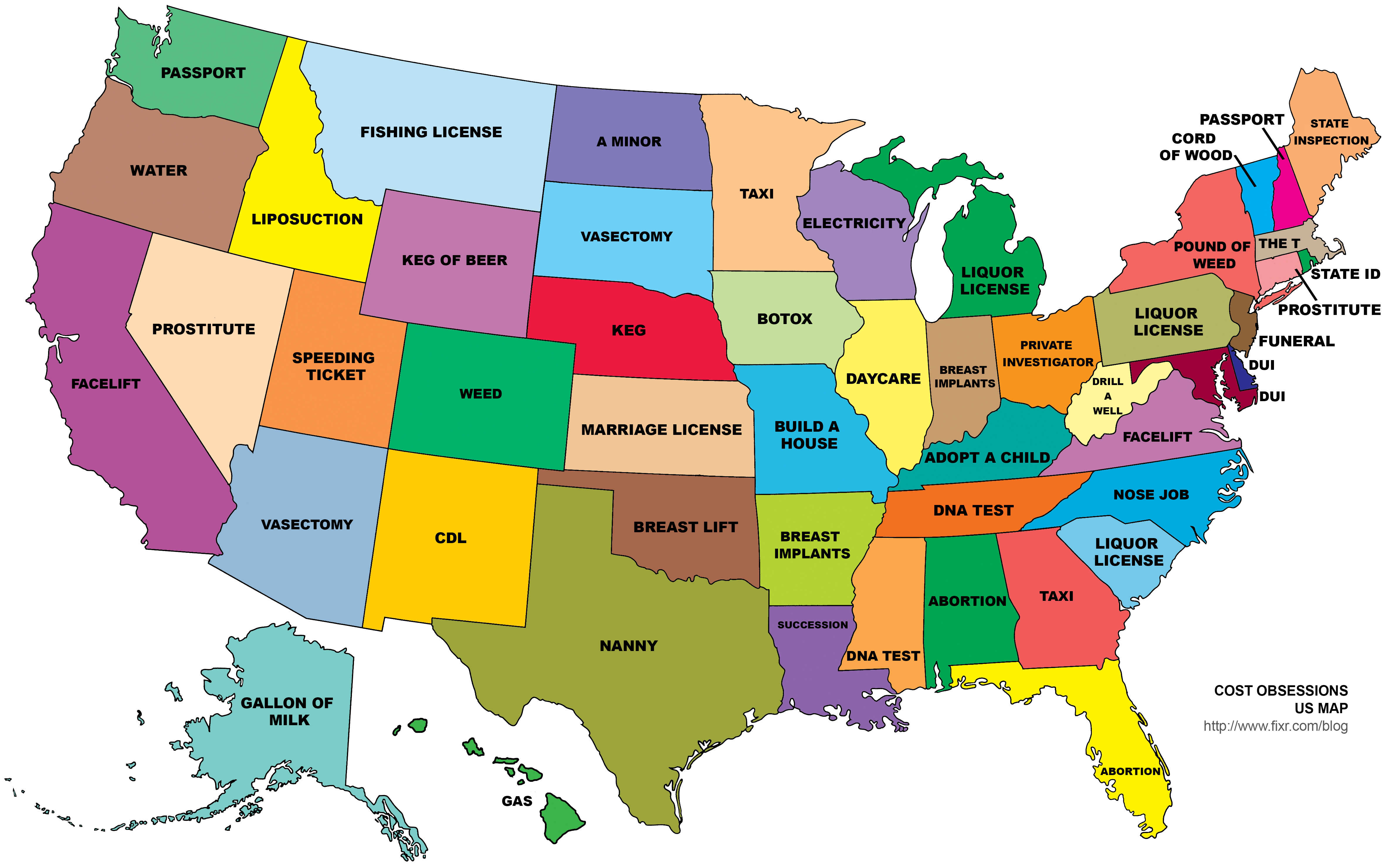
Or click here for a larger map and further explanation. The data are taken from Google searches from each state, and sadly the Northeast does not surprise me. (You will note that the searches seem to be done for the capital city of each state, which is selecting somewhat for low quality.) Perhaps Kentucky, Washington state, and Minnesota come off looking best…
For the pointer I thank Yuka.
*Chappie*, or Emile
This Neill Blomkamp (“District 9”) movie has received only lukewarm reviews, but while highly imperfect it is more interesting than most critics seem to realize. The initial premise is that in a few years’ time South Africa resorts to AI-driven, robot policemen. I see the film as revolving around three key questions:
1. What will a robot be like, if he grows up under rather brutal conditions? This is first and foremost a movie about education, and it could have been written by John Gray. Don’t assume that people (robots) have an irrevocable tendency to support liberal values, at least not when the chips are down and they have been beaten up. The gang motive is both popular and enduring.
2. Can a society dependent on robots for law enforcement become/remain a liberal society? Or will the “arms race” between the law and the criminals result in brutality and a loss of liberty?
3. How robust is a robot society to the eventual possibility of human error and depravity?
Along the way there are references to Asimov, “Silent Running,” Blade Runner, Verhoeven of course, and other android sources. I can’t endorse every angle of the ending, or every character decision, but still I didn’t consider leaving this one.
MRU is nominated for an International Academy of Web Television award
Here is the GMU press release:
Marginal Revolution University’s “Everyday Economics” video series has been nominated for an International Academy of Web Television award in the Best Documentary or Educational Series category.
There is more information here.
Does using Facebook make you happier?
I’ve long suggested that those worried about inequality, envy, and relative deprivation should tax Facebook rather than the private fortune of Bill Gates. Most envy is local, and connected to people you know and whose lives you are in touch with. Along these lines, here is some recent research by Verduyn, et.al.:
Prior research indicates that Facebook usage predicts declines in subjective well-being over time. How does this come about? We examined this issue in 2 studies using experimental and field methods. In Study 1, cueing people in the laboratory to use Facebook passively (rather than actively) led to declines in affective well-being over time. Study 2 replicated these findings in the field using experience-sampling techniques. It also demonstrated how passive Facebook usage leads to declines in affective well-being: by increasing envy. Critically, the relationship between passive Facebook usage and changes in affective well-being remained significant when controlling for active Facebook use, non-Facebook online social network usage, and direct social interactions, highlighting the specificity of this result. These findings demonstrate that passive Facebook usage undermines affective well-being.
The pointer is from Robin Hanson on Twitter.
Sentences to boggle the mind
Also, unlike Silicon Valley, the Stasi was regulated.
That is from Bryan Appleyard.
The self-assembling chair
There are few tasks more infuriating than assembling a piece of furniture. But a new project at MIT may eventually eliminate that pesky life chore entirely.
As Wired’s Liz Stinson reports, the loopy geniuses over at the Massachusetts Institute of Technology’s Self-Assembly Lab recently debuted a chair designed to put itself together, without the need for a single vaguely illustrated instruction manual.
There is also a good video at the link, courtesy of the excellent Samir Varma, a loyal MR reader. I sometimes toy with the proposition that there is in fact nothing I can assemble, not even simple items. My requested birthday gift this year was that Yana show me how to put together and operate that which I got for Christmas.
Robot sentences to ponder
Ironically, given all the concerns about robots destroying jobs, Mr Tsuda said one of the main constraints on the market’s growth was a shortage of human engineers.
“To use robots — not just to make them — you need quite a level of engineering,” he said. “If anything, for us and the market as a whole, growth is held back by the number of engineers who can do that.”
From Robin Harding at the FT, there is more here.
The disappointment of the professors?
The huge personal disappointment—and it puzzled me for a long time—was that junior professors did not, by and large, give us work I wanted to print. I knew their professional work was good. These were brilliant thinkers and writers. Yet the problems I encountered, I hasten to say, were absolutely not those of academic stereotype—not esotericism, specialization, jargon, the “inability” to address a nonacademic audience. The embarrassing truth was rather the opposite. When these brilliant people contemplated writing for the “public,” it seemed they merrily left difficulty at home, leapt into colloquial language with both feet, added unnatural (and frankly unfunny) jokes, talked about TV, took on a tone chummy and unctuous. They dumbed down, in short—even with the most innocent intentions. The public, even the “general reader,” seemed to mean someone less adept, ingenious, and critical than themselves. Writing for the public awakened the slang of mass media. The public signified fun, frothy, friendly. And it is certainly true that even in many supposedly “intellectual” but debased outlets of the mass culture, talking down to readers in a colorless fashion-magazine argot is such second nature that any alternative seems out of place.
That is from Mark Greif, an editor and founder of n+1. He says actually that graduate students do much better than the junior professors.
For the pointer I thank Claire Morgan.
What is it like to hear your own voice in an automated system?
…Most disturbing for Mr Briggs, was when he received a phone call from himself trying to flog payment protection insurance.
Briggs was also the voice of Siri for a while. Here is from another person who has been the voice of Siri:
The 65-year-old confesses she found listening to Siri a bit creepy. It was not that she hated hearing herself — that is an everyday occurrence for the voice recording artist. She is used to hearing her voice over tannoys at airports and stores, as well as telephone on-hold systems. She is her son’s bank’s automated voice and it tickles her to assume that voice and taunt him by saying: “Thank you for calling the bank. You are overdrawn.”
It was interacting with herself that felt so peculiar. “It was very strange having my voice coming back to me from my hand. I said, ‘Hi Siri, what are you doing?’ Siri said, disgustedly: ‘Talking to you.’”
That is from Emma Jacobs at the FT, interesting throughout.
Televised Korea markets in everything
I have seen this future in the eighth-floor apartment of Lee Chang-hyun in Seoul (pictured at work, above). At around midnight, he goes online with a couple of friends and performs his meal, spicy raw squid one day, crab the next. “Perform” is the right word. He is extravagant in his gestures, flaunting the food to his computer camera to tantalise the viewers. He eats noisily and that’s part of the show. He’s invested in a good microphone to capture the full crunch and slurp.
This is not a private affair. Some 10,000 people watch him eating per day, he says. They send a constant stream of messages to his computer and he responds verbally (by talking) and orally (by eating, very visibly and noisily).
If the audience like the performance, they allocate him what are called “star balloons” and each of these means a payment to him and to the internet television channel on which he performs. He is coy about how much he earns but the BBC has estimated, by noting the number of star balloons on his screen, that it would run into several hundred dollars for a two-hour stint.
The full story is here, and for the pointer I thank Claire Hill.
“I’m sorry, Dave…” (tractor edition, agriculture average is over)
Dave asked me if there was some way to bypass a bum sensor while waiting for the repairman to show up. But fixing Dave’s sensor problem required fiddling around in the tractor’s highly proprietary computer system—the tractor’s engine control unit (tECU): the brains behind the agricultural beast.
One hour later, I hopped back out of the cab of the tractor. Defeated. I was unable to breach the wall of proprietary defenses that protected the tECU like a fortress. I couldn’t even connect to the computer. Because John Deere says I can’t.
There is more here, interesting throughout, mostly about how farmers are no longer able to fix their own tractors, which by the way may cost $100,000 or more. This part is interesting too (“model this“):
There’s a thriving grey-market for diagnostic equipment and proprietary connectors. Some farmers have even managed to get their hands on the software they need to re-calibrate and repair equipment on their own—a laptop purchased from some nameless friend-of-a-friend with the software already loaded on it. There are even ways to get around the factory passwords that block access to the tECU to effect repairs.
But under modern copyright laws, that kind of “repairing” is legally questionable.
Manufacturers have every legal right to put a password or an encryption over the tECU. Owners, on the other hand, don’t have the legal right to break the digital lock over their own equipment. The Digital Millennium Copyright Act—a 1998 copyright law designed to prevent digital piracy—classifies breaking a technological protection measure over a device’s programming as a breach of copyright. So, it’s entirely possible that changing the engine timing on his own tractor makes a farmer a criminal.
In response, there is now a community of farmers looking to encourage “open source tractors.”
If this doesn’t concern you, I can assure you that in South Korea things are even worse.
For the pointer I thank the excellent Mark Thorson.