The economics of privacy
Perhaps the biggest complaint about tech companies today is that they do not respect our privacy. They gather and store data on us, and in some cases, such as Facebook, they charge companies for the ability to send targeted ads to us. They induce us to self-reveal on the internet, often in ways that are more public than we might at first expect. Furthermore, tech data practices are not entirely appropriate, as for instance Facebook recently stored user passwords in an insecure, plain text format.
This entire debate is overblown, and the major tech companies are much less of a threat to our actual privacy than is typically assumed.
For most people, gossip from friends, relatives, colleagues, and acquaintances is a bigger privacy risk than is information garnered on-line. Gossip is an age-old problem, and still today many of the biggest privacy harms come through very traditional channels. And unlike false charges planted on social media, often there is no way to strike back against secretive whisperings behind one’s back. In the workplace, one employee may tell the boss that another employee does not work hard enough, or high school gossip may destroy reputations and torment loners and non-conformists, to give two common examples of many.
If anything, the niche worlds made possible by the internet, and yes by Facebook and Google, are giving many people refuges from those worlds of public scrutiny and mockery – you can more easily find the people who and like respect you for what you really are.
Life in small towns and rural areas is another major threat to privacy – too often everybody knows everybody else’s business. In contrast, if you live in a major city or suburban area, you have a much greater ability to choose whom you interact with, and you are more protected from the prying of your neighbors and relatives. And it seems that so far, contrary to some initial “death of distance” predictions, the internet has encouraged people to move to major urban centers such as New York and San Francisco. To that extent, internet life has boosted privacy rather than destroying it.
There’s also evidence that young Americans are having less sex these days and they are less likely to be in a serious relationship. The internet is likely one cause of that isolation, and in my view those changes are probably social negatives on the whole, and they represent a valid criticism of on-line life. But is the internet in this regard boosting privacy? Absolutely. The internet makes it much easier to be in less contact with other people, whether or not that is always wise or the best life course overall. It strikes me as odd when the same people blame the internet for both loneliness and privacy destruction.
A lot of actual privacy problems in the public arena don’t seem to attract much attention, unless they are tied into a critique of big tech. For instance, autocratic governments are using Interpol and its police powers and databases (NYT) to track down and apprehend ostensible criminals who are in fact sometimes merely domestic political dissidents. It is likely that many innocent individuals have ended up in jail (can the same be said from social media violations of privacy?) That’s an example of using databases for truly evil ends and, while it was covered by The New York Times (p.A10), it is hardly a major story.
It is striking to me how much the advocates focus on regulating the big tech companies, because a true pro-privacy movement might not have that as a priority at all.
By the way, how do you feel about obituaries? The newspaper collects information on you for years, and then suddenly one day they publish it all and then keep it on the web, whether you like this or not. They’ll even throw in snide remarks, sarcastic tone, or moral judgments about you, depending on the outlet of course.
If the privacy landscape is so complex, why then is there so much anger at Facebook and other social media companies? First, most users of services such as Facebook and Google are actually pretty happy with those services and with the companies. Some of the opposition is coming from intellectuals with core anti-business grudges, politicians looking to get headlines, or often from media itself, who face Google and Facebook as major and far more profitable competitors.
Second, social media themselves create contagion effects, whereby attention is piled on a relatively small number of select victims. For instance, the #MeToo campaign has focused condemnation on a small set of offenders, such as Harvey Weinstein, then magnified by Twitter and other social media. Many other offenders get off scot-free, simply because attention has not been directed their way. Ironically, one of the better arguments against social media is to look at how social media treat and discuss social media itself. On the privacy issue, Facebook rather than say Google has ended up as the main whipping boy, even though it might have gone the other way (who again controls your gmail?). Ironically, perhaps the actual best argument about social media is how social media reflexively covers social media itself.
Third, many of the supposed concerns about privacy are perhaps questions of control. It is correct that the major tech companies do “funny things” with our data which we neither see nor understand nor control.This unsettles many people, even if it never means that some faux pas of yours is revealed in front of a party of your mocking friends. Still, I am not sure the underlying notion of “control” here has been satisfactorily defined. Many marketers, and not just on the internet, do things you do not control or even know about. Furthermore, see Jim Harper on privacy, who covers security, seclusion, autonomy, and absence of objectification as some of the different features of privacy concerns.
Of course, just as privacy violations do not stem mainly from the big tech companies, we have never been in control of what is done with information and opinion about us, again think back on social gossip. This fundamental lack of control is just now being pushed in our faces in new and unexpected ways. In part it is actually unsettling, but in part we also are overreacting.
Privacy is a real issue, but to the extent it can be fixed, most of that needs to happen outside of the major tech companies. Most of what is written about tech and privacy is simply steering us down the wrong track.
Wednesday assorted links
1. “We find an association between local practice of untouchability and open defecation that is robust; is not explained by economic, educational, or other observable differences; and is specific to open defecation rather than other health behavior or human capital investments more generally.” Link here.
2. Huawei selling its undersea cable business (but to whom exactly?).
3. Deepfake propaganda is maybe not such a big problem after all.
4. How marital sorting works for Brits (pdf).
5. Michael Strain tells us that the emergency expense story is wrong.
My Conversation with Russ Roberts
The podcast master himself, here is the audio and transcript, here is the opening summary:
What are the virtues of forgiveness? Are we subject to being manipulated by data? Why do people struggle with prayer? What really motivates us? How has the volunteer army system changed the incentives for war? These are just some of the questions that keep Russ Roberts going as he constantly analyzes the world and revisits his own biases through thirteen years of conversations on EconTalk.
Russ made his way to the Mercatus studio to talk with Tyler about these ideas and more. The pair examines where classical liberalism has gone wrong, if dropping out of college is overrated, and what people are missing from the Bible. Tyler questions Russ on Hayek, behavioral economics, and his favorite EconTalk conversation. Ever the host, Russ also throws in a couple questions to Tyler.
Here is one excerpt:
COWEN: Here’s a reader question. “In which areas are you more pro-regulation than the average American?” They mean government regulation.
ROBERTS: Than the average American?
COWEN: Yes.
ROBERTS: I can’t think of any. Can you help me out there, Tyler?
COWEN: Well, I’m not sure I know all of your views.
ROBERTS: What would you guess? Give me some things to think about there. In general, I think government should be smaller and regulations should be smaller.
COWEN: I’ll give you–
ROBERTS: Let me give you a trick answer. Then I’ll let you feed me some.
COWEN: Sure.
ROBERTS: Many people believe that the financial crisis was caused by deregulation. I think that’s a misreading of the evidence. It’s true that some pieces of the financial sector were deregulated, but government intervention in the financial sector was quite significant in advance of the crisis. In particular, the bailouts that we did of past failed financial institutions, I think, encouraged lenders to be more careless with how they lent their money, mainly to other institutions, not so much to people out in the world like you and me.
Deregulation’s a little bit tricky, so I wanted to get that in. I’m not sure how that pertains to the question. It does, probably, in some way. So give me something I should be more regulatory about.
COWEN: Well, one answer —
ROBERTS: Baseball? Baseball, of course. [laughs]
COWEN: I would say animal welfare — government should have a larger role. But also what counts as a tax-exempt institution, I would prefer our government be stricter.
ROBERTS: Well, I’m with you there. Yeah, okay, kind of.
COWEN: Well, that’s more regulation, okay?
ROBERTS: I guess.
COWEN: Kind of.
ROBERTS: Yeah, kind of. It’s different standards.
COWEN: Higher capital requirements for banks.
ROBERTS: I’m okay with that. Yeah, that’s a good one. I’d prefer a laissez-faire world for banks, more or less. If we can’t credibly promise not to bail out banks — if that’s the case, we live in a world where banks get to keep their profits and put their losses on taxpayers — bad world. A more regulated world would be better than the world we live in; not as good as my ideal world, though. But there’s a case where I would be in favor — like you just said — more capital requirements.
You’re on a roll. See what else you can come up with for me.
COWEN: Spending more money for tax enforcement, especially on the wealthy.
ROBERTS: Not the worst thing in the world.
COWEN: You can spend a dollar and bring in several times that, it seems.
ROBERTS: I don’t think rich people cheat on their taxes. Do you? [laughs]
COWEN: “Cheat” is a tricky word, but I think we could spend more money.
ROBERTS: We could probably collect more effectively.
COWEN: And it would more than pay for itself.
ROBERTS: Yeah. That’s probably true.
COWEN: We’re actually big fans of government regulation today.
ROBERTS: Yeah, we’ve really expanded the tent here. [laughs]
Do read or listen to the whole thing.
Taiwan facts of the day
Taiwan may be small, but the island has emerged as a financial superpower thanks to the thriftiness of local savers and an eye-watering current account surplus of about 15 per cent of gross domestic product. The country now has the second-largest financial system in the world, relative to gross domestic product. And its life insurance industry is the biggest, with assets-to-GDP of 145 per cent, according to JPMorgan.
The local economy is not big enough to accommodate these enormous sums, so Taiwanese financial institutions have funnelled a whopping $1.2tn abroad.
…Taiwanese insurers hold about 4 per cent of the entire US investment-grade corporate bond market, and 14 per cent of longer-term corporate bonds, according to JPMorgan. Insurers’ holdings of US mortgage-backed securities have nearly doubled over the past five years, to $260bn. That makes Taiwan the second-biggest foreign owner of such securities.
Here is the FT piece by Robin Wigglesworth.
Why do right-wing authoritarian regimes allow so much citizen exit?
Derek Bonett emails me:
I’ve been considering the differences between left-wing authoritarian regimes and right-wing authoritarian regimes throughout history. One particular difference springs to mind that I do not believe has been explored:
Left-wing authoritarian regimes very frequently restrict emigration. Legal emigration from the U.S.S.R. and the Eastern Bloc was very difficult, same with Mao’s China, Castro’s Cuba, the DPRK, “Democratic Kampuchea”, Ethiopia under Mengistu, the list goes on.
But, strikingly, it seems to me that with the partial exception of the Third Reich, fascist/ultranationalist/right-wing authoritarian regimes generally do not restrict emigration. In the Third Reich, it seems that even Jews were allowed to emigrate until 1941. Mussolini’s Italy didn’t impose extensive emigration controls either. And, accordingly to my admittedly casual familiarity with these regimes, neither did Franco’s Spain, Salazar’s Portugal, Pinochet’s Chile, nor the more generic authoritarian regimes of Chiang Kai Shek’s Taiwan or Park Chung He’s South Korea.
Does your much more comprehensive reading of history confirm this difference? Has someone already written about this?
Perhaps the more “right-wing” regimes tolerate different sorts of income inequality. Cuba and the USSR had plenty of inequality, but the main earners, in terms of living standards, are restricted to people within the state apparatus. That means a lot of the talent will want to leave. Many fascist regimes, however, are quite willing to cultivate multi-millionaires and then try to co-opt them into supporting the state. Since you can still earn a lot in the private sector, exit restrictions are less needed.
What would be other hypotheses?
I don’t find all global cities increasingly the same
Here is my Bloomberg column on that question, recently raised by Megan McArdle, here is one excerpt from my take:
Maybe it is only the “major” cities that are becoming more alike. If so, what is “major” supposed to mean? Among the more populous cities I have visited are Lagos, Tokyo, Mexico City, Delhi, Sao Paulo, Shanghai and Cairo. I can find very real similarities among their gyms, coffee shops, hotels and smart phones used by the locals. Still, it is hard to argue they are converging on some common set of experiences or cultural memes. Those cities show different movies (for the most part), play different kinds of music in public spaces, serve different dominant cuisines, exhibit different modes of personal dress, and of course speak different languages.
And:
Even central London and central Manhattan have fundamental differences, and that is without bringing Harlem or East Harlem into it. I almost always feel pleasant and relaxed walking around London. In central Manhattan, I often feel a bit stressed. I go to Manhattan to hear jazz, to visit contemporary art galleries, to soak up the energy of the streets. When I am in London (less frequently), I visit well-stocked bookshops, eat Indian food, and absorb a very different vision of government and politics.
To be blunt, if the two cities are so similar, why do I much prefer spending time in London?
…More than ever before, London and New York offer more good ways of having different experiences.
There is much more at the link, hearkening back to my earlier book Creative Destruction: How Globalization is Changing the World’s Cultures.
Tuesday assorted links
1. Has the Chinese audience induced Hollywood to make whiter casting decisions?
2. Redux of my 2016 Brexit post.
3. New learning on the Greek great depression — floating rates may not have helped much for very long.
4. Further evidence for the view that air pollution is really, really bad.
5. This is labeled “the most middle class argument ever.” I call it “the most British argument ever.” It is about flowers and property rights.
6. Against E-Verify.
Special Features of the Baumol Effect
I explained the Baumol effect in an earlier post based on Why Are the Prices So D*mn High?. In this post, I want to point out some special features of the Baumol effect that help to explain the data. Namely:
- The Baumol effect predicts that more spending will be accompanied by no increase in quality.
- The Baumol effect predicts that the increase in the relative price of the low productivity sector will be fastest when the economy is booming. i.e. the cost “disease” will be at its worst when the economy is most healthy!
- The Baumol effect cleanly resolves the mystery of higher prices accompanied by higher quantity demanded.

First, in the literature on rising prices it’s common to contrast massive increases in spending with little to no increases in quality, as for example, in contrasting education expenditures with mostly flat test scores (see at right). We have spent so much and gotten so little! Cui Bono? It must be teacher unions, administrators or the government!
All of that could be true but the Baumol effect predicts that more spending will be accompanied by no increase in quality. Go back to the classic example of the string quartet which becomes more expensive because labor in other industries increases in productivity over time. The price of the string quartet rises but does anyone expect that the the quality rises? Of course not. In the classic example the inputs to string quartet playing don’t change. The wages of the players rise because of productivity increases in other industries but we don’t invest any more real resources in string quartet playing and so we should not expect any increases in quality.
In just the same way, to the extent that greater spending on education, health care, or car repair is due to the rising opportunity costs of inputs we should not expect any increase in quality. (Note that increases in real resource use such as more teachers per student should result in increases in quality (and perhaps they do) but by eliminating the price increase portion of the higher spending we have eliminated a large portion of the mystery of higher spending with no increase in quality.)
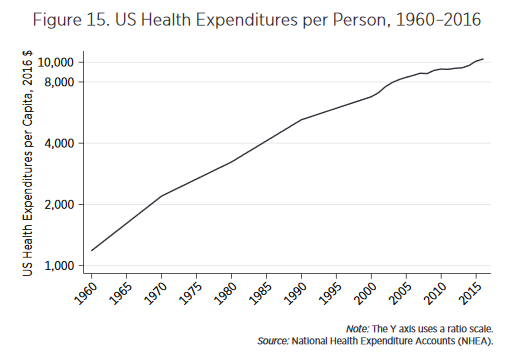 Second, explanations of rising prices that focus on bad things such as monopoly power or rent seeking tend to imply that price increases should be largest when the economy is doing poorly. In contrast, the Baumol effect predicts that increases in relative prices will be largest when the economy is booming. Consider health care. From news reports you might think that health care costs have gotten more “out of control” over time. In fact, the fastest increases in health care costs were in the 1960s. The graph at left is on a ratio scale so slopes indicate rates of growth and what one sees is that the growth rate of health expenditures per person is slowing. That might seem good but remember, from the Baumol point of view, the decline in relative price growth reflects slowing growth elsewhere in the economy.
Third, holding all else equal, the only rational response to an ordinary cost increase is to substitute away from the good. But in many rising price sectors we see not only greater expenditures (driven by increased prices and inelastic demand) but also greater quantity demanded. As I showed earlier, for example, we have increased the number of doctors, nurses and teachers per capita even as prices have risen. John Cochrane correctly noted that this is puzzling but it’s a bigger puzzle for non-Baumol theories than for Baumol. For non-Baumol theories to explain increases in the quantity purchased, we need two theories. One theory to explain the increase in price (bloat/regulation etc.) and another theory to explain why, despite the increase in price, people are still purchasing more (e.g. income effect). The world is a messy place and maybe that is what is happening. But the Baumol effect offers a cleaner answer.
A Baumol increase in relative price is always accompanied by higher income so it’s much easier to explain how price increases can accompany increases in quantity as well as increases in expenditure. The Baumol story for increased purchase of medical care even as prices increase, for example, is no more mysterious than why people can take more leisure when wages increase–namely the higher wage means a higher income for any given hours and people choose to take some of this higher income in leisure. Similarly, higher productivity in say goods production increases income at any given production level and people choose to take some of this higher income in services.
Summing up, if we examine each sector–education, health care, the arts, etc.–on its own then there are always many possible explanations for why prices might be increasing. Many of these explanations have true premises–there are a lot of administrators in higher education, health care is highly regulated, lower education is government run. But, on closer inspection the arguments often don’t fit the data very well. Prices were increasing before administrators were important, health care is highly regulated but so is manufacturing, private education is also increasing in price, the arts are not highly regulated. It’s impossible to knock down each of these arguments in every industry, so there is always room for doubt. Indeed, the great difficult is that these factors often do result in higher costs and greater inefficiency but I believe those are predominantly level effects not effects that accumulate over time. Moreover, when one considers the rising price industries as a whole these explanations begin to look ad hoc. In contrast, the Baumol effect appears capable of explaining the pricing behavior of a wide variety of industries over a long period of time using a simple but powerful and unified theory.
Addendum: Other posts in this series.
No sweet spot for Singapore in US-China tensions
That is the title of the new and remarkable Bilahari Kausikan Op-Ed in The Straits Times. I will serve up some bits, and please note this is now the world we live in:
Evoking the Long March [by Xi] is intended to prepare the Chinese people for a prolonged struggle with the US. It was, in effect, a tacit admission of the CCP’s mistakes with the consequent need for a retreat, while holding out the promise of ultimate victory…
The Chinese have long memories. Despite our constant denials, they still consider Singapore a “Chinese country” and may feel entitled to our support and will not quickly forget if we are regarded as insufficiently helpful in their time of need.
Some in the Trump administration also seem inclined to view the issue in racial terms. As the only ethnic Chinese-origin majority sovereign state outside greater China, we may be subject to special scrutiny.
What Singaporeans need to understand better is that, under present circumstances, there may be no sweet spot we can occupy that will keep both the Chinese and the Americans simultaneously happy. There is no silver bullet, and it is a fool’s errand to look for one.
Neither can we just lie low and hope for the best. You may not look for trouble but trouble may come looking for you. And trouble is all the more likely to seek you out if either side thinks you are, or can be, intimidated.
We must have the courage to pursue our own national interests. Sometimes our national interests may lead us to tilt one way, sometimes the other. But it must always be our national interest that guides us and nothing else.
Both the Chinese and Americans may not be too happy with us for pursuing our own interests. But Singapore does not exist to give joy to American or Chinese hearts. So long as neither side is so unhappy that it dismisses us as unredeemable, we can live with their unhappiness and manage it…
Our more complex domestic politics is a complication. I see still faint but distinct signs that some section of our population – how large, I do not know – either for transactional economic reasons, or unthinking ethnic sympathies, or sheer chauvinism, is beginning to look at the current US-China tensions through a racial lens.
As US-China competition heats up, this tendency may be accentuated. This is the greatest danger to Singapore in this new phase of US-China competition. It is still at a nascent stage and must be checked, if necessary by the prophylactic exercise of the coercive powers that are the legitimate monopoly of the state, before external and internal forces act and react with each other in a vicious spiral downwards.
If we hold together, we can manage the external complications. If we do not, and the social compact which is the foundation on which modern Singapore was built is strained or broken, these internal stresses may make the external complications unmanageable.
Since this period of US-China tensions will be prolonged, this is not a challenge that lends itself to definitive solutions. Managing it requires continual vigilance and periodic decisive action. It is our own Long March.
Do read the whole thing, as I said above this is now the world we live in.
W.E.B. Du Bois sentences to ponder
Du Bois was born in 1868, the year that Die Meistersinger von Nürnberg had its debut: he died in 1963, when “Surfin’ U.S.A.” was on the charts. His longevity gives us, I think, a sense that he is more modern than he really was. It can be startling to realize, for example, that when Khruschev gave him the Lenin Prize in 1959, Du Bois was being honored in the name of a man two years his junior.
That is from Kwame Anthony Appiah, Lines of Descent: W.E.B. Du Bois and the Emergence of Identity.
Monday assorted links
Cosmopolitanism vs. nationalism
That is the topic of my latest Bloomberg column. It is hard to excerpt, but here is the closing bit:
The best way for that to happen is to let practical nationalism reign, while at the margin seeking to soften it with moral cosmopolitanism. Both perspectives are valuable, and neither can be allowed to dominate. Each perspective, standing on its own, is intellectually vulnerable, yet the two outlooks together are not quite fully harmonious. It is this dynamic clash, however, that helps to account for the strength of each.
Try explaining all that, and its required background knowledge, in a 280-word tweet. Yet much of the world manages a pretty fruitful balance between moral cosmopolitanism and practical nationalism. There is a wisdom embodied in this lived experience which neither pundits nor philosophers can convey.
A tempered and centrist cosmopolitanism won’t always command the strongest loyalties, nor will practical nationalism always look so pretty. If we can accept that reality, then maybe we can stop throwing stones at each other.
Kevin Hassett to step down as CEA chair
Here are various links, Kevin we shall miss ye…it’s not your grandpa’s Trump administration anymore…
*The New Right: A Journey to the Fringe of American Politics*
That is the new book by Michael Malice, and I have to say it will go down as one of the more important albeit objectionable books of this year. Imagine an well-informed anthropological treatment of Gamergate, PUA, Ann Coulter, Mike Cernovich, Milo, and all the rest of “that stuff,” both its history and how it fits together.
Just to be clear, this book is not written from the perspective of a journalist trying to make these movements look weird, rather it is written from the perspective of an anarchist trying to make these movements look (relatively) normal. You might find that approach is not affiliated with the proper mood. I don’t get the sense that Malice is “one of them,” but his “objectivity” might not be the right kind of objectivity. I’m not going to try to resolve that meta-issue here, I’ll just say that a “normalizing” treatment of “the New Right” has some descriptive virtues, and you might end up more scared and more concerned than if you read a journalistic expose. That said, I am not sure the author really grasps the non-niceness of so much of this stuff, or the import of that non-niceness.
Every page of this book is interesting, and so I am going to recommend it. Here is a Kirkus Review, otherwise MSM doesn’t seem to be touching this one at all. Here is the Amazon link, 79 reviews and an average of five stars. The reviews themselves are not entirely reassuring.
I thank an MR reader for the pointer.
Sunday assorted links
2. The Tony Soprano house is for sale (NYT).
3. “Trump’s four-minute video about the North’s bright future, showed to Kim in Singapore, may have had more effect than observers once suggested. By now it’s clear that rich and poor North Koreans were sorely disappointed by the breakdown in talks with Trump.” Story here.
4. The history of the Laffer Curve. It’s worth noting that Laffer was correct about many of the original applications of the curve. Should there really have been Swedish and British marginal tax rates of 102 or even 95 percent? How soon people forget.