Results for “age of em” 17231 found
This is Not Fine
Why is California burning? The experts all know the answer–CA was made to burn and if you don’t do controlled burns, CA will burn uncontrolled. Here’s ProPublica in an article titled They Know How to Prevent Megafires. Why Won’t Anybody Listen?
Academics believe that between 4.4 million and 11.8 million acres burned each year in prehistoric California. Between 1982 and 1998, California’s agency land managers burned, on average, about 30,000 acres a year. Between 1999 and 2017, that number dropped to an annual 13,000 acres. The state passed a few new laws in 2018 designed to facilitate more intentional burning. But few are optimistic this, alone, will lead to significant change. We live with a deathly backlog. In February 2020, Nature Sustainability published this terrifying conclusion: California would need to burn 20 million acres — an area about the size of Maine — to restabilize in terms of fire.
…When I reached Malcolm North, a research ecologist with the U.S. Forest Service who is based in Mammoth, California, and asked if there was any meaningful scientific dissent to the idea that we need to do more controlled burning, he said, “None that I know of.”
So why doesn’t it happen? Liability law, risk-aversion, rent seeking and vetocracy. Here’s Pro-Publica on excess risk aversion in the fire service (driven by a risk averse public.) (Compare with my analysis of why the FDA is too risk averse.)
Burn bosses in California can more easily be held liable than their peers in some other states if the wind comes up and their burn goes awry. At the same time, California burn bosses typically suffer no consequences for deciding not to light. No promotion will be missed, no red flags rise. “There’s always extra political risk to a fire going bad,” Beasley said. “So whenever anything comes up, people say, OK, that’s it. We’re gonna put all the fires out.”
The ProPublica piece is actually remarkably radical as it offers as one solution, privatized burning!
Fire is not just for professionals, not just for government employees and their contractors. Intentional fire, as she sees it, is “a tool and anyone who’s managing land is going to have prescribed fire in their toolbox.” That is not the world we’ve been inhabiting in the West. “That’s been the hard part in California,” Quinn-Davidson said. “In trying to increase the pace and scale of prescribed fire, we’re actually fighting some really, some really deep cultural attitudes around who gets to use it and where it belongs in society.”
Here’s a bit on vetocracy:
Planned burns are human-made events and as such need to follow all environmental compliance rules. That includes the Clean Air Act, which limits the emission of PM 2.5, or fine particulate matter, from human-caused events. In California, those rules are enforced by CARB, the state’s mighty air resources board, and its local affiliates. “I’ve talked to many prescribed fire managers, particularly in the Sierra Nevada over the years, who’ve told me, ‘Yeah, we’ve spent thousands and thousands of dollars to get all geared up to do a prescribed burn,’ and then they get shut down.”
…“One thing to keep in mind is that air-quality impacts from prescribed burning are minuscule compared to what you’re experiencing right now,”
Francis Fukuyama also pointed to liability law, risk-aversion, rent seeking and vetocracy as factors driving dysfunction at the forest service in a 2014 article in Foreign Affairs but the forest service was only the jumping off point for his pieced titled, America in Decay The Sources of Political Dysfunction (jstor). I don’t agree with everything in that piece but it’s well worth reading to drive home the point that pandemics, forest fires, electrical shortages and more are deeply connected.
Hat tip: Garett Jones.
The fragility of herd immunity
Trouble in the Madrid region is brewing again, even though earlier seroprevalance had clocked in at about 20 percent:
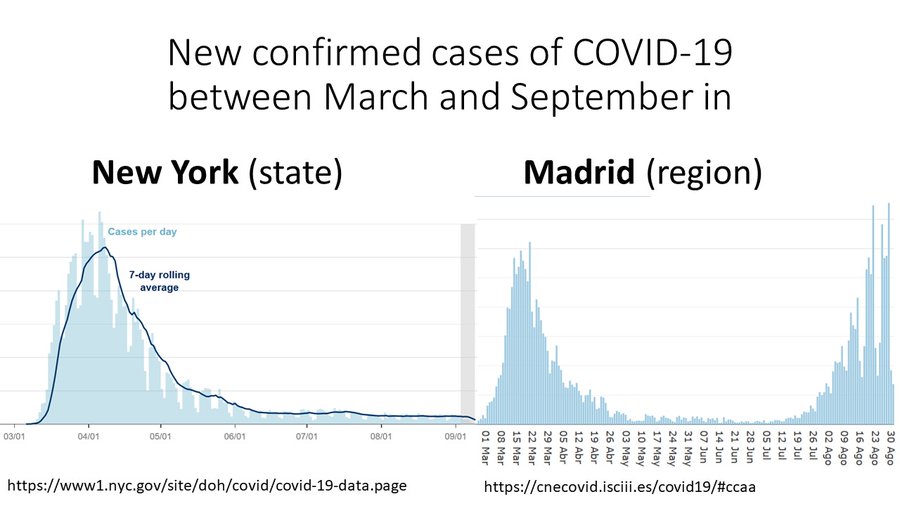
Good for New York of course, here is a thread discussing the comparison, to me the conclusions seem premature. The important point in any case is that Covid-protected time periods need not last forever, and you can end up in multiple rounds of “let it rip.” As far as I know, this is the first established case of a major “second wave” in a previously hard-hit area.
The good news is that Madrid cases seem to have peaked, and furthermore the death rate is much lower the second time around, the latter being one good reason for postponing cases into later time periods rather than taking them all up front.
Note also that England has had months of open pubs, and a very quiet situation, but now cases there are doubling every six to seven days (FT). Don’t switch back to talk of deaths! The “simple” theory of herd immunity is surprised to see that new trend in cases. What I call semi-herd immunity suggests a high degree of protection for the current configuration of social relations, after some point. As those social relations change, some of that temporary herd immunity dissolves, as new infecting connections are being created and new superspreaders arise and do their thing. But that takes a while, possibly months.
The herd immunity theorists downplay the possible temporariness of the equilibrium they pinpoint. They instead prefer to focus on the (correct) point that most of the mainstream approaches did not forecast the collapse in deaths and hospitalizations found in England, Sweden, New York, and now parts of the American South. In reality, you need to put both sides of the picture together, and grasp both the insights and limitations of the herd immunity theorists.
So herd immunity does seem to be fragile, and if other developments (treatment, antivirals, steroids, masks and thus lower dosage) lower death rates, bravo, but case behavior still moves against the simple herd immunity theory, at least in Madrid. How fragile we still do not know, and I readily grant and indeed would emphasize that Madrid is the only major counterexample to date. Appreciate the limits of knowledge!
If you listen to Ivor Cummins, a darling of the herd immunity theorists, he doesn’t seem to grasp these problems of possible temporariness (he loves to switch to talk of deaths at just the wrong time), but rather treats herd immunity as “it’s over,” with a few vague qualifiers tossed in at the very end. We will see.
The Washington Consensus Works: Causal Effects of Reform, 1970-2015
Sustained economic reform significantly raises real GDP per capita over a 5- to 10-year horizon.
Despite the unpopularity of the Washington Consensus, its policies reliably raise average incomes.
Countries that had sustained reform were 16% richer 10 years later.
As for the method:
In this paper, we define generalized reform as a discrete, sustained jump in an index of economic freedom, whose components map well onto the points of the old consensus. We identify 49 cases of generalized reform in our dataset that spans 141 countries from 1970 to 2015. The average treatment effect associated with these reforms is positive, sizeable, and significant over 5- and 10- year windows. The result is robust to different thresholds for defining reform and different estimation methods.
There are dozens of books trying to tell you this is not true, but…it is true, at least as best we know.
That is all from the new paper by Kevin and Robin Grier, did you know by the way that I helped to fix them up, leading to their later marriage and also coauthorships?
On audiobooks
From my email, from Robert Kwasny:
I imagine you listen to audio books rarely but, still, I wonder if you have any new thoughts on this topic.
Few thoughts of my own:
1. Shakespeare audiobooks are excellent. Much better than watching blu-rays. Unlike on real stage, Prospero (voiced by Ian McKellan in one production) can actually whisper softly to Miranda without worrying about people in the back rows. Stage directions are already included in the dialogue.
2. Pop psychology and self-help are terrible. Once cannot easily skip or skim the boring parts.
3. History books written by academics (e.g. The Sleepwalkers) are tough unless one already knows the necessary context. Otherwise it’s easy to get lost in the thicket of background facts. That’s probably true for all dense books. For example, Piketty’s books are available on Audible but I didn’t even bother sampling them. It’s just a wrong format.
4. I’ve had great experience with books written by authors with journalistic experience. Robert Caro’s works are excellent in audio form. William Manchester’s Churchill biography is good as well. Lawrence of Arabia by Scott Anderson too. Good audiobooks can’t be just one fact after another, they need to tell a story.
5. If the book’s author does the narration it’s usually bad. Voice acting is hard.
Unfortunately I don’t know of any book created specifically for audio. Where are biographies of Bob Dylan with songs included? Or books on rhetoric with audio of great speeches included? Audiobooks (and ebooks for that matter) don’t seem to be a new medium, at least so far. 10 years ago I would have not predicted that.
I have no new thoughts on audiobooks! Though for my next book (which is co-authored), I was asked to read at least part of the AudioBook. I will thus develop additional thoughts over time.
Those new service sector jobs, coffin whisperer edition
Also known as markets in everything:
Bill Edgar has, in his own words, “no respect for the living”. Instead, his loyalty is to the newly departed clients who hire Mr Edgar — known as “the coffin confessor” — to carry out their wishes from beyond the grave.
Mr Edgar runs a business in which, for $10,000, he is engaged by people “knocking on death’s door” to go to their funerals or gravesides and reveal the secrets they want their loved ones to know.
“They’ve got to have a voice and I lend my voice for them,” Mr Edgar said.
Mr Edgar, a Gold Coast private investigator, said the idea for his graveside hustle came when he was working for a terminally ill man.
“We got on to the topic of dying and death and he said he’d like to do something,” Mr Edgar said.
“I said, ‘Well, I could always crash your funeral for you’,” and a few weeks later the man called and took Mr Edgar up on his offer and a business was born.
In almost two years he has “crashed” 22 funerals and graveside events, spilling the tightly-held secrets of his clients who pay a flat fee of $10,000 for his service.
And:
In the case of his very first client Mr Edgar said he was instructed to interrupt the man’s best friend when he was delivering the eulogy.
“I was to tell the best mate to sit down and shut up,” he said.
“I also had to ask three mourners to stand up and to please leave the service and if they didn’t I was to escort them out.
“My client didn’t want them at his funeral and, like he said, it is his funeral and he wants to leave how he wanted to leave, not on somebody else’s terms.”
Despite the confronting nature of his job, Mr Edgar said “once you get the crowd on your side, you’re pretty right” because mourners were keen to know what was left unsaid.
You might think “that’s it,” but no the article is interesting throughout. For the pointer I thank Daniel Dummer.
My Conversation with Matt Yglesias
Substantive, interesting, and fun throughout, here is the audio, video, and transcript. For more do buy Matt’s new book One Billion Americans: The Case for Thinking Bigger. Here is the CWT summary:
They discussed why it’s easier to grow Tokyo than New York City, the governance issues of increasing urban populations, what Tyler got right about pro-immigration arguments, how to respond to declining fertility rates, why he’d be happy to see more people going to church (even though he’s not religious), why liberals and conservatives should take marriage incentive programs more seriously, what larger families would mean for feminism, why people should read Robert Nozick, whether the YIMBY movement will be weakened by COVID-19, how New York City will bounce back, why he’s long on Minneapolis, how to address constitutional ruptures, how to attract more competent people to state and local governments, what he’s learned growing up in a family full of economists, his mother’s wisdom about visual design and more.
Here is one excerpt:
COWEN: Now, I think people, on average, should become more religious, in part because that would encourage fertility. Do you also think people should become more religious?
YGLESIAS: Yeah, if I could be full Straussian and kind of —
COWEN: You can be! It’s not a hypothetical.
YGLESIAS: [laughs] No. I don’t really know how to do it. If I put in my book that I think we should make people be more religious, I don’t know how I would do that.
COWEN: Not make them, but just root for it. Talk up religion.
YGLESIAS: Look, if you told me, for mysterious reasons, church attendance is going to start going back up again over the next 30, 40 years, I would consider that to be a very optimistic forecast for America. I think good secondary things would follow from that. I think community institutions are important, and in a practical sense, religious ones are what seems to really work for people.
When I hear people say, “Oh this new woke anti-racism on the left — that’s like a new religion.” I don’t know that that’s 100 percent accurate. I think there’s something to that, and there’s also ways in which it’s not true.
But if it was really literally true — this is a new religion where people are going to get together once a week, and they’re going to know each other, and they’re going to have a higher value system that motivates them, and they’re going to make connections — that would be really good. Bad things have happened by religious people or under religious causes, but generally speaking, it’s good when people go to church.
COWEN: If you’re rooting for a more religious America, does that mean, in a sense, you’re rooting for a more right-wing America? These are correlated, right? Causality may be tricky, but I suspect there is some.
YGLESIAS: I think probably we say that religiousness is almost constitutive of right-wingy-ness, at least in some definitions. Yeah, I think a more traditionalist America, in some ways, would be good.
It was so much fun we even ran over the allotted time, we had to discuss Gilbert Arenas too.
Tuesday assorted links
1. Brazzaville. Photos.
2. MIE: Monetizing the physiological data of squash players. And the market doesn’t like it when journalists are killed.
3. Why Karachi floods. And why are so many in Karachi asymptomatic?
4. You can’t call them neurotics if all of them are.
5. NYT covers Nakamura playing blitz chess on Twitch. And coverage from The Conversation. Magnus is number one anyway, so it is Nakamura who is the big winner from this new regime, and Caruana — who is now “just another very good player” — who is the big loser.
6. For better or worse, those “Big Pharma” companies do not seem to have pledged anything concrete about not accelerating Phase 3 for their vaccine trials. It is amazing how gullible the intelligent world has become, if only a story makes them feel more intelligent, especially relative to you-know-who.
What I’ve been reading
1. Stephen Hough, Rough Ideas: Reflections on Music and More. Scattered tidbits, about half of them very interesting, most of the rest at least decently good, mostly for fans of classical music and piano music. Should you develop the habit of warming up? Why don’t they always have a piano in the “green room”? How many recordings should you sample before trying to play a piece? What kinds of relationships do pianists develop with their page turners? That sort of thing. I read the whole thing.
2. Jeremy England, Every Life is on Fire: How Thermodynamics Explains the Origins of Living Things. A fun and readable popular science book on why life may be likely to evolve from inanimate matter: “Living things…make copies of themselves, harvest and consume fuel, and accurately predict the surrounding environment.” Who could be against that?
3. Dov H. Levin, Meddling in the Ballot Box: The Causes and Effects of Partisan Electoral Interventions. “A fifth significant way in which the U.S. aided Adenauer’s reelection was achieved by Dulles publicly threatening, in an American press conference which took place two days before the elections, “disastrous effects” for Germany if Adenauer was not reelected.” A non-partisan, academic work, “This study is the first book-length study of partisan electoral interventions as a discrete, stand-alone phenomenon.” From 1946-2000, there were 81 discrete U.S. interventions in foreign elections, and 36 by the USSR/Russia, noting that outright conquest did not count in that data base.
4. John Kampfner, Why the Germans Do it Better: Notes from a Grown-Up Country (UK Amazon link, not yet in the USA). You should dismiss the title altogether, which is intended to provoke British people. In fact the author spends plenty of time on what is wrong with Germany, ranging from an incoherent foreign policy to the weaknesses of Frankfurt as a financial center. In any case, this is an excellent book trying to lay out and explain recent German politics and economics. It is more conventional wisdom than daring hypothesis, but the conventional wisdom is very often correct and how many people really know the conventional wisdom about Naomi Seibt anyway? Recommended, the best recent look at what is still one of the world’s most important countries.
5. David Carpenter, Henry III: 1207-1258. “No King of England came to the throne in a more desperate situation than Henry III.” The Magna Carta had just been instituted, Henry was just nine years old, and England was ruled by a triumvirate, with a very real chance that the French throne would swallow up England. This is one of those “has a lot of unfamiliar names that are hard to keep track of” books, but don’t blame Carpenter for that. In terms of scholarly contribution it stands amongst the very top books of the year. And yes there was already a Wales back then. They also started building Westminster Abbey under Henry’s reign. Here are some of the origins of state capacity libertarianism, volume II is yet to come.
6. Elena Ferrante, The Lying Life of Adults. The last quarter of the book closes strong, so my final assessment is enthusiastic, even if it isn’t in the exalted league of her Neapolitan quadrology. It will probably be better upon a rereading, which I will do.
*Tenet* — a review (no real spoilers)
Although liquid securities markets play no role in the plot, this is nonetheless a movie where the value of information is repeatedly very high.
You can think of the movie as constructing a world so that a high value for information is ruling all of the time. And how strange such a world would have to look.
Most plots are about effort, character, moral fortitude, luck, or preexisting conditions (“are they really meant for each other?”). It is about time we had a film about information, even though the final world that is built is stranger than you might have expected.
“We must go now.”
But in fact, in the real world, you hardly ever need to “go now.” You can go just a little bit later, and it won’t matter much.
But this is not the speed premium, rather the game-theoretic concept is that of last mover advantage, the opposite of Schelling’s first mover advantage. Few of us are intuitively ready to take that concept literally and to order our understanding of a movie around it.
If you have studied Steven Bram’s book Biblical Games (and his other writings), this film will flow naturally for you — otherwise not!
Unlike most slacker films, this movie takes a decided stance on Newcomb’s Paradox, though to reveal that would be a total spoiler.
The movie also has genuine innovations in its chase and fight scenes, a rarity and indeed near-impossibility these days.
The soundtrack is excellent, and might at least some of the music be palindromic?
As for inspirations, you might consider Raiders of the Lost Ark, most other Nolan movies, the Book of Exodus, the Sator Square, James Bond, Frank Tipler and Pierre Teilhard de Chardin, and most of all Buster Keaton’s Sherlock, Jr.
To be clear, I don’t love most of Nolan’s films, and Inception bored me, so I wasn’t expecting much from Tenet. I walked away happy.
Should I now be rooting for a sequel? Or would that be a prequel?
Kudos to Alex for renting out the theater, he is the real Protagonist is this one.
Diminished choice in your neighborhood supermarket
Americans are spending more, yet increasingly they are being offered fewer choices, both online and in person, slowing a years-long trend toward innovations that put “good for you” and “environmentally friendly” spins on established and much-loved products.
The winnowing — what one expert calls a “Sovietish” reduction of choice — is also solidifying eating patterns, for good or for ill. With customers’ selections reinforced by online advertising, repeat ordering and other algorithms, the food system is becoming bifurcated as consumers who have expressed enthusiasm for healthful or artisanal foods are offered more of the same, while those with a penchant for highly processed comfort foods are inundated with opportunities to restock.
There is a gender effect as well:
He says more men are claiming to be the primary shopper during the pandemic, and “they do buy different things and buy differently.” Men, Baum says, tend to favor efficiency: shopping club stores for bulk purchases, convenience stores and online. They report making fewer, larger, quicker trips for a narrower range of items.
This part surprised me, though I wonder if they have done a full data check:
This “narrower range” is not just a brick-and-mortar constriction. As the pandemic accelerates the shift to online shopping, the number of packaged food products available to purchase on the Internet fell 21 percent globally from January to May, according to Euromonitor International, a London-based market research company. It found that nine out of the 10 biggest countries by retail sales saw a drop in the number of unique SKUs available online.
Here is more from Laura Reiley, note this also is another reason why actual rates of price inflation are somewhat higher than what we are measuring.
Sunday assorted links
1. John Cleese on PC and wokeness. I think the first comment is satire rather than serious, but one can’t be entirely sure these days. The best-known Monty Python episodes these days are entirely acceptable, but some of the now lesser-known works are pretty…out there.
2. “Meanwhile, for-profit companies charge schools thousands of dollars for the training, making the active shooter drill industry worth an estimated $2.7 billion — “all in pursuit of a practice that, to date, is not evidence-based,” according to the researchers.” Link here.
3. Ross Douthat on how many lives a more competent president would have saved (NYT).
4. Why don’t coaches/manangers adjust more? A parable from the NBA, but with much broader applicability. Note that sometimes the star player is the problem too.
Is this a reason why sex has been declining?
Even pre-pandemic that is, for an illustration let’s turn to Washington Post’s Date Lab:
Sam says his ideal partner would share 80 percent of his political views (100 percent “would be boring,” he says), and over the nearly three-hour conversation, they discovered where their 20 percent gap in politics lay: former South Bend, Ind., mayor Pete Buttigieg. When Elli asked him who his preferred candidate was during the 2020 Democratic primaries, she said, “Please don’t say Pete.” (He said Pete.) Sam, on the other hand, says that Elli thought Buttigieg “was a Republican.” Ultimately, it was a difference that both of them could stomach.
Good for them! They are now set to have an in-person date.
Saturday assorted links
1. Bidet sales: the current countercyclical asset. It’s not just suburban real estate, Big Tech, and food service delivery.
3. 1955 University of Chicago Ph.D. price theory exam, chaired by Milton Friedman. Can you guess who got the best grade? How well would you do?
4. ““Nothing says white privilege like trying to orchestrate your own cancellation,” tweeted Sofia Quintero, a writer and activist from the Bronx.” Link here.
Should NBA referees call fouls objectively in playoff games?
I call them “rule of law” foul calls, because they are in accord with clearly defined standards for a foul call. In contrast, in the “good ol’ days” referees used to think: “I’m not going to let a foul call determine the outcome of this playoff game in the decisive moments.” So unless the defender really slugged the guy, or whacked his hand down when shooting, the refs would “let them play,” and the chips would fall as fate determined.
But Wednesday night I saw three critical foul calls (across two games) in the closing moments that were all “marginal fouls.” They were, in my opinion (and in the opinion of former referee Steve Javie), all legitimate foul calls. But just barely, and I am pretty sure that none of them would have been called fifteen years ago, or maybe not even five years ago. Bumping into a guy after he already missed his shot and the clock ran out? Is it a foul objectively speaking? Yes. Should it be called? Well…
The case against rule of law fouls is that games decided by the referees have less legitimacy, and that in turn hurts both the legitimacy and the popularity of the league. Even if it was “objectively a foul,” the fans either don’t know that, were unwilling to recognize that, or they may, like I, favor the good ol’ days when fouls were called less objectively and also less frequently in the closing moments of close games.
The case in favor of rule of law foul calls is that replays and social media make the truth easier to determine, and place extra burden on the refs to appear fair and consistent over time, to protect the legitimacy and popularity of the league. Furthermore, the heightened salience of racial issues encourages a more consistent standard to limit charges of discrimination, whether those charges are founded or not. It is more defensible to always call the same play the same way, regardless of the clock or the closeness of the score, which are ultimately somewhat subjective standards (just how close does the game have to be?).
So I recognize that rule of law foul calls may now be necessary, even if I do not myself prefer them.
One relevant point here is that with better recording and a wider dissemination of the recordings, the NBA has in fact moved much closer to the rule of law.
So it can be done, and perhaps others can do it too. Just like the spit testing.
Addendum from the comments: “The real reason must be gambling – they want gambling on the NBA to be legitimate, and this causes a lot of problems if the refs have a lot of latitude to make choices. The NBA has had problems with this.”
Friday assorted links
1. PBA cards, and implicit trades with police.
2. Australia: “Lawyers and civil liberty groups have expressed concerns about the way a pregnant woman was arrested at her home in Ballarat for allegedly encouraging people to take part in an anti-lockdown rally.” I guess she didn’t have a good enough PBA card.
3. The football culture that is Fargo. 10,000 at an indoors game? And is a two-puffin photo twice as good as a one-puffin photo?
5. New data on the Russian vaccine.