Results for “age of em” 17235 found
Tuesday assorted links
1. Stephen Jen makes excellent points about the global stock market rout.
2. Sharing economy for dogs. Of dogs? To the dogs?
3. I appreciate the reader who sent me this link to my earlier video debate with Roger Scruton about the nature of friendship.
4. Good interview with the highly intelligent George Soros, mostly on geopolitics. And Krugman on Bernie Sanders.
5. EconLog reading club on ancestry and long-term growth. These are very important issues, though I am never sure how much progress it is possible to make on them.
6. Does Germany not care about productivity growth?
7. Important update on Tinder and assortative mating. New information, basically.
Very good sentences for MLK day
…it is remarkable to consider that 1/6 or 1/5 of total U.S. growth in income per worker may be due to greater economic opportunity. In short, reducing discriminatory barriers isn’t just about justice and fairness to individuals; it’s also about a stronger U.S. economy that makes better use of the underlying talents of all its members.
From Timothy Taylor, that is for women and blacks over the last fifty years, and does not even measure gains for other disadvantaged groups over time.
Are queens more warlike?
There is a reason chess evolved the way it did:
…we find that queenly reigns participated more in inter-state conflicts, without experiencing more internal conflict. Moreover, the tendency of queens to participate as conflict aggressors varied based on marital status.
Among married monarchs, queens were more likely to participate as attackers than kings. Among unmarried monarchs, queens were more likely to be attacked than kings. These results are consistent with an account in which queens relied on their spouses to manage state affairs, enabling them to pursue more aggressive war policies. Kings, on the other hand, were less inclined to utilize a similar division of labor.
This asymmetry in how queens relied on male spouses and kings relied on female spouses strengthened the relative capacity of queenly reigns, facilitating their greater participation in warfare.
As Chris Blattman tells us, that is from “A new paper, Queens, by Oeindrila Dube and S.P. Harish.”
What I’ve been reading
1. Robert Trivers, Wild Life: Adventures of an Evolutionary Biologist. A wild memoir, full of tales of bipolar, murders in Jamaica, study at Harvard, marijuana, knee symmetry as a key variable in sprinting success, and the Black Panthers. It has sentences like “Best way to put it, nobody fucked with Ernst Mayr.” From one of the leading evolutionary biologists, recommended if you are up for the offbeat and the exotic and not obsessed with coherence. Burial instructions are included.
2. R.W. Johnson, How Long Will South Africa Survive?: The Looming Crisis. A stunning yet deeply pessimistic book about why the country is doing so badly. The rot seeps more badly than I had realized. The corruption, collapse of the legal system, and dismantling of the use of the government public to spend on public goods all are out of control and getting worse. Recommended. A bit idiosyncratic, but conceptual and original throughout.
3. C.L.R. James, Beyond a Boundary. Many people consider this the best book on cricket ever written. I cannot judge that, but it is a stellar sports book, colonialism book, and most of all a Caribbean Bildungsroman (Trinidad), definitely recommended to anyone with interests in those areas. Beautifully written, I read this one to prepare for Kareem.
4. Timur Vermes, Look Who’s Back. I don’t usually read books with “the Hitler gimmick,” but this recently translated German novel caught my eye in a London bookstore. Imagine that Hitler comes back (an unexplained plot twist), no one believes it is “the real Hitler,” and he is given his own TV show as a kind of crank celebrity imitator. It’s an interesting meditation on the commercial trivialization of evil, and how the modern world can process virtually any kind of message. Relevant for American politics today, I even laughed at some parts and I don’t usually find novels funny.
5. Amiri Baraka, SOS Poems 1961-2013. Is he actually one of America’s better poets? Imagine a mix of Walt Whitman, Ezra Pound, and the Black Panthers. Truly original and full of energy, here is his NYT obituary.
6. James Baldwin, Collected Essays. My favorite Baldwin, not the novels. The biggest surprise in here is his film criticism, most of all the short essay on Bergman, or on Porgy and Bess. Here is an Atlantic piece appreciating Baldwin as a movie critic. Or how about this sentence?: “He [Langston Hughes] is not the first American Negro to find the war between his social and artistic responsibilities all but irreconcilable.”
Filipino doughnut markets in everything
The Filipino restaurant Manila Social Club, in Brooklyn’s Williamsburg neighborhood, just made a splash with a confectionary creation that makes people crazy: a shiny, $100 doughnut covered in 24-carat gold.
There is more from the WSJ here, via Samir Varma. If nothing else, it makes the other prices on the menu seem reasonable…

Here is another account.
Saturday assorted links
1. Long profile of Richard Posner, more than just the usual.
2. Can robots be lawyers? A serious, detailed look, goes well beyond the usual.
3. Can editors and journalists be competitors? A serious, detailed look, with some not entirely pessimistic answers. In the meantime it is like academia, if academia had to compete.
4. Ed Glaeser reviews Robert Gordon; my own review will be coming out in Foreign Affairs.
5. The culture that is Canada: “I analyzed N.H.L. data from 1980 to 2007 for 737 professional players born in the Canadian prairies. The players share a common environment in the ice rink, but those who were born in areas historically outside the reach of the Mounties were penalized more often — an average of about 1.4 minutes per game — than those who were not — an average of about 1 minute per game. That 0.4 minute difference actually amounts to about 100 additional penalty minutes over a player’s career.” Link here.
Walmart tweet of the day
Walmart to close 154 stores. Yes! Think how much taxpayers will save by not subsidizing all those low wage workers.
That is from Alex, yes our Alex. But a mere day ago, before the closing news, here was Bernie Sanders on Twitter:
I say to Walmart: Get off of welfare. Start paying your employees a living wage!
Hmm…
Does it matter that to some extent banks are commonly owned?
There is now a paper on this topic by Azar, Raina, and Schmalz, the main result is this:
We document a secular increase of deposit account maintenance fees and fee thresholds with a new branch-level dataset, as well as substantial cross-sectional variation in these prices and in deposit rate spreads. We then examine whether variation in bank concentration helps explain the variation in prices. The standard measure of concentration, the HHI, is not correlated with any of the outcome variables. A generalized HHI (GHHI) that captures both common ownership (the degree to which banks are commonly owned by the same investors) and cross-ownership (the extent to which banks own shares in each other) is strongly correlated with higher maintenance fees, fee thresholds, and deposit rate spreads. We use the growth of index funds as a source of exogenous variation to establish a causal link from GHHI to higher prices for banking products.
In other words, if companies are owned by the same pension and mutual funds, why should they compete against each other? Imagine managers given financial incentives for greater stability rather than greater risk-taking, so this does not require a publicly traceable conspiracy.
The first paper on this general question was in fact written by me and Ami Glazer about twenty-five years ago, although we never managed to get it published. Our biggest problem was perhaps the lack of clear evidence at the time. This is the best evidence I have seen so far, although I still file this under “speculative”…
For the pointer I thank Uri Bram.
Being drafted during the Vietnam War also hurt your descendents
A decade after their military service, white veterans of the draft were earning about 15 percent less than their peers who didn’t serve, according to studies from MIT economist Josh Angrist.
Now, new research suggests that the draft did more than dim the prospects of that earlier generation: The children of men with unlucky draft numbers are also worse off today. They earn less and are less likely to have jobs, according to a draft of a report from Sarena F. Goodman, an economist with the Federal Reserve Board of Governors, and Adam Isen, an economist at the Treasury Department. (A copy was released by the Fed in December, but research does not reflect the opinions of the government.)
The researchers have not nailed down how, exactly, any of this is happening, nor why the disadvantage appears to be over twice as potent for sons than for daughters. But the work is valuable for showing how the circumstances of one’s parents can have lasting repercussions. This is one way that inequality persists through the generations.
That is from Jeff Guo at Wonkblog.
Friday links
2. Ross Douthat summary post on immigration, very good arguments though I favor considerably more immigration than he does.
3. Demand for El Chapo shirts is high and rising:
Asked about the risks of his advertising – that people might associate Barabas clothing with the brutal murders, cartel wars and legacy of corruption and addiction that Guzmán’s name suggests – Esteghbal paused to think. “No no, we’re just making clothes.
“I cannot say anything right now on that. They can think however they want to think, but reality is reality.”
For now, he said he’s content to sell the shirt, $128 a pop. “And sales are skyrocketing.”
4. Do you have a legal right to stop a drone from hovering over your yard? Would it be easy to hack the Fed? (speculative)
5. A mega-meta-list for classical music.
6. Christopher Balding update on China and the loss of confidence: “Fear seems to be gaining a foothold.”
Can economics change your mind?
Adam Ozimek wrote the blog post everyone else is talking about; he gives good examples there.
Where to start? I could write a whole ongoing blog on this question (wait…). In any case, here are just a few examples of where I have changed my mind due to economic evidence:
1. Before 1982-1984, and the Swiss experience, I thought fixed money growth rules were a good idea. One problem (not the only problem) is that the implied interest rate volatility is too high, or exchange rate volatility in the Swiss case.
2. Before witnessing China vs. Eastern Europe, I thought more rapid privatizations were almost always better. The correct answer depends on circumstance, and we are due to learn yet more about this as China attempts to reform its SOEs over the next five to ten years. I don’t consider this settled in the other direction either.
3. The elasticity of investment with respect to real interest rates turns out to be fairly low in most situations and across most typical parameter values.
4. In the 1990s, I thought information technology would be a definitely liberating, democratizing, and pro-liberty force. It seemed that more competition for resources, across borders, would improve economic policy around the entire world. Now this is far from clear.
5. Given the greater ease of converting labor income into capital income, I no longer am so convinced that a zero rate of taxation on capital income is best.
6. The social marginal value of health care is often quite low, much lower than I used to realize. By the way, hardly anyone takes this on consistently to guide their policy views, no matter how evidence-driven they may claim to be.
7. Mormonism, and other relatively strict religions, can have big anti-poverty effects. I wouldn’t say I ever believed the contrary, but for a long time I simply didn’t give the question much attention. I now think that Mormonism has a better anti-poverty agenda than does the Progressive Left.
8. There are positive excess returns to some momentum investment strategies.
Overall I find that history and theory-laden observation tend to be the forms of evidence which have convinced me the most. #3 and #8 are examples of “sheer econometrics,” but that is not usually how minds are changed, mine included. But I don’t intend that as an anti-econometrics remark, rather econometrics is a very useful check on our theory-laden historical observations. If you can’t get your synthetic, empirically-driven intuitions to work out in the numbers more formally, and that is indeed sometimes the case, your views probably still need more tweaking. And for some questions, especially in number-heavy, numbers-mean-clear-things finance, it’s sheer econometrics from top to bottom.
Here is Paul Krugman on the topic; he seems to hold a broadly similar view of econometrics.
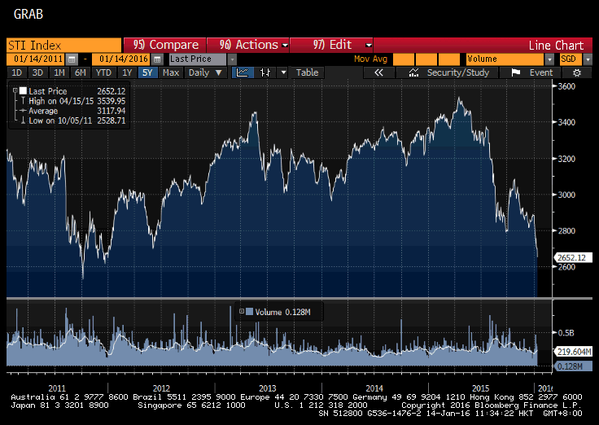
Singapore (China) fact of the day
One of the worst-hit markets has been Singapore’s ; lost over a THIRD of its value from April last year
Three Words – Any Place
Here’s an amazing new tool. what3words has identified every one of the 57 trillion 3mx3m squares on the entire planet with just three, easy to remember, words. My office, for example, not my building but my office, is token.oyster.whispering. Tyler’s office just down the hall is barons.huts.sneaky. (Especially easy to remember if you recall this is Tyrone’s office as well.)
Every location on the earth now has a fixed, easily-accessible and memorable address. Unpopulated places have addresses for the first time ever, of course, but now so do heavily populated places like favelas in Brazil where there are no roads or numbered houses. In principle, addressing could be done with latitude and longitude but that’s like trying to direct people to web sites with IP addresses–not good for humans.
Algorithms have assigned words to avoid homophones (sale & sail) and to place similar combos far from one another to aid in error detection. Simpler, more common words are used to address more populated areas and longer words are used in unpopulated areas.
Moreover the three word addresses are available not just in English but in French, Spanish, Portuguese, Swahili, Russian, German, Turkish and Swedish with more languages on the way. The addresses in other languages are not translations but unique 3 word addresses in those languages.
All of this is available in a small app so that it can be used even offline on a simple smartphone. Find your address here.
Hat tip: The Browser.
Economists on FDA Reciprocity
Daniel Klein & William Davis surveyed economists about whether it would be an improvement to reform the FDA so that “as soon as a new drug is approved by any one of five [FDA approved international] agencies, that drug automatically gains approval in the United States.” They report:
Of the 467 economists who answered the question and did not mark “Have no opinion,” 53 percent agreed that the reform would be an improvement, while 29 percent disagreed. (The remainder said they were “neutral.”) Moreover, those favoring the reform were more likely to say they held their belief “strongly.” Hence, the balance of economist judgment certainly leaned in favor of the liberalization.
Economists are not the only ones in favor of reciprocity. Others are also coming around, at least partially. In Generic Drug Regulation and Pharmaceutical Price-Jacking I argued in response to the massive increases in the price of Daraprim (generic name Pyrimethamine) that we ought to allow importation:
Pyrimethamine is also widely available in Europe. I’ve long argued for reciprocity, if a drug is approved in Europe it ought to be approved here. In this case, the logic is absurdly strong. The drug is already approved here! All that we would be doing is allowing import of any generic approved as such in Europe to be sold in the United States.
In a paper in JAMA discussing the same case, Drs Jeremy Greene, Gerard Anderson, and Joshua M. Sharfstein agree, writing:
A second option is to temporarily permit the importation of drug products reviewed by competent regulatory authorities and approved for sale outside the United States. For example, Glaxo, the original manufacturer of pyrimethamine, sells a version of the drug approved for use in the United Kingdom at less than $1 per tablet.
Dr Sharfstein by the way was Principal Deputy Commissioner of the US Food and Drug Administration from March 2009 to January 2011.
Addendum: I will be discussing/debating pharmaceutical policy with Dr. Sharfstein at on event sponsored by the Council on Foreign Relations in Washington, DC the morning of Monday January 25. Invitation only but email me if you want an invite.
Thursday assorted links
1. How well is Polish democracy doing?: a symposium. The answer from the Polish government is the most interesting, even if not entirely accurate. And might Poland be kicked out of the Eurovision Song Contest?
2. James Fallows is launching a war on leaf blowers.
4. Symposium on Jacob Levy’s Rationalism, Pluralism, and Freedom. And Kareem Abdul-Jabbar’s beautiful mind.
5. Why accurate financial disclosure may harm the interests of shareholders.
6. The economics of Netflix, and is it the next Amazon? (NYT)
7. Computerized dating at Harvard, circa 1965. And yes it is the same Douglas Ginsburg.