On the Internet Nobody Knows You Are a Dog
Bitcoin.com: A set of hackers managed to impersonate Binance chief communications officer (CCO) Patrick Hillmann in a series of video calls with several representatives of cryptocurrency projects. The attackers used what Hillman described as an AI hologram, a deepfake of his image for this objective, and managed to fool some representatives of these projects, making them think Hillmann was helping them get listed on the exchange.
It’s wild how good fake and synthetic video are becoming. Synthesia, for example, uses synthetic AI video instead of actors for training videos and similar–see the example below. Tyler and I could write econ scripts and then use AIs to create video–much cheaper and less time consuming than hiring a video director. Presumably, we could even create synthetic AIs in our own image.
Notice also that Synthesia reads text but could presumably also repeat text that it hears. Thus, the future of Zoom meetings is avatars. Fake faces on fake backgrounds. Choose your race, gender, age, species and so forth. No discrimination possible! Some people won’t be happy.
As Goes India, so Goes Democracy
We lost China. It is imperative that we not lose India.
By we, I mean the West and liberal democracy broadly speaking. Many of us thought that China would liberalize naturally as the Chinese people grew rich and demand followed Maslow’s hierarchy. Many other countries had followed this path. But China doesn’t have a liberal history, technology provided irresitible tools for social control, and democracy no longer looks to be as important for riches as it once did. With China lost and the United States in relative decline, the liberal world very much needs India as a large, multi-ethnic, and free democracy. Liberal democracy is also India’s best hope and bulwark against being ripped apart by internal divisions. But much remains in the balance. Suketu Mehta has a very good essay on this issue:
…Indian democracy is one of the 20th century’s greatest achievements. Over 75 years, we built, against great odds, a nation that for the first time in its 5,000-year history empowered women and the Dalits, people formerly known as untouchables. We largely abolished famine. We kept the army out of politics. After independence, many people predicted that we would become Balkanised. Yugoslavia became Balkanised, but India stayed together. No small feat.
But I write this today to tell you: things in India are more dire than you realise. India is a country that is majority Hindu, but it is not officially a Hindu state. The people who are in power in India today want to change this. They want India to be a Hindu ethnocratic state, where all other religions live by Hindu sufferance.
This has practical consequences: people of other religions are actively harassed, even lynched on the streets; their freedom to practice their religion in their own way is circumscribed. And when they protest, they are jailed and their houses bulldozed. Most worrying, much of the judiciary seems to be sympathetic to the Hindu nationalist agenda, and issues its verdicts accordingly.
There is also sustained and systematic harassment of writers, journalists, artists, activists, religious figures – anyone who questions the official narrative. We who have attached our names here are taking great personal risk in writing this: our citizenship of India could be revoked, we could be banned from the country, our property in India seized, our relatives harassed.
There are many others who think like we do but have told us they cannot speak out, for fear of the consequences. I never thought I’d use the word “dissident” in describing myself and my friends who have compiled this document. I thought that word only applied to the Soviet Union, North Korea, China.
It is crucial that India remains a democracy for all its citizens. India is not Pakistan, Iran, Afghanistan. Not yet. A lot of India’s standing in the world – the reason we are included in the respectable nations, the reason our people and our tech companies are welcome all over the world – is that we are seen, unlike, say, China, as being a multi-ethnic democracy that protects its minorities.
With over 200 million Indian Muslims, India is the third largest Muslim country in the world. There are 30 million Indian Christians. There are Sikhs, Buddhists, Jains, Zoroastrians, Atheists. They are as Indian as I am – a Hindu who’s proud of being a Hindu, but not a Hindu as Prime Minister Narendra Modi and the Bharatiya Janata Party seek to define me.
…The alienation of Indian Muslims would be catastrophic, for India and the world. They are being told: you are invaders, this is not your country, go back to where you came from. But Indian Muslims did not come from elsewhere; they were in the country all along, and chose which God to worship. After the Partition of India and Pakistan in 1947, they voted with their feet; they chose to stay, and build a nation.
…The country also has an enormous, restive, and largely unemployed youth population – half of its population is under 25. But only 36% of the working-age population has a job. To meet these challenges, it is crucial that the country stay united, and not fracture along religious lines, spend its energies building a brighter future instead of darkly contemplating past invasions.
In this time when country after country is turning its back on democracy, India has to be an example to countries around the world, this beautiful dream of nationhood expressed in the Hindu scriptures as “Vasudhaiva Kutumbakam” – the whole earth is a family. We should all be rooting for this incredible experiment in multiplicity to work. As goes India, so goes democracy.
Still under-policed and over-imprisoned
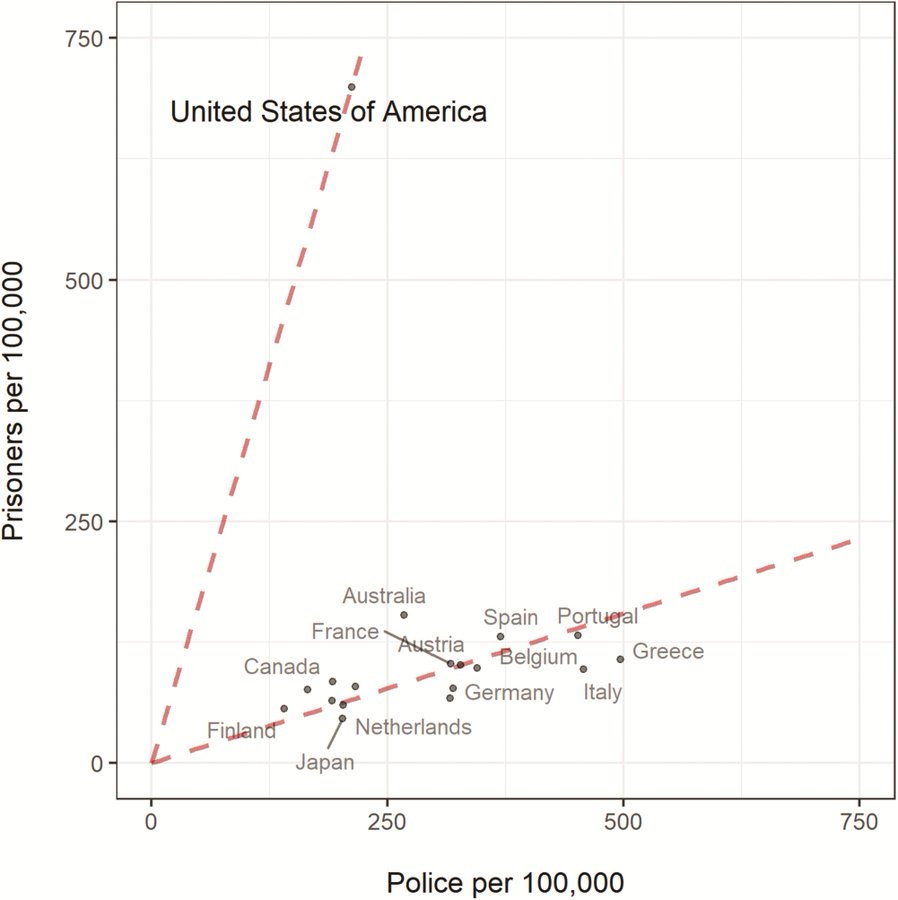
A new paper, The Injustice of Under-Policing, makes a point that I have been emphasizing for many years, namely, relative to other developed countries the United States is under-policed and over-imprisoned.
…the American criminal legal system is characterized by an exceptional kind of under-policing, and a heavy reliance on long prison sentences, compared to other developed nations. In this country, roughly three people are incarcerated per police officer employed. The rest of the developed world strikes a diametrically opposite balance between these twin arms of the penal state, employing roughly three and a half times more police officers than the number of people they incarcerate. We argue that the United States has it backward. Justice and efficiency demand that we strike a balance between policing and incarceration more like that of the rest of the developed world. We call this the “First World Balance.”
First, as is well known, the US has a very high rate of imprisonment compared to other countries but less well known is that the US has a relatively low rate of police per capita.
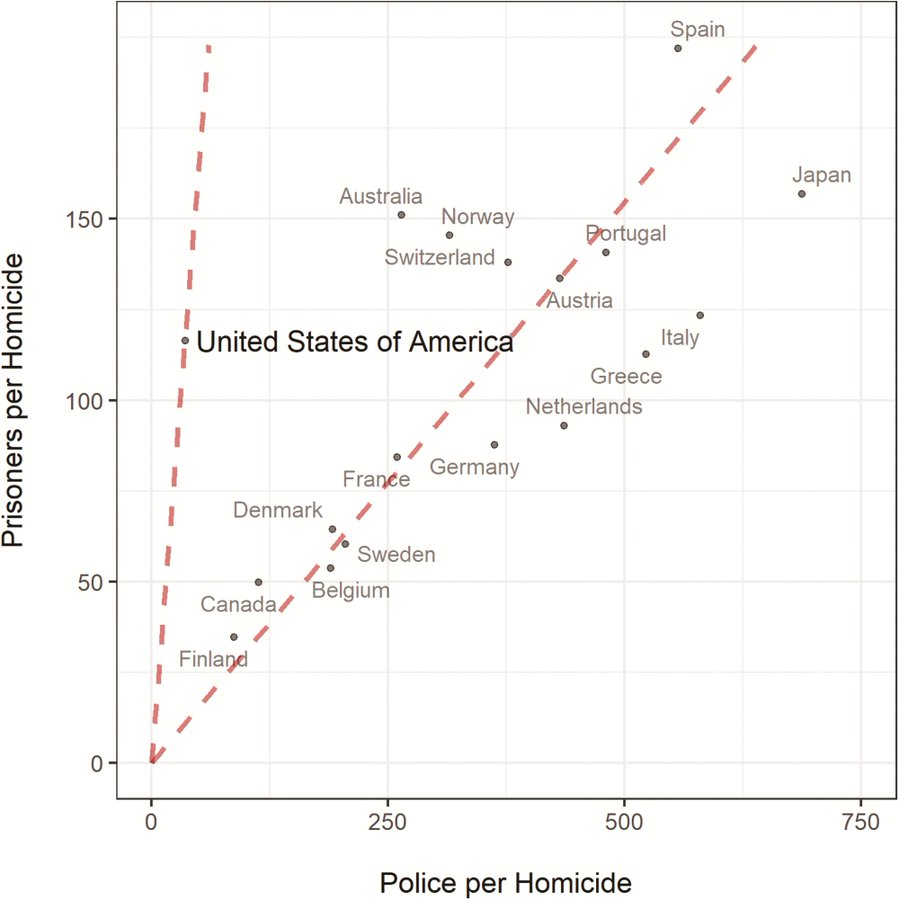
If we focus on rates relative to crime then we get a slightly different but similar perspective. Namely, relative to the number of homicides we have a normal rate of imprisonment but are still surprisingly under-policed.
As a result, as I argued in What Was Gary Becker’s Biggest Mistake?, we have a low certainty of punishment (measured as arrests per homicide) and then try to make up for that with high punishment levels (prisoners per arrest). The low certainty, high punishment level is especially notably for black Americans.
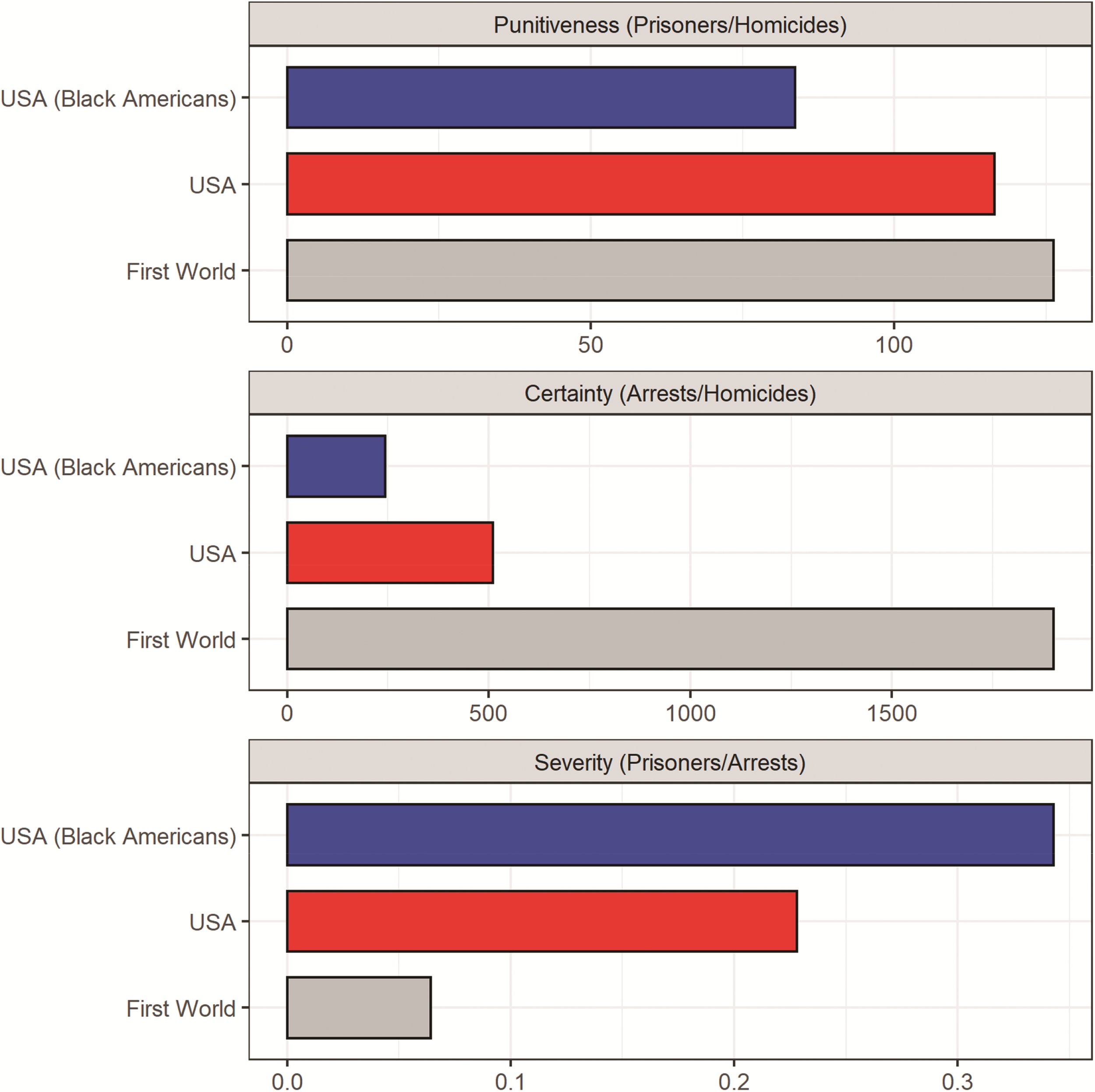
Shifting to more police and less imprisonment could reduce crime and improve policing. More police and less imprisonment also has the advantage of being a feasible policy. Large majorities of blacks, hispanics and whites support hiring more police. “Tough on crime” can be interpreted as greater certainty of punishment and with greater certainty of punishment we can safely reduce punishment levels.
Hat tip: A thread from Justin Nix.
Time for Direct Instruction!
Time magazine has a good piece on the massive efforts to return to phonics based reading instruction. The Open Court program mentioned below is a variant of Direct Instruction (DI) which I have written about before (most recently here). As usual, DI works but the teachers don’t like it.
As a teacher in Oakland, Calif., Kareem Weaver helped struggling fourth- and fifth-grade kids learn to read by using a very structured, phonics-based reading curriculum called Open Court. It worked for the students, but not so much for the teachers. “For seven years in a row, Oakland was the fastest-gaining urban district in California for reading,” recalls Weaver. “And we hated it.”
The teachers felt like curriculum robots—and pushed back. “This seems dehumanizing, this is colonizing, this is the man telling us what to do,” says Weaver, describing their response to the approach. “So we fought tooth and nail as a teacher group to throw that out.” It was replaced in 2015 by a curriculum that emphasized rich literary experiences. “Those who wanted to fight for social justice, they figured that this new progressive way of teaching reading was the way,” he says.
Gender Differences in Peer Recognition by Economists
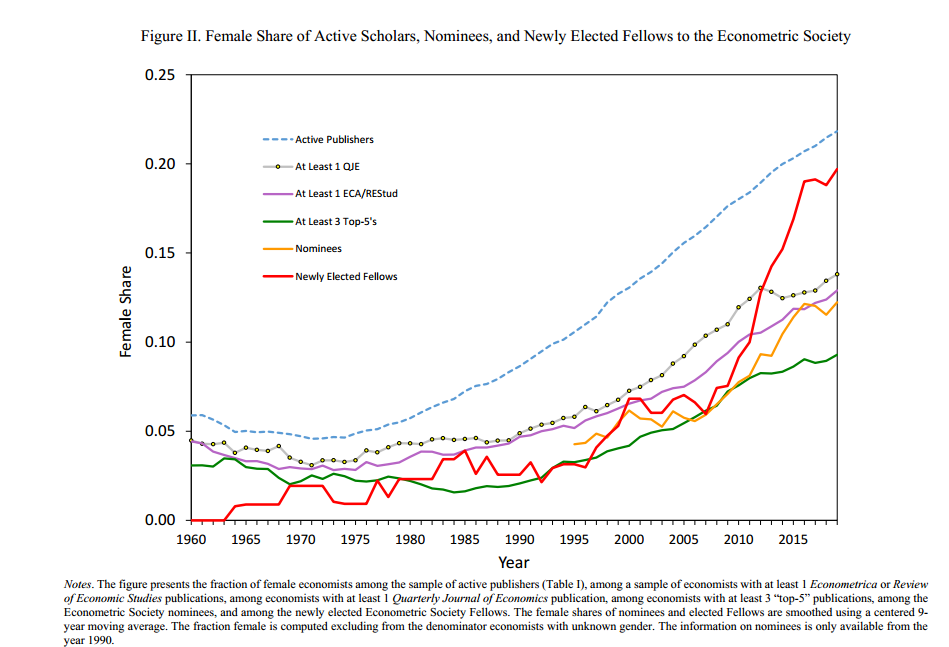
Card et al. study the selection of fellows to the prestigious Econometrics Society showing essentially that prior to about 1980 there was modest discrimination against women. Between 1980 and 2005 about equal access but since 2005 a large bias towards women. Not surprising but citation metrics give us a way of comparing selection with achievement.
The key result can be seen in the raw data–compare the green line of at least 3 top-5s with the red line of selection as an ES fellow.
Here is the abstract to the paper with more details.
We study the selection of Fellows of the Econometric Society, using a new data set of publications and citations for over 40,000 actively publishing economists since the early 1900s. Conditional on achievement, we document a large negative gap in the probability that women were selected as Fellows in the 1933-1979 period. This gap became positive (though not statistically significant) from 1980 to 2010, and in the past decade has become large and highly significant, with over a 100% increase in the probability of selection for female authors relative to males with similar publications and citations. The positive boost affects highly qualified female candidates (in the top 10% of authors) with no effect for the bottom 90%. Using nomination data for the past 30 years, we find a key proximate role for the Society’s Nominating Committee in this shift. Since 2012 the Committee has had an explicit mandate to nominate highly qualified women, and its nominees enjoy above-average election success (controlling for achievement). Looking beyond gender, we document similar shifts in the premium for geographic diversity: in the mid-2000s, both the Fellows and the Nominating Committee became significantly more likely to nominate and elect candidates from outside the US. Finally, we examine gender gaps in several other major awards for US economists. We show that the gaps in the probability of selection of new fellows of the American Academy of Arts and Sciences and the National Academy of Sciences closely parallel those of the Econometric Society, with historically negative penalties for women turning to positive premiums in recent years.
Evolution and the Poorly Designed Human Eye
The human eye is marvelous but also very poorly designed. The poor design is evidence against intelligent design and in favor of the “unguided, unplanned, messy, quirky, and historically contingent” process of evolutionary design. A short piece from 2008, Suboptimal Optics: Vision Problems as Scars of Evolutionary History, does a nice job explaining.
Most well known is that the wiring is backwards.
The most obvious design flaw of the retina is that the cellular layers are backwards. Light has to travel through multiple layers in order to get to the rods and cones that act as the photoreceptors. There is no functional reason for this arrangement—it is purely quirky and contingent.
Even in a healthy and normally functioning eye, this arrangement causes problems. Because the nerve fibers coming from the rods and cones need to come together as the optic nerve, which then has to travel back to the brain, there needs to be a hole in the retina through which the optic nerve can travel. This hole creates a blind spot in each eye. Our brains compensate for this blind spot so that we normally do not perceive it—but it is there.
From a practical point of view, this is a minor compromise to visual function, but it is completely unnecessary. If the rods and cones were simply turned around so that their cell bodies and axons were behind them (oriented to the direction of light), then there would be no need for a blind spot at all.
Cephalopod’s like octopuses took a slightly different evolutionary path and have a better design:

But the reversal of the wiring isn’t the only design flaw.
The arrangement of the extraocular muscles—the muscles that move the eyes—is also difficult to explain without appealing to evolutionary contingency. There are more muscles than are minimally necessary and yet there is no functional redundancy. In order to move a sphere in any direction, only three muscles would be necessary, evenly spaced like the legs of a tripod. The human eye has six—the superior, inferior, lateral, and medial rectus, and the superior and inferior oblique. And yet, despite the extra three muscles, the loss of function of any one muscle causes an impairment of eye movement and results in double vision or displaced vision. A more frugal design with only three muscles would be more efficient and less prone to malfunction, as there are fewer components to break down.
If the eye were to be designed with more than the minimal three muscles, then it would make sense to arrange the muscles so that the loss of one or even more would not impair eye movement.
Read the whole thing.
Hat tip: Paul Kedrosky.
Dose Stretching for the Monkeypox Vaccine

We are making all the same errors with monkeypox policy that we made with Covid but we are correcting the errors more rapidly. (It remains to be seen whether we are correcting rapidly enough.) I’ve already mentioned the rapid movement of some organizations to first doses first for the monkeypox vaccine. Another example is dose stretching. I argued on the basis of immunological evidence that A Half Dose of Moderna is More Effective Than a Full Dose of AstraZeneca and with Witold Wiecek, Michael Kremer, Chris Snyder and others wrote a paper simulating the effect of dose stretching for COVID in an SIER model. We even worked with a number of groups to accelerate clinical trials on dose stretching. Yet, the idea was slow to take off. On the other hand, the NIH has already announced a dose stretching trial for monkeypox.
Scientists at the National Institutes of Health are getting ready to explore a possible work-around. They are putting the finishing touches on the design of a clinical trial to assess two methods of stretching available doses of Jynneos, the only vaccine in the United States approved for vaccination against monkeypox.
They plan to test whether fractional dosing — using one-fifth of the regular amount of vaccine per person — would provide as much protection as the current regimen of two full doses of the vaccine given 28 days apart. They will also test whether using a single dose might be enough to protect against infection.
The first approach would allow roughly five times as many people to be vaccinated as the current licensed approach, and the latter would mean twice as many people could be vaccinated with existing vaccine supplies.
…The answers the study will generate, hopefully by late November or early December, could significantly aid efforts to bring this unprecedented monkeypox outbreak under control.
Another interesting aspect of the dose stretching protocol is that the vaccine will be applied to the skin, i.e. intradermally, which is known to often create a stronger immune response. Again, the idea isn’t new, I mentioned it in passing a couple of times on MR. But we just weren’t prepared to take these step for COVID. Nevertheless, COVID got these ideas into the public square and now that the pump has been primed we appear to be moving more rapidly on monkeypox.
Addendum: Jonathan Nankivell asked on the prediction market, Manifold Markets, ‘whether a 1/5 dose of the monkey pox vaccine would provide at least 50% the protection of the full dose?’ which is now running at a 67% chance. Well worth doing the clinical trial! Especially if we think that the supply of the vaccine will not expand soon.
There is No Such Thing as Development Economics
I used to think there was such a thing as development economics. There are still richer and poorer countries, of course, but is there a “development economics,” a special type of economics for poor countries? I don’t think so. Maybe there once was. In the twentieth century, divergence in per-capita GDP increased big time and it was a burning question why poor countries weren’t on the same development path as the developed nations. Starting around 1990-2000, however, we have seen convergence. Most countries are now on the same path. Poorer countries and richer countries are becoming more alike, sometimes for good and sometimes for bad. I tweeted the following news headline recently:

Notice the commentary on NYC infrastructure but also the man bites dog angle. In Pakistan people on social media are apparently sharing videos of flooding in the New York subway to complain about the poor state of infrastructure in Pakistan!
My own anecdote fit the pattern. This week I am in Delhi and due to a series of unfortunate supply chain shocks at my house-build in the US, for the first time in 3 weeks I have running hot water and reliable internet access! Not only that but although India has sadly fallen for the paper straw nonsense the top hotels remain free from flow constrictors so the water gushes out of the shower with elan just as God intended. Civilization is truly moving back east.
More generally, poorer and richer countries face many of the same problems today: infrastructure, low-skill workers and technological change, climate adaption and so forth. Is the latest paper on cash transfers, pollution, or corruption about a poor country or a rich country? It’s hard to tell. Poor countries still have their own unique problems, of course, but those problems are best analyzed by country rather than by income category. India is not the same as Thailand or Peru. I see little that unites poor countries under the rubric development economics.
Assorted Tabarrok Links
-
- Connor Tabarrok on his series of engineering wonders of our world with #4, The Delta and Zuiderzee Works.
- Connor Tabarrok on the sinking Millenium Tower and the dangers of building on reclaimed land.
- Maxwell Tabarrok on David Deutsch and the infinity hotel and how the paradoxes of infinity apply to the prospects for growth
Get the Lead Out of Turmeric!
Exposure to lead especially in childhood can have a lifetime of negative consequences:
According to the WHO, there is no known safe level of lead exposure. Relatively low levels of lead exposure that were previously considered ‘safe’ have been shown to damage children’s health and impair their cognitive development. Lead is a potent neurotoxin that, with even low-level exposure, is associated with a reduction in IQ scores, shortened attention spans and potentially violent and even criminal behaviour later in life. Children under the age of 5 years are at the greatest risk of suffering lifelong neurological, cognitive and physical damage and even death from lead poisoning.
In recent decades, some countries have begun to address the problem by removing lead from gasoline, paint, and pipes. Lead poisoning, however, remains a serious problem in South Asian countries such as Bangladesh. But where is the lead coming from?

Incredibly, one small study that examined the blood of pregnant women in Bangladesh for lead isotopes concluded that a major source of lead exposure is from turmeric consumption. Turmeric is a spice used in India and Bangladesh and other South East Asian both in cooking and for health. Lead from the soil could enter turmeric but the major cause seems to be lead pigments that are illegally added to turmeric to give it a pleasing looking yellow color. Lead in spices can exceed national limits by hundreds of times.
Our results indicate that turmeric Pb concentrations were as high as 1151 μg/g (Table 2). Eight of 28 market turmeric samples contained Pb above the 2.5 μg/g Government of Bangladesh limit for Pb in turmeric (Table S6). Using the simplified bioaccessibility extraction test, prior studies reported that the bioaccessible fraction of Pb in turmeric varied from 42.9 to 70% of total Pb. (12,39) Given that turmeric is used in dishes containing tamarind and other acidic ingredients, cooking could further increase the bioaccessibility of the Pb. (40) Other researchers hypothesized that PbCrO4 is added to turmeric to enhance its color or weight, but they did not test any turmeric processing powders to assess molar Pb/Cr ratios or Pb speciation. (12) We found that the yellow pigment powders used in turmeric processing contained 6–10% Pb by weight (61 870–101 300 μg/g Pb). Both pigment and turmeric samples also contained elevated chromium (Cr) concentrations, with average Pb/Cr molar ratios of 1.3 ± 0.06 (2 SD) and 1.1 ± 0.8 (2 SD), respectively. X-ray diffraction analyses indicated that all three pigment samples contained lead chromate (PbCrO4, 10–15%), that two of the pigments also contained lead carbonate (PbCO3, 2–3%), and that one also contained lead sulfate (PbSO4, 3%). Because PbCO3 and PbSO4 have a greater bioaccessibility than PbCrO4, our results support the parallel findings of high turmeric bioaccessibility reported in other studies. (12,39,41)
Respondents described turmeric, primarily purchased as a loose powder, as one of three essential spices consumed daily, alongside chili powder and cumin. Women reported adding turmeric in heaping spoonfuls to curries and other dishes for at least one meal per day.
I’d also worry about lead adulteration of safron, another yellow spice. The problem is not limited to Bangladesh, significant amounts of lead have been found in spices sold in in New York.
Addendum: Givewell has a good rundown on Pure Earth a charity working to address this problem.
Hat tip: Alexander Berger.
Photo Credit: MaxPixel.
Nashville: Snitch City
In Nashville, complaints about vague code violations can be made anonymously. The city gets fine revenue. There are a mix of black and white, poor and rich residents, and newly gentrifying neighborhoods. The result: a perfect brew for evil busybodies, meddlers, and assholes trying to leverage the power of the state to make a buck. A story to make you mad as hell from the great Radley Balko.
…to get to the main problem, I have to take the couple’s long driveway up to the house and enter the backyard to find the carport that extends out from the home. Benford spends a lot of time under the carport. He works on the Coronet here. He tinkers at his workbench and listens to the radio. On the blistering June day I visit, it isn’t hard to see why he likes it. The trees provide shade, rustle up a nice breeze, and bathe the area in dappled light. As we talk, the couple’s lab mix Bella patrols a T-shaped patch of grass.
“See that mini fridge over there? He wrote me up for that,” Benford says, referring to the Codes inspector. “I never heard of something so dumb. A man can’t have a mini fridge in his own garage?”
Benford sighs, rolls his eyes, and continues. “He wrote me up for having tools out here. Said you can’t have tools that aren’t put away. He said I can’t have the work bench. Once I was drinking a can of soda when he came over. He told me to put it away. You believe that? I’m a grown man, and you’re telling me to put away my soda. Everything you see out here, they told me I can’t have.”
Benford’s hardly a hoarder. At worst, you could say the carport has some clutter. There are a few chairs, some tools, a grill and a couple empty kerosene tanks. In 2018, his wife suffered a fall in the shower, hit her head, and sustained injuries that required brain surgery and a long convalescence. Benford himself recently had knee surgery. So there’s also a walker, a cane and assorted medical devices.
The structure is enclosed by the house on one side. The other three sides are open. And that, apparently, is the problem. “If that was an enclosed garage, it wouldn’t be an issue,” says Jamie Hollin, the couple’s attorney. “But they can’t afford to build a garage. So the city won’t leave them alone.” The carport isn’t visible from any public space, and as far as I could tell, the surrounding neighbors would have to strain to see it.
…Those reports attracted the attention of a particular Codes inspector, who then became a thorn in the couple’s side for nearly two decades. “At first he’d only come around when she called in a complaint,” Benford says. “But then he just started showing up on his own. He’d just come into the backyard and start telling me to put things away. Neighbors told me he’d sometimes park in their driveway and watch us with binoculars.”
The Coronet also became an issue. Nashville prohibits residents from keeping inoperable or unregistered vehicles on residential properties unless they’re stored in an enclosed garage. Paradoxically, the city also forbids residents from making major repairs on their own vehicles — again, unless it’s done in an enclosed garage. For Benford, that means when the Coronet has broken down over the years, his only legal option is to have it towed to a garage and pay someone else to fix it, even though he has the skills to fix it himself. According to Benford, the same Codes inspector has repeatedly shown up at his home over the years solely to demand that Benford prove that the car is operable. “I lost count of how many times he made me do that,” Benford says. “More than 20.”
“It’s just outrageous and demeaning,” says Hollin. “You’re going to come out and make this man start his car for you on command? You’re going to put a lien on this couple’s home over an old car? Some chairs in a carport? A goddamn refrigerator?”
That is just one example:
…Because complaints are anonymous, it’s almost impossible to prove who filed them. But in 2019, Nashville’s Fox affiliate WZTV ran a series of reports alleging that developers have been weaponizing codes to target properties they want to acquire. Two reports focused on Evelyn Suggs, a beloved, then-94-year-old Black landlord in North Nashville. Suggs told the station several of her properties had recently been hit with a rash of Codes complaints. Shortly after, developers began contacting her with offers to buy those properties. Some made reference to her battles with Codes. Other local residents, including Freddie Benford, have similar stories.
It’s possible that these developers simply scoured the complaints and court records available online to find property owners with fines, then made offers to those owners. But Burt, the local builder, says he’s witnessed it firsthand. “It absolutely happens,” he says. “I’d go so far as to say it’s common. I’ve personally heard developers boast about ‘lighting up Codes’ on a property they want to buy.”
Advocates like Weiss and Maurer say this is common in other places. “It’s just eminent domain by another name,” Maurer says. “Instead of officially declaring a property blighted and handing it over to a developer, you just hit it with codes complaints until the owner is overwhelmed.”
Now on top of this nonsense add vaguely written regulations and an administrative system that thinks it’s a court but isn’t subject to any due process or oversight.
Property rights aren’t simply about buying and selling for profit they are about privacy, individuality and freedom from busybodies. The urge to collectivize all decisions is a curse. Property rights, they make good neighbors.
Addendum: Yes I am in a bad mood today. I am, however, pleased to have played a very small role in the story. Read the whole thing for more.
Economics of Ideas, Science and Innovation Online PhD Short Course
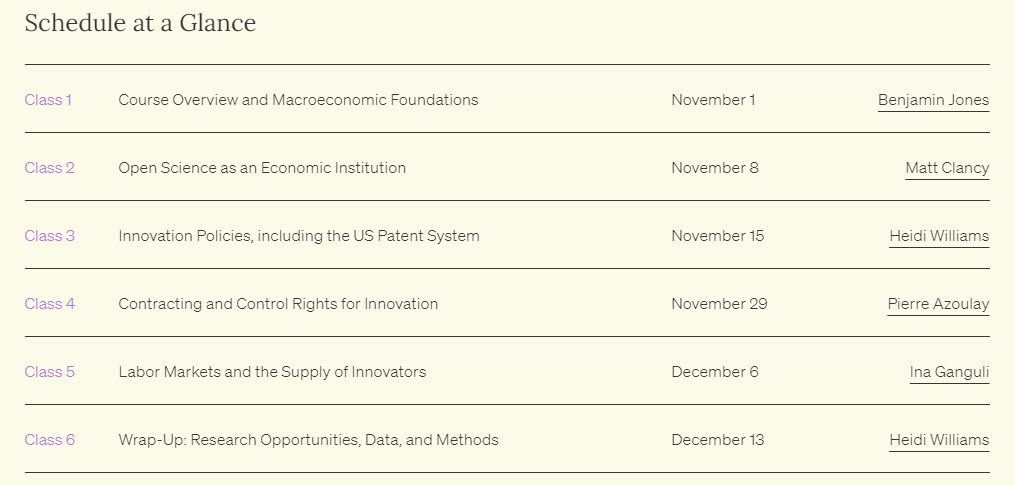
The Institute for Progress is hosting a six week course on the economics of ideas, science and innovation taught at the PhD level by Pierre Azoulay, Matt Clancy, Ina Ganguli, Benjamin Jones, and Heidi Williams. What an all star-cast! The syllabus is excellent. The course is aimed at first year or more PhD students. More details here.
What to Watch
The Rehearsal (HBO): The new Nathan Fielder show has a strange premise. Fielder helps a real person rehearse an upcoming event that they are worried about. In the first episode, Kor has told a friend he has a MA when in fact he has a BA. The fib has tormented him for years. For the rehearsal, Fielder builds a life-sized replica of Kor’s favorite bar where the confession will take place and he stocks it with actors. The  confession is run through multiple times, ala Groundhog Day. The rehearsal probably cost five hundred thousand or more. The enormous difference between the scale of the rehearsal and the fib is part of the point. Kor is an expert on the trivial. Fielder himself rehearses the rehearsal. It’s ridiculous but why don’t we do this more often? How about rehearsing a pandemic?
I confess that on first watching I missed that the ending was a rehearsal (like missing the gorrilla on the basketball court). Very meta. Strange but recommended. Tyler would like it and I don’t normally say that kind of thing.
The Old Man (HULU/FX): Jeff Bridges seems miscast as an action hero, even an aging action hero. Yet, the writers turn that to their advantage and make the action scenes slower, more realistic, and more brutal than is typical. The Old Man builds as it slows. Excellent performances from Bridges, John Lithgow and especially Amy Brenneman. A reverse Stockholm effect. The underlying story in which an Afghan warlord seems to control the US government at the very highest level is a bit absurd and there is an entirely unnecessary substory with another old man but the ending is superb, logical, meaningful, and deepening and changing everything that came before.
The Alpinist on Netflix. Recommend to me after I recommended 14 Peaks: Nothing is Impossible but I could only handle 10 minutes. Too scary. Too nuts. Like watching Roman gladiators battling to the death, it just felt wrong to watch. When I came to write this review, I was not surprised to find that Leclerc had perished.
Westworld S4 (HBO): Season One was one of the best seasons of television ever. S2-S4 are a waste of time. S4 I found incomprehensible.
Merit, Fairness and Equality
Noted Canadian chemist Patanjali Kambhampati on the DIE movement:
My “lived experiences” as a Third World immigrant to the United States has in fact led me to be a lifelong defender of the practices of merit, fairness and equality — practices derived from classical liberal principles….My father was born Third World poor. [My father’s] only hope was to gain employment as a secretary or to be able to test into the top engineering school in India, the Indian Institute of Science. By gaining admission to this top school, my father was able to bring his family to America, where we received a superb education and tremendous opportunities.
In my father’s world, it was merit that enabled him to advance and his family to flourish. Merit and the practice of meritocracy are also classical liberal values. Merit is also central to the immigrant dream, and the rise of modern society.
…As a recent example of common practices in science funding in North America, I was denied funding opportunities twice by Canada’s federal science foundations, both of which were detailed in these pages, purely because I said I would hire research assistants based on merit, regardless of their gender or ethnic or cultural backgrounds.
Over the past year, the encroachment of the cult of DIE into academia has only grown. There are now many positions that are simply off limits to straight white men who are not handicapped. One must pledge allegiance to these illiberal principles in order to be a practising scientist in 2022.
These are some of the reasons I am writing about DIE in science and in the broader society. As someone who has dealt with the “lived experience” of racism, I am here to make the case that we need to move beyond antiquated intellectual racism and inept modern anti-racism, and move instead toward a more individualistic approach….I hope that my experiences can play a role in enabling others to speak and think freely and add value to the never-ending drive for human progress and freedom.
First Doses First for Monkeypox
The rollout of the Monkeypox vaccine hasn’t been without problems but we are making fewer mistakes. I feel pretty good that my work on first doses first for COVID (as well as that of Tyler, Michael Mina, Robert Wachter and others) pushed the Overton window. This is good to see.