Category: Economics
We are more risk-averse for other people
Are we more inclined to take risks for ourselves rather than on someone else’s behalf? The current study reviews and summarizes 28 effects from 18 studies (n=4,784). Across all studies, choices for others were significantly more risk-averse than choices for self (d=0.15, p=0.012). Two objective features of the choices moderated these effects: potential losses and reciprocal relationships. First, self-other differences in risk preferences were significant in the presence of potential losses (k=14, d=0.33, p<.001), and not significant (k=14, d=-0.06, p=0.473) in the gains-only domain (Q=12.56, p=<0.001). Choices for others were significantly more risk-averse when decision makers were reciprocally related to recipients (k=6, d=0.33, p=0.018) but no different in the absence of such a relationship (d=0.11, p=0.115). Reciprocal relationship was a marginally significant predictor (Q=2.02, p=0.155). Results are shown separately by publication status and by context (medical, economic game, hypothetical choice). A relational model of surrogate risk taking is proposed to explain the pattern of results, which emphasizes the importance of chooser-recipient relationships, and the tendency of choosers to minimize anticipated blame from losses, rather than maximizing credit for gains. Implications for benefits design, medical and managerial decision making are discussed.
At least that is what the science says.
John Geanakoplos tells Yale to keep on spending on excellence
Putting things into some perspective, Geanakoplos also said that the $250 million Yale lost as a result of COVID-19 represents one day’s average fluctuation in the value of the endowment. The salary freeze that accompanied the hiring freeze, meanwhile, saved the Faculty of Arts and Sciences $5 million.
And:
Geanakoplos, for instance, said at an October Senate meeting, “I hope the Yale administration will listen to the science of financial crises and take the right calculated risk to deal with the COVID financial crisis.”
Yale, he continued, is “unlikely in the next 50 years to have so good an opportunity to make progress in faculty excellence and diversity as it has right now.” Many peer institutions, especially public ones, continue to face the financial fallout of COVID-19, and so Yale’s “opportunity is now huge,” Geanakoplos urged. “Seize it … Seeing an opportunity while having the money at the same time is truly extraordinary.”
Here is the full story, via Mike.
What should I ask Brian Armstrong?
I will be doing a Conversation with him, in case you do not know Brian is co-founder and CEO at Coinbase.
So what should I ask him? And to be clear, this is the conversation I want to have with him, namely one that maximizes my selfish learning, not your mood affiliation. Here is the Wikipedia page for Coinbase, here is Brian on Twitter, why does a major CEO and person with 410k Twitter followers have no Wikipedia page of his own?
The AstraZeneca Factory in Baltimore
Emergent BioSolutions has a factory in Baltimore that operates under an innovative long-term private-partnership agreement with BARDA. Essentially BARDA subsidized the factory in return for an option to use it in an emergency–Operation Warp Speed exercised that option and in June-July AstraZeneca signed a licensing agreement with Emergent for large-scale manufacturing of its vaccine.
According to the Baltimore Sun the AZ vaccine is already being made at the facility. I hope they are making millions of doses. I want the AZ vaccine approved in the United States immediately but if we won’t take it (yet) they can still export it to Britain and the many other countries which will approve the vaccine.
More generally, there are three vaccines in the near term pipeline. AstraZeneca, Johnson and Johnson and Novavax. If there is anything that we can do to speed these vaccines to people it would be worth billions. All of these vaccine manufacturers should be making and storing millions of doses now.
It’s important to understand that a policy like First Doses First works best when capacity is increasing rapidly so approving these additional vaccines is part of an integrated plan.
Here’s the factory in Baltimore. It’s capable of producing tens to hundreds of millions of vaccine doses a year. Isn’t it beautiful?

Addendum: One more thing. Stop telling me that the problem is vaccine distribution not supply. Guess what? I am thinking ahead.
First Doses First? — show your work!
Alex has been arguing for a “First Doses First” policy, and I find his views persuasive (while agreeing that “halfsies” may be better yet, more on that soon). There are a number of numerical attempts to show the superiority of First Doses First, here is one example of a sketched-out argument, I have linked to a few others in recent days, or see this recent model, or here, here is an NYT survey of the broader debate. The simplest numerical case for the policy is that 2 x 0.8 > 0.95, noting that if you think complications overturn that comparison please show us how. (Addendum: here is now one effort by Joshua Gans).
On Twitter I have been asking people to provide comparable back-of-the-envelope calculations against First Doses First. What is remarkable is that I cannot find a single example of a person who has done so. Not one expert, and at this point I feel that if it happens it will come from an intelligent layperson. Nor does the new FDA statement add anything. As a rational Bayesian, I am (so far) inferring that the numerical, expected value case against First Doses First just isn’t that strong.
Show your work people!
One counter argument is that letting “half-vaccinated” people walk around will induce additional virus mutations. Florian Kramer raises this issue, as do a number of others.
Maybe, but again I wish to see your expected value calculations. And in doing these calculations, keep the following points in mind:
a. It is hard to find vaccines where there is a recommendation of “must give the second dose within 21 days” — are there any?
b. The 21-day (or 28-day) interval between doses was chosen to accelerate the completion of the trial, not because it has magical medical properties.
c. Way back when people were thrilled at the idea of Covid vaccines with possible 60% efficacy, few if any painted that scenario as a nightmare of mutations and otherwise giant monster swarms.
d. You get feedback along the way, including from the UK: “If it turns out that immunity wanes quickly with 1 dose, switch policies!” It is easy enough to apply serological testing to a control group to learn along the way. Yes I know this means egg on the face for public health types and the regulators.
e. Under the status quo, with basically p = 1 we have seen two mutations — the English and the South African — from currently unvaccinated populations. Those mutations are here, and they are likely to overwhelm U.S. health care systems within two months. That not only increases the need for a speedy response, it also indicates the chance of regular mutations from the currently “totally unvaccinated” population is really quite high and the results are really quite dire! If you are so worried about hypothetical mutations from the “half vaccinated” we do need a numerical, expected value calculation comparing it to something we already know has happened and may happen yet again. When doing your comparison, the hurdle you will have to clear here is very high.
When you offer your expected value calculation, or when you refuse to, here are a bunch of things you please should not tell me:
f. “There just isn’t any data!” Do read that excellent thread from Robert Wiblin. Similar points hold for “you just can’t calculate this.” A decision to stick with the status quo represents an implicit, non-transparent calculation of sorts, whether you admit it or not.
g. “This would risk public confidence in the vaccine process.” Question-begging, but even if true tell us how many expected lives you are sacrificing to satisfy that end of maintaining public confidence. This same point applies to many other rejoinders. It is fine to cite additional moral values, but then tell us the trade-offs with respect to lives. Note that egalitarianism also favors First Doses First.
h. “We shouldn’t be arguing about this, we should be getting more vaccines out the door!” Yes we should be getting more vaccines out the door, but the more we succeed at that, as likely we will, the more important this dosing issue will become. Please do not try to distract our attention, this one would fail in an undergraduate class in Philosophical Logic.
i. Other fallacies, including “the insiders at the FDA don’t feel comfortable about this.” Maybe so, but then it ought to be easy enough to sketch for us in numerical terms why their reasons are good ones.
j. All other fallacies and moral failings. The most evasive of those might be: “This is all the more reason why we need to protect everyone now.” Well, yes, but still show your work and base your calculations on the level of protection you can plausibly expect, not on the level of protection you are wishing for.
At the risk of venturing into psychoanalysis, it is hard for me to avoid the feeling that a lot of public health experts are very risk-averse and they are used to hiding behind RCT results to minimize the chance of blame. They fear committing sins of commission more than committing sins of omission because of their training, they are fairly conformist, they are used to holding entrenched positions of authority, and subconsciously they identify their status and protected positions with good public health outcomes (a correlation usually but not always true), and so they have self-deceived into pursuing their status and security rather than the actual outcomes. Doing a back of the envelope calculation to support their recommendation against First Doses First would expose that cognitive dissonance and thus it is an uncomfortable activity they shy away from. Instead, they prefer to dip their toes into the water by citing “a single argument” and running away from a full comparison.
It is downright bizarre to me — and yes scandalous — that a significant percentage of public health experts are not working day and night to produce and circulate such numerical expected value estimates, no matter which side of the debate they may be on.
How many times have I read Twitter threads where public health experts, at around tweet #11, make the cliched call for transparency in decision-making? If you wish to argue against First Doses First, now it is time to actually provide such transparency. Show your work people, we will gladly listen and change our minds if your arguments are good ones.
Does soil heterogeneity induce greater individualism?
Itzchak Tzachi Raz says maybe so:
This paper studies the impact of social learning on the formation of close-knit communities. It provides empirical support to the hypothesis, put forth by the historian Fred Shannon in 1945, that local soil heterogeneity limited the ability of American farmers to learn from the experience of their neighbors, and that this contributed to their “traditional individualism.” Consistent with this hypothesis, I establish that historically, U.S. counties with a higher degree of soil heterogeneity displayed weaker communal ties. I provide causal evidence on the formation of this pattern in a Difference-in-Differences framework, documenting a reduction in the strength of farmers’ communal ties following migration to a soil-heterogeneous county, relative to farmers that moved to a soil-homogeneous county. Using the same design, I also show that soil heterogeneity did not affect the social ties of non-farmers. The impact of soil heterogeneity is long-lasting, still affecting culture today. These findings suggest that, while understudied, social learning is an important determinant of culture.
Here is the full paper. See also his paper on homesteading: “…we find that areas with greater historical exposure to homesteading are poorer and more rural today.”
Half-Doses as Good as Full?
NYTimes: A top official of Operation Warp Speed floated a new idea on Sunday for stretching the limited number of Covid-19 vaccine doses in the United States: Halving the dose of each shot of Moderna’s vaccine to potentially double the number of people who could receive it.
Data from Moderna’s clinical trials demonstrated that people between the ages of 18 and 55 who received two 50-microgram doses showed an “identical immune response” to the standard of two 100-microgram doses, said the official, Dr. Moncef Slaoui.
Dr. Slaoui said that Operation Warp Speed was in discussions with the Food and Drug Administration and the pharmaceutical company Moderna over implementing the half-dose regimen. Moderna did not respond immediately to a request for comment.
Each vaccine would still be delivered in two, on-schedule doses four weeks apart, Dr. Slaoui said in an interview with “CBS’s Face the Nation.” He said it would be up to the F.D.A. to decide whether to move forward with the plan.
Half dosing would double Moderna doses permanently rather than temporarily (as with First Doses First). Thus, I would be very happy to see half-dosing and it would obviate the need for FDF.
I and a handful of others started to discuss and advocate First Doses First on Dec. 8 and many times since then. The advocacy was then joined by Tony Blair and by many epidemiologists, immunologists, vaccine researchers, physicians and public health experts as well, of course, by the British experts on the Joint Committee on Vaccination and Immunisation. It’s clear that the FDA and Operation Warp Speed are now feeling the pressure to take some serious actions to increase supply. If so, my small efforts will have had a very high return.
Keep the pressure on.
Addendum: By the way, the British have yet to approve the Moderna vaccine (probably because they can’t get doses for some time anyway) and the AstraZeneca vaccine appears to work better with a longer dosing interval. So FDF makes sense for the British and we can do half-dosing on Moderna, potentially setting a new and beneficial standard for the entire world.
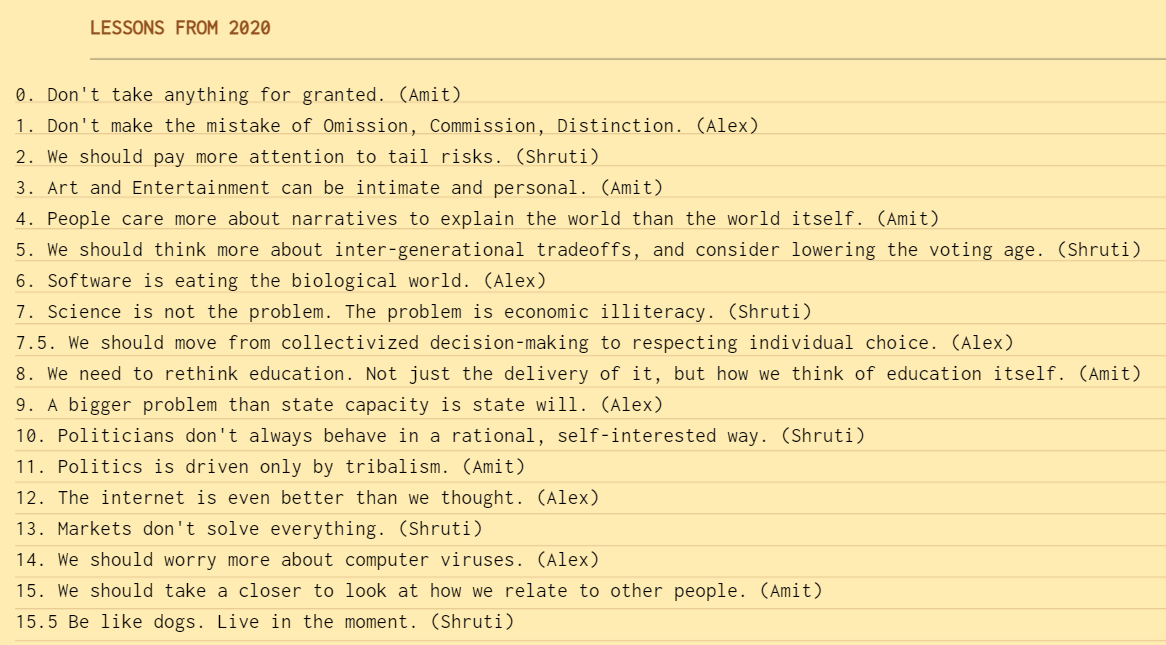
Lessons from 2020
I talk with Amit Varma and Shruti Rajagopalan on a special The Seen and the Unseen podcast. What lessons did we learn from 2020? It’s a good episode and a great podcast. Check it out!
The Best Movies and Television Shows about Invention
Anton Howes, author of the excellent Arts and Minds: How the Royal Society of Arts Changed a Nation, asked on twitter about the best movies and televisions shows about invention. Here’s the collated list.

Anton started watching Pad Man, which is on Netflix and loved it. It’s based on the true story of a man who invented a cheap way of making sanitary pads for women in India which I was familiar with, from the TED talk, but I didn’t know about the movie. It is excellent! Great story, especially strong on the costs of innovating when the inventor must overcome social ostracism and ridicule as well as the difficulties with creating the invention itself. Also some great shots of Maheshwar India.
Hail Britannia!
The British approved the Pfizer vaccine, they approved the AstraZeneca vaccine, they moved to first doses first and now they are allowing (not yet encouraging they are running a trial) mix and match. Under the present circumstances, the British focus on doing what it takes to save lives is smart, admirable, and impressive.
As I wrote on Dec. 10, in Herd Immunity is Herd Immunity:
Mix and matching has two potentially good properties. First, mix and matching could make the immune system response stronger than either vaccine alone because different vaccines stimulate the immune system in different ways. Second, it could help with distribution. It’s going to be easier to scale up the AZ vaccine than the mRNA vaccines, so if we can use both widely we can get more bang for our shot.
Addendum: The CDC is projecting 80,000 COVID deaths in the United States over the next three weeks.
The New Strain and the Need for Speed
I was going to write a long blog post on the new strain but Zeynep Tufekci has written an excellent piece for The Atlantic. I will quote from it and add a few points.
One of the big virtues of mRNA vaccines is that much like switching a bottling plant from Sprite to 7-Up we could tweak the formula and produce a new vaccine using exactly the same manufacturing plants. Moreover, Marks and Hahn at the FDA have said that the FDA would not require new clinical trials for safety and efficacy just smaller, shorter trials for immune response (similarly we don’t do new large-scale clinical trials for every iteration of the flu vaccine.) Thus, if we needed it, we could modify mRNA vaccines (not other types) for a new variant in say 8-12 weeks. As Zeynep notes, however, the vaccines are very likely to work well for the new variant. It’s nice to know, however, that we do have some flexibility.
The real worry is not that the vaccines won’t work but that we won’t get them into arms fast enough. We were already going too slow but in a race against the new more transmissible variant we are looking like tortoises.
A more transmissible variant of COVID-19 is a potential catastrophe in and of itself. If anything, given the stage in the pandemic we are at, a more transmissible variant is in some ways much more dangerous than a more severe variant. That’s because higher transmissibility subjects us to a more contagious virus spreading with exponential growth, whereas the risk from increased severity would have increased in a linear manner, affecting only those infected.
Here’s a key example from epidemiologist Adam Kucharski:
As an example, suppose current R=1.1, infection fatality risk is 0.8%, generation time is 6 days, and 10k people infected (plausible for many European cities recently). So we’d expect 10000 x 1.1^5 x 0.8% = 129 eventual new fatalities after a month of spread. What happens if fatality risk increases by 50%? By above, we’d expect 10000 x 1.1^5 x (0.8% x 1.5) = 193 new fatalities.
Now suppose transmissibility increases by 50%. By above, we’d expect 10000 x (1.1 x 1.5)^5 x 0.8% = 978 eventual new fatalities after a month of spread.
…the key message: an increase in something that grows exponentially (i.e. transmission) can have far more effect than the same proportional increase in something that just scales an outcome (i.e. severity).
I argued that the FDA should have approved the Pfizer vaccine, on a revocable basis, as soon as the data on the safety and efficacy of its vaccine were made available around Nov. 20. But the FDA scheduled it’s meeting of experts for weeks later and didn’t approve until Dec. 11, even as thousands of people were dying daily. We could have been weeks ahead of where we are today. Now the epidemiologists are telling us that weeks are critical. As Zeynep notes holding back second doses looks like a clear mistake and the balance of the evidence also suggests we should move to first doses first:
All this means that the speed of the vaccine rollout is of enormous importance.
…Meanwhile, the United States was reportedly planning to hold back half the vaccine it has in freezers as a hedge against supply-chain issues, and some states may be slowed down by murky prioritization plans. Scott Gottlieb—the former FDA chief and a current board member of Pfizer—has argued that the U.S. should also go ahead with vaccinating as many people as possible right now and trust that the supply chain will be there for the booster. Researchers in Canada—where some provinces decided to vaccinate now as much as possible without holding half in reserve, and will administer the booster with future supplies—estimate that this type of front-loading can help “avert between 34 and 42 per cent more symptomatic coronavirus infections, compared with a strategy of keeping half the shipments in reserve.” (Note that this strategy, which is different from the one the United Kingdom just announced it will adopt in prioritizing the first dose, does not even necessarily involve explicitly changing booster timing protocols in order to maximize vaccination now; it just means not waiting to get shots into arms when the vaccines are currently available.) These were already important conversations to have, but given the threat posed by this new variant, they are even more urgent.
Perhaps most critically, the FDA should approve the AstraZeneca vaccine if not as part of Operation Warp Speed then on a right to try basis. We need every weapon in the arsenal. How many times must we learn not to play with exponential matches?
Addendum: See also this excellent Miles Kimball post, How Perfectionism Has Made the Pandemic Worse.
X-inefficiency is an underrated idea
Here is Harvey Leibenstein from way back when:
Complete constraint concern is the same as maximization. Selective rationality usually involves less than complete constraint concern. Also, there is a tradeoff between less constraint concern and more internalized pressure that an individual feels as a consequence of less concern. Thus an individual’s personality will determine the combination of degree of constraint concern and pressure he or she would like to choose — one that he feels most comfortable with. In general the individual strikes a compromise between the way he would like to behave (very low constraint concern) and the way he feels he ought to behave, which depends on internalized standards for performance and external pressures. This implies that individuals do not necessarily or usually pursue gains to be obtained from an opportunity to a maximum degree or marshal information to an optimal degree; also, maximizing behavior is a special case in this system.
…Thus personality and context select, so to speak, the degree of rationality that will control an individual’s decision-making (and performing) behavior.
A competitive environment may not eliminate X-inefficiency for at least two reasons. First, “There may be a lack of supply of the right kind of entrepreneurs.” Second, firms may engage in rent-sheltering activities instead.
Inertia and peer groups also were central ideas in Leibenstein’s theory, and you can see both factors at work today, or sometimes not at work, in our response to various emergencies. You will note this framework may help explain why the responses of our national, state, and local governments can vary so much in quality, depending on the issue.
Leibenstein was still at Harvard when I studied there, but word was that he himself had “gone X-inefficiency” and decided to stop producing. Here are Dean and Perlman with an appreciation of Leibenstein. As for Leibenstein’s key piece on x-inefficiency: “Between 1969 and 1980, the article was the third most frequently cited in the Social Science Citation Index.” Today it is virtually forgotten.
Welcome to another year of MR!
Blaming the states yes I do you should too
States and local public health officials have warned for months that they would need more than $8 billion in additional funding to stand up the infrastructure needed to administer vaccines. The Trump administration instead provided states $340 million in funding to prepare for vaccinations. Congressional lawmakers also balked for months at appropriating additional funding for vaccine distribution, although the coronavirus stimulus package signed by President Trump on Sunday included $8 billion in funding for that effort.
That is from a recent StatNews article. Now I gladly would have expanded the federal contribution, by several times over if need be. But people, let us put this in perspective. First, the states got the $8 billion they were asking for. Yes, the delay is very very bad, but let’s say they had come up with $8 billion on their own several months ago.
Total state and local spending is about $3.7 trillion, $2.3 trillion from the states alone. $8 billion is how much of that?
About one-third of one percent.
Our states cannot come up with one third of one percent of their budgets to meet the greatest emergency in my lifetime?
This has been a pandemic of outrages, but this undercovered issue is one of the very largest of those outrages. Heaven forbid that states should have to take a sliver of their budget away from deserving recipients. To so many people this is simply unthinkable, and I mean that word in a very literal sense.
(And yes I do know this year is especially tight on state budgets, etc. But even if those budgets were cut to a third of their normal level — hardly the case — that is still only one percent of state budgets.)
The other outrage is how few people have been willing to criticize the states for not having done better fiscal planning here. You will find many deserved criticisms of Trump on this, but there is more than one line of defense, or at least there is supposed to be. So yes, you should be mad at the states.
Jeff Holmes does a CWT with Tyler
Here is the summary:
On this special year-in-review episode, producer Jeff Holmes sat down with Tyler to talk about the most popular — and most underrated — episodes, Tyler’s personal highlight of the year, how well state capacity libertarianism has fared, a new food rule for ordering well during the pandemic, how his production function changed this year, why he got sick of pickles, when he thinks the next face-to-face recording will be, the first thing he’ll do post vaccine, an update on his next book, and more.
Here is the full dialogue, with audio and transcript, here is one short excerpt:
I think the downside of state capacity libertarianism is simply realizing there are some very nice features to not being surveilled all the time, as they do in China. When I said a moment ago that the United States is not very good at trace, though it’s good at innovating — if you had stronger state capacity, presumably you should worry more about state surveillance, and I do. That, to me, is the best case against state capacity libertarianism as I envision it.
Even though having a good trace regime would have been fine in this instance, I’m not sure it would have been a good precedent.
I also tell you what I thought of the guests we had on for the year, and also which episode had the most downloads. Self-recommended.
And if you have enjoyed this year in Conversations, please consider donating here before the end of the year. Thank you!
Most Popular MR Posts of the Year
Here is a selection of the most popular MR posts of 2020. COVID was a big of course. Let’s start with Tyler’s post warning that herd immunity was fragile because it holds only “for the current configuration of social relations”. Absolutely correct.
The fragility of herd immunity
Tyler also predicted the pandemic yo-yo and Tyler’s post (or was it Tyrone?) What does this economist think of epidemiologists? was popular.
Tyler has an amazing ability to be ahead of the curve. A case in point, What libertarianism has become and will become — State Capacity Libertarianism was written on January 1 of last year, before anyone was talking about pandemics! State capacity libertarianism became my leitmotif for the year. I worked with Kremer on pushing government to use market incentives to increase vaccine supply and at the same repeatedly demanded that the FDA move faster and stop prohibiting people from taking vaccines or using rapid tests. As I put it;
Fake libertarians whine about masks. Real libertarians assert the right to medical self-defense and demand access to vaccines on a right to try basis.
See my 2015 post Is the FDA Too Conservative or Too Aggressive for a good review of ideas on the FDA. A silver lining of the pandemic may be that more people realize that FDA delay kills.
My historical posts the The Forgotten Recession and Pandemic of 1957 and What Worked in 1918? and the frightening The Lasting Effects of the the 1918 Influenza Pandemic were well linked.
Outside of COVID, Tyler’s 2005 post Why did so many Germans support Hitler? suddenly attracted a lot of interest. I wonder why?
Policing was also popular including my post Why Are the Police in Charge of Road Safety? which called for unbundling the police and my post Underpoliced and Overprisoned revisited.
Tyler’s great post The economic policy of Elizabeth Warren remains more relevant than I would like. On a more positive note see Tyler’s post Best Non-Fiction Books of the Year.
One of the most popular posts of the year and my most popular post was The Gaslighting of Parasite.
But the post attracting the most page views in 2020 by far, however, was Tyler’s and it was…
You people are weird. Don’t expect more UFO content this year. Unless, well you know.