Category: History
Coffeehouses and the Scientific Revolution
Abstract Historians have long credited coffeehouses, venues for conversation where strangers met across social ranks, with fostering scientific contacts and activity during the Scientific Revolution. We test this claim in seventeenth-century London. Relying on newly geocoded records and a staggered event study across parishes, we find that the opening of the first coffeehouse in a parish is followed by a persistent increase in applied scientists and scientific instrument shops. Effects are concentrated among applied scientists with weak family ties to Oxford and Cambridge. Social connections that link craft skill to theory increase, and new shops turn toward experimental instruments. Across European cities in the seventeenth century, we similarly find that the numbers of applied mathematics titles and scientific instrument makers rise after a city’s first coffeehouse, relative to cities of similar size and growth. In a quantitative urban model calibrated to our parish- and city-level estimates, coffeehouses account for 31 percent of London’s applied scientists in the half century after the first one opened in 1652. These findings show that social institutions can raise the production and use of knowledge by broadening access to intellectual exchange beyond formal academic networks
That is a recent paper by Monir Bounadi and Jens Oehlen, noting that Bounadi is on the job market this year.
What should I ask Simon Sebag Montefiore?
I will be doing a Conversation with him, most of all about his new and very good book The Cauldron: The Making of the Modern Middle East. He has many other excellent books too, including on Russian history and some fiction. Here is his home page, here is his Wikipedia page.
So what should I ask him?
End the State Veto on Power Lines
It’s one of the peculiarities of American regulatory history that a natural gas pipeline can cross state lines with a single federal permit, but oil and electricity must run a gauntlet of state approvals. When a power line crosses one state to reach another, for example, the intervening state often imposes exorbitant tolls or, worse, vetoes the project entirely. It’s the holdout problem played out among the states.
In a new paper, Liscow, Shapiro and Williams show that after Congress ended the states’ veto over interstate gas pipelines in 1947, miles built per year rose nearly sixfold. Oil pipelines, which still had to run the state gauntlet, held steady. Lower transaction costs let natural gas flow to where it was most valued, creating a national market.
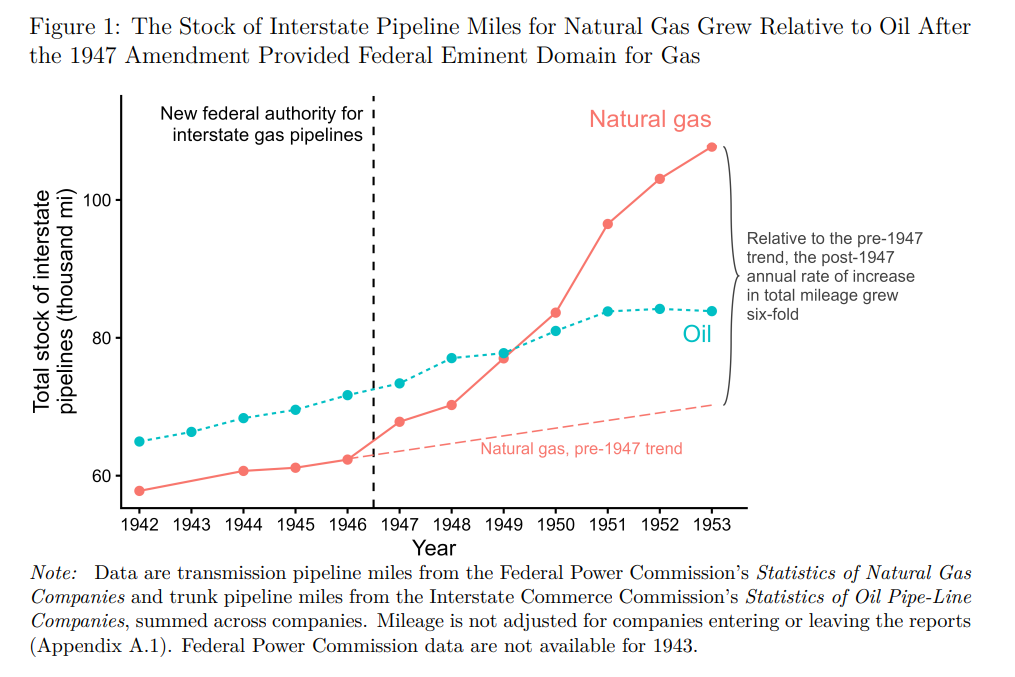
Today, as Liscow and Shapiro write in the Washington Post, the issue is electricity:
An interstate power line, however, typically needs approval from every state it crosses. That gives each state a veto over projects in which the benefits often flow mostly to its neighbors.
New England has experienced the consequences. In 2016, Massachusetts attempted to import Canadian hydropower. New Hampshire, which would have hosted the power lines without getting the same influx of cheap energy, rejected it. A second route through Maine was blocked in a referendum and didn’t deliver power until January. Meanwhile, Massachusetts households paid some of the highest electricity prices in the country.
As with natural gas, electricity is cheapest to produce far from where it is most valued, so to get the most from our national resources we need to transmit electricity across the country.
The Bipartisan American Affordability and Jobs Act, which faces a Senate cloture vote on Monday, would let FERC approve an interstate line that a state has blocked or stalled for a year, a big step toward a national market in electricity.
Let the power flow!
Was Mossadegh a liberal, democratizing force?
One reads and hears so many times that Iran was on the path to democracy until a CIA coup installed the Shah in 1953. It turns out that account is quite wrong, as is detailed by Simon Sebag Montefiore:
As his support in the Majlis ebbed, Mosaddegh demanded autocratic powers. Both the shah and Majlis refused. On 16 July 1952, Mosaddegh resigned and the shah appointed the ‘Old Fox’ Qavam…On 21 July, five days later [after a shooting], the mobs forced Mosaddegh’s reinstatement.
…Mosaddegh had not been able to resist the temptation of supreme power. His attempt to undermine the monarchy by getting control of the army and to declaw the army by purging officers and making budget cuts had offended supporters of both. The demeaning of the monarchy, secular policies and prosecution of Fadayan assassins had offended the clergy. His moves to bypass the democratically elected parliament by taking plenary powers outraged liberals and democrats. Alienating all of them, Mosaddegh quickly lost control, languishing, pyjama-clad and close to nervous breakdown, in his residence.
…When the police chief was assassinated, Mosaddegh ordered mass arrests that led to Malija members flooring a vote of no conffidence. The once idealistic premier, resorting to authoritarian measures, called a faked plebiscite [with no secret ballot the results were 2 million yes, 1,207 no] to dismiss parliament and huge demonstrations to support him by the communists.
So it was one bad guy succeeding another. Montefiore also argues that what brought down Mossadegh was a second Iranian coup, not the initial coup attempt organized by the CIA.
That is all from the new and excellent The Cauldron: The Making of the Modern Middle East.
What They Took From You
Until August 1914 a sensible, law-abiding Englishman could pass through life and hardly notice the existence of the state, beyond the post office and the police. He could live where he liked and as he liked. He had no official number or identity card. He could travel abroad or leave forever without a passport or any sort of official permission. He could exchange his money for any currency without restriction or limit. He could buy goods from any country in the world on the same terms as he bought goods at home. For that matter, a foreigner could spend his life in this country without permit and without informing the police. Unlike the countries of the European continent, the state did not require its citizens to perform military service. An Englishman could enlist, if he chose, in the regular army, the navy, or the territorials. He could also ignore, if he chose, the demands of national defence. Substantial householders were occasionally called on for jury service. Otherwise, only those helped the state who wished to do so. The Englishman paid taxes on a modest scale: nearly 200 million pounds in 1913-14, or rather less than 8 cent. of the national income…broadly speaking, the state acted only to help those who could not help themselves. It left the adult citizen alone.
— A. J. P. Taylor, English History, 1914-1945 (Oxford University Press, 1975).
Hat tip Mark Skousen, quoted in Richard Ebeling’s new book, Liberty and the History of Ideas.
My very good Conversation with Richard Hanania
Here is the video, audio, and transcript. Here is part of the episode summary:
The first half of the conversation stays close to the text [Conrad’s Nostromo], covering the novel’s political backdrop, its deliberately scrambled timeline, the near-total absence of religion in Conrad’s universe, Nostromo’s own vanity and treatment of women, a close reading of the “folly and murder” passage, the Fredric Jameson claim that no Latin American author could have written this book, and their very different research methods for preparing. Then the conversation opens outward, moving through why Latin America has unusually high crime despite not being especially poor, Panama’s surprising success story, Shakespeare’s objective greatness, the state of media criticism after the AI boom, who on the populist right is actually worth reading, why conservative women hug and liberal women shake hands, what Hanania wants to write and learn next, and more.
Excerpt:
COWEN: Here’s one thing that struck me, and I’m not sure you’ll agree. Early in the novel, there’s all this talk about the Italians and Garibaldi and liberty, and the extent to which I think this book is also a critique of classical liberalism is what surprised me reading it for the second time. The first time was probably, I’d guess, 30 years ago, that Conrad is not against the classical liberal prescription, really, but he views it as another pathology inserted into a hopeless situation.
It just morphs into some form of corruption and interest groups. It’s replaced by the autocrats, but it turns out to not really matter more. There’s, again, this dead hand of history. The indigenous groups, their customs, their norms are really what rule the area. The foreigners come and go, and they may steal or extract wealth, but at the end of the day, the talk of liberty and democracy, for him, it’s a kind of fraud. I think it’s also a recognition that imperialism was not going to do the job.
HANANIA: Don’t you think that the Occidental Province had a higher GDP per capita than the rest of the country? It wasn’t just they made money. It seems like there was real wealth. Getting to the end, to the spoilers, the miners actually march on the city because they’re so loyal to Gould. They like what’s going on. There is actual improvement in people’s lives. It’s not that nihilistic, right?
COWEN: It may be higher GDP, but keep in mind GNP may be what counts. I don’t think Conrad thought in those terms. I don’t read him as a consequentialist, though I’m mostly one myself. For him, progress is about moral progress. He doesn’t see a lot of moral progress in this setting. The point that that’s not happening is, for him, at least more important than, oh, living standards went up a bit or, well, isn’t this better than the even poorer societies they had earlier on? I think he grew up in what we now call Poland, but then was ruled by Russia. The idea of foreign rule is something he had such a strong instinctive dislike of. And you see it in his other books as well that he’s a cynic about foreign presence, though I don’t think he’s saying things were better before.
HANANIA: No, I don’t think I agree.
COWEN: I didn’t think you would agree. That’s why I said that.
HANANIA: There is a noble savage idea. There’s one part where he goes into the rant when Sotillo, the general, is torturing Hirsch. I think he goes into a rant about how primitive man did not devise as much sadistic torture, which I don’t think is probably true, but that’s Conrad’s idea. Basically, there’s a kind of innocence there.
I look at the Hernandez and the robbers and the people who are living in the countryside. Those people are purest case of noble savage. There is part of that. You’re right. Conrad is into honor. This is a book about love and men caring about women. There’s Monygham, the doctor’s loyalty to Mrs. Gould, and then Decoud’s loyalty to Antonia. His other books are about this. Yes, he’s a romantic. He’s not a romantic in politics. He thinks politics is a dirty—
COWEN: Agreed.
HANANIA: —unromantic world. If he thinks socialism and populism on a scale of one to 10 are like a one and classical liberalism is a four, to me, he’s a classical liberal, even though he’s not an eight or a nine on classical liberalism.
COWEN: I think I read him as believing in contingency as the most important truth of politics and a geographic relativism. I don’t think he has much Rousseau in him of idealizing the noble savages, but he sees the noble savages are not noble. They’re terrible, but what’s terrible in them gets recreated in us at higher levels of wealth and power. That, for him, is the most fundamental truth of politics.
Interesting throughout, recommended. And here is Richard’s prescient recent book Kakistocracy: Why Populism Ends in Disaster.
Trade and the end of antiquity, or did Islam serve to deglobalize the world?
How did trade and economic activity evolve at the End of Antiquity, when political power shifts away from the Mediterranean towards the Middle East and northern Europe? No records of ancient production, consumption, and trade exist. Yet the composition of coin finds reveals information about monetized transactions, as coins gradually diffused along trade routes. To recover trade and consumption time series, we assemble a database of half a million ancient coins from the fourth to the tenth century and estimate a dynamic model of trade and money. Our estimates suggest that: Mediterranean trade was disrupted by the newly formed border between Islam and Christianity; economic activity shifts away from the Mediterranean starting in the sixth century; real consumption peaks in the Middle East in the eighth century; and by the end of the ninth century, Islamic Spain and Frankish northwestern Europe are the wealthiest regions of the ancient western world.
Recently published in Econometrica, by Johannes Boehm.
Are economists declining in status?
That is the theme of my latest Free Press article. Excerpt, which offers the beginning of the story:
If we look at the 1960s, the John F. Kennedy and Lyndon Baines Johnson administrations brought James Tobin, Robert Solow, Kenneth Arrow (all three later Nobel laureates), Arthur Okun, Walter Heller, Gardner Ackley, Otto Eckstein, and Walt Rostow into government. Those were all names with significant academic heft who could count among the world’s leading macroeconomists. Nobel laureate Paul Samuelson served as a consultant to the government. Heller and some of the others helped to shape the Kennedy-Johnson tax cut of 1964.
That cluster of talent and its influence should come as no surprise. This was an age of elites, of love for science, of the moon landing project, and of network news shows with an establishment bent. Americans were used to deferring to elites, who had won World War II for them, and who were not out there making fools of themselves on the internet. With the Cold War raging, Americans felt their government had to get it right…
Most of this respect was still in place by the 1980s. President Ronald Reagan appointed Martin Feldstein to chair his Council of Economic Advisers (CEA), Feldstein being a Harvard professor and one of the leading market-oriented economists of his time. Two of the junior economists working for Feldstein were Paul Krugman and Lawrence Summers—before they became famous, but the intellectual firepower was already there. Michael Mussa and William Niskanen were other notables in the administration, and Milton Friedman and Friedrich A. Hayek were standing sources of inspiration.
And this:
On top of those political trends, there are further mechanisms at work pushing down the social status of economists. The Trump administration is proposing to eliminate social sciences funding at the National Science Foundation, and there are declining enrollments on the horizon for American colleges and universities. Academia is now seen as more politicized and left-leaning than used to be the case. Our best AI models are often better economists than the humans, just as they are proving theorems that human mathematicians cannot. All of those trends, even if you might consider some of them good news overall, are reinforcing a declining status for economists.
Worth a ponder.
How Tyler Cowen and Alex Tabarrok Have Changed Their Views on AI and Where They Disagree
From the Archives-written by ChatGPT.
Both became dramatically more confident in AI’s capabilities while remaining optimistic about its economic potential. Their differences concern how benefits arrive, how seriously to weight emerging dangers, and whether AI might possess consciousness. Cowen emphasizes institutions, bottlenecks, and geopolitical competition. Tabarrok emphasizes inexpensive intelligence, scientific discovery, and—especially in his later writing—concrete safety failures.
The dated passages below trace those changes across the public archive. Quotations are the authors’ own words, including excerpts from their columns; outside material they reproduce is identified separately.
Early views on unequal gains and abundance
Cowen’s early framework grew out of chess. On March 11, 2011, he observed that stronger computers required stronger human partners:
“The required education level — for the team’s ‘wage premium’ — is ratcheted up.”
His concern was already distributional: computers could increase productivity while changing which human skills commanded a premium. He also emphasized learning how to work with computers. What I learn from chess and computers.
Tabarrok’s April 12, 2016 argument was more explicitly reassuring:
“AI will be cheap and ownership will be widespread.”
He compared AI to an increase in the world’s supply of educated people: more intelligence produces useful ideas, and competition spreads the benefits to consumers. But his forecast of comprehensive substitution was cautious—AI becoming a perfect substitute for human intelligence could be “100 years or more” away. Will the proliferation of affordable AI decimate the middle class?
Neither position was absolute. Cowen warned in February 2017 that the Industrial Revolution involved decades of painful adjustment; historical progress did not guarantee quick wage gains. Tabarrok, in October 2019, praised the argument that mediocre automation could displace workers without creating enough additional wealth to compensate. See Cowen’s historical warning and Tabarrok’s Beware the Mediocre Robots!
Rising confidence in AI capabilities from 2020 to 2025
Cowen was already optimistic about language models in July 2020. After publishing a skeptical reader’s assessment of GPT-3, he added:
“I remain bullish, but it is always worth considering other opinions.”
That attribution matters: the skeptical arguments in the post were the reader’s, not Cowen’s. The case against the import of GPT-3, July 23, 2020.
Tabarrok’s shift toward near-term transformative AI became unmistakable by March 2, 2023:
“I never expected to witness the birth of aliens.”
Later that month, he endorsed Microsoft researchers’ description of GPT-4 as exhibiting an incomplete form of general intelligence: “They are correct.” This is a substantial acceleration from his 2016 outlook, although perfect substitution for humans and early general intelligence are different thresholds. See AGI is Coming and Baby AGI is Here, March 24, 2023.
Cowen reached an especially explicit formulation on April 16, 2025, discussing o3:
“I think it is AGI, seriously.”
But he immediately separated capability from adoption:
“It still will take us a long time to use it properly.”
His growing enthusiasm about the technology did not imply an equally dramatic forecast for immediate economic growth. o3 and AGI, is April 16th AGI day?
Economic transformation and the pace of adoption
On January 6, 2025, Tabarrok wrote:
“The intelligence revolution is going to be bigger, more impactful and more wrenching than the industrial revolution.”
This is his own concluding sentence, following a quotation from Sam Altman. The Intelligence Revolution.
Cowen’s February 23, 2025 response to rapid-takeoff expectations focused on a different constraint:
“Human bottlenecks become more important, the more productive is AI.”
Energy, regulation, organizational habits, and weak human collaborators can constrain the economic value of better models. He offered an explicitly tentative estimate of an additional half percentage point of annual growth—large when compounded, but far from an immediate economic explosion. Why I think AI take-off is relatively slow.
By September 3, 2026, Tabarrok was developing the distributional implications:
“A smaller share of a much larger economy can still mean more income for labor.”
He argued that even substantial displacement could leave aggregate labor income higher, or make compensation affordable. He explicitly acknowledged painful losses for particular workers. His high-growth calculations are scenarios, not forecasts. How Much Redistribution Will AI Require?
They also converge more than their rhetoric suggests. In May 2026, Cowen rejected mass unemployment while identifying transitional hiring problems. In August 2026, Tabarrok interpreted business-survey evidence as consistent with their shared position that AI had not yet broadly reduced employment. See Cowen, May 13, and Tabarrok, August 31.
Growing attention to safety and institutional limits
Cowen stated his central position on November 19, 2023:
“I view AI as more likely to lower than to raise net existential risks.”
His reasoning was comparative: the world already faces serious dangers, and stronger science could improve our defenses. My summary views on AI existential risk.
Tabarrok’s later writing places more weight on specific vulnerabilities. On April 8, 2026, he described:
“the worrying combination that very powerful AI’s are very vulnerable.”
He was discussing cybersecurity capabilities alongside agents’ susceptibility to manipulation. AI Risks.
On September 17, 2026, he sharpened the institutional objection to assuming that beneficial science will automatically offset dangerous capabilities:
“But faster science does not automatically mean faster defense.”
This can be read as a qualification of Cowen’s earlier optimism: defensive discoveries must pass through institutions that may move slowly. It also applies Cowen’s own bottleneck logic to safety. Pandemic Preparation is AI Safety.
Cowen nevertheless supports safeguards. In August 2026, he proposed government-overseen, industry-led safety audits. In September, he opposed restrictions on recursive improvement as impractical to enforce internationally. His position is therefore selective regulation combined with continued development. See his August 27 proposal and September 22 critique.
The September 2026 exchange about AI leaders
On September 16, 2026, Tabarrok rejected the claim that executives’ safety warnings were merely marketing or regulatory capture:
“Amodei actually believes what he’s saying.”
He did not thereby establish that the warnings or proposed policies were correct. His argument concerned sincerity and incentives. What Regulatory Capture Actually Looks Like.
Cowen replied the next day:
“I agree with Alex that the standard model of regulatory capture does not apply here”
But he emphasized competition for power: each executive sincerely thinks their own company should win. For Cowen, that complicates treating their warnings as disinterested policy advice. They agree that concern is sincere; they differ over which incentives best explain behavior. The correct model of AI CEO behavior, September 17, 2026.
Consciousness and Tabarrok’s warning about infant pain
On March 17, 2025, Tabarrok’s What Did We Learn From Torturing Babies? drew a moral lesson from medicine’s historical dismissal of infant pain. He described how theories about immature brains allowed physicians to discount babies’ observable distress and perform procedures without adequate anesthesia. His warning explicitly extended to judgments about animals and AI:
“If we must err, let us err on the side of compassion.”
Tabarrok’s position is stronger than mere openness to AI consciousness: he argues for moral caution under uncertainty. The analogy does not establish that AI suffers. It challenges confidence that a theory ruling out suffering is sufficient grounds to disregard possible evidence of it.
On October 14, 2025, he went further in his own commentary following an essay by Jack Clark:
“these systems are becoming self-aware”
He distinguished self-awareness from sentience, while warning against confidently dismissing the latter. His link accompanying that warning points back to the infant-pain essay, making the connection explicit. We Turned the Light On—and the AI Looked Back.
Cowen’s position is much more categorical. On August 31, 2026, he wrote:
“I am very much opposed to the view that the AIs are sentient, or might be sentient.”
He treats AI sentience as a category error, although he accepts that human-like descriptions can sometimes help predict AI behavior. Anthropomorphizing AI?
The disagreement concerns both what AI might experience and how to act when we cannot confidently know. Tabarrok’s historical analogy places greater weight on the moral cost of mistakenly denying consciousness; Cowen expresses much greater confidence that sentience is the wrong category to apply. These are their philosophical assessments, not established findings about AI consciousness.
Is “Who’s on First?” funny?
Well, no, it is not funny, it would be too easy to relieve the dramatic tension by having Abbott explain the actual situation to Costello. One is not wrong to call the whole thing stupid.
Yet there is another reading of the skit which stands at least some chance of being funny, though it is not funny either.
You will note that Louis Costello was an Italian-American and son of an immigrant, and he had the obvious class mannerisms of such a stereotype. Bud Abbott was half Jewish and I believe half some mainstream ethnicity. He is a stand-in for the establishment, part of which was Jewish and highly commercial. You can read the skit as a commentary on how the establishment rips off the “less tutored” immigrants and refuses to apologize for that or even to explain it. The establishment simply keeps on talking rings around the lower-class immigrant, whether or not those words make sense. The immigrant has no real recourse, as he is less articulate and is also less in control and can only play the role of boob. In essence, Abbott, by not telling Costello the real names of the players, is not letting the ethnic assimilate into that most American of pasttimes, namely baseball.
Note how Costello admits, early in the skit, that he is the one with the funny name (Sebastian Dinwitty in the skit, likely a take-off on “dimwit”). And Abbott, by speaking of the players as being named Who, What, and “I don’t know,” is expressing his frustration with an America that does not sound or look the same any more. Abbott is in essence saying “Hey, what is this? I was not expecting Ted Kluszewski in my country!” He is throwing the growing presence of immigrants in the country back in the face of the ethnic and then stonewalling it.
In the skit, Abbott has the name of “Mr. Broadhurst,” very reminiscent of the establishment.
The skit does show we had an America too obsessed with names, and to no fruitful purpose. It is no accident that in addition to the “hames” for all the baseball players, we are given names for the skit characters as well, even though that might appear not necessary for the unfolding of the dialogue as it usually is understood.
Racist is not the right word, but the skit plays on ethnic prejudices in a manner which one can rightfully find somewhat uncomfortable. The back and forth dynamic reflects the prejudices of American life, though the presenters mirror and amplify those dynamics rather than merely critiquing them. And (again) while the skit is not funny, this interpretation at least opens a door to some people finding it funny.
When Larry David and Seinfeld note they were influenced by Abbott and Costello, they (especially LD) sometimes deploy ethnic stereotypes in a similar manner.
Of course I, being from northern New Jersey, would happen upon this interpretation of Abbott and Costello.
By the way, Costello grew up in Paterson, New Jersey. Abbott was born in Asbury Park, New Jersey, and he grew up in Coney Island. I wonder if they thought the skit was funny.
Elizabeth Holmes, in the recent You Can See Everything Movie, was right to say she did not understand the skit. She grew up in WDC until age nine and then Houston, plus she was born too late. Furthermore, she is used to a world where you hire a guy named “Hu,” right?
The Panic Patrol
The Panic Patrol, a division of the department of future corrections, reminds us of past panics. Here’s one case in point I wasn’t aware of:
Facts about breastfeeding
We produce a numerical estimate of the value of unpaid breastfeeding relative to national income spanning five centuries and integrating historical and bioarchaeological data. The relative economic contribution of maternal nursing was greater in the distant past than in recent history, rivaling regionally significant industries such as pottery, glassmaking, and even the historical public sector. It was likely the largest source of human capital investment in early modern England, supporting the physical and cognitive development of the workforce. Finally, we show that breastfeeding rates probably fell as incomes rose, challenging the Malthusian assumption that higher income correlates with lower mortality.
That is from a recent paper by Louis Henderson and Jane Humphries. Via the excellent Samir Varma.
How Long Do Wealth Shocks Persist? Less Than Three Generations in England, 1700–2026
What happens across generations to wealth shocks? Do they endure and even magnify, or do they dissipate? By implication, how much modern wealth is attributable to events before 1900? This paper uses random shocks to family size in England before 1880 that created wealth shocks for the children to measure the persistence of wealth shocks. Fertility in England before 1880 was a biological lottery. For richer families, family size strongly influenced child wealth. This paper finds that such biology-induced wealth shocks had no impact on descendant wealth by three generations later. Since wealth itself persisted across more than five generations this implies that, in the long run, wealth mainly derives from sources other than inherited wealth. The observed link between nineteenth century and modern wealth does not lie in wealth transfers alone. Wealth persisted because of the familial inheritance of behaviors associated with wealth accumulation and retention.
That is from a recent paper by Gregory Clark and Neil Cummins. Via the excellent Kevin Lewis.
*This Beautiful Country*
The author is Edward Cutler and the subtitle is How Italy’s Nature Shaped its Culture and Civilisation. This is an excellent book on how “the Italy you know” has been shaped by its natural environment, such as its mountains, rivers, geology, and so on. Ever wondered why Sardinia is different? The book is good at sticking to specifics. Excerpt:
This extraordinary overlap has made Italy the continent’s botanical crossroads and one of its greatest arboreal sanctuaries. Within Europe, few countries host such a variety of native trees: at least 140 species, more than almost anywhere west of the Balkans. Some, like the Sicilian fir, Lobel’s maple and the Etna birch, are totally unique. The structure of Italy’s forests is equally diverse — dense, high-altitude canopies, open oak pastures, cork scrub and coastal maquis, each shaped by centuries of disturbance and renewal. This is the legacy of a land that sreved first as Europe’s refuge during the Ice Ages and later as its great corridor of return, where northern, eastern and African floras met and mingled in perpetual exchange.
Recommended to all those with an interest in Italy.
The archaeology tranche of Emergent Ventures
- Björn Öste is building Arkhub, an AI-powered platform that analyzes remote-sensing and other archaeological data to identify potential ancient sites in the Amazon and enable further investigation by citizen scientists.
- J. Cameron Monroe is leading the Allada Regional Archaeology Project, using lidar, remote sensing, and archaeological fieldwork to reconstruct the historical landscape of the Kingdom of Allada and strengthen cultural heritage preservation in Benin.
Previously reported grantees include:
- Benjamin Arbuckle is combining archaeology and ancient DNA analysis to reconstruct entire ecosystems of ancient cities, with the goal of understanding how human societies can thrive in balance with their environments.
- Jesse Casana, an archaeology professor at Dartmouth, is developing drone-based radar imaging methods to detect and map archaeological sites buried beneath desert sands. His work combines advanced remote-sensing technologies with efforts to preserve endangered cultural landscapes.
- Leila Character is developing drone-based imaging and AI tools to detect hidden archaeological sites, making discovery faster, cheaper, and more accessible to researchers worldwide.
- Bryce Hoenigman is developing an AI tool to help date ancient cuneiform tablets by analyzing how written symbols evolved over time, with the goal of making archaeological research faster and more accurate.
With thanks to Yonatan Ben Shimon for his generosity in support of this. We do still have funds remaining in this tranche…