Results for “age of em” 17234 found
How the government shutdown will end the real Deep State has acted
Here is a reprise from my January 17 column:
The real power here is held by government employees, especially those in critical jobs. Let’s say that more TSA screeners decided to walk off the job. It’s already the case that the TSA absentee rate has gone up to 7.6 percent, from 3.2 percent a year ago. It is possible to imagine screeners staying home in much greater numbers, thus crippling the entire nation. That could either force President Donald Trump’s hand or lead to a congressional override of a potential presidential veto.
And the close:
So what does the final equilibrium look like? Some number of extra weeks (months?) of talking about Trump and the wall. Trump over time becoming less popular. Congressional Republicans folding, and Trump lying about both the outcome and the process. Democrats looking better, at least relatively. Federal workers emerging with bruised morale, but mostly intact.
If you think those are implausible outcomes, you haven’t been paying close enough attention to the last two years.
File under Prophets of the Marginal Revolution…
Nav Canada
As La Guardia closes due to the government shutdown, this seems like an opportune time to think about Nav Canada.
We are Canada’s Air Navigation Service Provider (ANSP) managing 3.3 million flights a year for 40,000 customers in over 18 million square kilometres – the world’s second-largest ANSP by traffic volume.
Our airspace stretches from the Pacific West coast to the East coast of Newfoundland and out to the centre of the North Atlantic, the world’s busiest oceanic airspace with some 1,200 flights crossing to and from the European continent daily. It also stretches from the busy U.S-Canada border with major international airports to the North Pole where aircraft fly polar routes to reach Asia.
We are also the world’s first fully privatized civil air navigation service provider, created in 1996 through the combined efforts of commercial air carriers, general aviation, the Government of Canada, as well as our employees and their unions.
Our revenues come from our aviation customers, not government subsidies. By investing in operations and controlling costs, we strive to keep customer charges stable, while improving safety and flight efficiency.
In addition to Canada, New Zealand, Germany, Australia, and the United Kingdom have moved in recent decades towards a more private system based on user fees rather than government funding. See also my earlier post on European airports.
Unsolved Shootings are Rising
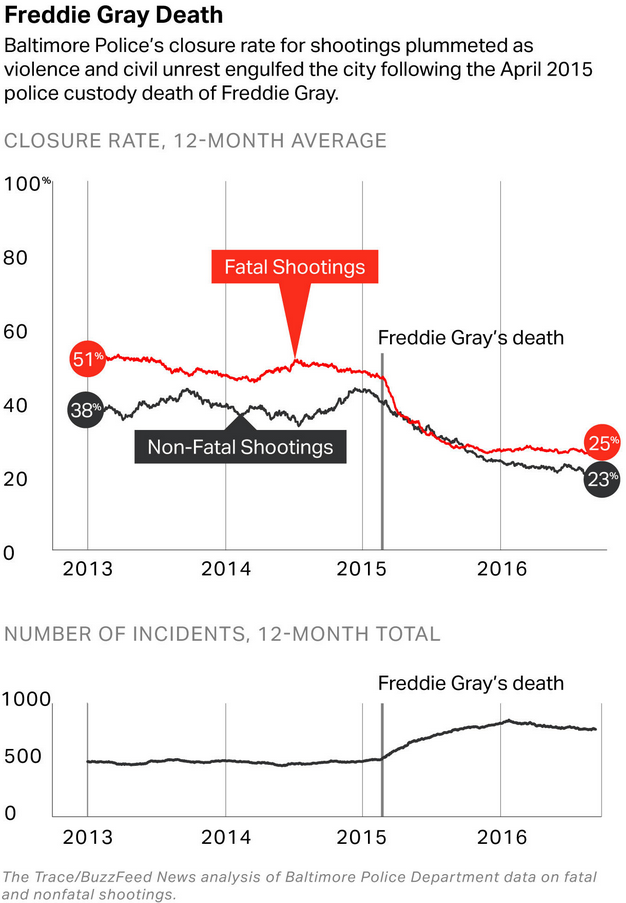 In 2015, I documented that crime in Baltimore was rising rapidly as police resources became stretched as they dealt with riots and anger following the death of Freddie Gray. I warned that the city could tip into a permanently higher crime rate.
It’s now become clear that is exactly what happened as an investigative report by The Trace reveals:
Instead of getting backup, detectives were pulled from their cases, sometimes for days at a time, to help quell the violence. By 2016, homicide investigators cumulatively spent 10,000 hours working riot duty and patrol rather than tracking down murderers…
In the ensuing months, Baltimore’s closure rate for shootings dropped to 25 percent, the lowest in recent history. More than 1,100 cases from 2015 and 2016 alone remained unsolved by the following summer.
As the closure rate fell, the number of shootings increased (see data at right).
It’s not just Baltimore, however:
The crisis of unsolved shootings isn’t confined to cash-strapped cities like Baltimore, but also hits some of America’s most affluent metropolises. In 2016, Los Angeles made arrests for just 17 percent of gun assaults, and Chicago for less than 12 percent. The same year, San Francisco managed to make arrests in just 15 percent of the city’s nonfatal shootings. In Boston, the figure was just 10 percent.
Crime is lower today than in the past but we are in danger of becoming complacent. The rate of unsolved crimes is very high and in some cities it is soaring. Any city with an arrest rate for assaults of 15% is primed for a crime wave.
We need more police as well as better policing.
Addendum: I wonder how many of these cities are still devoting significant resources to marijuana busts?
Drop Gangs
Cryptocurrencies, GPS, drones, and cheap beacons are driving a new evolution in illegal markets:
…[A] major change is the use of “dead drops” instead of the postal system which has proven vulnerable to tracking and interception. Now, goods are hidden in publicly accessible places like parks and the location is given to the customer on purchase. The customer then goes to the location and picks up the goods. This means that delivery becomes asynchronous for the merchant, he can hide a lot of product in different locations for future, not yet known, purchases. For the client the time to delivery is significantly shorter than waiting for a letter or parcel shipped by traditional means – he has the product in his hands in a matter of hours instead of days. Furthermore this method does not require for the customer to give any personally identifiable information to the merchant, which in turn doesn’t have to safeguard it anymore. Less data means less risk for everyone.
The use of dead drops also significantly reduces the risk of the merchant to be discovered by tracking within the postal system. He does not have to visit any easily to surveil post office or letter box, instead the whole public space becomes his hiding territory.
…Classically, when used by intelligence agencies, dead drops relied on being concealed. This lead to dead drops being hard to find even by the intended recipients without costly preparation and training. One of the results of this was that dead drops were often used repeatedly, which increased the probability of both sender and recipient being identified by surveillance.
An ideal dead drop is however used exactly once. Only then can the risks of using it be reduced to pure bad luck.
This challenge is met by Dropgangs in various ways. The primary one is that the documentation of each dead drop is conducted in minute detail, covering GPS coordinates, photos of the surrounding and the location, as well as photos of the concealment device in which the product is hidden (such as an empty coke can). The documentation however increases the risk for the Dropgang since whoever creates it would be more easy to identify by surveillance. In addition, even great documentation still requires the customer to understand it and follow it precisely, which can lead to suspicious behavior around the dead drop location (staring at photos, visually comparing them to the surrounding, etc).
A first development to mitigate the problem of localizing is the use of Bluetooth beacons. In addition to the product, the dead drop contains a little electronic device that sends a signal that can be received by a smartphone, which in turn can display the direction and approximate distance to the device. In addition to the GPS coordinates, the customer requires only a smartphone with the correct App. Beacon devices like these are available on the open market for under ten dollars.
They do however pose the risk of a non-authorized party to discover the dead drop, simply by searching an area suitable for hiding dead drops with their own smartphone.
There are first reports of using beacon devices that are not constantly sending a signal, but have to be activated first. The activation usually happens by establishing a WiFi hotspot on the customer’s phone (by using the WiFi tethering feature). Only if the beacon sees a WiFi hotspot with a specific, merchant provided, unique name will it start to send a homing signal itself. Devices like these are very cheap (<15 USD) and have gained traction in the field, but they pose risks to the customer: His smartphone becomes identifiable by observers, even over considerable distance. This can lead to tracking the customer.
…A plausible next step would be the development of markets for dead drop operators that make their living by picking up product from one dead drop and placing it in another, working as a proxy for the customer to increase his safety and to reduce his efforts. This would also make this distribution model wider spread and available to more products, which will blur the lines between the black and the legal market. On this blurred line new services and technologies will establish themselves, inherently dual use services like lock boxes that can be paid by peer-to-peer cryptocurrencies.
Looking even further into the future, it seems plausible that the whole urban environment might find itself integrated into a dynamic landscape of very short-lived dead drops that are serviced by humans and cheap drones (unmanned aerial vehicles), which are already cheaply available and likely only require one market actor to develop and spread a mechanism to pick up and drop goods. Both merchant and customer could use drones, that are available for rent through dedicated Apps, to deliver product to a meeting point on a roof, where another drone would pick it up. Chaining multiple exchanges like this will make the tracing of the delivery extremely hard, essentially leading to mixing techniques so far used only in anonymizing digital communication.
Read the whole thing.
Hat tip: Eli Dourado.
Cable TV really does matter for political outcomes
This is only one estimate, from Gregory J. Martin and Ali Yurukoglu, but nonetheless it is backed by a plausible identification stragegy and this is very interesting research:
We find that in a hypothetical world without Fox News but with no other changes, the Republican vote share in the 2000 election would have been about half a percentage point lower. By 2008, the effect of there being no Fox News rises to more than six percentage points – a result of the channel’s increasing viewership and increasingly conservative slant over this period.
Unfortunately, that is followed by a real clunker of a paragraph:
All of these results suggest that citizens and regulators have reason to be concerned about media consolidation and the non-market objectives of media owners. A hypothetical monopolist controlling all three channels and interested in electoral influence would have enormous power over election outcomes.
How many things are wrong in those two sentences? How can a profession supposedly devoted to rigor allow such sloppy thought to continue? Here are a few of my objections:
1. The real story in this paper is about Fox News, and Fox — whether you like it or not — is very much an alternative to the mainstream media approach. If you don’t like Fox, you might have preferred the “bad old days” of three dominant and pretty similar networks.
2. Do the authors have any argument that “the non-market objectives of media owners” are bad? No. In fact, there is a longstanding literature that “the market objectives of media owners” are bad, whether you agree or not. Do they really just mean to say “I don’t like Fox News”? Just say it. Don’t worry, I don’t think most authors, especially of media studies, are objective to begin with.
3. Don’t the results suggest we should perhaps be worried about polarized news rather than consolidated news ownership?
4. Is it possible to consolidate news ownership in a world with so many cable channels and so many news alternatives to cable? I strongly doubt this, but in any case it is not something the authors have shown. Instead, they have shown that a renegade news channel can rise to a position of great political influence.
5. Might it have been better simply to have written?: “I am really worried that Rupert Murdoch, in the absence of regulation, could buy up all the news channels and implement political outcomes I do not like.” That is an entirely coherent argument, and I wonder if it isn’t what the authors were getting at but couldn’t bring themselves to write it and thus were forced into the most illogical two sentences I have read this week.
6. By the way, Murdoch owns a lot of media properties and most of them have political stances, and most of all tones, fairly different from that of Fox News. Worth a ponder.
For the pointer I thank the excellent Samir Varma.
The wisdom of Arnold Kling (a Kamala Harris parable)
Here is the opener of my Bloomberg column:
One of the worst tendencies in American politics is to restrict supply and subsidize demand. (The phrase is from the economist Arnold Kling.) The likely result of such policies is high and rising prices, restricted access and often poor quality. If you limit the number of homes and apartments, for example, but give buyers subsidies, that is a formula for exorbitant prices.
That is what makes early accounts of Senator Kamala Harris’s economic plans so disappointing. There is still room for course corrections as she campaigns for president, but too much of what is being bandied about seems designed to annoy Arnold Kling.
Do read the whole thing.
Tuesday assorted links
Those new service sector jobs
Ms. Golden, 43, has developed these no-fly lists in her four years as a dating app ghostwriter. For $2,000 a month, she swipes, chats and charms, impersonating her clients. Once she has earned a client a date, she tags them in and becomes a more traditional dating coach, reviewing each encounter in detailed post-mortems, helping to guide their next moves. Some clients disclose to their dates that they have used Ms. Golden’s services, and others do not.
And what does she use for input?:
Tone is essential to Ms. Golden’s — and her clients’ — success. She learns to imitate their conversational styles through the use of an eight-page intake form that includes specific questions: How do you take your coffee? Have you ever “swam with dolphins or stingrays or enormous turtles”?
By the time a potential client has answered those questions and had an hourlong introductory conversation, Ms. Golden thinks she can mimic them convincingly enough — down to whether they would type “gonna” or “going to” — to start chatting.
Don’t forget this:
She subscribes to a less-is-more mind-set, and much of the work she does is in how little she says.
Facts that contradict the standard housing bubble story
Here I am doing a mix of quoting and paraphrasing the excellent Kevin Erdmann:
1. “Housing construction has been constricted in our most prosperous cities.”
2. “Home prices in many developed countries rose at least as sharply as inthe US.”
3. “…rent inflation has been persistently high for 20 years.”
4. “Growth in real rent expenditures generally had been declining throughout the supposed boom period.”
5. “During the boom, the relative income of the typical homebuyer did not decline.”
6. During the boom, homeowners were not “buying up.”
7. Homeownership rates, even at their peak levels in 2004, among age groups under 65 years old, were no higher than homeownership rates had been in the late 1970s and early 1980s.”
8. “…when taking into account all types of housing, the number of new housing units never even rose very far above the long-term average.”
Those are all from Kevin’s new and very important book Shut Out: How a Housing Shortage Caused the Great Recession and Crippled Our Economy. The simple “housing bubble” story is not in fact as true as it might seem, as Kevin shows, and furthermore just look at how many parts of America now have home prices at or above their “bubbly peaks.” I hope this work gets the attention it deserves.
Short-term lending in response to the government shutdown
Gridlock in Washington over President Donald Trump’s plans to build a wall on the border with Mexico has deprived hundreds of thousands of government employees and contractors of their wages. As a result, some have turned to specialist consumer-finance companies to bridge gaps between earnings and outgoings. Shares in World Acceptance, a South Carolina-based short-term lender, are up 22 per cent since the shutdown took effect about a month ago. EZ Corp, a pawnshop operator based in Austin, Texas, is 20 per cent higher over that period. In both cases, the rises are much more than benchmarks, suggesting investors could be betting on a surge in demand to cover unexpected expenses.
…Chad Prashad, chief executive of World Acceptance, said his company was seeing demand in Texas and the south-east of the US where there were big airports employing government workers. In response to the shutdown, World Acceptance is offering cash-strapped government employees deferrals on their loans without interest or fee penalties. New customers can get up to $1,250 in a 10-month loan with 0 per cent interest and no fees.
Shout it from the rooftops
Many top earners during the high-rate era, such as politicians Dwight Eisenhower and Ronald Reagan, entertainer Jack Benny and librettist Alan Jay Lerner, didn’t pay the top rates. In 1952, for example, when the top rate was 92%, the highest-earning 1% of taxpayers had an average rate of 32%, according to Elliot Brownlee, a tax historian and emeritus professor at the University of California, Santa Barbara.
“When top tax rates were high, there was always a large gap between the stated rates and what the highest earners actually paid as a percentage of their income,” says Joel Slemrod, an economics professor at the University of Michigan.
This one would not work today:
Gen. Dwight Eisenhower also successfully argued that $635,000 he earned from his 1948 memoir, “Crusade in Europe,” should be treated as a capital gain, saving him as much as $400,000 of tax, says Joseph Thorndike, a historian with Tax Notes magazine.
Here is the Laura Saunders WSJ piece.
In India Everyone Gets Affirmative Action
India has long affirmative-action-like programs for members of scheduled castes, scheduled tribes and other backward classes (yes, that is the official name). The programs typically reserve a certain number of political seats, government jobs, and educational placements for members of historically disadvantaged and discriminated against groups, hence the the term reservations. Over time, the number of reservations has been increased and the category expanded to more and more groups. In fact, under a new reservation program just announced, virtually everyone will be covered by one reservation or another!
The new program will cover household income of less than 8 lakhs which is $11,000, far above India’s GDP per capita! The new program is meant to benefit middle and upper castes who have chafed under reservations for the historically discriminated against. The fact that the program is open to so many people, however, means that it’s really not much of a benefit at all.
Moreover, ultimately reservations mean very little if there aren’t private-sector, wealth-creating jobs which is India’s primary challenge.

What should I ask Ed Boyden?
I will be doing a Conversations with Tyler with him, no associated public event. Here is his MIT bio:
Ed Boyden is Y. Eva Tan Professor in Neurotechnology at MIT, associate professor of Biological Engineering and Brain and Cognitive Sciences at MIT’s Media Lab and McGovern Institute for Brain Research, and was recently selected to be an Investigator of the Howard Hughes Medical Institute (2018). He leads the Synthetic Neurobiology Group, which develops tools for analyzing and repairing complex biological systems such as the brain, and applies them systematically to reveal ground truth principles of biological function as well as to repair these systems. These technologies include expansion microscopy, which enables complex biological systems to be imaged with nanoscale precision; optogenetic tools, which enable the activation and silencing of neural activity with light; robotic methods for directed evolution that are yielding new synthetic biology reagents for dynamic imaging of physiological signals; novel methods of noninvasive focal brain stimulation; and new methods of nanofabrication using shrinking of patterned materials to create nanostructures with ordinary lab equipment. He co-directs the MIT Center for Neurobiological Engineering, which aims to develop new tools to accelerate neuroscience progress.
Here are other Ed Boyden links. So what should I ask him?
Friday assorted links
A Behavioral Interpretation of the Origins of African American Family Structure
That is a new paper by Gerald D. Jaynes, Department of Economics, Yale University. The abstract is difficult to read, so here is an excerpt from the paper:
The hypothesis underlying my reinterpretation of the origins of contemporary black family structure is, through the late 20th Century, throughout American history, structural differences in the race relations and economic discrimination confronting blacks in rural versus urban locations produced distinct childhood socialization experiences. These distinct socialization experiences exposed urbanized black children (north and south) to large numbers of recusant adults — men and women socially alienated by urban job ceilings and truculently refusing to acquiesce to race relations based in white supremacy. Observation of and interaction with recusant adults and discriminatory economic institutions put urbanized black children at great risk of early projection of a failure to achieve self-verification of an acceptable social identity. The developmental outcome was early adoption of recusant identities and oppositional agencies leading to a polarized choice: either seek self-verification elsewhere by avoiding institutions such as schools, labor markets, and marriage (causing high rates of single parent families), or (attempting to alter one’s reception in such institutions) intensely engage them leading to civil rights activism and a rising black middle class. In contrast, rural black children were more likely exposed to adults seeking self-verification by striving to climb the agricultural tenure ladder a life goal requiring conforming to behavioral norms based in the era’s white supremacist race relations. Failure to self-verify a positive self-image by achieving land ownership or rental tenancy occurred later in life when the adoption of oppositional agencies was greatly mitigated.
Speculative and uneven, but nonetheless of interest.