How Much Redistribution Will AI Require?
How much redistribution will AI require? A common scenario is that AI raises output enormously, but labor’s share of income collapses. GDP per capita goes up but workers get poorer, and making workers whole requires massive redistribution. In my latest paper, I run the numbers and conclude that this is probably incorrect.
The idea is simple. Labor income is GDP multiplied by labor’s share of GDP. What matters is the product. A smaller share of a much larger economy can still mean more income for labor. If the pie is growing, labor’s slice of the pie can shrink even as labor income rises.
Suppose that without AI, real GDP per capita grows at 2 percent a year and labor receives 60 percent of GDP. Now look ten years ahead. What is required to keep labor’s income growing at the same or higher rate?
If AI raises growth to 5 percent a year, GDP after ten years will be about 34 percent larger than on the no-AI path. Labor’s share can fall from 60 percent to about 45 percent and workers, in aggregate, will still have exactly as much real income as they would have had without AI.
If AI raises growth to 10 percent a year—the kind of number Satya Nadella and Dario Amodei talk about—GDP after ten years will be more than twice as large relative to the no-AI path. Labor’s share can then fall all the way to 28 percent without reducing aggregate labor income. Twenty-eight percent of an economy that has more than doubled is about the same as sixty percent of the smaller economy.
The figure shows how much redistribution is required after 10 years under a variety of scenarios.
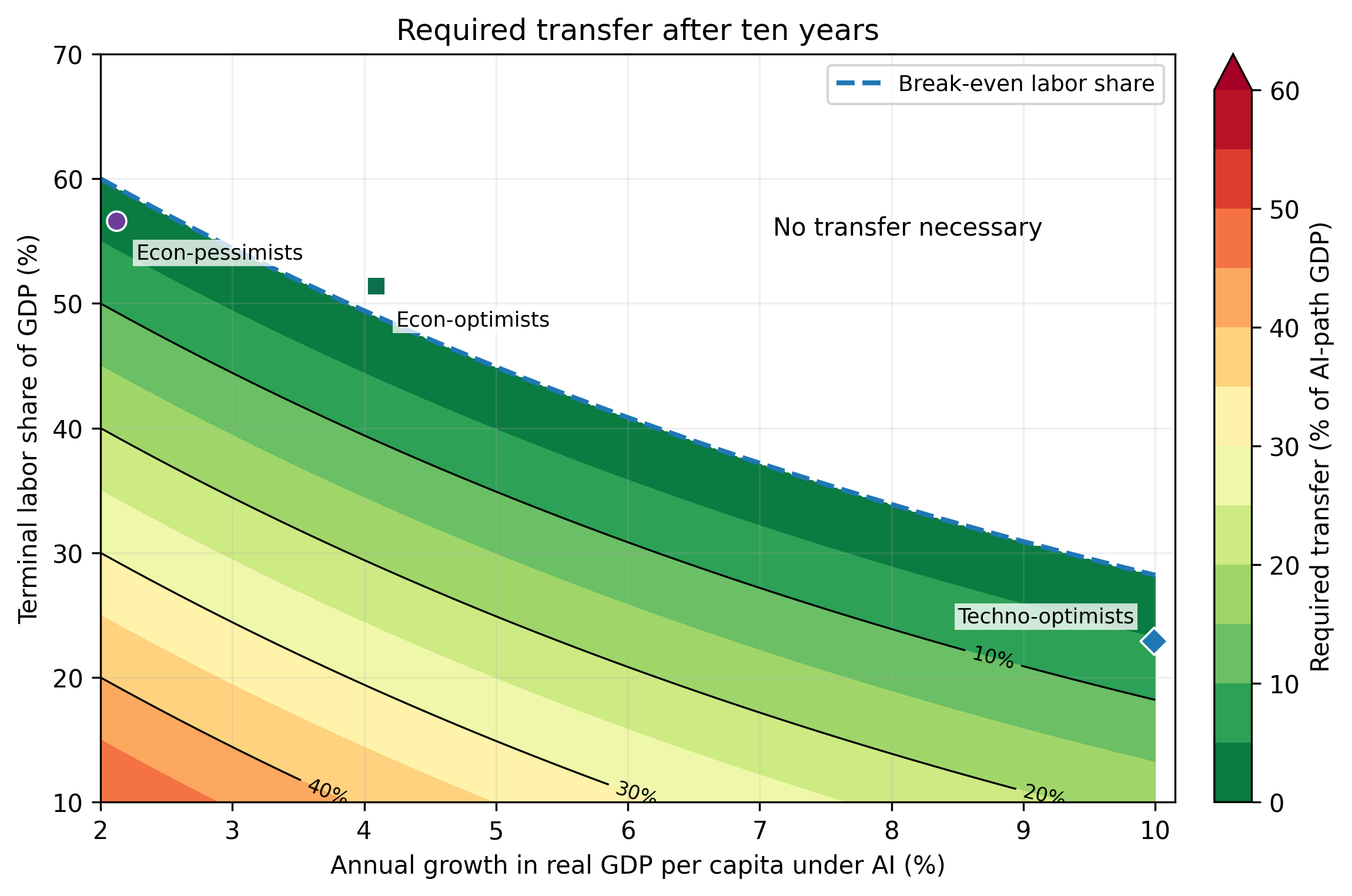
The white region above the dashed line requires no transfer. Which region are we headed for? Consider three “stylized” views.
The econ-pessimist, following Acemoglu, thinks AI displaces some but relatively few tasks because AI simply is not productive enough to replace much labor profitably. Growth is only 2.1 percent and labor’s share falls to 56.6 percent, although particular industries may still get hammered. The required transfer is 2.7 percent of GDP.
The econ-optimist, in the spirit of Tyler, myself, and Kevin Bryan, thinks automation also creates complementarities and new tasks for humans. Growth rises to 4.1 percent, labor’s share is 51.4 percent, and both labor and capital gain without any transfer.
The techno-optimist, following Amodei, has the superficially scariest labor-market scenario: three-quarters of labor income is displaced and labor’s share falls to just 22.9 percent. But productivity growth is also enormous, producing 10 percent annual growth. The transfer needed to keep labor as a whole on its no-AI path is only 5.3 percent of GDP.
That last calculation is the one I find most surprising. You can have something close to the techno-capitalist dystopia in terms of factor shares—labor gets less than a quarter of GDP—and still have a manageable redistribution problem because GDP has gotten so much larger.
Moreover, a transfer equal to 5 percent of GDP need not mean raising taxes by 5 percent of GDP. We already tax labor a lot. We could thus compensate labor by shifting from labor taxes to other taxes. Federal payroll taxes alone are about 6 percent of GDP. Cutting payroll taxes and replacing them with a broad consumption tax that also reaches spending from capital income and accumulated wealth is a form of labor compensation (plus we could have some transfers to those with no labor income).
Of course, keeping aggregate labor income whole does not mean every worker does well. There could still be enormous churn, big losses in particular occupations, and painful transitions.
Nevertheless, the larger point is that labor’s share by itself tells us surprisingly little about the distributional consequences of AI. We also need to know how much the economy grows.
If AI produces ordinary growth while dramatically reducing labor’s share, redistribution becomes very difficult. But if AI really does produce 5, 10, or 15 percent annual growth, the compensation problem is surprisingly modest even with very large displacement. As I have emphasized elsewhere, we could cut the working week in half under many scenarios and increase hourly wages above the non-AI benchmark and make both capital and labor better off.
Growth is a good problem to have.
AI and Employment: So Far, So Good
In September 2023, the Census Bureau added questions about AI to its Business Trends and Outlook Survey. Census asked hundreds of thousands of businesses whether they had used AI in the previous two weeks to produce goods and services. At that time, 3.7% said yes; by late 2025 the figure had reached about 10%. (In November 2025 Census broadened the question to ask about AI use in any business function, producing a jump in measured adoption to about 18%.)
Twice the Bureau has asked a key question:
In the last six months, how did the use of Artificial Intelligence affect this business’s total employment?
In Dec. 2023 to Feb 24, when ~5% of firms were using AI the answers were 2.8% increased, 2.6% decreased and 94.6% reported no change. Two years later, in the Nov 2025–Feb 2026 supplement, the answers were: 2.3% increased, 2.0% decreased, and 95.7% reported no change. The answers were similar by firm size.
Some sectors reported more action. Information is the one sector where fewer than 92% report no change. But overall, almost all firms report no change and of those reporting change it’s about evenly divided between increasing and decreasing employment.

The supplement also asked about tasks. Among firms using AI, 44% say it supplemented or enhanced work an employee already does. Ten percent say it performed a task an employee used to do. Eleven percent say it introduced a task no one had been doing.
Among those using generative AI, 85% of firms cited writing or editing documents and email as the biggest uses, half cite searching for information, 45% summarizing documents, and 13% coding. Sixty-four percent of adopters say they changed nothing about the business in order to use AI, 15% trained existing staff, another 15% built new workflows, and just over one percent hired anyone with AI skills.
Among firms where AI has taken over some employee tasks, the degree of substitution is growing. The share reporting that AI took over “a large number” of tasks rose from 2.4% to 7.1%, while the share reporting “a moderate number” rose from 13% to 22%. But this group is still small: only about a tenth of AI adopters, who themselves make up about a fifth of firms.
I have reported firm-weighted estimates but employment-weighting gives essentially the same result. Thus, we have unusually direct evidence from a very large sample, and it says that the overwhelming majority of firms using AI do not yet report any effect on total employment. Very consistent with what Tyler and I said in our talk to OpenAI.
I used Fable and ChatGPT Sol in producing this post.
Scholar Data
In our paper, A Skeptical View of the National Science Foundation’s Role in Economic Research, Tyler and I point out that if the NSF is doing what it should, it ought to be doing very different things than other funders:
Public goods theory tells us that the National Science Foundation should support activities that are especially hard to support through traditional university, philanthropic, and private-sector sources. This insight suggests a simple test: to the extent that the NSF allocates funds to genuine public goods as opposed to subsidies on the margin, we ought to see a large difference in the kinds of projects the NSF supports compared to what the “market” sector supports. But what stands out from lists of prominent NSF grants (like the one provided by Moffitt in this symposium) is how similar they look to lists of “good” research produced by today’s status quo. If we take public goods theory seriously, what areas of economics should be supported?
We suggest replication studies and support for producing public datasets. Which brings me to Scholar Data, a neat new project that won NIH’s competition to create a data-sharing index. Scholar data creates an S-Index, like an H-Index for papers, but instead the S-Index measures a dataset’s ease of access, citations and other mentions. The point is to create a metric to reward the creation of a public good:
Researchers invest years collecting and sharing datasets that underpin reproducibility, transparency, and discovery across every field. Without shared data, findings can’t be verified, built upon, or trusted. And yet, the metrics that define academic careers, such as citations, h-index, and impact factor, only count publications. Data sharing goes unrecognized and unrewarded.
This creates a broken incentive: researchers are expected to share data, but get no credit for doing so. The result is that data sharing is treated as a chore rather than a contribution.
Scholar Data and the S-index are aimed at fixing this. By measuring how impactful your datasets are, the S-index gives data sharing the same visibility and recognition as publishing, turning it from an obligation into a career asset.
Bravo! Your dataset may already be catalogued. You can get credit at ScholarData.
A Big Bet on Explosive AI-Driven Growth
Wow! The excellent Ben Moll has put together a high-stakes bet on US economic growth.
A bet on near-term explosive AI-driven growth: whether U.S. real GDP per capita will grow by at least 15% within a single year (measured relative to prior peak) by the end of 2033. Agreed on X, 15–16 August 2026. This document summarizes the agreed terms.
1. Parties and stakes
Fast-growth side (wins if the growth condition in Section 2 is met):
● William MacAskill https://www.williammacaskill.com/ — $10,000
● Samuel Albanie https://samuelalbanie.com/ — $25,000
● Tom Cohen https://x.com/tomcohen — $25,000
● Total: $60,000
No-fast-growth side (wins otherwise):
● Benjamin Moll http://benjaminmoll.com/ — $40,000
● Andrew Ho https://andrewho.xyz/ — $200,000
● Total: $240,000Odds: 4:1 — every $1 staked by the fast-growth side is matched by $4 from the no-fast-growth
side. Implied probability of the fast-growth scenario: 20%.
I’m known for quipping that a bet is a tax on bullshit but I don’t think either side is BSing. We have a genuine and important disagreement. I’d side with Moll, for what it is worth.
The Antitrust Academy
The Antitrust Academy is an online platform hosting hundreds of videos comprising a complete course in antitrust law and economics. Teachers include Judge Douglas Ginsburg, Jon Klick, Joshua Wright and others. I am an advisor. A great resource whether you are learning this material for the first time or need to brush up on some legal or economic doctrines.
Data Centers and the Open Access Order
The US discussion over datacenters is depressing. Datacenters do not use a lot of water, they produce very useful outputs, they are not a blight on the landscape. All of this is obvious. But I don’t want to restate the obvious. What bothers me most about the discussion is that people seem to think this is or should be a collective decision. No.
We have a simple set of rules that everyone must follow. You buy land from someone willing to sell it. You contract for electricity. You hire workers who want the job. Your obligations to your local neighbors come from the same laws that govern everyone else. We do not ask what the land, electricity and labor is for. If you follow the rules, that is nobody’s business.
This is the distinction North, Wallis and Weingast make in Violence and Social Orders (paper here) between limited access orders or the natural state and open-access orders. For most of recorded history large-scale economic activity depended on access to political power. In the natural state, “people outside the coalition have only limited access to organizations, privileges, and valuable resources and activities.” The dominant coalition controlled entry into valuable activities and created rents by granting privileges.
An open access order works through general criteria. Organizational formation is “open to everyone who meets a set of minimal and impersonal criteria.” In economic life, the transition entails “the ability to create economic organizations at will, open entry and competition in many markets.”
The key word is impersonal. The same conditions apply regardless of who wants to build or whether public officials admire the proposed use. The state is not necessarily laissez-faire but its role ends once you have complied with the impersonal rules.
Now look at how a data center actually gets built. Rezoning, special use permits, comprehensive plan amendments, a negotiated “community benefits agreement” of school donations, fiber, soccer fields, and payments in lieu of taxes, public comment and then more public comment. These are not general rules. They are terms of admission negotiated with whoever holds the veto. Calling them community benefits doesn’t change the structure. Access to economic activity has become something that must be bargained for, argued for in the collective sphere, and paid for–with success determined by rents and political access. The natural state returns.
(The subsidies, by the way. are the same error wearing the other hat. A sales tax exemption written for datacenters and a county moratorium aimed at datacenters both replace a general rule with a judgment about whether this industry deserves to exist. An open access order offers neither special favors nor special burdens. It offers a rule.)
Opponents often complain that communities deserve more of a say. No, they do not. You did not vote on the bakery and the baker did not vote on you. That is the deal.
Datacenters happen to be where this is most visible today. Their size and novelty make them easy targets for vilification and rent extraction. But the big issue is not datacenters. It is whether building depends on following impersonal rules or on securing permission case by case from those who control access. The natural state was the human default for ten thousand years. The open access order that displaced it is the foundation of our prosperity and our political strength, and it is younger and more fragile than we like to think.
Towards a New House of Lords
In Britain, the House of Lords was traditionally dominated by hereditary peers–a right bequeathed by the monarch, sometimes in ancient times, to sit in the House of Lords that was transmitted generationally. That system has been withering away for decades, however, and was finally ended this year by the 2026 Hereditary Peers Act. So how should members of the House of Lords be chosen?
One idea which comes to mind quickly is selection by merit. Perhaps the House of Lords should be filled with Nobel Prize winners, wise professors, former politicians, distinguished public servants and so forth. All very well and good but the nub here is that these people have to be chosen by someone, and whoever controls the selection process inevitably influences the kind of people selected. That makes an appointed chamber less independent of, and potentially more similar to, ordinary politics, even with lifetime appointments. Moreover, what is their interest? Madison argued that for a good system “the interest of the man must be connected with the constitutional rights of the place.” A politicized selection of representatives, even meritorious representatives with lifetime appointments, may not differ enough from ordinary elected politicians to make much difference.
In 10% Less Democracy, my colleague Garett Jones, suggests that bondholders have a formal role in government. So let us consider, a House of Lords based on bond holdings. The advantage of this system is that bond holders are self-selected and their interests are in long-term stability–exactly what we want in a check on the popular house.
Votes in the House of Lords could be allocated proportionally to holdings; thus in practice we would get institutional representatives most notably including pension funds. If you want stability and growth, giving pension funds a bit more sway in national politics does not seem like a terrible idea. Bondholders would, for example, likely be more concerned with long-run financial stability, for example than current politicians seem to be. Should foreign holders of bonds be given a vote? Why not? Perhaps this would improve the prospects for peace. Although the popular house will always have the final say.
If anything, bondholders might prove too fiscally conservative as they are concerned primarily with default risk. The traditional House of Lords based on hereditary peers really amounted to a House of Lords based on landed property which isn’t a bad proxy for long-term stability and growth. After all, land owners do tend to do well when the country does well and you can’t take your land to another country. The ancient system had its wisdom; but landholding is not perfectly aligned with national prosperity. The House of Lords defended tariffs on imported foods (the corn laws) to promote land rents at the expense of food prices for everyone else. For similar reasons, we might, therefore, want to leaven the House of Lords with some equity, say ownership of Trills–the Robert Shiller idea for shares backed by real GDP. We would thus have a popular house and a corporate house divided into equity and bonds, all well aligned.
Democracy and Caeserism
In my 2015 post discussing Joseph Heath’s excellent book Enlightenment 2.0, I had this to say:
One of the reasons that I oppose the extension of democratic politics into every aspect of modern life is precisely that in trying to do too much, democracy delivers incoherence, gridlock and frustration, forces that eventually undermine its own legitimacy. I worry about democratic legitimacy because I see democracy as a check and balance on Leviathan (while Heath sees it as a check on government by experts).
The legislature has become a sideshow. But I worry, because the more Congress is held in contempt the greater the support for a bold executive that takes charge, makes decisions and gets things done. Under these pressures, executive power has grown not just in the United States but also in Canada and Great Britain (on this theme see F.H. Buckley’s The Once and Future King.) But for all its faults, the legislature and the rule of law are more conducive to liberty than the executive and the administrative state. Legislators are satisfied with reelection and a bit of pork but executives hunger for greatness and in so doing they promote the real dangers, idolatry, the centralization of power and war.
In short, I worry that the pathologies of democracy drive the demand not for rational, technocratic government but for Caesarism.
I should note that this was before Donald Trump was a Republican presidential contender, let alone a candidate for office.
Addendum: See also my review of Enlightenment 2.0. It has some good lines!
The propagandizing messages of markets and politics are also very different. Market messages are largely inclusive and cosmopolitan. Coca-Cola advertises “I’d Like to Buy the World a Coke” because they’d like the world to buy a Coke. Firms do try to build brand affiliation but they rarely do so by promoting hatred of their competitors. Pepsi doesn’t tell the Pepsi Generation that Coke drinkers are stealing their jobs and spitting on their gods.
Hat tip: @kingofthecoastt who recently tweeted about the original post.
Breaking Ground: Can Refund Bonuses Solve the Holdout Problem?
My latest paper (with Cason and Zubrickas) has just been published by the Journal of Urban Economics. We show that refund bonuses can indeed improve the holdout problem.
Abstract: The holdout problem presents a pervasive challenge in situations that require the assembly of independently controlled assets, where due to complementarity the combined whole is worth more than the sum of its parts. One avenue for addressing holdout problems involves contingent contracts, where agreements are conditional upon reaching a predetermined threshold. This paper reports an experiment to investigate a new refund bonus contingent mechanism, in which asset owners who agree to participate (e.g., sell their asset) receive a bonus payment if the required threshold for project success is not met. The refund bonus eliminates failure equilibria and improves the frequency of successfully reaching the threshold in the symmetric mixed strategy equilibrium. In the experiment, individual asset holders choose each round whether to accept an offer to sell. Multiple owners must accept for the (contingent) sale to materialize, and holdout owners who do not sell can earn more, so the game has the strategic incentives of a volunteer’s dilemma. The data show that the bonus mechanism increases agreements to sell, the frequency of successful projects, and efficiency. By the second half of the experimental sessions, the total number of sales is 35 percent higher and the threshold is met nearly twice as often with the bonus than without.
I also cover this paper in my Refund Bonus (aka Dominant Assurance Contract) Explainer.
Why Aren’t Modernist Bridges Awful?
The public dislikes modern architecture but, generally speaking, they do not dislike modern bridges. Lists of the most awesome, most stunning, most beautiful bridges in the world will mention classics like London’s Tower Bridge, the Brooklyn Bridge, or the Rakotzbrücke but alongside them they will picture the Kubitschek Bridge in Brazil (Shutterstock).
 The Rio-Antirrio Bridge in Greece:
 or the Moses “Bridge” in the Netherlands.

Whether you like these bridges or not, I don’t see in the literature an idea that modern bridges are all ugly or that modern bridge building has failed or fallen behind the great bridges of the past in the way that there is such a critique for modern architecture in general.
Why is this? I have a theory, which is that bridge designers come from engineering schools rather than schools of architecture. It is possible, of course, that there is something in the nature of bridges that prunes the design space in a way that attracts beauty–maybe we like catenaries, arches, cables in tension and beauty is just a byproduct of the engineering.
It is possible, however, to produce ugly bridges so it’s not just an engineering constraint. Moreover, one small but telling piece of evidence in favor of my theory is that most of the bridges chosen by Wallpaper magazine, an architecture magazine specifically, are in fact ugly (and with no overlap in the bridges from my first category of “popular” beautiful bridges). Here are a few, judge for yourself:



The fact that modern bridges are often beautiful, especially when they come from engineers, is consistent with Samuel Hughes’s argument that ugly has been a choice, not a constraint.
Regulated Markets Are Slow to Handle Change
Gowrisankaran, Langer and Reguant have an excellent paper, Energy Transitions in Regulated Markets (WP), in the latest AER.
The basic idea is that regulation designed to prevent utilities from building useless power plants can induce them to keep obsolete power plants. Some background. We regulated electric utilities under the theory that they were natural monopolies and therefore we would do better by pushing their prices down. What’s a reasonable price? Hard to say, so regulated utilities were allowed to recoup their operating costs plus a fair return on their “rate base”—their capital stock. Makes sense, but once profits depended on the size of the capital stock, utilities had an incentive to build too much—the classic Averch–Johnson effect. Regulators responded with “prudence” requirements and the rule that capital must be “used and useful.” In a stable world, that rule is a check, albeit an imperfect check, on so-called gold-plating.
But now consider what happens in a time of technological change, such as a rapid decrease in the cost of generating electricity with natural gas (driven by fracking and improvements in combined-cycle natural-gas (CCNG) technology). In a free market, large decreases in costs would cause firms to abandon coal and move to natural gas—some would do this to make profits, others to avoid losses. In short, the market forces sunk investments to be abandoned when not profitable.
But there is another possibility under regulation. Tell the regulator that your plants are still viable. Well, telling is cheap talk so you keep burning coal to prove that the plant remains useful. If you can keep your base operating that’s better than abandoning it and to signal how valuable your coal plant still is, it may even be worth while to burn coal when the cost exceeds the price of electricity! The authors have some nice data on exactly this point.
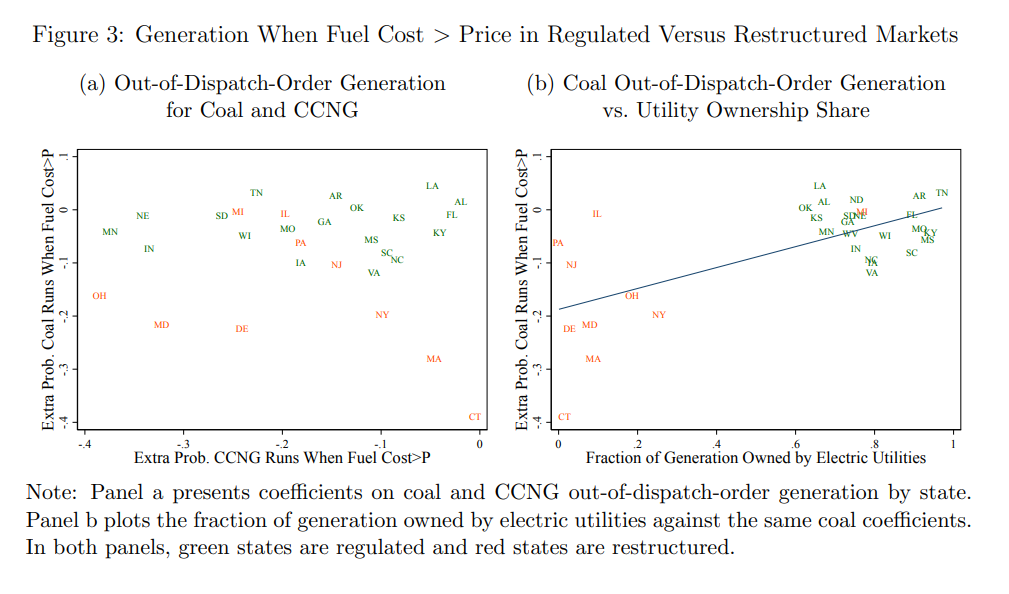
Figure 3 takes a little work to understand, but the pattern is clear. Each point represents a state. In panel A, the vertical axis shows how much less likely a coal plant is to run when the cost of coal exceeds the price of electricity. Obviously, a strongly negative coefficient is the economically sensible response: when burning coal is more expensive than buying electricity, the plant should burn less.
The red points represent restructured states and the green points regulated states. In restructured states coal burning falls when prices fall, just as expected. Coal burning in regulated states responds much less. (I.e., the red points generally lie below the green points.) Indeed, the six states with the largest reductions in coal operation are all restructured states.
One objection to this analysis might be that utilities in general are just slow to respond to prices, so on the horizontal axis the authors plot how well utilities respond to a higher price of gas. Note that these coefficients are all negative and there is no obvious difference between regulated and restructured states. In both types of states, utilities respond well to the price of gas, but only in restructured states do utilities respond strongly to the price of coal. (Why coal and not gas? Because the used-and-useful standard binds on capital whose usefulness is in doubt—which, once gas got cheap, meant coal. In other words, the utilities have to defend coal to the regulators, not gas.)
Panel B on the right shows a slightly different way of presenting the same data. The vertical axis is again how much less likely a coal plant is to run when its cost exceeds the electricity price. The horizontal axis is the fraction of generation owned by electric utilities. Regulated states tend to be vertically integrated, while restructured states opened electricity generation to competition, so utility ownership and regulatory status are closely correlated. Regulated states generally have utility ownership above 60%, while all the restructured states but one are below 30%. The best-fit line slopes upward: in other words, the more generation a state’s utilities own, the less coal dispatch responds to price. A different perspective on the same story.
That is the direct empirical evidence. The authors then construct a more ambitious structural model. In theory, regulation could produce either too much or too little investment in the new technology; their estimates imply too much. Much, too much. Not only do regulated utilities retain too much coal, they also build too much gas capacity. In short, they accumulate both too much old capital and too much new capital. Averch–Johnson on steroids.
The bottom line is that regulation under dynamic conditions is much more difficult than under static conditions. My view is that it may not even be worth the candle.
Impedimenta Developerum!
NME: Harry Potter fans have succeeded in moving a construction project that would have originally gone through the “grave” of the character Dobby.
The 125-mile Greenlink power connector, which costs £430million, is intended to link power between the UK’s National Grid and Ireland, running between County Wexford and Freshwater West in Pembrokeshire.
However, the latter site is known to Potter fans as the site of house elf Dobby’s grave in the film Harry Potter And The Deathly Hallows, and contains a pile of stones with the words “here lies Dobby” that many flock to…
All I can say is that Voldemort would never have put up with this shit.
JFK’s AI Voice
From Kennedy’s 1961 inaugural:
- “Ask not what your country can do for you—ask what you can do for your country.”
- “Let us never negotiate out of fear. But let us never fear to negotiate.”
- “United, there is little we cannot do… Divided, there is little we can do.”
- “If a free society cannot help the many who are poor, it cannot save the few who are rich.
and from the 1962 moon speech at Rice University;
- We choose to do these things not because they are easy but because they are hard.
and from Lyndon Johnson’s inaugural speech:
- John Kennedy’s death commands what his life conveyed—that America must move forward.
- On the 20th day of January, in 1961, John F. Kennedy told his countrymen that our national work would not be finished ‘in the first thousand days, nor in the life of this administration, nor even perhaps in our lifetime on this planet.’ But, he said, ‘let us begin.’ Today, in this moment of new resolve, I would say to all my fellow Americans, let us continue.
Sound familiar?
Were John F. Kennedy’s speeches written by an AI? Probably not. But were AI’s trained on the speech writer Ted Sorensen? It would appear so. Or to be more accurate, AIs have absorbed the Sorensen toolkit: symmetry, parallelism, antithesis, repetition, and the neatly turned reversal.
Sorensen is considered a great stylist, and these are iconic lines. The problem with AI voice is not the techniques themselves. It is the overuse of them—their deployment to describe a trip to 7-Eleven with the same rhetorical flourishes once used to send men to the moon.
I suspect that will be an easy problem to fix, so don’t expect AI voice to continue.
Hat tip: murgh
Pressure
Who would have thought that someone could make a gripping movie about predicting the weather? Nevertheless, Pressure delivers. To be sure, it’s predicting the weather for D-Day. Excellent cast. Hews very close to the truth. The two camps really did divide on theory versus past prediction and the weather was as portrayed. After the war, John F. Kennedy asked Eisenhower what gave the Allies the decisive advantage during the D-Day invasion, Eisenhower replied, “We had better meteorologists than the Germans.”
I agree with Tyler’s earlier review: A truly excellent movie, one of the best of the year. Specifically, it concerns the meteorological forecasts (!) leading up to the D-Day invasion. Thematically, it is about the differences between Americans and Brits, how bureaucracy operates, the nature of leadership, and the proper role of science in government. It is like an old-style Hollywood movie. Most of the action takes place in only a few rooms, and with superb dialogue and performances. Although you all know how D-Day turns out, the movie still generates suspense on some of the major plot points.
AI and Marginal Revolutions in Wastewater Treatment
An interesting paper from French economists, including recent Nobelist Philippe Aghion, looks at the savings from a predictive machine-learning model applied to wastewater treatment:
This paper studies the environmental effects of a specialised AI aeration-control system deployed across French wastewater treatment plants operated by a global leader in water supply services. Exploiting quasi-experimental variation in both the timing of adoption and outages, we estimate the causal impact of AI on electricity use, carbon emissions, and energy expenditures. We find that full-time AI control reduces plants’ electricity consumption and carbon emissions by 5.4% and 6% respectively, and energy expenditures by 8.2%, resulting in negative abatement costs, while also improving water effluent quality. The additional electricity demand generated by AI models represents less than 1% of these savings. Beyond these effects, AI-equipped plants prove more resilient to high operational stress during extreme meteorological events and chemical pollutant peaks. They also improve load management by reallocating electricity consumption from peak to off-peak hours. Finally, we use the DICE model to assess the aggregate implications of our findings
in three diffusion scenarios. We find substantial global welfare gains from the CO2 reductions associated with this industrial AI use case.
One annoyance: The authors frame the paper as a contrast to worries about AI’s energy use and environmental impact. But those objections are almost entirely innumerate and pretextual and casting the paper as a rebuttal lends them more credibility than they deserve.
One note: Don’t misread the “less than 1%” line as being in the same units as the 5.4%, 6%, and 8.2% figures above it — it isn’t a comparable percentage-point offset. It means the AI system’s own electricity draw is a rounding error next to the savings it generates.
More generally, the effect of AI will be through many, many improvements of this nature.